
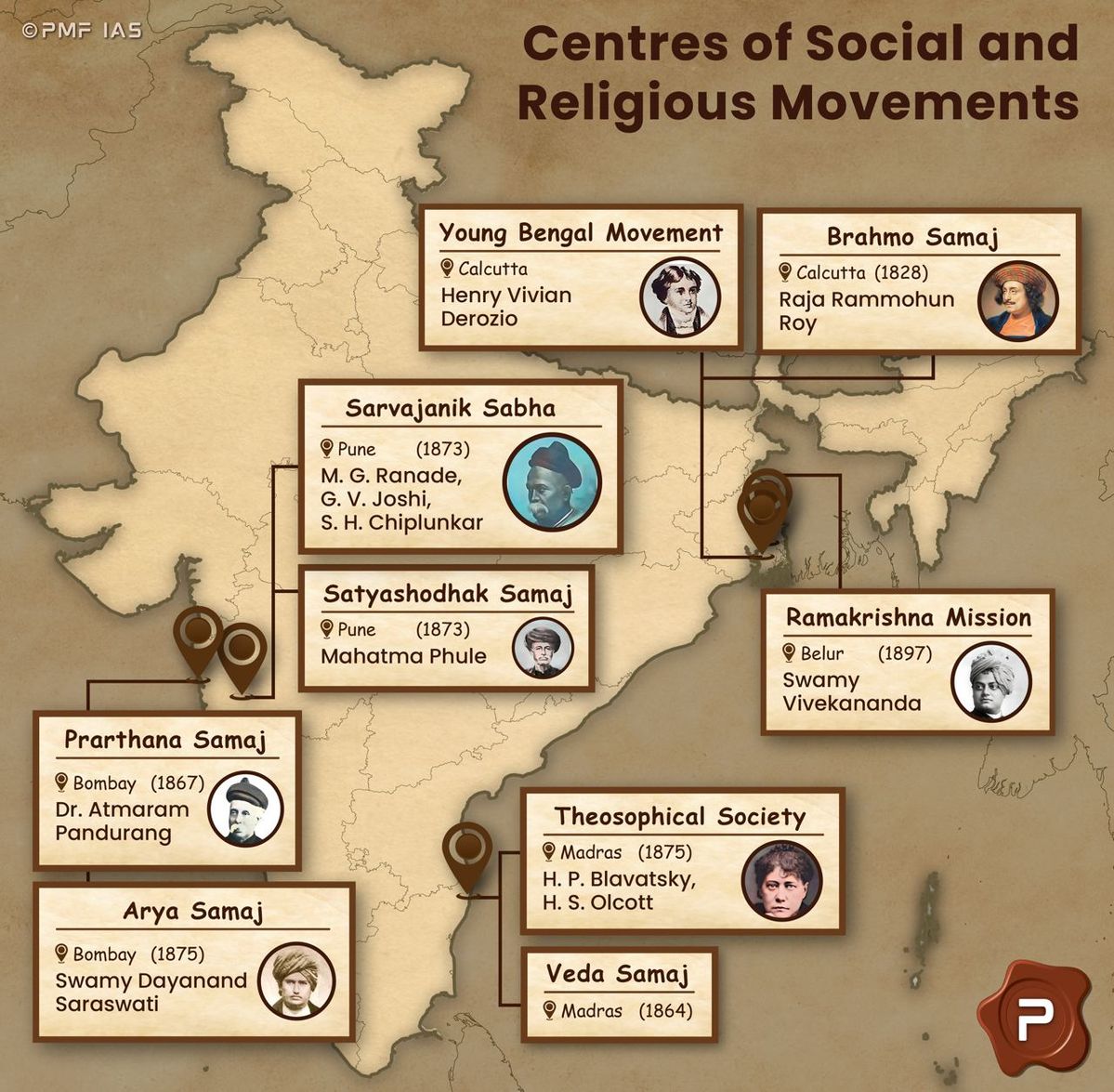
Social Reforms: The Social Reformers of India played a pivotal role in shaping modern Indian society by challenging outdated customs, promoting education, and fighting for equality. From the Brahmo Samaj founded by Raja Rammohan Roy to the Arya Samaj established by Dayanand Saraswati, these reform movements aimed to remove social inequalities, uplift women, and spread modern education. Leaders like Swami Vivekananda inspired Indians with ideas of self-confidence, spiritual awakening, and national pride, while the press and literature helped nurture the spirit of nationalism. This ICSE Class 8 History guide provides detailed question and answers on key social reformers, their contributions, and the impact of their movements, helping students prepare effectively for exams.
Answer the following questions on Social Reforms as per the given instructions:
Fill in the Blanks – ICSE Class 8 History
- Hicky’s Bengal Gazette was the first Indian newspaper.
- Raja Ram Mohan Roy is known as the Father of the Indian Renaissance.
- The Hindu College was founded in Calcutta by David Hare.
- M.G. Ranade founded the Prarthana Samaj in 1867 in Bombay.
- Vivekananda was the disciple of Sri Ramakrishna Paramahamsa.
Match the Following – Social Reformers and Movements
| A | B |
| 1. Swami Vivekananda | Ramakrishna Mission |
| 2. Madam Blavatsky | Theosophical Society |
| 3. Swami Dayanand | Arya Samaj |
| 4. Sir Syed Ahmed Khan | Aligarh Movement |
| 5. Henry Vivian Derozio | Young Bengal Movement |
True or False – ICSE History Answers
- C.V. Raman received the Nobel Prize for the Raman Effect. — True
- The Arya Samaj opposed child marriage and encouraged widow remarriage. — True
- Rabindranath Tagore received the Nobel Prize for his outstanding performance as a social reformer. — False
- Dadabhai Naoroji was affectionately called the Grand Old Man of India. — True
- The Indian Association for the Cultivation of Science was founded by Mahendra Lal Sarkar. — True
Answer the Following in 3-4 Sentences:
- What were the two newspapers started by Raja Ram Mohan Roy?
Ans: Newspapers Started by Raja Ram Mohan Roy: Newspapers Started by Raja Ram Mohan Roy: Sambad Kaumudi and Mirat ul Akbar were two newspapers started by Raja Rammohan Roy. - Name the three spirits inspired by Louis Vivian Derozio’s studies.
Ans: Ideas Inspired by Derozio: The spirits of Liberty, Equality and Fraternity were inspired by Louis Vivian Derozio’s studies. - Who was Sister Nivedita?
Ans: Sister Nivedita originally belonged to Ireland became a prominent disciple of Swami Vivekananda.She supported Indian National Movement, women’s education and worked for their emancipation. - Who dedicated her life to liberating women from social restrictions and opened Sardar Sadan Home for widows?
Ans: Founder of Sardar Sadan: Pandita Ramabai was a self educated reformer from Maharashtra, dedicated her life to liberate women from social restrictions. She opened Sardar Sadan a home for widows. - Who was known as Vidyasagar of South India?
Ans: Vidyasagar of South India: Kandukuri Veeresalingam Pantulu was known as the Vidyasagar of South India. - Who was the founder of the Mohammedan Literary Society of Calcutta?
Ans: Founder of the Mohammedan Literary Society of Calcutta:The Mohammedan Literary Society of Calcutta was founded by Nawab Abdul Latif. - Name the person who was elected the President of the Congress three times and was affectionately called the Grand Old Man of India.
Ans: Grand Old Man of India: Dadabhai Naroroji was elected the President of the Congress three times and was affectionately called the Grand old Man of India. - Who composed the national song Vande Mataram?
Ans: Composer of Vande Mataram: Bankim Chandra Chatterjee composed the national song Vande Mataram. - Who was Srinivasa Ramanujan?
Ans: Srinivasa Ramanujan: Srinivasa Ramanujan was one of the greatest mathematician of the century. He compiled nearly 3900 identities and equations. - Who was the driving force behind the Bhadravati Iron and Steel Works?
Ans: Bhadravati Iron and Steel Works: Sir M. Visvesvaraya was the driving force behind the Bhadravati Iron and Steel Works.
Answer the Following in 5-6 Sentences:
- Who started the Young Bengal Movement? How did it contribute towards social and religious reforms?
Ans: Young Bengal Movement and Its Contribution: The Young Bengal Movement was started by Henry Vivian Louis Derozio who was a professor of Hindu College.
The Derozions ridiculed the existing social customs and traditions like the caste system, debated the existence of God , defied social and religious conventions and demanded the freedom of thought and education for women.
2. Explain how literature and art helped in promoting social reforms and spreading nationalism.
Ans: Role of Literature and Art in Social Reforms: Social reformers like Bhartendu Harish Chandra was the pioneer of modern Hindi literature. . Through his novels, short stories , plays , essays and poems, he spread the ideas of reforms and condemned social injustice.
Poets likeIqbal, Subramania Bharati, Sarojini Niadu and numerous others inspired the massees with the spirit of nationalism through their patriotic songs.. Premchand wrote about the misery of the poor and oppressed which roused the people against social injustice.
- What was the main contribution of Sir Syed Ahmed Khan in the field of education?
Ans: Contribution of Sir Syed Ahmed Khan to Education: Sir Syed Ahmad Khan started the Translation Society , later known as the Scientific Society, to translate English books on Science and other subjects in Urdu. He also started an Englsih-Urdu journal to spread the ideas of social reform. In 1869 he visited England and after his return, established the Mohammedan Anglo-Oriental College at Aligarh in 1875. - Who was Ishwar Chandra Vidyasagar? What were his contributions as a social reformer?
Ans: Ishwar Chandra Vidyasagar as a Social Reformer: Ishwar Chandra Vidyasagar was another reformer from Bengal.
Vidyasagar enrolled students belonging to lower castes to study Sanskrit. Earlier, the study of Sanskrit was the privilege of the Brahmins. He mades significant contributions to the Bengali language and wrote a Bengali primer, Barna Parichaya which is still in use. His greatest contribution was the upliftment of windows and education of women. He opened a number of new schools for girls in the districts under his charge. It waas due to his sincere efforts that a law was passed which made widow remarriage legal through the Widow Remarriage Act , 1856.
- When and by whom was the Arya Samaj founded? In which part of India did it become popular?
Ans: Arya Samaj – Foundation and Popularity : In 1875, Dayanad Saraswati founded the Arya Samaj in Bombay.
For promotion of education, a network of schools and colleges were established by Arya Samaj both for the boys and girls.
Read an essay on History as my favourite subject
- How did the Arya Samaj help in removing inequalities in society? What contributions did it make in the field of education?
Ans: Removal of Social Inequalities:
The Arya Samaj worked actively to remove social inequalities by opposing caste discrimination, untouchability, child marriage, and the practice of sati. It promoted the idea of equality based on the teachings of the Vedas and encouraged widow remarriage and women’s upliftment. Through movements like Shuddhi, it tried to bring people of lower castes back into the Hindu fold, thereby promoting social equality and unity. - Contribution to Education:
In the field of education, the Arya Samaj made significant contributions by establishing DAV (Dayanand Anglo-Vedic) schools and colleges across India. These institutions combined modern Western education with Indian values and Vedic teachings. The Arya Samaj also emphasized education for women and spread awareness about scientific thinking, rationalism, and moral values, helping to create an educated and socially conscious society.
- Who established the Theosophical Society? What were its main aims?
Ans: The Theosophical Society was established in 1875 by Madame Helena Petrovna Blavatsky along with Colonel Henry Steel Olcott (and later supported by Annie Besant).
Main Aims of the Theosophical Society:
- To promote the universal brotherhood of humanity without distinction of race, caste, creed, or colour.
- To encourage the study of ancient religions, philosophies, and sciences, especially Indian spiritual traditions.
- To investigate the unexplained laws of nature and the hidden spiritual powers in humans.
- Who was the founder of the Brahmo Samaj? What were its main features?
Ans: Raja Rammohan Roy was the founder of Brahmo Samaj. It became an important organisation of religious reform.
The main features of Brahmo Samaj are as follows:
- It believed in the basic unity of all religions and forbade idol worship.
- It opposed the caste system and supported the upliftment of women in the society through education.
- It worked toward abolition of polygamy and child marriage.
Explore the Study Guide on Expansion of the British Rule ICSE Class 8 History
- What was the contribution of Swami Vivekananda in the awakening of the Indian people?
Ans: Contribution of Swami Vivekananda in the Awakening of the Indian People:
Swami Vivekananda played a vital role in awakening the Indian people by instilling a sense of pride in India’s spiritual and cultural heritage. Through his powerful speeches, especially at the Parliament of Religions in Chicago (1893), he spread the message of universal brotherhood, tolerance, and human dignity. He emphasized character building, self-confidence, and service to humanity, inspiring Indians—especially the youth—to work for national regeneration and social upliftment.
- The press played an important role in imbibing the spirit of nationalism. Explain.
Ans:Role of the Press in Imbibing the Spirit of Nationalism:The press played an important role in spreading the spirit of nationalism by creating political awareness among the people. Newspapers and journals exposed the exploitative policies and injustices of British rule, thereby mobilizing public opinion. Nationalist newspapers like Kesari, Amrita Bazar Patrika, The Hindu, and Bande Mataram inspired unity, encouraged participation in the freedom movement, and helped spread ideas of liberty, equality, and self-rule across India.