
The Rise of Nationalism in Europe Class 10 Notes, PYQs & MCQs (NCERT Hindi Belt)
📖 Introduction (Hook + Board Exam Relevance)
Do you know that before 19th century, Europe was not a map of countries like we see today? Instead, it was a patchwork of kingdoms, empires, and duchies. The chapter “The Rise of Nationalism in Europe” (Class 10 History Chapter 1) is not just a story of the past—it directly appears in UP Board, Bihar Board, RBSE, MP Board, and other state exams with questions worth 5–8 marks.
In this post, you will find exam-oriented notes, previous year questions, memory tricks, and important keywords that will help you score full marks.
📋 Chapter Overview
| Aspect | Details |
|---|---|
| Chapter Name | The Rise of Nationalism in Europe |
| Subject | History (India and the Contemporary World – II) |
| Class | 10 |
| Weightage in Board Exams | 8–10 marks |
| Main Topics | French Revolution, Napoleon, Romanticism, Unification of Germany & Italy, Balkan Issue |
🏛️ Historical Background (Before Nationalism)
Before nationalism, Europe was ruled by autocratic monarchies (like the Bourbon dynasty in France, Habsburg Empire in Austria). People spoke different languages and were loyal to local lords, not the nation.
What is a Nation?
A nation is a group of people who share a common identity—language, culture, history, or territory. Nationalism means feeling of oneness and wanting self-rule. NLP Keyword: Collective identity, sovereign state, nation-state.
📚 Detailed Explanation (Simplified for Students)
1. The French Revolution (1789) – The Spark
The French Revolution is the first clear expression of nationalism. Key change: Transfer of sovereignty from monarchy to citizens. La Marseillaise: The national anthem composed by Roget de L’Isle. Key ideas: Liberty, Equality, Fraternity. Napoleon (1804–1815): Initially spread revolutionary ideas through the Napoleonic Code (equality before law, abolished feudalism).
2. The Making of Nationalism in Europe (Mid-19th Century)
a) The Aristocracy and the New Middle Class: Aristocracy (landed upper class), Middle class (industrialists, professionals) believed in liberal nationalism.
b) What did Liberals want? End of autocracy, right to vote for property-owning men, freedom of press.
c) The Conservative Regimes (After 1815): Treaty of Vienna (1815) – Duke Metternich called nationalism a “mental disease”.
3. The Romantic Imagination and Nationalism
Romanticism: cultural movement emphasizing emotions, folk traditions. Johann Gottfried Herder (German) collected folk songs; Karol Kurpinski (Poland) used music to keep nationalist spirit alive. Semantic Keyword: Cultural nationalism, folk culture.
4. The Age of Revolutions (1830–1848)
July Revolution (1830) – France: Charles X overthrown.
Greek War of Independence (1821–1829): Greece under Ottoman Empire, supported by England, France, Russia → Treaty of Constantinople (1832).
Frankfurt Parliament (1848): 831 elected members, all-German National Assembly, failed because Prussian king Friedrich Wilhelm IV rejected crown.
5. The Unification of Germany (1866–1871) – Most Important
| Leader | Otto von Bismarck (Chief Minister of Prussia) |
|---|---|
| Policy | “Blood and Iron” (war and industry) |
| Wars | War with Denmark (1864), Austro-Prussian (1866), Franco-Prussian (1870–71) |
| Result | German Empire declared in Hall of Mirrors, Versailles (1871), King Kaiser William I |
6. The Unification of Italy
Problems: Italy divided into 7 states. Leader: Count Camillo di Cavour, Revolutionaries: Giuseppe Mazzini (Young Italy), Giuseppe Garibaldi (Red Shirts). Victor Emmanuel II crowned King of United Italy (1861).
7. The Balkan Issue – Nationalism’s Dark Side
Balkan region: Romania, Bulgaria, Greece, etc. Crumbling Ottoman Empire, Slavic nationalities wanted freedom. Rivalry between Russia and Austria-Hungary → major cause of World War I (1914).
📅 Important Dates and Events (Don’t Miss These)
| Year | Event |
|---|---|
| 1789 | French Revolution begins |
| 1797 | Napoleon invades Italy |
| 1815 | Treaty of Vienna (Congress of Vienna) |
| 1821 | Greek struggle for independence starts |
| 1830 | July Revolution in France |
| 1832 | Treaty of Constantinople (Greece independent) |
| 1848 | Frankfurt Parliament; Revolutions in Europe |
| 1859–1861 | Unification of Italy |
| 1866–1871 | Unification of Germany |
| 1871 | German Empire proclaimed |
👤 Important Personalities (Match-the-columns possible)
- Napoleon Bonaparte – Napoleonic Code, spread nationalism
- Giuseppe Mazzini – Young Italy, “Prophet of Italian nationalism”
- Count Cavour – Diplomatic unification of Italy
- Giuseppe Garibaldi – Red Shirts, “Sword of Italian unification”
- Otto von Bismarck – Blood and Iron, German unification
- Kaiser William I – First German Emperor
- Duke Metternich – Conservative, opposed nationalism
📌 Causes and Effects (For 3-mark answers)
Causes of Rise of Nationalism in Europe
Influence of French Revolution, Napoleonic reforms, rise of middle class, Romanticism, Greek War of Independence.
Effects
Formation of nation-states (Germany, Italy), decline of old empires, Balkan rivalry, end of Vienna Settlement.
🔑 Key Terms and Definitions (NLP Keywords)
| Term | Definition |
|---|---|
| Nationalism | Loyalty and devotion to one’s nation. |
| Nation-state | A state where people share a common identity. |
| Zollverein | Customs union in Germany (1834) to remove tariff barriers. |
| Plebiscite | Direct vote by citizens on an issue. |
📝 Important Questions and Answers (Exam-Oriented)
MCQs (1 Mark Each)
- Who said “When France sneezes, the rest of Europe catches cold”? ✅ b) Metternich
- The Frankfurt Parliament was held at: ✅ c) St. Paul’s Church, Frankfurt
- Which treaty recognised Greece as an independent nation? ✅ b) Treaty of Constantinople
Very Short Answer (2 Marks)
Q: What was the policy of ‘Blood and Iron’? (UP Board 2019)
Ans: Policy by Otto von Bismarck: ‘Blood’ meant war, ‘Iron’ meant weapons industry → unification through war and industry.
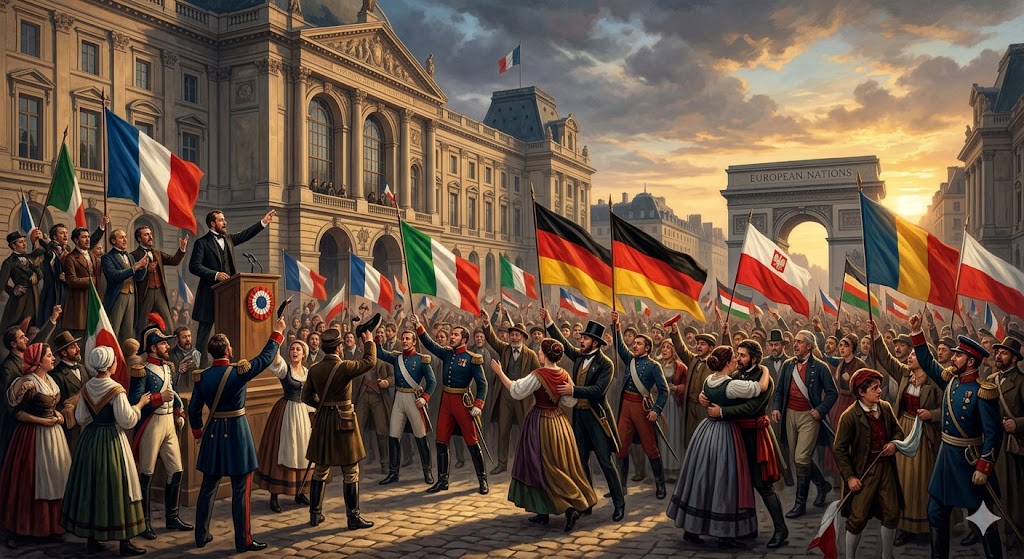
Q: Define ‘Utopian Vision’. Ans: Ideal society that exists in imagination (e.g., painting by Frederic Sorrieu).
Long Answer (5 Marks – Highly Repeated)
Q: Describe the role of Giuseppe Mazzini in the unification of Italy. (Bihar Board 2020)
Answer: Founder of Young Italy (1831), inspired revolutions, prophet of Italian nationalism, influenced Garibaldi, kept nationalist flame alive despite failures.
Assertion-Reason Question
Assertion (A): The Frankfurt Parliament failed to unify Germany. Reason (R): Prussian king Friedrich Wilhelm IV rejected the crown.
✅ a) Both A and R are true, and R is the correct explanation.
Source-Based (Competency)
“Nationalism in Europe did not only mean wars and treaties. It also meant collection of folk songs…”
Q1: Which movement? Ans: Romanticism. Q2: Name two Romanticists – Johann Gottfried Herder, Karol Kurpinski.
📌 Previous Year Board Questions (State-Wise)
– Provisions of Treaty of Vienna (5 marks)
– Why Balkan region became source of tension? (3 marks)
– Role of Romanticism in nationalism (5 marks)
– Who was Duke Metternich? (2 marks)
– Three differences between German and Italian unification (3 marks)
– Define Nation-state (2 marks)
– Process of German unification under Bismarck (5 marks)
💡 Important Exam Notes & Answer Presentation Tips
- Draw a timeline of 5–6 major events (1830,1848,1861,1871).
- Underline keywords like Blood and Iron, Zollverein, Young Italy.
- Start 5-mark answers with introduction, end with conclusion.
- Use tables or bullet points for comparison questions.
⚠️ Common Mistakes Students Make
- Confusing dates: 1848 Frankfurt Parliament ≠ 1830 July Revolution.
- Misspelling names: Mazzini, Cavour.
- Ignoring Balkan issue in source-based.
🧠 Mnemonic for Italian Leaders: M (Mazzini – Prophet), C (Cavour – Brain), G (Garibaldi – Sword), V (Victor Emmanuel – King) → MCGV.
⚡ Chapter Summary / Quick Revision (Last 10 Minutes)
Step 1: French Revolution (1789) → Step 2: Napoleonic Code → Step 3: 1815 Vienna Congress → Step 4: Romanticism → Step 5: 1830 & 1848 revolutions → Step 6: Germany unified by Bismarck (1871) → Step 7: Italy unified by Cavour & Garibaldi (1861) → Step 8: Balkan nationalism → WWI (1914).
❓ FAQs (People Also Ask – Google Extracted)
- What were the main causes of the rise of nationalism in Europe class 10? French Revolution, Napoleonic reforms, rise of middle class, romanticism, Greek War of Independence.
- Difference between nation and nation-state? Nation = shared identity; nation-state = political entity governing itself within borders.
- What is Zollverein? Customs union in Germany (1834) to abolish tariff barriers.
- Why did Frankfurt Parliament fail? Prussian king refused crown, lacked military power.
- Is this chapter important for board exams? Yes, carries 8–10 marks in Hindi Belt boards.
- Where can I download PDF notes? NCERT official website or educational blogs.
🔗 Suggested Internal & External Links
Internal: Class 10 History Chapter 2: Nationalism in India | Class 10 Civics Chapter 1: Power Sharing
External: NCERT Textbook (India and the Contemporary World-II), Britannica: Unification of Germany.
📸 Image & Infographic Suggestions
- Frederic Sorrieu’s painting – alt text: “Utopian vision of nationalism painting class 10”
- Timeline infographic: 1789 to 1871
- Unification of Germany map
- Portrait collage: Mazzini, Garibaldi, Cavour, Bismarck
🎯 Conclusion (Motivation for Students)
You have now completed the most important chapter of Class 10 History. For board exams, practice writing 5-mark answers with dates and names. Revise unification tables of Germany and Italy, solve previous year papers, and aim for full marks.
Your target: Score full 8 out of 8 marks from this chapter. You can do it.
Good luck from your history mentor! 📚🎓