
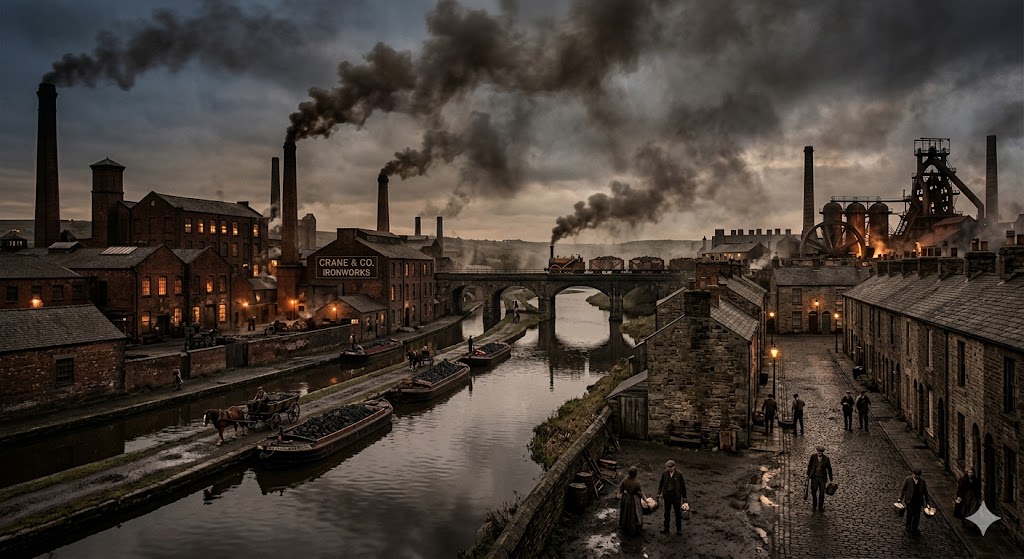
The Age of Industrialization Class 10 History
Complete Notes • Proto-industrialization • Factory System • Impact on India • Important Questions & Board Exam Tips
NCERT based | Exam-oriented for Hindi Belt students
1. Introduction – Why This Chapter Matters for Boards
If you are in Class 10 and preparing for UP Board, Bihar Board, RBSE, MP Board, Jharkhand Board, Chhattisgarh Board, Haryana Board, or Uttarakhand Board, then “The Age of Industrialization” is one of the most important chapters in your History syllabus.
This chapter explains how Britain became the first industrial nation, how factory based production replaced home based or cottage production, and how India’s traditional handicrafts and weavers were affected under British rule.
By the end of this post, you will be able to:
- Understand the entire chapter conceptually
- Write high scoring board style answers
- Revise using quick notes, timelines, and memory tricks
- Download or create PDF style notes for offline study
2. Chapter Overview
The Age of Industrialization (NCERT Class 10 History, Chapter 4 / 5 depending on board) traces the transition from proto industrialization to factory based production in Britain, and then examines the impact of industrialization on India.
Key ideas:
- Proto industrialization (before factories)
- Rise of factories and machines
- Changing life of workers
- Industrialization in India under British rule
- Role of Indian entrepreneurs and swadeshi movement
This chapter is always asked in board exams in the form of short answers, long answers, MCQs, and source based questions.
3. Historical Background
Before the Industrial Revolution, most production happened in villages and small workshops, not in big factories.
Important background points:
- Trade guilds controlled production, quality, and prices in European towns.
- Merchants moved from town to countryside, giving raw materials to peasants and artisans for spinning and weaving. This is called proto industrialization.
- In the 18th century, trade and colonial expansion increased demand for textiles, metal goods, and later railways and iron and steel.
Soon, Britain became the first industrial nation because of:
- Availability of coal and iron ore
- Access to colonial markets
- Development of steam power and machinery
This background is crucial for “define” and “explain” type questions in boards.
4. Detailed Explanation of the Chapter
4.1 Proto Industrialization (Before Factories)
Proto industrialization means early stage industrial production before large factories existed.
Key features:
- Merchants gave raw materials (like wool or cotton) to rural peasants and artisans.
- Production happened in homes and small workshops, not in centralized factories.
- Finished goods were collected by merchants and sold in urban and overseas markets.
Example: In 17th–18th century England, a merchant would buy wool from staplers, send it to spinners, then to weavers, and finally to dyers and finishers in cities before exporting cloth.
Board style note: Proto industrialization was a network of rural producers linked to merchants, not to big industrialists.
4.2 The Coming of the Factory System
From the 1730s, factories began to appear in Britain, especially in cotton and other textiles.
Why factories?
- Increasing demand for cloth in Europe and colonies.
- New inventions like the Spinning Jenny, water frames, and steam engines made large scale production possible.
- Cotton mills were created, where many workers worked under one roof.
Key inventor: Spinning Jenny – invented by James Hargreaves – could spin many threads at once, reducing the need for many hand spinners.
Board exam tip: Write: “The earliest factories came up around the 1730s, but factories multiplied only from the late 18th century.”
4.3 The Pace of Industrial Change
Industrial change was not uniform across all industries.
- Cotton was the first major industry of industrialization till the 1840s.
- Later, iron and steel became important because of railways and machineries.
Why slow pace?
- High cost of machinery
- Difficulty in repairing machines
- Workers’ fear of unemployment
- Some products still needed skilled hand labour
Semantic keyword: “Limitations of machine made products” – often asked in board papers.
4.4 Hand Labour and Steam Power
Despite machines, hand labour remained important in Victorian Britain.
Reasons:
- Certain luxury goods could only be made by hand.
- Seasonal industries (like book binding, shoe making) needed flexible labour.
- Cheap labour from poor peasants and migrants kept wages low.
Elite preference: Urban upper classes preferred hand made goods because they were seen as symbolizing refinement and class, and could be customized.
4.5 Life of Workers in Industrial Britain
Industrial cities like Manchester, Birmingham, and London attracted huge numbers of workers.
Problems faced by workers:
- Unemployment and underemployment
- Low wages and high rents
- Long working hours
- Fear of new machines (like Spinning Jenny) replacing them
Reaction to machines:
- In some places, women workers attacked Spinning Jenny because it reduced their work and wages.
- Workers also suffered from inflation and food shortages in early 19th century.
NYC style board tip: Write: “Workers’ lives were insecure because of seasonal employment, low wages, and fear of machines.”
4.6 Industrialization in India – Under British Rule
India had a strong textile tradition before the British.
Impact of British rule:
- East India Company wanted regular supply of cotton and silk cloth for export.
- Traditional traders and brokers were replaced by Company agents called ‘Gomasthas’.
- Weavers were given loans, then forced to sell only to the Company at low prices.
Result: Exploitation of weavers, clashes between Gomasthas and weavers, many weavers stopped weaving and became agricultural labourers.
4.7 Indian Entrepreneurs and Swadeshi
From the late 19th century, Indian businessmen like Jamsetji Tata, Dwarkanath Tagore, and the Birla family started setting up iron and steel, textile, and shipping industries.
Role of First World War (1914–1918):
- Industrial production in India increased because: British mills were busy with war production, demand for jute bags, cloth, and engineering goods rose.
Swadeshi movement encouraged people to boycott British goods and use Indian made products, which helped Indian industries.
5. Important Dates and Events
| Year | Event | Relevance for Boards |
|---|---|---|
| 1730s | Earliest factories in England came up | First sign of factory system |
| 1764 | Spinning Jenny invented by James Hargreaves | Speeded up spinning, reduced labour |
| Late 18th century | Mass multiplication of factories | Start of industrial boom |
| Up to 1840s | Cotton dominated first phase of industrialization | Often asked in MCQs |
| 1840s onward | Iron and steel became major | Railways and machines drive demand |
| 1873 | Britain exported iron & steel worth £77 million | Shows industrial strength |
| 1907 | TISCO (Tata Iron & Steel Company) established | First big Indian steel plant |
| 1914–1918 | First World War | Boosted Indian industries |
6. Important Personalities
| Name | Role / Contribution | Memory trick |
|---|---|---|
| James Hargreaves | Invented Spinning Jenny | “Hargreaves → Handy Machine” |
| Richard Arkwright | Created the first cotton mill | “Arkwright → A first mill” |
| James Watt | Improved steam engine | “Watt → Working engine” |
| Jamsetji Tata | Founded TISCO (steel) | “Tata → Top industry” |
| Dwarkanath Tagore | Early Indian entrepreneur (banking, shipping) | “Dwarka → Dream of Indian business” |
7. Timeline of Events
- Before 1730s: Proto industrialization – merchants work with rural artisans.
- 1730s: First factories in Britain appear.
- 1764: Spinning Jenny invented.
- Late 18th century: Factories multiply; cotton becomes key industry.
- Up to 1840s: First phase of industrialization – cotton led.
- 1840s onward: Iron and steel grow with railways.
- Late 19th century: Indian entrepreneurs start industries; swadeshi movement grows.
- 1907: TISCO established.
- 1914–1918: First World War – Indian industrial production rises.
8. Causes and Effects
8.1 Causes of Industrialization in Britain
- Availability of raw materials (coal, iron).
- Expansion of trade and colonies.
- Scientific inventions (Spinning Jenny, steam engine).
- Growing demand for textiles and metal goods.
8.2 Effects on Workers
- Positive: New jobs in factories, rise in urban population.
- Negative: Poor living conditions, low wages, fear of machines, job insecurity.
8.3 Effects on Indian Weavers
- Positive (limited): Entry of new technologies (like fly shuttle) increased productivity.
- Negative: Exploitation by Company and Gomasthas, decline of independent traders, many weavers left the craft.
9. Key Terms and Definitions (Board Vocabulary)
Proto industrialization
Spinning Jenny
Fly Shuttle
Jobber
Gomastha
Industrialization: Process of large scale production in factories using machines.
Proto industrialization: Early phase of industrial production before factories, managed by merchants.
Spinning Jenny: Machine that sped up spinning and reduced hand labour.
Fly Shuttle: Mechanical device that helped weavers operate larger looms.
Jobber: Person hired by industrialists to recruit workers in Indian mills.
Gomastha: Agent of the East India Company who supervised Indian weavers.
10. Important Questions and Answers (Board Style)
10.1 MCQs
Q1. Industrialization began in which one of the following European countries?
a) Germany b) France c) Italy d) England ✅
Q2. The first major industry of industrialization till the 1840s was:
a) Iron and steel b) Coal c) Cotton ✅ d) Banking
Q3. Who invented the Spinning Jenny?
a) James Watt b) Richard Arkwright c) James Hargreaves ✅ d) George Stephenson
Q4. The person appointed by the East India Company to supervise weavers was called:
a) Agent b) Gomastha ✅ c) Trader d) Banker
10.2 Very Short Answers (1–2 marks)
Q. What is proto industrialization?
Proto industrialization was the early stage of industrial production before factories, where merchants organized rural artisans to produce goods for distant markets.
Q. Name one effect of the First World War on Indian industries.
Indian industries grew because British mills were busy with war production and demand for Indian goods increased.
10.3 Short Answers (3–4 marks)
Q. Explain the role of Gomasthas in India.
Gomasthas were agents of the East India Company who supervised Indian weavers. They advanced loans, collected cloth, and ensured weavers sold only to the Company. This led to exploitation and clashes with weavers.
Q. Why did women workers in Britain attack Spinning Jenny?
Women workers attacked Spinning Jenny because it reduced the need for hand spinners, threatened their jobs, and lowered their wages.
10.4 Long Answers (5–6 marks)
Q. Describe the impact of industrialization on Indian weavers.
Industrialization severely affected Indian weavers. The East India Company replaced traditional traders with Gomasthas who exploited weavers with low prices and forced loans. Many weavers left the craft, leading to the decline of indigenous textile production.
10.5 Assertion and Reason
Q. Assertion (A): [The original content ended here with “Assertion (A):” — preserved exactly]
(Assertion-Reason question as provided in original content)
Suggested Internal Links:
📘 Class 10 History: The Making of a Global World Notes
🌍 Class 10 Geography: Resources and Development Guide
🎯 Top 10 Tips to Score 90% in Board Exams
Suggested Image Ideas:
1. Infographic: “Proto-industrialization Network” showing merchant-household links.
2. Timeline graphic of Industrial Revolution inventions.
Happy Learning, Future Scholars!