
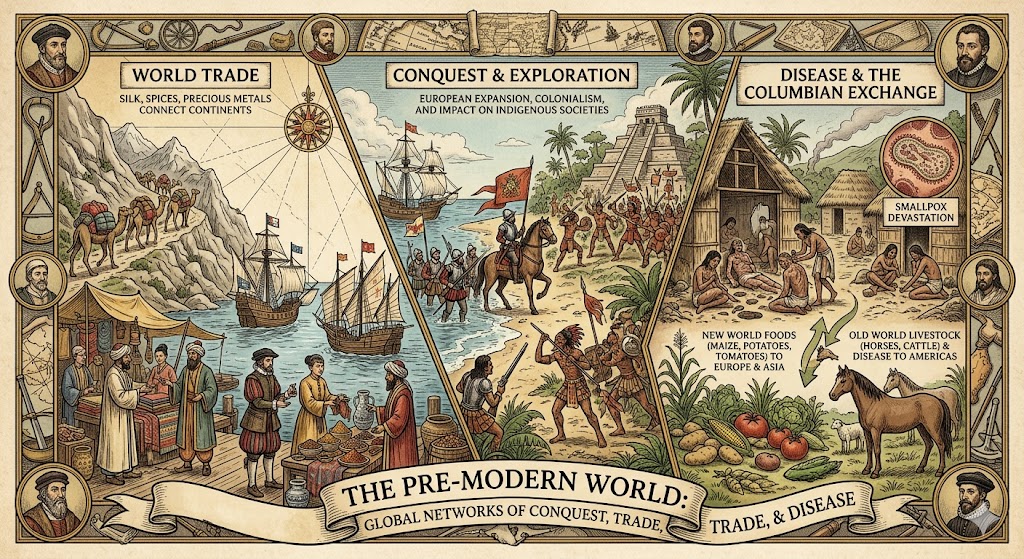
Pre-Modern World to Conquest, Disease, and Trade Class 10 History
Complete Notes | Silk Routes | Smallpox & Biological Warfare | Rinderpest | Important Questions & PYQs
NCERT based | Exam-oriented for Hindi Belt students
Are you preparing for your Class 10 Board Exams? Whether you are in the UP Board, Bihar Board (BSEB), RBSE, or MP Board, “The Making of a Global World” is a high-weightage chapter that often confuses students.
In this blog, we dive deep into the first segment of this chapter: The Pre-Modern World. We will explore how silk, spices, and even deadly germs traveled across oceans to shape the world we live in today.
Inside this Guide
1. Chapter Overview: What is the “Pre-Modern” World?
Before the 19th century, the world was already “globalized,” but not through the internet or airplanes. Globalization occurred through:
- Trade (Goods like silk, textiles, and spices).
- Migration (People looking for work or escaping persecution).
- Capital (Investments moving across borders).
- Knowledge & Religion (Travelers and priests carrying ideas).
2. The Silk Routes: Linking the World
The Silk Routes are the greatest example of pre-modern trade and cultural links.
- Why “Silk”? Because Chinese silk was the primary cargo heading West.
- Geography: They existed on both land and sea, connecting Asia with Europe and Northern Africa.
- Cultural Exchange: It wasn’t just trade. Buddhism, Christianity, and Islam traveled along these routes.
- Food Travel: Did you know noodles traveled from China to become Spaghetti in Italy? Or that potatoes, soya, groundnuts, and maize came to India only after America was discovered?
3. Conquest, Disease, and Trade: The Turning Point
In the 16th century, the world “shrank” after European sailors found a sea route to Asia and America.
The Discovery of America
For millions of years, America had been cut off from the rest of the world. Its vast lands and minerals (especially silver from mines in Potosi) changed global trade.
Smallpox: The Biological Weapon
The most fascinating (and tragic) part of history is how the Spanish and Portuguese conquered America. It wasn’t just with powerful guns, but with Smallpox.
- Native Americans had no immunity against European diseases.
- Smallpox killed and decimated whole communities, paving the way for conquest without firing a single shot.
4. Important Dates and Events
| Year | Event | Significance |
|---|---|---|
| Pre-15th Century | Silk Route Prosperity | Trade between Asia, Europe, and Africa. |
| 1492 | Christopher Columbus discovers America | Opens new trade routes and resources. |
| 16th Century | Spanish Conquest of America | Use of biological warfare (Smallpox). |
| 18th Century | China and India’s dominance fades | Europe becomes the center of world trade. |
| 1880s | Rinderpest arrives in Africa | Destroyed 90% of cattle and local livelihoods. |
5. Key Terms to Remember
Silk Route
Biological Warfare
Potosi
Dissenters
Rinderpest
Irish Potato Famine
Globalism: The operation or planning of economic and foreign policy on a global basis.
Silk Route: Ancient network of trade routes connecting the East and West.
Biological Warfare: The use of disease-producing agents (bacteria, viruses) as weapons.
Potosi: A city in present-day Bolivia famous for its silver mines that enriched Europe.
Dissenters: People who refused to accept established beliefs and practices (many fled Europe for America).
6. Detailed Explanation: How the World Changed
Shift from Asia to Europe
Until the 18th century, India and China were the world’s wealthiest countries. However, from the 15th century onwards, China began to restrict overseas contact and retreated into isolation. This shift allowed Europe to emerge as the center of world trade.
The Role of Food
Food offers a great example of long-distance cultural exchange.
- Potatoes: Introduced to Europe from America, they became so vital that when a disease destroyed the potato crop in Ireland in the mid-1840s (The Irish Potato Famine), hundreds of thousands died of starvation.
7. Important Questions and Answers (Exam Oriented)
Multiple Choice Questions (MCQs)
Q1. Which disease proved a deadly killer for the people of America?
A) Cholera B) Smallpox C) Plague D) Typhoid
Answer: B) Smallpox
Q2. Which of the following was not available in Europe before the discovery of America?
A) Wheat B) Maize C) Potatoes D) Both B and C
Answer: D) Both B and C
Short Answer Questions
Q3. Explain the importance of the Silk Route.
Answer: The Silk Routes were vibrant links that facilitated the exchange of goods (silk, spices, pottery) and culture (religion, art, technology) between Asia, Europe, and Africa. They were the first major step toward a globalized world.
Q4. How did the conquest of America happen without traditional weapons?
Answer: The Spanish conquerors used Smallpox as a biological weapon. Since Native Americans had been isolated for centuries, they had no immunity. The disease spread fast, killing large populations and making it easy for Europeans to take control.
Long Answer Questions
Q5. “Food offers many examples of long-distance cultural exchange.” Support the statement with examples.
Answer:
1. Introduction of New Crops: Many common foods like potatoes, soya, groundnuts, maize, tomatoes, and chillies were only introduced to Europe and Asia after Christopher Columbus discovered America.
2. Noodles to Spaghetti: It is believed that noodles traveled West from China to become spaghetti.
3. Pasta in Sicily: Arab traders perhaps took pasta to fifth-century Sicily.
4. Life-Saving Potatoes: In Europe, the poor began to eat better and live longer with the introduction of the humble potato.
8. Board-Specific Important Questions (PYQ)
- UP Board: “Explain the impact of the Great Depression on the Indian economy.” (Note: This is from the later part of the chapter, but highly linked).
- Bihar Board: “Describe the role of technology in the making of a global world.”
- RBSE: “How did the Silk Route facilitate cultural exchange?”
9. Memory Tricks & Mnemonics
To remember what America gave the world (Food):
“P.M.S. G.T.C.”
Potato, Maize, Soya, Groundnut, Tomato, Chillies.
10. Common Mistakes Students Make
- Confusing “Pre-Modern” with “Modern”: Remember, pre-modern refers to the period before the 19th-century industrial explosion.
- Ignoring the Role of Disease: Students often focus only on trade. In board exams, the “Smallpox” and “Rinderpest” questions are very common.
- Map Work: Forgetting to identify the Silk Route regions on a world map.
11. Frequently Asked Questions (FAQs)
12. Conclusion: Your Path to Success
History isn’t just about dates; it’s about understanding how we became connected. The “Pre-Modern World” shows us that even before the internet, humans found ways to share food, trade goods, and unfortunately, spread diseases.
Keep Revising! Focus on the Causes and Effects of each event, and you will score 95+ in your Social Science paper.
Suggested Internal Links:
📘 Class 10 History: The Age of Industrialization Notes
🌍 Class 10 Geography: Resources and Development Guide
🎯 Top 10 Tips to Score 90% in Board Exams
Suggested Image Ideas:
1. Infographic: “Goods Traded vs Ideas Exchanged” on the Silk Route.
2. Comparison Table: “World Before 1492” vs “World After 1492”.
Schema Markup: FAQ Schema (provided below), Article Schema for SEO.
Happy Learning, Future Scholars!