
SEO Meta Data & Keyword Strategy
- SEO Title: The French Revolution Class 9 Notes: Causes, Timeline, Events & Important Questions for Board Exams
- Meta Description: Master Chapter 1 of Class 9 History! Get detailed notes on The French Revolution: Causes, Timeline, Napoleon, Important Dates, MCQs, and Previous Year Board Questions. Perfect for UP, Bihar, MP Board exams.
- Focus Keyword: The French Revolution Class 9
- Secondary Keywords: Causes of French Revolution, Reign of Terror, NCERT History Chapter 1, Louis XVI, Class 9 Social Science Notes.
- Long-tail Keywords: What were the causes of the French Revolution class 9?, Timeline of French Revolution for board exam, Difference between Jacobins and Girondins, Who invented the guillotine.
- URL Slug: french-revolution-class-9-notes-history
Table of Contents
1. Introduction
2. Chapter Overview
3. Historical Background: France before 1789
4. Detailed Explanation of Causes
5. The Outbreak of the Revolution
6. Important Events & Timeline
7. The Reign of Terror (1793-1794)
8. Role of Women & Abolition of Slavery
9. Rise of Napoleon Bonaparte
10. Important Personalities
11. Important Questions & Answers (MCQs, Short & Long)
12. Previous Year Board Questions (UP/Bihar/MP)
13. Memory Tricks & Mnemonics
14. Chapter Summary / Quick Revision Notes
15. Frequently Asked Questions (FAQs)
16. Conclusion
Introduction
“जब एक राजा अपनी प्रजा की भूख और पीड़ा को नहीं समझता, तो इतिहास उसे बदलने का रास्ता सिखाता है।” This is the story of The French Revolution, one of the most explosive events in world history. For students of Class 9 History (Chapter 1), this chapter is not just a story of a kingdom falling; it is the foundation of modern democracy, liberty, and equality.
Whether you are studying for the UP Board, Bihar Board, MP Board, or RBSE, understanding this chapter is crucial for scoring high marks. In this post, we will break down the complex Causes of the French Revolution, the dramatic Timeline of Events, and provide Exam-Oriented Notes to help you revise quickly.
Chapter Overview
In the late 18th century, France was the most advanced country in Europe but also the most unequal. The French Revolution (1789-1799) was a period of radical social and political upheaval. It overthrew the Monarchy (King), established a Republic, and eventually led to the dictatorship of Napoleon Bonaparte. For NCERT Class 9 Social Science, this chapter explains how ideas like “Liberty, Equality, and Fraternity” became the guiding principles of modern nations.
Historical Background: The Old Regime
Before 1789, France followed the Ancien Régime (Old Regime). Society was divided into three Estates, which created massive resentment.
The Three Estates
| Estate | Class | Population | Land Ownership | Tax Burden (Taille) |
| :— | :— | :— | :— | :— |
| First Estate | Clergy (Church officials) | ~1% | 10% | Exempted (paid no taxes) |
| Second Estate | Nobility (Rich aristocrats) | ~2% | 25% | Exempted (paid no taxes) |
| Third Estate | Peasants, Workers, Bourgeoisie | 97% | 65% | Paid all taxes (Taille, Tithes, Poll tax) |
The Struggle for Survival: The population of France grew from 23 million to 28 million. This led to a massive increase in demand for food grains (bread). When harvests were bad (due to drought or hail), the price of bread skyrocketed, causing Subsistence Crisis (scarcity of food).
Detailed Explanation of Causes of the French Revolution (Class 9 Focus)
Board exams often ask: “Describe the circumstances leading to the outbreak of revolutionary protest in France.” Here are the 5 main causes:
1. Political Causes (Weak Leadership)
– King Louis XVI: He became king at the age of 20. He was an autocratic ruler but indecisive and weak-willed.
– Empty Treasury: France helped the 13 American colonies gain independence from Britain. This war drained the French treasury, leaving it bankrupt. The king spent lavishly at the Palace of Versailles while the people starved.
2. Social Causes (Inequality)
– The Clergy (1st Estate) and Nobility (2nd Estate) enjoyed privileges by birth (like not paying taxes). They held the highest positions in the army and church.
– The Third Estate bore the entire burden. They paid direct tax (Taille) and indirect taxes on everyday items like salt.
3. Economic Causes (Subsistence Crisis)
– Tax Burden: Only the Third Estate paid taxes.
– Rising Prices: The cost of living (especially bread) rose faster than wages.
– Unemployment: The textile industry suffered, leading to widespread unemployment.
4. Intellectual Causes (Role of Philosophers)
– The “Age of Enlightenment” changed people’s thinking. Philosophers questioned the divine right of kings.
– John Locke: Criticized the divine rights of kings. Said power should be with the people.
– Jean Jacques Rousseau: Put forward the idea of Social Contract (government based on the consent of the people).
– Montesquieu: Proposed Division of Powers (Legislative, Executive, Judiciary) to prevent dictatorship.
5. Immediate Cause (The Spark)
– Financial Crisis: Louis XVI needed money to run the government.
– Estates General (May 5, 1789): The king called a meeting of all three estates to approve new taxes. In the past, each estate had one vote (giving 1st & 2nd Estate power).
– The Revolt: The Third Estate demanded voting by head count (each member having one vote). When the king rejected this, the Third Estate walked out.
The Outbreak: Key Events
The Tennis Court Oath (June 20, 1789)
The Third Estate declared themselves the National Assembly. They were locked out of their meeting hall, so they gathered in an indoor tennis court. They swore not to disperse until France had a written constitution. This was the Tennis Court Oath.
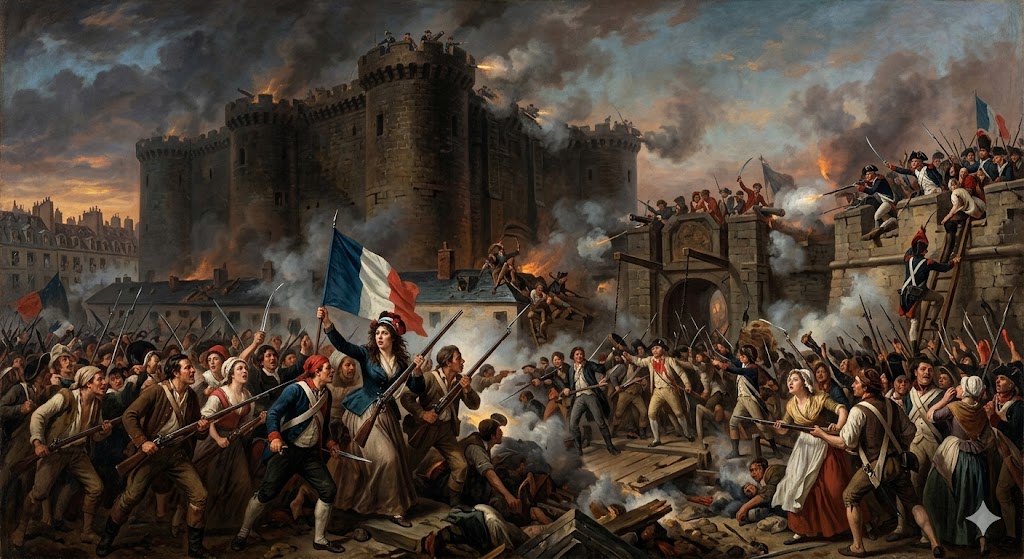
Storming of the Bastille (July 14, 1789)
– Why? The king ordered troops to move into Paris. The common people feared he would suppress the National Assembly. They needed gunpowder and weapons.
– The Event: An angry crowd stormed the Bastille Fortress (a prison and symbol of royal tyranny).
– Importance: The commander was killed, and prisoners were released. July 14 is celebrated as France’s National Day (Bastille Day).
The Great Fear (July-August 1789)
Rumors spread in the countryside that nobles were hiring brigands to destroy peasant crops. Panic-stricken peasants attacked noble houses, burned feudal records, and looted grain.
Important Dates and Timeline (1789-1794)
For board exams, dates are very important. Create a mental timeline:
– 1774: Louis XVI becomes King.
– 1789, May 5: Estates General convened.
– 1789, June 20: Tennis Court Oath.
– 1789, July 14: Storming of the Bastille (Start of the Revolution).
– 1789, August 4: Abolition of Feudal System (Nobles gave up their rights).
– 1789, August 26: Declaration of the Rights of Man and Citizen.
– 1791: Constitution of 1791 drafted (Constitutional Monarchy).
– 1792: France becomes a Republic. Jacobins take over.
– 1793: King Louis XVI executed.
– 1793-1794: The Reign of Terror (Robespierre’s rule).
– 1794: Robespierre is executed.
– 1799: Napoleon Bonaparte comes to power.
The Declaration of the Rights of Man and Citizen (August 26, 1789)
This was a landmark document. It stated that men are born free and remain free and equal in rights. These rights included:
– Liberty, Property, Security, and Resistance to oppression.
– Equal right to hold public office.
– Freedom of speech and press (abolition of censorship).
Contradiction: While it said “men are born equal,” it did not apply to women and slaves.
The Reign of Terror (1793-1794)
Who were the Jacobins?
– A radical political club led by Maximilian Robespierre.
– They were called Sans-culottes (those without knee-breeches) because they wore long striped trousers (symbolizing the common man).
Robespierre’s Policies:
1. The Guillotine: Enemies of the republic were beheaded using the guillotine (a beheading device). Dr. Guillotin invented it for humane executions.
2. Price Control: Fixed maximum ceiling on wages and prices. Rationing of bread and meat.
3. De-Christianization: Churches were shut down. Priests were forced to marry.
4. Change of Language: Citizens were addressed as “Citizen” instead of “Sir/Madam.”
End of Terror: The people got tired of the violence. Robespierre was himself guillotined in July 1794.
Role of Women and Abolition of Slavery
Women’s Revolution
– Women were active participants. They marched to Versailles demanding bread (The Women’s March).
– They had no political rights (could not vote).
– They demanded equal wages and the right to vote.
– Result: Women in France finally won the right to vote in 1946 (much later, after WWII).
Abolition of Slavery
– There was a Triangular Slave Trade between Europe, Africa, and America.
– In 1794, the Jacobin regime abolished slavery in French colonies.
– However, Napoleon reintroduced slavery in 1804.
– It was finally abolished in 1848.
Rise of Napoleon Bonaparte
– After the fall of Robespierre, a new constitution was made (1795). It established a Directory (5 members executive) which was weak and corrupt.
– Napoleon Bonaparte was a brilliant military general.
– In 1799, he staged a coup (military takeover) and overthrew the Directory.
– He declared himself Emperor of France in 1804.
– He introduced the Napoleonic Code (which did away with privileges based on birth and established equality before the law).
Important Personalities (Match the Following)
1. Louis XVI: King of France during the Revolution (Executed by guillotine).
2. Marie Antoinette: Queen of France, symbol of extravagance (called “Madame Deficit”).
3. Maximilian Robespierre: Leader of the Jacobins and Reign of Terror.
4. John Locke: Philosopher who criticized the divine right of kings.
5. Jean Jacques Rousseau: Philosopher who gave the idea of Social Contract.
6. Montesquieu: Proposed division of powers.
7. Mirabeau & Abbé Sieyès: Leaders of the Third Estate in the National Assembly.
8. Olympe de Gouges: Feminist who wrote the “Declaration of Rights of Woman and the Female Citizen.”
Important Questions and Answers (Exam-Oriented)
A. Multiple Choice Questions (MCQs)
1. The National Assembly framed a constitution in 1791 to:
(a) Give absolute powers to the king
(b) Limit the powers of the king
(c) Establish a religious state
(d) Abolish the monarchy entirely
Answer: (b) Limit the powers of the king
2. What was the ‘Tithe’?
(a) Tax paid to the state
(b) Tax paid by nobles to the church
(c) Tax levied by the church (one-tenth of agricultural produce)
(d) Tax on salt
Answer: (c) Tax levied by the church (one-tenth of agricultural produce)
3. The term ‘Sans-culottes’ referred to:
(a) The nobility
(b) The clergy
(c) The common people of France (wearing long trousers)
(d) The King’s bodyguard
Answer: (c) The common people of France
B. Short Answer Questions (3 Marks)
Q: Why was the Bastille hated by the French people?
Ans:
1. The Bastille was a fortress prison.
2. It stood for the despotic power (tyranny) of the king.
3. People were imprisoned there without any trial by the king’s order. It was a symbol of oppression.
Q: What is the legacy of the French Revolution?
Ans:
1. Spread of Ideas: It spread the ideas of Liberty, Equality, and Fraternity across the world.
2. End of Feudalism: It inspired movements to end feudalism and serfdom globally.
3. Democratic Rights: It gave the world the concept of democratic rights and constitutions (e.g., Universal Declaration of Human Rights).
C. Long Answer Questions (5 Marks)
Q: Describe the social and economic causes of the French Revolution.
Ans:
Social Causes:
1. French society was divided into three estates. The Clergy (1st) and Nobles (2nd) were privileged.
2. The Third Estate (97% of population) bore all the taxes and had no political rights.
3. The rising middle class (Bourgeoisie) were wealthy but still treated as third-class citizens, which frustrated them.
Economic Causes:
1. The treasury of France was empty due to long years of war (including aid to the American War of Independence) and lavish living at Versailles.
2. Louis XVI imposed heavy taxes (Taille) to meet expenses, but only the Third Estate paid them.
3. There was a Subsistence Crisis: Population growth led to high demand for bread, but wages remained low, and harvests failed, leading to hunger.
Previous Year Board Questions (UP, Bihar, MP Board)
These are commonly repeated questions.
– UP Board: “Mention any three political causes of the French Revolution.” (2020, 2022)
– Bihar Board: “What is ‘Reign of Terror’? Who was its leader?” (2019, 2023)
– MP Board: “Explain the role of philosophers in the French Revolution.” (2021)
– RBSE: “Write a note on the Declaration of Rights of Man and Citizen.” (2022)
Common Mistakes Students Make
1. Spelling Errors: Common mistakes include “Louis XIV” (Wrong, it is Louis XVI), “Robspierre” (Wrong, it is Robespierre).
2. Confusing Dates: Mixing up 1791 (Constitution) and 1793 (King Executed). Focus on the timeline.
3. Rights Confusion: Forgetting that the “Right to Vote” was initially only for men (Active Citizens). Women got it much later (1946).
Memory Tricks and Mnemonics
To remember the 3 Estates: “Church, Nobles, Nobody”
– C = Clergy (1st)
– N = Nobles (2nd)
– N = Nobody/Commoners (3rd)
To remember the dates:
– 5-5-1789: Estates General meet (Looks like two estates fighting? No, three estates! but remember 5-5).
– 14-7-1789: Bastille Day (Easy to remember: Independence Day of France).
Causes Mnemonic (P-E-S-T):
– Political (Weak king)
– Economic (Empty treasury)
– Social (Estate system)
– Thinkers (Philosophers)
Chapter Summary / Quick Revision Notes (PDF Style)
1. Why did it happen? Society was unfair (1st & 2nd Estate had all rights, 3rd paid all taxes). Treasury was empty. Philosophers encouraged revolt.
2. Key Event: Storming of Bastille (July 14, 1789).
3. Outcome 1 (1791): Constitutional Monarchy (King has limited powers).
4. Outcome 2 (1792): Republic declared. King executed.
5. Dark Phase (1793-94): Robespierre’s Reign of Terror (Guillotine).
6. End (1799): Napoleon Bonaparte takes over.
Frequently Asked Questions (FAQs)
Q1: What is the French Revolution Class 9 summary?
Ans: It was a period from 1789 to 1799 where the French people overthrew the monarchy and took control of the government. It ended feudalism and introduced the rights of Liberty, Equality, and Fraternity to the common man.
Q2: Who was the king of France during the revolution?
Ans: King Louis XVI of the Bourbon dynasty. He was executed for treason in 1793.
Q3: What was the guillotine?
Ans: It was a beheading device used during the Reign of Terror. It had a heavy blade that fell vertically. Ironically, King Louis XVI had helped improve its design earlier, but was later killed by it.
Q4: When did women in France get the right to vote?
Ans: The struggle was long. French women finally won the right to vote in 1946.
Conclusion
The French Revolution was a turning point in modern history. For Class 9 students, it teaches us that when inequality becomes too high and the voice of the people is suppressed, history will find a way to correct it.
We hope these The French Revolution Class 9 Notes help you ace your NCERT exams. Save this page, download it as a PDF using the browser print option, and share it with your friends. Keep revising, and remember: Liberty, Equality, and Fraternity!
Internal Linking Suggestion: Check out our notes for Class 9 History Chapter 2: Socialism in Europe and the Russian Revolution next!
Image Suggestions for the Blog:
1. Infographic showing the Triangle of the Three Estates (Clergy on top, then Nobility, massive base of Peasants).
2. Image of the Tennis Court Oath painting by Jacques-Louis David.
3. A simple timeline chart from 1789 to 1799.
4. Image of the Guillotine or a diagram explaining how it worked.
Suggested Schema: FAQ Schema for the FAQs section. Article Schema for the blog post.