
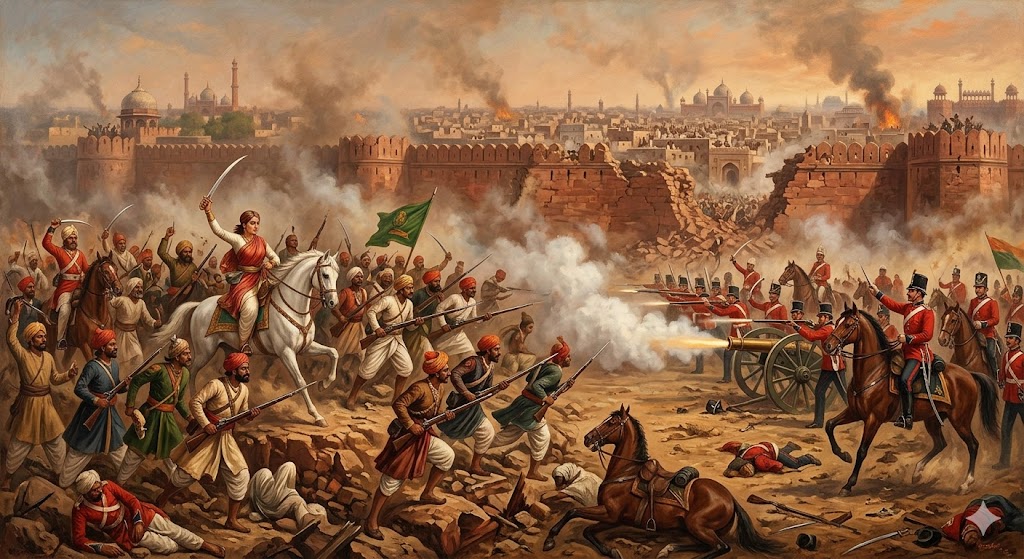
INTRODUCTION
“The British wanted our country, our wealth, and our souls. In 1857, India said NO.”
Imagine a time when Indian soldiers were forced to bite cartridges greased with cow and pig fat. Imagine kings being thrown off their thrones simply because they had no natural heir. Imagine famine, poverty, and the destruction of entire industries. This was India under the British East India Company in the 1850s.
Then came 1857.
For ICSE Class 10 students, The First War of Independence (also called the Revolt of 1857 or the Sepoy Mutiny) is one of the most important chapters in your History syllabus. Board examiners LOVE this chapter. Every year, questions appear on the causes of the revolt, Queen Victoria’s Proclamation (1858), and changes in the army after 1857.
But here is the problem: Many students find the causes confusing (political? economic? socio-religious? military?). Others mix up the consequences. And almost everyone forgets the exact wording of the Queen’s Proclamation.
This guide solves all of that.
Here is what you will learn:
- ✅ All 4 causes of the revolt (Political, Socio-religious, Economic, Military) – explained with examples and board-important points
- ✅ The immediate cause – the greased cartridges and Mangal Pandey
- ✅ The spread of the revolt – the main centres and leaders (for continuity and understanding)
- ✅ Consequences of the revolt – ONLY what ICSE tests: Queen’s Proclamation, changes in administration, relation with Princely States, changes in the army
- ✅ Complete Question-Answer bank – previous year questions, expected 2026 questions, MCQs, assertion-reason, source-based questions
- ✅ Last-minute revision notes – one-page summary, mnemonics, common mistakes
- ✅ Board exam writing tips – how to structure your answers for maximum marks
Let us begin.
WHAT YOU WILL LEARN
TopicWhat ICSE Expects You to KnowBoard ImportancePolitical CausesDoctrine of Lapse, Annexation of Awadh, Treatment of Bahadur Shah Zafar, Nana Sahib, Rani Laxmibai⭐⭐⭐⭐⭐Socio-religious CausesInterference with customs, racial discrimination, missionary activities, taxation of religious property⭐⭐⭐⭐Economic CausesDrain of wealth, decline of handicrafts, heavy land revenue, destruction of peasants⭐⭐⭐⭐Military CausesLow pay, poor treatment, General Service Enlistment Act, greased cartridges⭐⭐⭐⭐⭐Immediate CauseEnfield Rifle, greased cartridges, Mangal Pandey⭐⭐⭐⭐⭐Spread of the RevoltDelhi, Kanpur, Lucknow, Jhansi, Bareilly (main centres and leaders)⭐⭐⭐Consequences (BOARD FOCUS)Queen’s Proclamation (1858), Changes in Administration, Relation with Princely States, Changes in the Army⭐⭐⭐⭐⭐
COMPLETE CHAPTER EXPLANATION
The First War of Independence, 1857 – An Overview
The Revolt of 1857 was the first major organised uprising against British rule in India. It began on 10 May 1857 at Meerut and spread rapidly to Delhi, Kanpur, Lucknow, Jhansi, and other parts of northern and central India. While the revolt was ultimately suppressed by the British, it had far-reaching consequences that changed the nature of British rule in India forever.
The event is known by different names:
| Name | Who Uses It | Why |
|---|---|---|
| First War of Independence | Indian nationalists (e.g., V.D. Savarkar) | Emphasises that it was a national uprising against foreign rule |
| Sepoy Mutiny | British historians | Focuses only on the military aspects |
| Revolt of 1857 | Neutral historians | A balanced term |
| Great Uprising of 1857 | Some Indian historians | Highlights its scale and significance |
For ICSE, the term “First War of Independence” is widely accepted, though board papers may also use “Revolt of 1857.”
Causes of the Revolt of 1857
The revolt was not a sudden event. It was the result of years of discontent that built up across Indian society. ICSE Class 10 syllabus categorises the causes into four main types: Political, Socio-religious, Economic, and Military.
Political Causes (Most Important for Boards)
The political causes revolve around how the British systematically destroyed Indian ruling families and annexed their kingdoms.
1. The Doctrine of Lapse
| Aspect | Detail |
|---|---|
| Introduced by | Lord Dalhousie (Governor-General of India, 1848–1856) |
| What it meant | If an Indian ruler died without a natural male heir, his kingdom would automatically lapse (be annexed) to the British East India Company |
| Key point | The British refused to recognise adopted heirs as legitimate successors |
Why was this deeply resented?
In Indian tradition (both Hindu and Muslim), adoption was a well-established practice to continue a royal line. By rejecting adoptions, the British were seen as interfering with Indian customs and religion. This was also a deliberate policy of expansion disguised as law.
States annexed under the Doctrine of Lapse:
| State | Year of Annexation | Key Figure Affected |
|---|---|---|
| Satara | 1848 | – |
| Jhansi | 1854 | Rani Laxmibai – one of the revolt’s bravest leaders |
| Nagpur | 1854 | – |
Board Exam Tip: When writing about Rani Laxmibai’s reasons for revolting, ALWAYS mention that Jhansi was annexed under the Doctrine of Lapse.
2. Annexation of Awadh (Oudh) – 1856
| Aspect | Detail |
|---|---|
| Annexed by | Lord Dalhousie |
| Reason given by British | “Mismanagement” by Nawab Wajid Ali Shah |
| Real reason | Awadh was a rich and fertile kingdom. The British wanted direct control over its revenue |
Why did this cause widespread anger?
- This was the last major Indian kingdom to be annexed.
- The Nawab of Awadh was a popular ruler, deeply loved by his people.
- Many sepoys (Indian soldiers) in the British army came from Awadh. They felt personally betrayed when their Nawab was removed.
3. Disrespect towards Bahadur Shah Zafar (Last Mughal Emperor)
The Mughal Emperor had been a powerless figurehead for decades. However, he still commanded symbolic respect across India.
| Action by British | How it Angered Indians |
|---|---|
| Lord Dalhousie announced that after Bahadur Shah Zafar’s death, his family would be thrown out of the Red Fort | The Mughal dynasty, which had ruled India for over 300 years, was being insulted |
| The Emperor’s name was removed from coins minted by the British | Coins traditionally carried the name of the ruling sovereign – removing it was a public humiliation |
| Lord Canning declared that Bahadur Shah Zafar would be the last Mughal king | The 300-year-old Mughal Empire was officially being ended |
4. Grievances of Nana Sahib (Heir of the Peshwa)
| Aspect | Detail |
|---|---|
| Who was Nana Sahib? | Adopted son of Baji Rao II, the last Maratha Peshwa |
| What did the British do? | Refused to recognise his adoption and stopped his pension |
| Result | Nana Sahib became a bitter enemy of the British and led the revolt in Kanpur |
5. Subsidiary Alliance System
Before the Doctrine of Lapse, Lord Wellesley had introduced the Subsidiary Alliance. Under this system:
- Indian rulers had to keep a British army in their territory
- They had to pay for its maintenance
- They lost control over foreign affairs and defence
States brought under Subsidiary Alliance: Hyderabad, Awadh, Gwalior, etc.
Socio-religious Causes
The British interfered in Indian social and religious life, creating deep suspicion and anger.
1. Interference with Social Customs
| British Reform | Why Indians Resented It |
|---|---|
| Abolition of Sati (1829) | Considered an attack on Hindu religious traditions |
| Widow Remarriage Act (1856) | Seen as interference in Hindu social structure |
| Law allowing converts to inherit ancestral property (1850) | Feared that this would encourage conversions to Christianity |
Board Exam Tip: When answering questions on socio-religious causes, mention that Indians saw these reforms as “interference” even if some reforms were progressive. The point is not whether the reforms were good or bad – the point is that Indians perceived them as an attack on their religion.
2. Racial Discrimination and Arrogance of the British
The British treated Indians with contempt. They believed in their own racial superiority. Indian officers were insulted. Indian merchants were humiliated. This created a deep sense of anger and humiliation across all sections of society.
3. Aggressive Activities of Christian Missionaries
- Missionaries openly criticised Hindu and Muslim religions
- They used government schools to spread Christianity
- There were rumours that the British wanted to forcibly convert all Indians to Christianity
4. Taxation of Religious Property
The British imposed taxes on lands owned by temples and mosques. This affected temple priests and Muslim clerics (maulvis) who depended on these lands for their livelihood.
Economic Causes
The British systematically destroyed the Indian economy for their own benefit.
1. Destruction of Indian Handicrafts and Industries
| Before British Rule | After British Rule |
|---|---|
| India exported cotton and silk textiles worldwide | British textile factories destroyed Indian exports |
| Indian artisans were skilled and prosperous | Artisans became unemployed; many starved |
| Towns like Dhaka, Surat, and Murshidabad were thriving industrial centres | These towns declined and became impoverished |
How did this happen?
- The British imposed heavy duties on Indian textiles exported to Britain
- They allowed British goods to enter India tax-free
- Indian handicrafts could not compete with cheap British machine-made goods
2. Impoverishment of Peasants (Cultivators)
| British Policy | Effect on Peasants |
|---|---|
| Heavy land revenue taxes | Peasants were left with very little of their produce |
| Forced cultivation of indigo | Peasants were forced to grow indigo instead of food crops |
| Frequent famines (no relief from British) | Millions died of starvation |
British revenue policies reduced peasants to poverty and debt. The zamindars (landlords) who collected taxes on behalf of the British also lost their lands when they failed to pay the demanded revenue.
3. Drain of Wealth
India’s wealth was systematically drained to England. The British used Indian revenues to pay for:
- Their own salaries (highly inflated)
- Wars fought in other parts of the world
- Maintenance of the British army in India
This was called “absentee sovereignty” – the rulers lived far away, took India’s money, but did not care for its people.
Military Causes
Indian sepoys (soldiers) were the backbone of the British army in India. However, they were deeply unhappy.
1. Low Pay and Poor Treatment
| British Sepoy | Indian Sepoy |
|---|---|
| High salary | Much lower salary |
| Better allowances | No allowances |
| Promoted quickly | Rarely promoted to officer ranks |
| Treated with respect | Treated with contempt |
2. General Service Enlistment Act (1856)
| What it meant | Why Indians Resented It |
|---|---|
| Indian sepoys could be forced to serve overseas (across the sea) | Crossing the sea was considered religiously forbidden for many Hindus (Kala Pani) |
Before this Act, sepoys could refuse overseas service.
3. Discrimination and Humiliation
Indian sepoys were publicly humiliated by British officers. They were called names. They could be dismissed arbitrarily. Their religious sentiments were not respected.
4. Rumours of Forced Conversion
There were widespread rumours that the British were mixing bone dust of cows and pigs in the atta (flour) supplied to sepoys. This was believed to be an attempt to convert them to Christianity by destroying their caste.
Immediate Cause – The Greased Cartridges (The Spark)
The long-building discontent exploded over one small thing: a rifle cartridge.
The Enfield Rifle
| Aspect | Detail |
|---|---|
| New rifle introduced | Enfield Rifle |
| Problem | The cartridge was covered with greased paper. To load the rifle, the sepoy had to bite off the greased cover |
| Rumor | The grease was made from cow fat (offensive to Hindus) and pig fat (offensive to Muslims) |
The British insisted that the grease was made from vegetable oils, but the sepoys did not believe them.
Mangal Pandey – The First Martyr
| Event | Details |
|---|---|
| Who | Mangal Pandey, a sepoy in the British army at Barrackpore (near Kolkata) |
| What happened | On 29 March 1857, he attacked his British officers, refusing to use the greased cartridges |
| Outcome | He was arrested and hanged on 8 April 1857 |
Mangal Pandey’s execution became a symbol of British oppression.
The Outbreak at Meerut – 10 May 1857
| Event | Details |
|---|---|
| What happened | 85 sepoys at Meerut refused to use the greased cartridges |
| British punishment | They were publicly disarmed, put in chains, and sentenced to 10 years imprisonment |
| Reaction | On 10 May 1857, their fellow sepoys rose in revolt. They released the prisoners, killed British officers, and marched to Delhi |
This marks the official beginning of the First War of Independence.
Spread of the Revolt (For Continuity and Comprehension)
While the detailed events are not tested as per the ICSE syllabus, you need to know the main centres and leaders to understand the scale of the uprising.
| Centre | Leader(s) | Significance |
|---|---|---|
| Delhi | Bahadur Shah Zafar (declared Emperor of India) | The revolt spread when sepoys from Meerut reached Delhi and proclaimed the aged Mughal emperor as their leader |
| Kanpur | Nana Sahib (adopted son of the last Peshwa) | Nana Sahib led the revolt; the British recaptured Kanpur after fierce fighting |
| Lucknow | Begum Hazrat Mahal (wife of Nawab Wajid Ali Shah) | She led the revolt in Awadh after her husband was deposed |
| Jhansi | Rani Laxmibai | She fought bravely after her kingdom was annexed under the Doctrine of Lapse |
| Bareilly | Khan Bahadur Khan | Led revolt in Rohilkhand |
Causes Table – One-Shot Revision
| Category | Key Points |
|---|---|
| Political | Doctrine of Lapse (Jhansi, Satara, Nagpur), Annexation of Awadh (1856), Disrespect to Bahadur Shah Zafar, Nana Sahib’s pension stopped, Subsidiary Alliance |
| Socio-religious | Abolition of Sati, Widow Remarriage Act, Conversion law (1850), Missionary activities, Taxation of temples/mosques, Racial discrimination |
| Economic | Destruction of Indian handicrafts (Dhaka, Surat declined), Heavy land revenue, Forced indigo cultivation, Drain of wealth to England |
| Military | Low pay, Poor treatment, General Service Enlistment Act (overseas service), Greased cartridges (Enfield Rifle), Mangal Pandey execution |
Consequences of the Revolt (Board Focus)
ICSE Class 10 syllabus specifies that ONLY the following consequences will be tested:
- Changes in Administration (including Queen Victoria’s Proclamation)
- Relation with Princely States
- Changes in the Army
Let us examine each in detail.
Changes in Administration
1. End of East India Company Rule (Government of India Act, 1858)
| Before the Revolt | After the Revolt |
|---|---|
| The East India Company ruled India on behalf of the British Crown | The Company was abolished – India came under direct rule of the British Crown (Queen Victoria) |
Key point: The Government of India Act, 1858 transferred all powers from the East India Company to the British Crown.
2. Secretary of State for India
| New Position | Role |
|---|---|
| Secretary of State for India | A British Cabinet Minister responsible for Indian affairs |
| Assisted by | India Council (15 members) |
The Board of Control and Court of Directors (both from Company days) were abolished.
3. Governor-General Became Viceroy
| Before | After |
|---|---|
| Governor-General of India | Viceroy of India (representative of the British Crown) |
| Lord Canning was the last Governor-General and the first Viceroy of India | |
4. Queen Victoria’s Proclamation (1 November 1858) – MOST IMPORTANT FOR BOARDS
This is a HOT topic for ICSE board exams. Memorise the key promises made by Queen Victoria.
| Promise in Queen’s Proclamation | What it meant |
|---|---|
| “We hold the people of India to be entitled to the same rights and privileges as our other subjects” | Indians were theoretically equal to British citizens – though in practice this was not fully implemented |
| “We disclaim any right to interfere in matters of religion” | The British promised not to interfere in Indian religious practices – a direct response to the socio-religious grievances |
| “We shall respect the rights, dignity, and honour of Indian princes” | Indian rulers were assured that their kingdoms would not be annexed arbitrarily |
| Indians would be appointed to government jobs based on merit | A promise of equal opportunity (though very few Indians actually got high posts) |
Key Points for Board Answers:
- The Proclamation was made by Queen Victoria on 1 November 1858
- It was read out by Lord Canning (the first Viceroy) at a grand durbar in Allahabad
- It officially ended the rule of the East India Company
Relation with Princely States
| Before the Revolt | After the Revolt |
|---|---|
| Policy of annexation (Doctrine of Lapse, Subsidiary Alliance) | Policy of annexation was abandoned |
| Indian rulers were seen as obstacles to British expansion | Indian rulers were seen as allies who could help the British maintain control |
Key Changes:
| Change | Explanation |
|---|---|
| Doctrine of Lapse abolished | Indian rulers could now adopt heirs without fear of annexation |
| Loyal princes rewarded | Princes who helped the British suppress the revolt were given back their lands and rewarded with titles and honours |
| Treaties honoured | The British promised to honour all previous treaties with Indian rulers |
Purpose of this change: The British realised that Indian rulers could be useful allies in controlling the vast Indian population. They abandoned expansionist policies and instead cultivated loyalty among the princes.
Changes in the Army
The British completely reorganised the Indian army to prevent another revolt.
Key Changes in the Army (Memorise for Boards)
| Change | Explanation |
|---|---|
| Increase in European troops | The number of European soldiers in India was significantly increased. The ratio of European to Indian troops was fixed. The general principle was that the number of Indian sepoys should not be more than twice the number of European troops |
| Artillery placed only in European hands | Indian sepoys were not allowed to handle advanced weapons and artillery. The British feared that if Indians had access to modern weaponry, they could rebel again |
| European troops stationed in strategic locations | Key military positions and commanding heights were held only by European soldiers |
| Mixed-caste regiments | To prevent Hindu and Muslim soldiers from uniting against the British, regiments were deliberately composed of different castes and communities. This was part of the “Divide and Rule” policy |
| Indian soldiers isolated from nationalist ideas | Newspapers and nationalist publications were banned for soldiers. The army was kept isolated from the general population so that revolutionary ideas could not spread |
| Better pay and conditions for Indian sepoys | Some grievances were addressed. Pay was increased (though still less than European soldiers) |
| Recruitment from “martial races” | The British began recruiting heavily from communities they considered “martial” (loyal and fierce), such as Sikhs, Gurkhas, and Pathans, while limiting recruitment from Awadh and other areas that had been centres of the revolt |
Timeline Table
| Date | Event |
|---|---|
| 29 March 1857 | Mangal Pandey attacks British officers at Barrackpore |
| 8 April 1857 | Mangal Pandey executed |
| 9 May 1857 | 85 sepoys at Meerut are court-martialed and imprisoned for refusing greased cartridges |
| 10 May 1857 | Meerut sepoys revolt, release prisoners, and march to Delhi – beginning of the Revolt |
| 11 May 1857 | Rebels reach Delhi; Bahadur Shah Zafar declared Emperor |
| 1857–1858 | Revolt spreads to Kanpur, Lucknow, Jhansi, Bareilly, etc. |
| 1858 | Revolt suppressed by the British |
| 1 November 1858 | Queen Victoria’s Proclamation is read out at Allahabad |
| 2 August 1858 | Government of India Act, 1858 passed (Act for the Better Government of India) |
Important Dates Table
| Date | Significance |
|---|---|
| 1857 | Year of the First War of Independence |
| 10 May 1857 | Revolt begins at Meerut |
| 1858 | Government of India Act; Queen Victoria’s Proclamation |
| 1 November 1858 | Queen’s Proclamation announced in India |
Important Terms and Definitions
</
| Term | Definition |
|---|---|
| Doctrine of Lapse | Policy introduced by Lord Dalhousie – if an Indian ruler died without a natural male heir, his kingdom would be annexed by the British |
| Subsidiary Alliance | System introduced by Lord Wellesley – Indian rulers had to accept a British army in their territory and pay for its maintenance |
| General Service Enlistment Act (1856) | Act that forced Indian sepoys to serve overseas if required |
| Queen’s Proclamation (1858) | Declaration by Queen Victoria announcing direct Crown rule over India and promising religious non-interference |
| Viceroy | Title given to the Governor-General of India after 1858 (representative of the British Crown) |
| Secretary of State for India | British Cabinet Minister responsible for governing India after 1858 |
| Government of India Act, 1858 | Act that abolished the East India Company and transferred power to the British Crown |
| Sepoy | Indian soldier in the British East India Company’s army |