📝 Most Important Board Questions for 2027
Multiple Choice Questions (MCQs)
- Q1: The outermost layer of the Earth is called:
a) Mantle b) Core c) Crust d) Lithosphere → Answer: c) Crust
- Q2: The Earth’s magnetic field is mainly produced by movements in the:
a) Crust b) Mantle c) Outer core d) Inner core → Answer: c) Outer core
- Q3: Sial is mainly composed of:
a) Silicon and magnesium b) Silicon and aluminium c) Iron and nickel d) Iron and magnesium → Answer: b) Silicon and aluminium
- Q4: The densest layer of the Earth is the:
a) Crust b) Mantle c) Outer core d) Core → Answer: d) Core
- Q5: The layer that contains semi-molten rock and convection currents is the:
a) Crust b) Mantle c) Inner core d) Lithosphere → Answer: b) Mantle
Fill in the Blanks
- The Earth’s crust is divided into continental crust and oceanic crust.
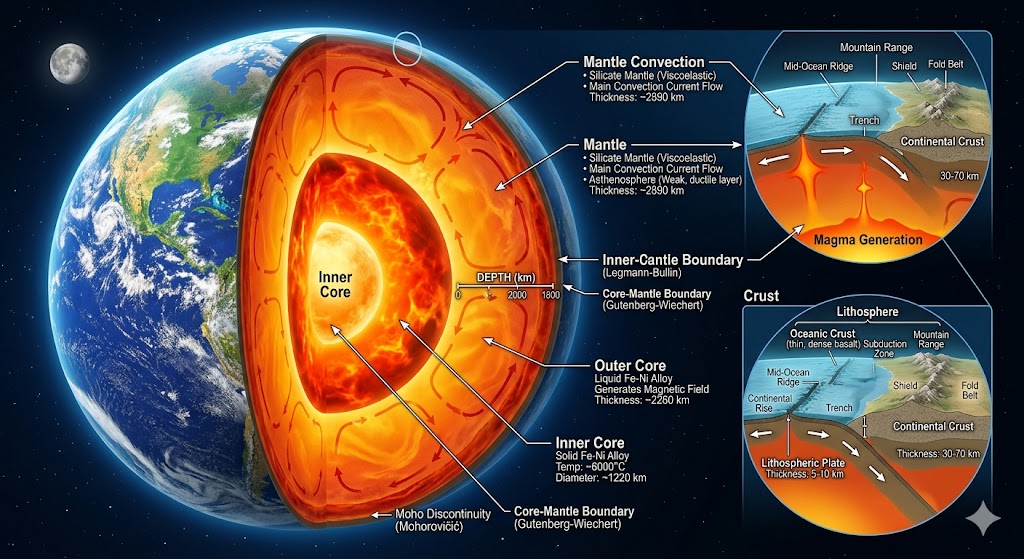
- The mantle extends to a depth of about 2,900 km below the crust.
- The core is mostly made of iron and nickel.
- The outer core is in a liquid state.
- The inner part of the crust rich in silicon and aluminium is called sial.
Match the Following
| Column A | Column B |
|---|
| 1. Sial | c) Silicon and aluminium |
| 2. Sima | d) Silicon and magnesium |
| 3. Outer core | a) Liquid metal layer |
| 4. Inner core | b) Solid inner metallic layer |
| 5. Mantle | e) Between crust and core |
True / False
- The crust forms the largest volume of the Earth. → False (Mantle forms the largest volume)
- The mantle is completely liquid. → False (Mostly solid with semi-molten parts)
- The inner core is solid due to extremely high pressure. → True
- Sima is less dense than sial. → False (Sima is more dense)
- The core is made mostly of iron and nickel. → True
Very Short Answer Questions (2 Marks)
- Q: Name the three main layers of the Earth.
Ans: Crust, Mantle, Core
- Q: What is nife?
Ans: Nife refers to the core made of nickel (Ni) and iron (Fe).
- Q: Why is the inner core solid?
Ans: Due to extremely high pressure from overlying layers.
- Q: What is meant by lithosphere?
Ans: The rigid outer layer including crust and uppermost mantle.
- Q: Which layer contains convection currents?
Ans: The mantle.
Short Answer Questions (3–4 Marks)
- Distinguish between continental crust and oceanic crust.
- Explain why the crust is important for human life.
- Briefly describe the composition and state of the mantle.
- What is the role of the outer core in Earth’s magnetism?
- How do seismic waves help us understand Earth’s interior?
Long Answer Questions (5–6 Marks)
- Describe the structure of the Earth with the help of a neat diagram.
- Explain the main characteristics of the crust, mantle and core.
- What are sial and sima? How are they different? Why are these terms important?
- Discuss how knowledge of Earth’s structure helps us understand earthquakes and volcanoes.
✅ Solved Previous Year Type Questions (PYQ-Style)
Q1. Name the three main layers of the Earth and write one characteristic of each. (3 marks)- Crust – Outermost and thinnest layer, forms continents and ocean floors.
- Mantle – Middle, very thick layer of hot, solid and semi-molten rock.
- Core – Innermost and densest layer, mainly made of iron and nickel.
Q2. State three differences between continental crust and oceanic crust. (3 marks)- Continental crust is thicker (30–40 km) while oceanic crust is thinner (5–10 km).
- Continental crust is made of sial (silicon + aluminium); oceanic crust is made of sima (silicon + magnesium).
- Continental crust is less dense; oceanic crust is more dense.
Q3. Why is the inner core solid even though its temperature is very high? (2–3 marks)- The inner core experiences extremely high pressure due to the weight of overlying layers.
- This pressure keeps iron and nickel tightly packed, preventing them from melting.
- Therefore, despite very high temperature, the inner core remains solid.
Q4. What is meant by sial and sima? Why are these terms important? (3–4 marks)- Sial = Silicon + Aluminium (upper continental crust)
- Sima = Silicon + Magnesium (oceanic/lower crust)
- Importance: Helps understand composition, density and distribution of rocks in the crust.
Q5. Explain the role of the outer core in producing Earth’s magnetic field. (3–4 marks)- Outer core is mainly liquid iron and nickel.
- Movement of this conducting liquid metal acts like a giant dynamo.
- This generates Earth’s magnetic field, which protects life from harmful solar radiation.
—
A. Match the columns:
1:
Spring tide →
b: Full moon2:
Crest →
a: Wave3:
Sial →
d: Continental crust4:
Ozone →
e: Stratosphere5:
Marble →
c: Metamorphic rock
B. Write True or False:
1: The temperature inside the Earth decreases with an increase in depth:
False2: Sedimentary rocks are formed due to the cooling and solidification of magma:
False3: The movement of ocean water in the form of a stream is called the water cycle:
False4: Oxygen is found in the lower layer of the atmosphere because it is a heavy gas:
True5: Pollution needs to be checked so that the delicate balance of nature can be maintained:
True
C. Give reasons for the following:
1:
We cannot get direct information about the interior of the Earth.Ans: The interior of the Earth is extremely hot and under immense pressure. No human-made instrument can withstand such extreme conditions. Hence, direct exploration of the Earth’s interior is impossible, and scientists rely on
indirect sources such as seismic waves, volcanic eruptions, and deep drilling to study it.2:
Neap tides occur on a half-moon.Ans: Neap tides occur when the Sun, Earth, and Moon form a
right angle, which happens during the
first and third quarters of the moon (half-moon phases). The gravitational pull of the Sun and Moon counteract each other, causing tides that are lower than usual.
D. Answer the following questions:
1:
Distinguish between Crust and Core.Crust:
a. The crust is also called the
lithosphere, which is the solid outer layer of the Earth.
b. The upper part of the crust is called the
continental crust, and the lower part is called the
oceanic crust.
c. The density of the crust is about
3 grams per cubic centimeter.
Core:
a. The core lies
below the mantle and around the center of the Earth.
b. It is made up of
dense and heavy metals such as nickel and iron.
c. The average density of the core ranges between
5 g/cm³ and 13 g/cm³.2:
What are rocks? Name the main types of rocks with two examples of each.Ans: Rocks are
aggregates of minerals. They do not possess a definite chemical composition. Minerals, on the other hand, are naturally occurring solid substances present in rocks.
The three main types of rocks are:a.
Igneous Rocks – Formed by the cooling and solidification of magma.
Examples: Granite, Basalt.b.
Sedimentary Rocks – Formed by the deposition and compression of sediments.
Examples: Sandstone, Coal.c.
Metamorphic Rocks – Formed when existing rocks undergo changes due to heat and pressure.
Examples: Marble, Slate.3:
What are the causes for the occurrence of tides and ocean currents?Ans: The causes of
tides and
ocean currents include:
a.
Gravitational pull of the Sun and the Moon.
b.
Prevailing winds that drive surface currents.
c.
Differences in temperature and salinity of ocean water.
d.
Variations in ocean water density due to different levels of heating by the Sun.4:
Explain the working of the hydrological cycle with the help of a neatly labeled diagram.Ans: The hydrological cycle, or
water cycle, describes the continuous movement of water between the
Earth’s surface and the atmosphere.
- Water from oceans, rivers, and lakes evaporates into the atmosphere due to the Sun’s heat.
- Water vapor cools and condenses to form clouds.
- Clouds lead to precipitation in the form of rain, snow, or sleet.
- Water returns to water bodies through runoff and infiltration into the ground, completing the cycle.
(Note: Add a labeled diagram of the water cycle if required.)5:
Define atmosphere. Name the different layers of the atmosphere and their extent.Ans: The
atmosphere is the
thin layer of gases surrounding the Earth. It extends from
sea level up to 1,600 km above the Earth’s surface.
The five layers of the atmosphere are:a.
Troposphere – Extends
8 km over the poles and
18 km over the equator. It contains most of the Earth’s weather.
b.
Stratosphere – Extends
up to 50 km from sea level. It contains the
ozone layer, which absorbs harmful UV rays.
c.
Mesosphere – Extends from
50 km to 80 km. Meteors burn up in this layer.
d.
Thermosphere – Extends from
80 km to 400 km. It contains the
ionosphere, which reflects radio waves.
e.
Exosphere – The
outermost layer, gradually merging with space.6:
Mention three ways in which the atmosphere is useful to us.Ans: The atmosphere is important because:a. The
lower layer of the atmosphere contains
oxygen, which is essential for breathing.
b. It
protects us from the
harmful ultraviolet (UV) rays of the Sun.
c. It
retains heat, keeping the
Earth’s surface warm even at night.7:
What is the biosphere? Name the elements of the biosphere.Ans: The word
“biosphere” comes from the
Greek word “bios” (life) and the
Latin word “sphaira” (sphere). The biosphere is the
sphere of living organisms, where the
lithosphere, hydrosphere, and atmosphere interact to support life.
The elements of the biosphere include:
a.
Plants
b.
Animals
c.
Human beings
d.
Microbes