
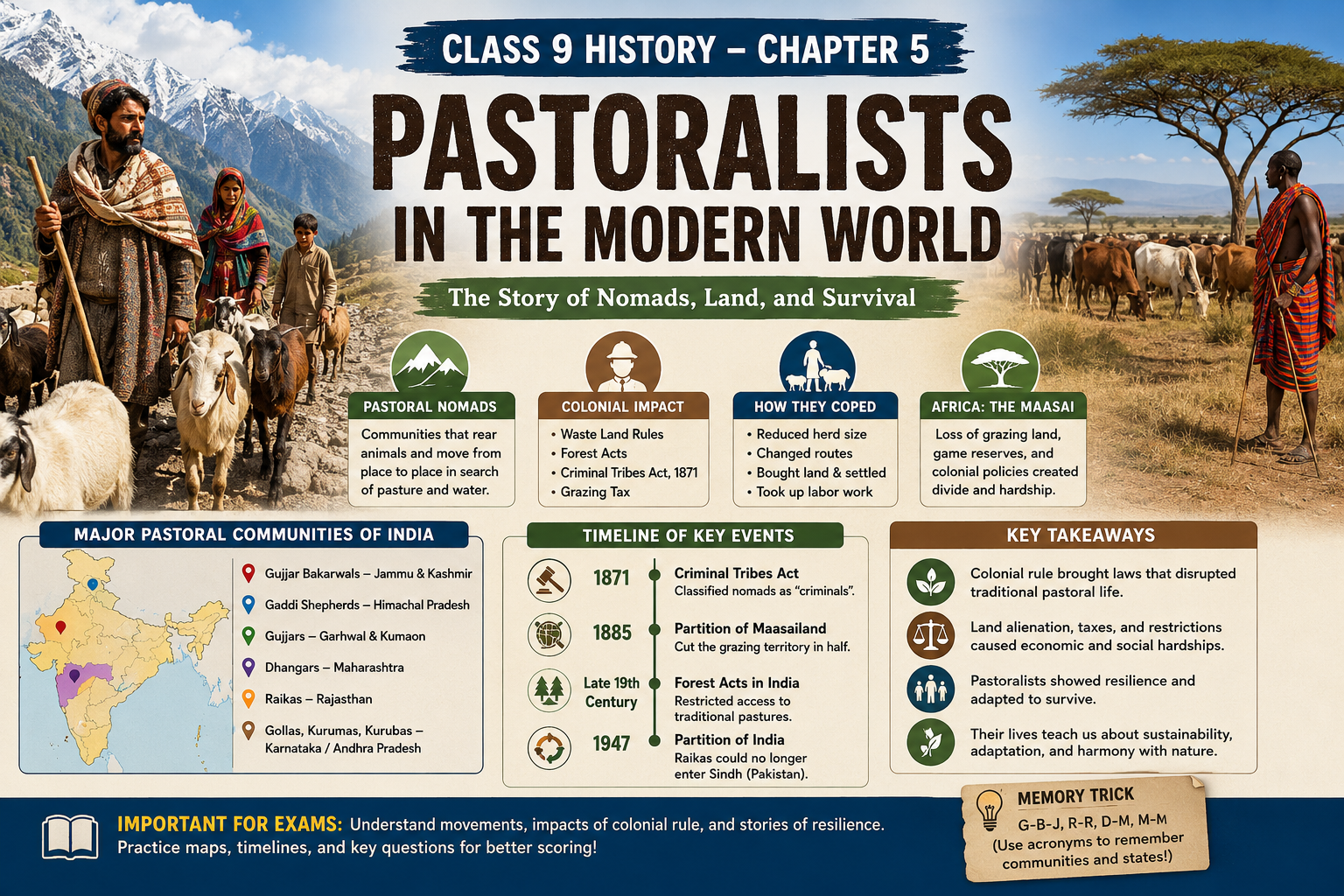
Introduction: Why Should We Care About Nomads?
When we think of “History,” we usually think of kings, battles, and great empires. But have you ever wondered about the people who are always on the move? Those who don’t have permanent homes but travel hundreds of miles with their sheep, goats, and camels?
In Class 9 History Chapter 5, “Pastoralists in the Modern World,” we dive into the lives of nomad communities like the Gujjar Bakarwals, Gaddi Shepherds, and the Maasai. This chapter is vital for your social science exams (especially for UP Board, Bihar Board, and CBSE) because it explains how the modern world—with its borders and laws—completely changed the lives of people who thrive on freedom.
1. Pastoral Nomads and Their Movements
Pastoralists are people who rear animals for a living and move from one place to another in search of pasture (grazing land). They don’t belong to one fixed spot; they belong to the rhythm of the seasons.
A. The Mountains: Life in the Himalayas
In the high mountains of India, pastoralists move between high summer meadows (Bugyals) and low-altitude winter grazing grounds.
- Gujjar Bakarwals (Jammu & Kashmir): They rear sheep and goats. In winter, they live in the low hills of the Siwaliks. In summer, they cross the Pir Panjal passes to reach the lush green mountain meadows.
- Gaddi Shepherds (Himachal Pradesh): They follow a similar cycle. By April, they move north to spend summer in Lahaul and Spiti.
- Gujjars (Garhwal and Kumaon): They spend winters in the dry forests of the Bhabar and summers in the high Bugyals.
B. The Plateaus, Plains, and Deserts
- Dhangars (Maharashtra): An important pastoral community. During the monsoon, they stay in the central plateau of Maharashtra. By October, they move to the Konkan region, where their cattle help fertilize the agricultural fields with manure.
- Gollas, Kurumas, and Kurubas (Karnataka/Andhra Pradesh): They rear cattle, sheep, and goats and trade in blankets.
- Raikas (Rajasthan): Living in the Thar Desert, they combine cultivation with pastoralism. During the dry season, they move out of their villages to find water and forage for their camels and sheep.
2. Colonial Rule and Pastoral Life: The Great Turning Point
Before the British arrived, pastoralists moved freely. However, colonial rule changed everything. The British government viewed pastoralists with suspicion because they were hard to tax and control.
How did Colonial Laws Impact Pastoralists?
- Waste Land Rules: The British believed “unsettled” land was unproductive. They took over grazing lands and converted them into agricultural farms to increase land revenue.
- Forest Acts: Forests were classified into Reserved (no entry) and Protected (limited entry). Pastoralists were suddenly “trespassers” in their own traditional homes.
- Criminal Tribes Act (1871): The British classified many nomadic communities as “Criminal Tribes” by nature. They were forced to live in settled villages and required permits to move.
- Grazing Tax: To maximize profit, the British introduced a tax on every animal. This made life economically miserable for poor herders.
3. How Did Pastoralists Cope?
Pastoralists didn’t just give up. They adapted in several ways:
- Reducing Herd Size: Many sold off their animals because they couldn’t feed them.
- Changing Tracks: When old grazing lands were closed, they found new routes (e.g., Raikas moving to Haryana after 1947).
- Buying Land: Wealthier pastoralists settled down and became farmers or traders.
- Labor Work: Poorer herders often lost their stock and became casual laborers in towns.
4. Pastoralism in Africa: The Story of the Maasai
Africa is home to over half the world’s pastoral population. The Maasai are the most famous community here.
The Loss of Grazing Land
Before European colonization, Maasai land stretched from North Kenya to Northern Tanzania.
- Scramble for Africa: In 1885, Maasai land was cut in half by an international boundary between British Kenya and German Tanganyika.
- Game Reserves: The best grazing lands were turned into National Parks like Serengeti and Maasai Mara. Herders were forbidden from entering.
The Social Divide
The British appointed “Chiefs” to manage Maasai affairs. This created a new social gap:
- The Chiefs: Became wealthy and had a steady income.
- The Poor Pastoralists: Lost everything during droughts and wars, often working in charcoal burners or construction.
5. Timeline of Key Events
| Year | Event | Importance |
|---|---|---|
| 1871 | Criminal Tribes Act | Classified nomads as “criminals.” |
| 1885 | Partition of Maasailand | Cut the grazing territory in half. |
| Late 19th Century | Forest Acts in India | Restricted access to traditional pastures. |
| 1947 | Partition of India | Raikas could no longer enter Sindh (Pakistan). |
6. Key Terms to Remember (Glossary)
- Bhabar: A dry forested area below the foothills of the Siwaliks.
- Bugyal: High-altitude summer meadows in the Himalayas.
- Kharif: The autumn harvest, reaped near the end of the monsoon.
- Rabi: The spring harvest, usually harvested after March.
- Stumpage: A tax paid by herders to graze on forest land.
- Nomadic: People who do not live in one place but move to survive.
7. Important Questions and Answers (Exam Oriented)
Multiple Choice Questions (MCQs)
Q1. Which pastoral community belongs to Jammu & Kashmir?
A) Gaddi
B) Raika
C) Gujjar Bakarwal
D) Dhangar
Answer: C) Gujjar Bakarwal
Q2. The ‘Criminal Tribes Act’ was passed in which year?
A) 1857
B) 1871
C) 1901
D) 1947
Answer: B) 1871
Short Answer Questions (3 Marks)
Q1. Why did the British introduce Waste Land Rules?
The British wanted to convert “waste” (grazing) land into cultivated land to:
- Increase land revenue.
- Produce raw materials like cotton and jute for export.
- Bring nomadic people under settled, taxable control.
Q2. Explain the seasonal movement of the Gaddi Shepherds.
Gaddi shepherds spend winters in the low hills of the Siwaliks. By April, they move north to Lahaul and Spiti. Once the snow melts, they move to higher mountain meadows. In September, they begin their return journey, stopping to harvest their summer crops and sow winter ones.
Long Answer Questions (5 Marks)
Q1. How did the Forest Acts change the lives of pastoralists in India?
The Forest Acts were devastating:
- Loss of Access: Areas that provided forage were declared “Reserved,” and entry was banned.
- Permit System: In “Protected” forests, pastoralists needed a permit. Their hours and days in the forest were strictly monitored.
- Harassment: Forest guards often took bribes and harassed herders.
- Overgrazing: Since large areas were closed, the remaining open pastures were overused, leading to a decline in vegetation and the health of the cattle.
8. Memory Tricks for Board Exams
- G-B-J: Gujjar Bakarwals = Jammu & Kashmir.
- R-R: Raikas = Rajasthan.
- D-M: Dhangars = Maharashtra.
- M-M: Maasai = Mara (Maasai Mara).
9. Common Mistakes Students Make
- Confusing Bhabar and Bugyal: Remember, Bhabar is at the bottom (dry forest), and Bugyal is at the top (green meadows).
- Mixing Communities: Students often swap Raikas with Dhangars. Use the state-based memory trick above.
- Ignoring Africa: Many students skip the Maasai section. Boards often ask a 5-mark question comparing Indian and African pastoralism.
10. Frequently Asked Questions (FAQs)
Q1. Is pastoralism still relevant today?
Yes! Many environmentalists believe pastoralism is the most sustainable way of life for dry and mountainous regions where traditional farming is impossible.
Q2. Why were the Maasai forbidden from entering Serengeti?
The colonial government turned the best grazing lands into “Game Reserves” for wildlife protection and tourism, ignoring the fact that Maasai had coexisted with wildlife for centuries.
Q3. Where can I find the PDF for Class 9 History Chapter 5?
You can download the official NCERT PDF from the e-pathshala website or use these notes for quick revision.
Conclusion: The Resilience of Nomads
The story of Pastoralists in the Modern World is a story of survival. Despite harsh laws, loss of land, and being labeled as criminals, these communities have found ways to persist. They teach us that human flexibility and a deep connection with nature are powerful tools.
Study Tip: Draw the migration maps of the Gujjar Bakarwals and Raikas in your notebook. Visualizing the routes will help you remember their movements for the exam!