
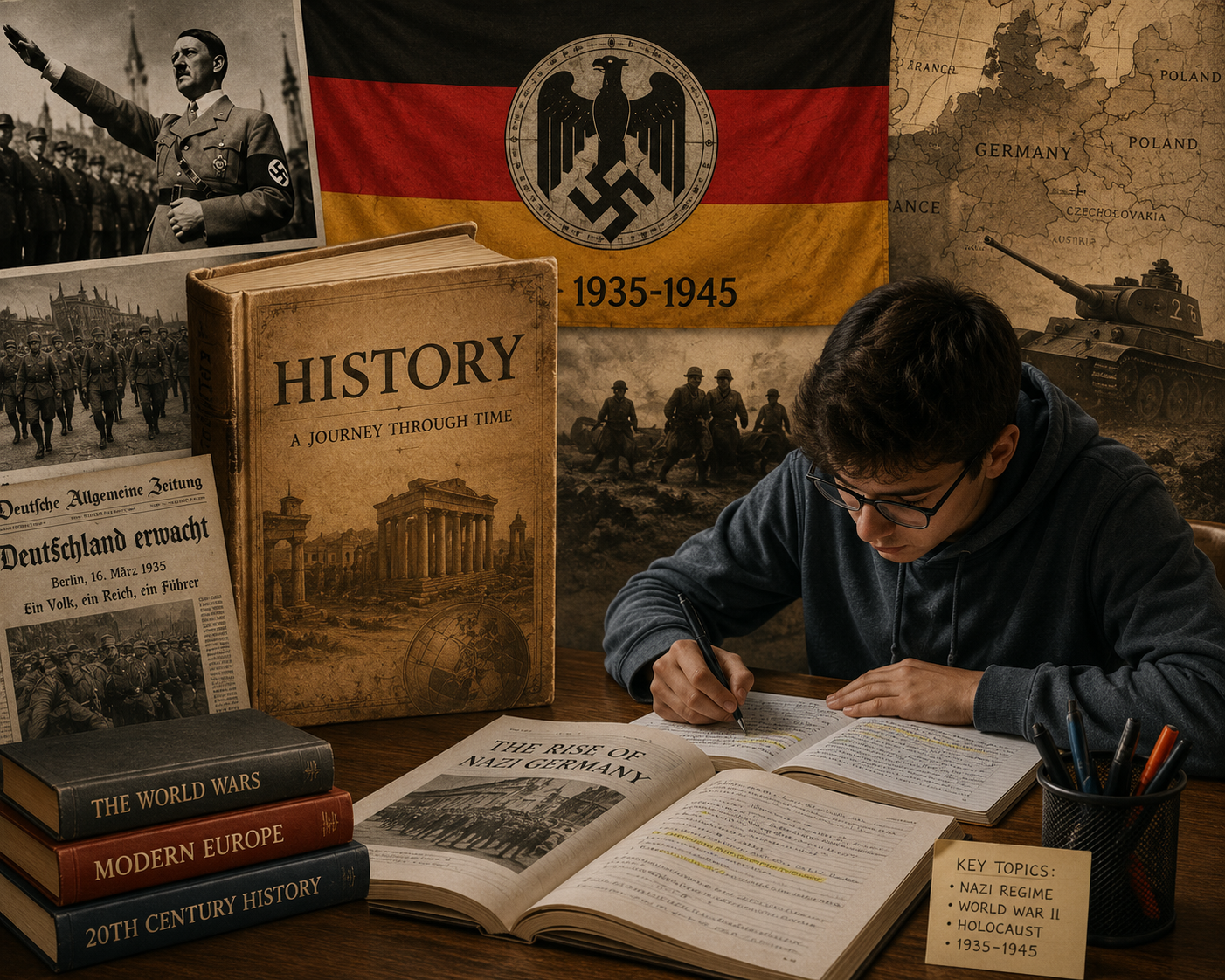
Are you struggling to understand the complex events that led to the rise of Adolf Hitler and the Nazi Party? Do you find the dates and ideologies of World War II confusing? You are not alone. “Nazism and the Rise of Hitler” is one of the most important chapters in your Class 9 History syllabus, and it carries high weightage in UP Board, Bihar Board, MP Board, and RBSE exams.
In this comprehensive guide, we have broken down the chapter into easy-to-digest notes, exam-oriented questions, and memory tricks. Whether you are preparing for your mid-terms or final board exams, these Class 9 History notes will help you score full marks.
Chapter Overview: Nazism and the Rise of Hitler
This chapter deals with the aftermath of World War I in Germany, the collapse of democracy, the rise of the Nazi Party, and the horrific impact of Hitler’s ideology on the world. It explains how a fragile democracy (Weimar Republic) gave way to one of the most brutal dictatorships in human history.
Why is this chapter important for Board Exams?
* High Frequency: Questions about the Treaty of Versailles, the Great Depression, and the Holocaust appear almost every year in UP and Bihar Board exams.
* Conceptual Understanding: It helps you understand how economic crises lead to political instability.
* Source-Based Questions: NCERT frequently uses cartoons and images from this era for competency-based questions.
Historical Background: Birth of the Weimar Republic
After Germany lost World War I (1914-1918), a democratic government was established. This is known as the Weimar Republic.
Features of the Weimar Republic
1. Democratic Constitution: It allowed voting rights for all adults (including women).
2. Weaknesses: The constitution had a fatal flaw. Article 48 gave the President the power to suspend civil rights and rule by decree in an emergency. This loophole would later help Hitler destroy democracy.
The Humiliation of Versailles
The Treaty of Versailles (1919) was harsh on Germany:
* Germany lost its overseas colonies.
* 13% of its territory was taken away.
* Germany had to pay a massive war compensation (₹ 6 billion).
* The army was limited to 100,000 men.
Impact: The German public hated the Weimar politicians for signing this “treaty of disgrace.” This anger created fertile ground for leaders like Hitler, who promised to undo the humiliation.
Detailed Explanation: The Rise of Hitler
1. The Great Depression (1929)
The US economy crashed, affecting the entire world.
* Effect on Germany: The US recalled the loans it had given to Germany under the Dawes Plan.
* Economic Collapse: German industries shut down, workers lost jobs, and inflation skyrocketed.
* Political Impact: People lost faith in democracy. They turned to radical parties like the Nazis (NSDAP) and the Communists.
2. Hitler’s Oratory and Propaganda
Adolf Hitler was a powerful speaker. He promised:
* To build a strong nation.
* To undo the wrongs of Versailles.
* To restore the dignity of the German people.
3. The Burning of the Reichstag (1933)
The Reichstag (German Parliament) building was set on fire. Hitler blamed the Communists.
* The Fire Decree: This gave Hitler the power to arrest without warrant and suppress civil liberties. This was the death knell for German democracy.
4. The Enabling Act (1933)
This Act established dictatorship in Germany. It gave Hitler the power to make laws without the Parliament. The Weimar Republic was officially dead, and the Third Reich began.
Nazi Ideology and Worldview
To score well in your Class 9 board exams, you must understand the core beliefs of the Nazis.
1. Racial Hierarchy
* The Aryans: Nazis believed Germans belonged to a “Master Race” (Aryans) who were tall, blonde, and blue-eyed (Nordic features).
* The Jews: Jews were considered the lowest race and were held responsible for Germany’s problems.
* Others: Poles and Slavs were considered sub-human who must serve the Aryan race.
2. Lebensraum (Living Space)
Hitler believed that new territories must be acquired for settlement. This expansion would displace the local “inferior” population.
3. The Holocaust
The Nazis wanted to create a racial state of pure Germans. They led a systematic mass murder of Jews.
* Ghettoization: Jews were forced to live in segregated areas.
* Gas Chambers: Large killing chambers were built in places like Auschwitz.
* Death Toll: Approximately 6 million Jews were killed.
Important Dates and Events (Timeline)
* 1914-1918: First World War.
* 1919: Treaty of Versailles signed.
* 1933: Hitler becomes Chancellor; Reichstag Fire; Enabling Act passed.
* 1939: Germany invades Poland; Start of World War II.
* 1945: Germany defeated; Hitler commits suicide; End of World War II.
Important Personalities
1. Adolf Hitler: Leader of the Nazi Party (NSDAP) and Chancellor of Germany.
2. Paul von Hindenburg: President of Germany who appointed Hitler as Chancellor.
3. Gustav Stresemann: Foreign Minister who tried to stabilize Germany’s economy (briefly mentioned).
Key Terms and Definitions (Class 9 History Vocabulary)
* Allies: The alliance of Britain, France, Russia, and later the USA.
* Axis Powers: Germany, Italy, and Japan during WWII.
* Reichstag: The German Parliament.
* Genocide: Killing of a large number of people from a particular ethnic group.
* Propaganda: Information used to promote a political cause or point of view (e.g., Nazi films).
* Concentration Camps: Prisons where people were detained and often killed.
* Jungvolk: Nazi organization for children below 14 years of age.
* Hitler Youth: Organization for youth to train them in Nazi ideology.
Important Questions and Answers (Board Exam Focus)
Here we have categorized questions to help you practice for UP Board, Bihar Board, and MP Board exams.
MCQs (Multiple Choice Questions)
Q1. Why did the Treaty of Versailles humiliate Germany?
a) It forced Germany to accept defeat
b) It took away German territories
c) It demanded heavy compensation
d) All of the above
Answer: (d) All of the above
Q2. What was ‘Gleichschaltung’?
a) The policy of shooting enemies
b) The policy of coordination
c) The policy of appeasement
d) The policy of isolation
Answer: (b) The policy of coordination
Q3. Who were called the “November Criminals”?
a) The Communists
b) The Jews
c) The supporters of the Weimar Republic
d) The Nazis
Answer: (c) The supporters of the Weimar Republic
Very Short Answer Questions (2 Marks)
Q1. What was the Dawes Plan?
Answer: The Dawes Plan was a plan where US banks and investors loaned money to Germany to stabilize its economy and pay reparations to Britain and France.
Q2. Define the term “Aryan Race” according to the Nazis.
Answer: The Nazis considered the German Aryan race as the finest (purest) race who had to retain its purity, become stronger, and dominate the world.
Short Answer Questions (3 Marks)
Q1. Explain any three features of the Nazi School System.
Answer:
1. Racial Science: Children were taught to be loyal to Hitler and believe in Nazi racial superiority.
2. Discipline: Boxing was made compulsory to make children aggressive and strong.
3. Ideological Training: Textbooks were rewritten to glorify Nazis and hate Jews.
4. Segregation: Jewish children were not allowed to sit with German children.
Q2. How did the Great Depression contribute to the rise of Hitler?
Answer:
The Great Depression led to the collapse of the German economy. Workers lost jobs, and businesses shut down. The middle class and the poor were filled with fear and anxiety. In this despair, Hitler promised “employment” and a “strong nation.” People voted for the Nazi Party hoping for a better future.
Long Answer Questions (5 Marks)
Q1. Describe the policy of Hitler towards the youth of Germany.
Answer:
Hitler believed that the strength of the Nazi state lay in its children.
1. Organizations: All youth were required to join Nazi youth organizations—Jungvolk (for 10-14 year olds) and Hitler Youth (for 14-18 year olds).
2. Indoctrination: They were taught to hate Jews and worship Hitler.
3. Training: They learned to be violent, dominant, and obey orders blindly.
4. Physical Fitness: Outdoor games and sports were encouraged to build a strong Aryan race.
5. Future Role: These children were the future soldiers of the Nazi army, meant to fight for Hitler’s expansionist policies.
Previous Year Board Questions (Analysis: UP, Bihar, MP Board)
Based on Class 9 History previous year papers, here are the most likely questions for your upcoming board exams:
1. Bihar Board Trend: Often asks about the “Enabling Act” or the “Treaty of Versailles”.
2. UP Board Trend: Focuses on source-based questions interpreting a cartoon or a poster of the Nazi era.
3. MP Board/RBSE Trend: Frequently asks for definitions (e.g., Genocide, Concentration Camps) or the difference between the young and old Germany (Nazi propaganda).
Sample Assertion-Reasoning Question:
Assertion (A): The Nazi regime used modern methods of propaganda.
Reason (R): They wanted to create a consensus among the people regarding their policies.
Answer: Both A and R are true, and R is the correct explanation of A.
Important Exam Notes & Revision Points
* The Holocaust: The Nazis wanted to solve the “Jewish Problem” through mass extermination. Jews were transported to Concentration Camps.
* Women in Nazi Germany: Women were dismissed from respectable jobs and told to become good mothers and bear pure Aryan children.
* Hitler’s War: He invaded Poland in 1939, starting WWII. He later invaded the USSR (Operation Barbarossa), which proved to be a blunder as the harsh winter defeated the German army.
* The End: The USA entered the war, and the Allies pushed back Germany. Hitler committed suicide in his bunker in Berlin in April 1945.
Common Mistakes Students Make in Board Exams
1. Confusing Fascism and Nazism: While similar, Nazism is specific to Germany based on extreme racial theories. Fascism (Mussolini in Italy) was based on the supremacy of the state, not necessarily “race” in the same biological sense.
2. Missing the “Why”: Don’t just memorize dates. In UP and Bihar boards, you get marks for explaining why the Weimar Republic failed, not just when.
3. Spelling Errors: Be careful with words like “Holocaust,” “Auschwitz,” and “Reichstag.”
4. Source Analysis: Students often look at the cartoon image and write a generic answer. Always look for details like “Who is being mocked?” or “What symbols are used?” (e.g., Swastika, Skull, Bones).
Memory Tricks and Mnemonics
Here is a quick trick to remember the causes of Hitler’s rise to power:
Word: G.R.E.A.T.
* Great Depression (Economic crisis).
* Reichstag Fire (Emergency declared).
* Enabling Act (Dictatorship began).
* Army Support (Hindenburg and the Army trusted him).
* Treaty of Versailles (Humiliation and anger).
Chapter Summary: Quick Revision Notes
* Birth of Weimar Republic: Democratic post-WWI Germany, but weak due to Article 48.
* Treaty of Versailles: Humiliated Germany, led to economic misery.
* Hitler’s Rise: Used powerful speeches, Nazi propaganda, and exploited the economic crisis.
* Nazi Ideology: Racial hierarchy (Aryans supreme), hatred for Jews, expansionism (Lebensraum).
* The Holocaust: Systematic mass murder of Jews (6 million).
* World War II: Started with the invasion of Poland (1939). Ended in 1945 with Germany’s defeat.
* Youth & Propaganda: Schools and media were used to brainwash children into loyal Nazis.
Frequently Asked Questions (FAQs)
Q1. Who was Hitler and why is he famous?
Adolf Hitler was the leader of the Nazi Party and the dictator of Germany from 1933 to 1945. He is infamous for starting World War II and the Holocaust, the genocide of millions of Jews.
Q2. What is the Holocaust in Class 9 History?
The Holocaust refers to the systematic, state-sponsored murder of approximately six million Jews by the Nazi regime and its collaborators during World War II.
Q3. Why was the Weimar Republic weak?
It was weak because it was born out of defeat, was burdened by the Treaty of Versailles, had Article 48 (dictatorship clause), and had too many political parties making it unstable.
Q4. How can I get full marks in this chapter?
To score full marks in UP/Bihar/MP Boards:
1. Read the NCERT text thoroughly.
2. Practice the “box questions” (images/cartoons) given in the book.
3. Write dates and definitions clearly in answers.
Q5. Where can I download Nazism and the Rise of Hitler notes PDF?
You can save this page as a PDF or look for educational websites that provide Class 9 History Notes PDF download based on the NCERT syllabus for the 2024-25 session.
Conclusion
“Nazism and the Rise of Hitler” is not just a history lesson; it is a warning about the dangers of unchecked power, racial hatred, and economic desperation. For your Class 9 Board Exams, this chapter is a goldmine for scoring marks if you understand the sequence of events.
Revise the timeline, memorize the key terms, and practice writing long answers regarding Hitler’s policies. Good luck with your studies! You are capable of achieving top marks.