
Introduction
Welcome, young geographers! Have you ever wondered why the weather reporter mentions “maximum” and “minimum” temperatures? Or how scientists know exactly how many millimeters of rain fell during a heavy monsoon downpour?
In the ICSE Class 8 Geography syllabus, understanding the Measurement of Temperature and Rainfall is fundamental. It isn’t just about numbers; it’s about understanding the atmosphere that surrounds us. This chapter is a scoring favorite in exams because it relies on clear concepts and simple instruments. Let’s dive in and turn you into a weather expert!
1. Measurement of Temperature
Temperature refers to the degree of hotness or coldness of the air. In Geography, we don’t just feel the heat; we measure it precisely.
The Six’s Maximum and Minimum Thermometer
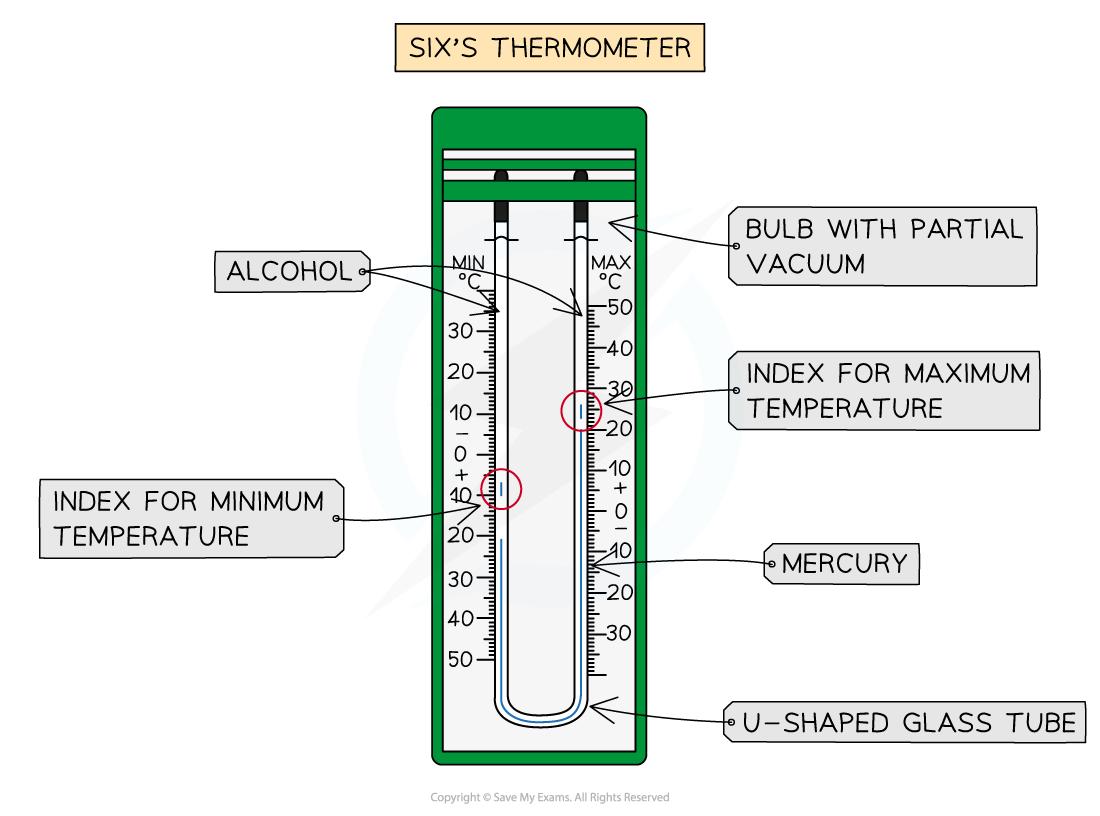
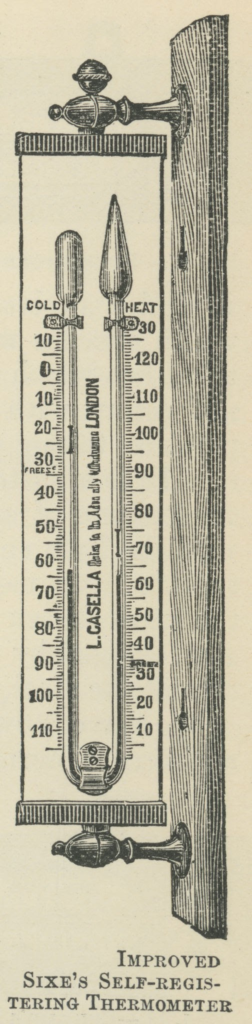
The most important tool for this chapter is the Six’s Thermometer, named after its inventor, James Six. Unlike a clinical thermometer, this “U-shaped” glass tube records the highest and lowest temperatures reached during a 24-hour period.
- How it works: It contains mercury and alcohol. As the temperature rises, the alcohol expands and pushes the mercury up the “Maximum” side. When it cools, the alcohol contracts, and the mercury moves up the “Minimum” side.
- The Indicators: Small metal pieces called indices stay at the highest and lowest points reached, allowing us to read the data even after the temperature changes.
Important Temperature Terms
- Mean Daily Temperature: The average of the maximum and minimum temperatures in 24 hours.$$Mean = \frac{Max + Min}{2}$$
- Diurnal Range of Temperature: The difference between the maximum and minimum temperature of a single day.
- Isotherms: Imaginary lines drawn on a map joining places having the same temperature.
2. Measurement of Rainfall
Rainfall is measured using an instrument called a Rain Gauge.
How a Rain Gauge Works
A standard rain gauge consists of a copper cylinder, a glass bottle, and a funnel.
- The funnel collects the rain and directs it into the bottle.
- The collected water is then poured into a graduated measuring cylinder.
- The reading is usually taken in millimeters (mm) or centimeters (cm).
Placement Tip: To get an accurate reading, a rain gauge must be placed in an open area, away from trees or tall buildings that might block the rain or cause extra drips.
Shutterstock
Explore
Key Rainfall Terms
- Isohyets: Lines on a map connecting places that receive the same amount of rainfall.
- Annual Rainfall: The sum total of rainfall received in all twelve months of a year.
3. The Stevenson Screen
You can’t just leave a thermometer out in the direct sun! To get the “shade temperature,” we use a Stevenson Screen.
- Design: It is a wooden box with louvered (slatted) sides to allow free air circulation while blocking direct sunlight and rain.
- Placement: It is painted white to reflect sunlight and is placed on a stand about 1.25 meters above the ground to avoid heat radiating from the earth.
🔷 Key Points / Revision Notes
- Temperature Unit: Measured in Celsius (°C) or Fahrenheit (°F).
- Rainfall Unit: Measured in millimeters (mm).
- Instrument for Pressure: Barometer (though temperature/rainfall are the focus here).
- Standard Height: Instruments are kept at a specific height to avoid ground interference.
- Mercury: Used in thermometers because it is a good conductor and does not stick to glass.
🔷 Important Questions & Answers
Very Short Answer Questions (1 Mark)
- Name the instrument used to measure maximum and minimum temperature.
- Ans: Six’s Maximum and Minimum Thermometer.
- What are Isotherms?
- Ans: Lines joining places with equal temperature.
- What is the unit for measuring rainfall?
- Ans: Millimeters (mm).
Short Answer Questions (2-3 Marks)
- Why is a Stevenson Screen painted white?
- Ans: It is painted white to reflect solar radiation, ensuring that the thermometers inside measure the actual air temperature (shade temperature) rather than heat from direct sunlight.
- How is the Diurnal Range of temperature calculated?
- Ans: It is calculated by subtracting the minimum temperature from the maximum temperature recorded in a 24-hour period.
Long Answer Questions (5 Marks)
- Describe the construction and working of a Rain Gauge.
- Ans: A rain gauge consists of a metal cylinder containing a glass collecting bottle and a funnel on top. The funnel has a diameter of usually 12.7 cm. Rain falling into the funnel is collected in the bottle. Every 24 hours, this water is poured into a graduated measuring glass. The depth of the water in the cylinder represents the rainfall for that day. It must be placed in an open space to ensure accuracy.
🔷 Most Expected Exam Questions
- Explain the importance of the “Index” in a Six’s Thermometer.
- Differentiate between Isotherms and Isohyets.
- Why is the Stevenson Screen kept 1.2 meters above the ground?
- Calculate the Mean Annual Temperature if the sum of monthly means is 300°C.
- Why is mercury preferred over water in thermometers?
🔷 Quick Revision Cheat Sheet
| Element | Instrument | Unit | Map Line |
| Temperature | Six’s Thermometer | Celsius (°C) | Isotherm |
| Rainfall | Rain Gauge | Millimeters (mm) | Isohyet |
| Air Pressure | Barometer | Millibars (mb) | Isobar |
🔷 Common Mistakes Students Make
- Mixing up Units: Writing “cm” for temperature instead of “°C”.
- Calculation Errors: Forgetting that “Range” is subtraction and “Mean” is addition followed by division.
- Instrument Placement: Thinking the Rain Gauge should be kept under a tree to “protect” it—remember, it needs to be in the open!
- Spelling: Confusing “Isohyet” with “Isotherm.” Remember: Therm = Heat/Temperature.
Conclusion
The Measurement of Temperature and Rainfall is a vital part of your ICSE Class 8 Geography journey. By mastering the instruments and terms like Isotherms and Isohyets, you are well on your way to an A+ in your geography exam.
Pro-Tip: Try drawing the diagrams of the Stevenson Screen and Rain Gauge at least twice before your exam—visuals carry extra weight in Geography!
Keep studying, stay curious, and happy learning!