
Introduction
Hello, young explorers! Have you ever felt a strong breeze while standing on a balcony? Welcome to the invisible but powerful world of Atmospheric Pressure and Winds. In the ICSE Class 8 Geography syllabus, this chapter is a cornerstone of Climatology. Before we dive into the air above us, you might find it helpful to review our notes on the Earth and Moon to understand how rotation affects our planet.
🔷 Main Explanation: Air on the Move
1. What is Atmospheric Pressure?
Air might feel weightless, but it has mass! Atmospheric pressure is the force exerted by the weight of air on the Earth’s surface. It is measured using a Barometer in millibars (mb).
2. Factors Affecting Pressure
Altitude: Pressure decreases as we go higher.
Temperature: Hot air creates Low Pressure (LP); Cold air creates High Pressure (HP).
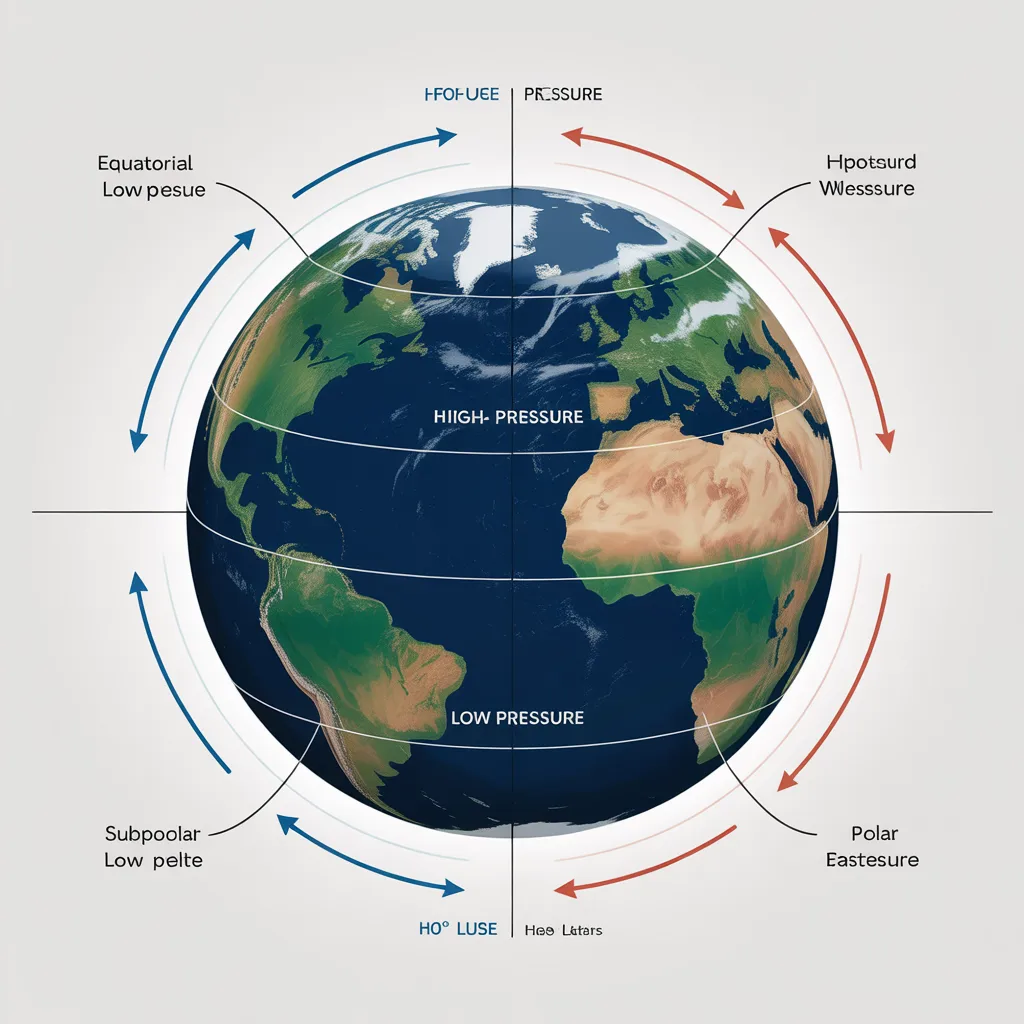
3. World Pressure Belts
Our Earth is divided into distinct zones:
Equatorial Low (Doldrums)
Sub-Tropical High (Horse Latitudes)
Sub-Polar Low
Polar High
🔷 Important Questions & Answers
Practicing the right questions is the key to ICSE exam preparation. Below are some ICSE Geography Important Questions curated for this chapter.
Q: Why is the Equatorial Low called ‘Doldrums’?
Ans: Due to intense heat, air rises vertically, creating a region with very little horizontal wind movement, leading to calm conditions.
🔷 Quick Revision Cheat Sheet
Instrument for Speed: Anemometer.
Instrument for Direction: Wind Vane.
Lines of equal pressure: Isobars.
🔷 Important Questions & Answers
Very Short Answer Questions (1 Mark)
- Name the instrument used to measure maximum and minimum temperature.
- Ans: Six’s Maximum and Minimum Thermometer.
- What are Isotherms?
- Ans: Lines joining places with equal temperature.
- What is the unit for measuring rainfall?
- Ans: Millimeters (mm).
Short Answer Questions (2-3 Marks)
- Why is a Stevenson Screen painted white?
- Ans: It is painted white to reflect solar radiation, ensuring that the thermometers inside measure the actual air temperature (shade temperature) rather than heat from direct sunlight.
- How is the Diurnal Range of temperature calculated?
- Ans: It is calculated by subtracting the minimum temperature from the maximum temperature recorded in a 24-hour period.
Long Answer Questions (5 Marks)
- Describe the construction and working of a Rain Gauge.
- Ans: A rain gauge consists of a metal cylinder containing a glass collecting bottle and a funnel on top. The funnel has a diameter of usually 12.7 cm. Rain falling into the funnel is collected in the bottle. Every 24 hours, this water is poured into a graduated measuring glass. The depth of the water in the cylinder represents the rainfall for that day. It must be placed in an open space to ensure accuracy.
🔷 Most Expected Exam Questions
- Explain the importance of the “Index” in a Six’s Thermometer.
- Differentiate between Isotherms and Isohyets.
- Why is the Stevenson Screen kept 1.2 meters above the ground?
- Calculate the Mean Annual Temperature if the sum of monthly means is 300°C.
- Why is mercury preferred over water in thermometers?