
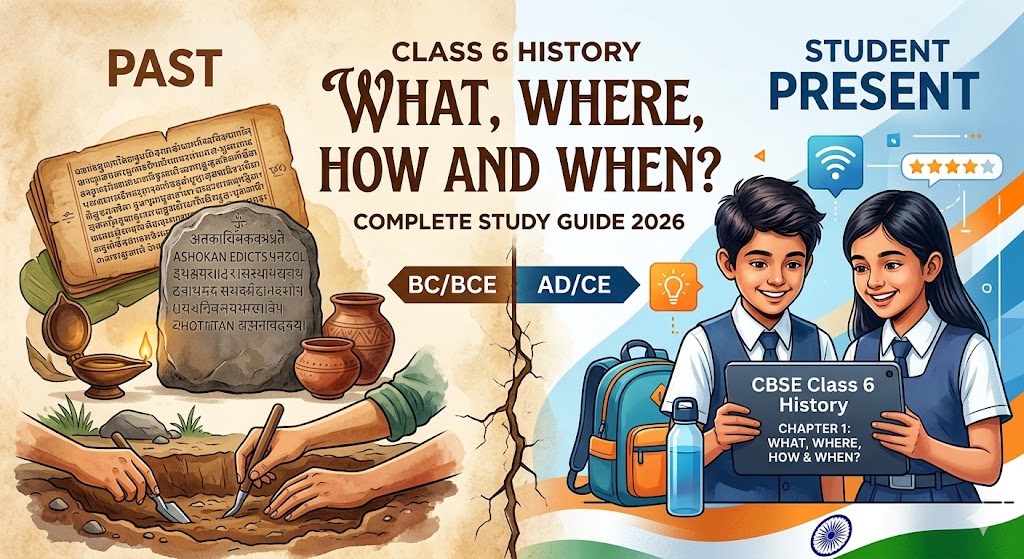
Introduction
Have you ever wondered how people lived thousands of years ago? Without the internet, smartphones, or even paper, how did they survive and communicate? Class 6 History Chapter 1: What, Where, How and When? is your time-traveling portal to the past.
For CBSE students, this chapter is the most critical foundation. It doesn’t just teach facts; it teaches you how to think like a detective. Whether you are preparing for your school unit tests or looking for a complete study guide, this article covers everything from the banks of the Narmada to the secrets of ancient manuscripts.
Chapter Overview
History is not just about memorizing dates; it is the story of human evolution. This chapter explores:
What people ate and wore.
Where they lived (geographic locations).
How we find out about them (archaeology).
When specific events happened (the concept of time).
Historical Background
Human civilization didn’t start in cities. It began with gatherers and hunters. Over thousands of years, humans shifted from moving constantly to settling down, farming, and building the mighty civilizations we read about today. The geography of India—with its vast rivers and mountains—played a starring role in where people chose to build their homes.
Important Dates
Understanding time in History is like using a ruler. We use BC/BCE and AD/CE.
| Time Period | Event / Significance |
| 8000 years ago | Beginning of agriculture (Wheat & Barley) in Sulaiman & Kirthar hills. |
| 4700 years ago | First cities emerged on the banks of the River Indus. |
| 2500 years ago | Cities developed on the banks of the Ganga and its tributaries. |
| 2026 (Present) | Our current year in the Common Era (CE). |
Important Personalities
Archaeologists: The “detectives” of history who study remains, bones, and artifacts.
Historians: Scholars who study the past using information found in “sources.”
Manuscript Writers: Ancient scribes who wrote by hand on palm leaves or birch bark.
Detailed Explanation of the Chapter
1. Where did people live?
Early humans chose locations based on the availability of water and food.
Narmada River: People lived here for several hundred thousand years. They were skilled gatherers who knew about the vast wealth of plants in the surrounding forests.
Sulaiman and Kirthar Hills: Located in the Northwest (modern-day Pakistan), this is where women and men first began to grow crops like wheat and barley about 8,000 years ago.
Garo Hills & Vindhyas: Areas where agriculture developed. Rice was first grown to the north of the Vindhyas.
Indus & its Tributaries: The site of the earliest cities about 4,700 years ago.
Ganga & Son Valley: Later cities developed here around 2,500 years ago. The area south of the Ganga was known as Magadha, a powerful kingdom.
2. How do we know about the past? (Sources of History)
Historians use “clues” to reconstruct the past. These are called Sources.
A. Manuscripts
These were hand-written records.
Material: Usually written on palm leaves or the specially prepared bark of a tree known as the birch (found in the Himalayas).
Subjects: Religious beliefs, lives of kings, medicine, and science.
Languages: Sanskrit, Prakrit (language of common people), and Tamil.
B. Inscriptions
These are writings on relatively hard surfaces such as stone or metal.
Purpose: Kings often kept records of victories in battle or issued orders so that people could see and obey them.
C. Archaeology
Archaeologists study the physical remains:
Objects like pots, pans, ornaments, and weapons.
Remains of buildings made of stone and brick.
Bones of animals, birds, and fish to find out what people ate.
3. One Past or Many?
The title of our book is Our Pasts (plural). This is because the past was different for different groups. The life of a king was very different from the life of a herder or a merchant. Even today, people in the Andaman Islands follow different lives compared to those living in cities.
Timeline Section
8000 BCE: Agriculture starts.
4700 BCE: Early Indus Valley cities.
2500 BCE: Magadha Kingdom and Ganga valley cities.
Current Era: We use AD (Anno Domini) or CE (Common Era).
Important Terms & Definitions
Tributaries: Smaller rivers that flow into a larger river (e.g., Son is a tributary of Ganga).
Archaeology: The study of human history through the excavation of sites and the analysis of artifacts.
Decipherment: The process of understanding and reading ancient scripts (e.g., Rosetta Stone).
Prakrit: A language used by common people in ancient India.
Significance of the Chapter
This chapter is the “Instruction Manual” for History. It teaches us that history is not a static set of stories but a continuous process of discovery. It helps us understand our identity and how our ancestors’ choices shaped our current world.
Important Visual Suggestions
CBSE Board Exam Important Questions
Very Short Answer Questions (1 Mark)
Where was rice first grown?
Ans: North of the Vindhyas.
What is the full form of BCE?
Ans: Before Common Era.
Name the bark used for writing manuscripts.
Ans: Birch bark.
Short Answer Questions (3 Marks)
Distinguish between Manuscripts and Inscriptions.
Ans: Manuscripts are handwritten on soft materials like palm leaves; Inscriptions are engraved on hard surfaces like stone or metal.
Why did hunter-gatherers move from place to place?
Ans: In search of food, following animal movements, and seeking seasonal fruits and water.
Long Answer Questions (5 Marks)
How do archaeologists help us in knowing about the past? Explain with examples.
Ans: Discuss excavation, studying artifacts (pots/tools), and analyzing biological remains (bones/seeds).
MCQs with Answers
Magadha was located in the bank of:
a) Indus
b) Narmada
c) Ganga (Answer)
d) Godavari
Common Mistakes Students Make
Confusing BC and AD: Remember, BC counts backward, AD counts forward.
Mixing up Tributaries: Don’t confuse the main river with its branches.
Ignoring Maps: Many students skip the map work, but CBSE often asks location-based questions.
Smart Revision Notes (Mnemonics)
M-I-N-T: To remember sources: Manuscripts, Inscriptions, Narratives (Stories), Tools (Archaeology).
Agriculture Tip: Sulaiman = Sheep/Goat (Animal rearing started here too).
Frequently Asked Questions (FAQs)
Q: Why is India called Bharat?
A: The name Bharata was used for a group of people who lived in the northwest, mentioned in the Rigveda.
Q: What do dates mean in history?
A: Dates help us sequence events. 2000 BC means 2000 years before the birth of Christ.
Conclusion
History is your superpower. By understanding What, Where, How and When, you aren’t just learning for an exam; you are learning the story of you. Keep questioning, keep exploring, and remember—every object around you today will be an “artifact” for someone in the future!