
Introduction
Hey there, future astronomers! Have you ever looked up at the night sky and wondered about the vast neighborhood our Earth lives in? In the ICSE Class 8 Geography syllabus, “The Solar System” is one of the most fascinating chapters you will encounter.
Understanding our celestial backyard isn’t just about memorizing the names of planets; it’s about understanding the forces that keep our world in balance. This chapter is a high-scoring section in your ICSE exam preparation, and this guide is designed to help you ace it with ease.
🔷 Main Explanation: Our Celestial Neighborhood
1. What is the Solar System?
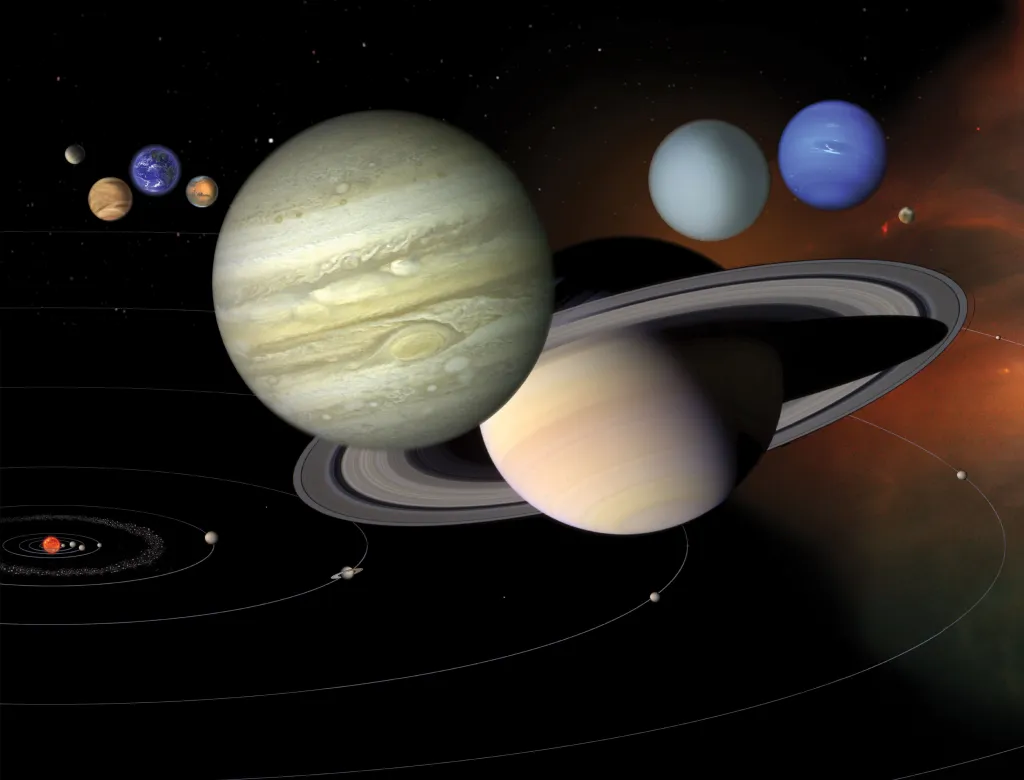
The Solar System consists of the Sun at its center, eight major planets, their moons (satellites), dwarf planets, asteroids, comets, and meteoroids. Everything in the system is bound together by the Sun’s massive gravitational pull.
2. The Sun: The Ultimate Powerhouse
The Sun is a medium-sized star that accounts for about 99.8% of the total mass of the solar system.
Composition: Primarily Hydrogen and Helium.
Energy Source: Nuclear fusion.
Importance: It provides the light and heat necessary for life on Earth and keeps all celestial bodies in their respective orbits.
3. The Eight Planets
The planets are divided into two distinct groups:
A. Inner Planets (Terrestrial Planets)
These are Mercury, Venus, Earth, and Mars.
They are made of rock and metal.
They have solid surfaces and few or no moons.
Earth: The only planet known to support life, often called the “Blue Planet.”
B. Outer Planets (Jovian Planets/Gas Giants)
These are Jupiter, Saturn, Uranus, and Neptune.
They are composed mostly of gases (Hydrogen and Helium) or ices.
They are much larger than the inner planets and have ring systems and many moons.
Jupiter: The largest planet, famous for its “Great Red Spot.”
4. Other Celestial Bodies
The Solar System consists of the Sun at its center, eight major planets, their moons, and various small bodies. To see high-definition images and real-time data on these planets, you can explore NASA’s Solar System Exploration page, which brings these distant worlds to life.
Satellites: Natural bodies that orbit planets (e.g., our Moon).
Asteroids: Small, rocky objects found mostly in the Asteroid Belt between Mars and Jupiter.
Comets: “Dirty snowballs” made of ice and dust that develop a glowing tail when they get close to the Sun.
Meteoroids, Meteors, and Meteorites: Rocks traveling through space. A “shooting star” is actually a meteor burning up in Earth’s atmosphere.
🔷 Key Points / Revision Notes
Orbits: The elliptical paths followed by planets around the Sun.
Rotation: The spinning of a planet on its axis (causes day and night).
Revolution: The movement of a planet around the Sun (causes years/seasons).
Goldilocks Zone: The habitable zone around a star where the temperature is just right for liquid water to exist.
Kuiper Belt: A region beyond Neptune filled with icy objects and dwarf planets like Pluto.
These revision notes are designed to help you memorize facts quickly. For a deeper dive into other chapters, make sure to check out our comprehensive Class 8 Geography Study Material, which covers the entire ICSE syllabus in detail.
🔷 Important Questions & Answers Section
Very Short Answer Questions (1 Mark)
Which planet is known as the “Evening Star”?
Ans: Venus.
What is the distance of the Earth from the Sun?
Ans: Approximately 150 million kilometers.
Name the largest satellite in the Solar System.
Ans: Ganymede (Moon of Jupiter).
Short Answer Questions (3 Marks)
Why is Venus the hottest planet even though Mercury is closer to the Sun?
Ans: Venus has a very thick atmosphere composed mainly of Carbon Dioxide, which traps heat through an extreme Greenhouse Effect, making it hotter than Mercury.
Define the Asteroid Belt.
Ans: The Asteroid Belt is a wide region located between the orbits of Mars and Jupiter that contains millions of irregularly shaped rocky bodies called asteroids.
Long Answer Questions (5 Marks)
Differentiate between Inner and Outer Planets.
Ans:
Composition: Inner planets are rocky; Outer planets are gaseous/icy.
Size: Inner planets are small; Outer planets are massive.
Rings: Inner planets have no rings; Outer planets have prominent ring systems.
Moons: Inner planets have very few moons (0–2); Outer planets have dozens of moons.
Explain the importance of the Sun in the Solar System.
Ans: The Sun is the primary source of energy. It provides heat and light, which are essential for photosynthesis and the survival of life on Earth. Its massive gravity keeps the planets in stable orbits, preventing them from drifting into deep space.
🔷 “Most Expected Exam Questions”
Explain why Earth is called a “Unique Planet.”
Describe the three layers of the Sun’s atmosphere.
What is a light-year and how is it used in Geography?
Compare and contrast Meteors and Meteorites.
Why was Pluto reclassified as a “Dwarf Planet”?
Explain the formation of a Comet’s tail.
🔷 Quick Revision Cheat Sheet
Hottest Planet: Venus
Coldest Planet: Neptune
Largest Planet: Jupiter
Smallest Planet: Mercury
Red Planet: Mars
Fastest Revolution: Mercury (88 days)
Slowest Revolution: Neptune (Approx 165 years)
🔷 Common Mistakes Students Make
Order of Planets: Students often swap Neptune and Uranus. Remember the mnemonic: My Very Educated Mother Just Served Us Noodles.
Rotation vs. Revolution: Confusing the two is common. Rotation = Spin (Day); Revolution = Orbit (Year).
Meteoroids vs. Meteors: A Meteor is only a meteor when it enters the atmosphere and glows. If it hits the ground, it’s a Meteorite.
Conclusion
The Solar System is a vast and beautiful subject. By mastering these ICSE Class 8 Geography notes, you are not just preparing for an exam, but gaining a better understanding of our place in the universe.
Expert Tip: For your Class 8 Geography explanation in exams, always try to draw small diagrams of orbits or planet structures to show the examiner you really know your stuff!
Keep reaching for the stars!