
Introduction
Hey students! 👋 Have you ever wondered how your grandparents or parents lived when they were young? Now imagine going back 12,000 years – no mobile phones, no schools, no markets, no wheat fields, no pet dogs, and no cities. Shocking, right?
Chapter 2 – “From Hunting–Gathering to Growing Food” is one of the most important chapters in your Class 6 History syllabus. Why? Because it tells the greatest story of human change – how our ancestors stopped running behind animals and started growing their own food. This shift changed everything: villages were born, animals became friends (not just food), and human civilization actually began.
This chapter is extremely important for all NCERT-based exams – CBSE, UP Board, Bihar Board (BSEB), Rajasthan Board (RBSE), MP Board, Jharkhand, Haryana, and all other Hindi Belt state boards. Every year, questions appear from:
- Domestication (what is it? why important?)
- Neolithic Age tools and discoveries
- Mehrgarh (one of the earliest villages)
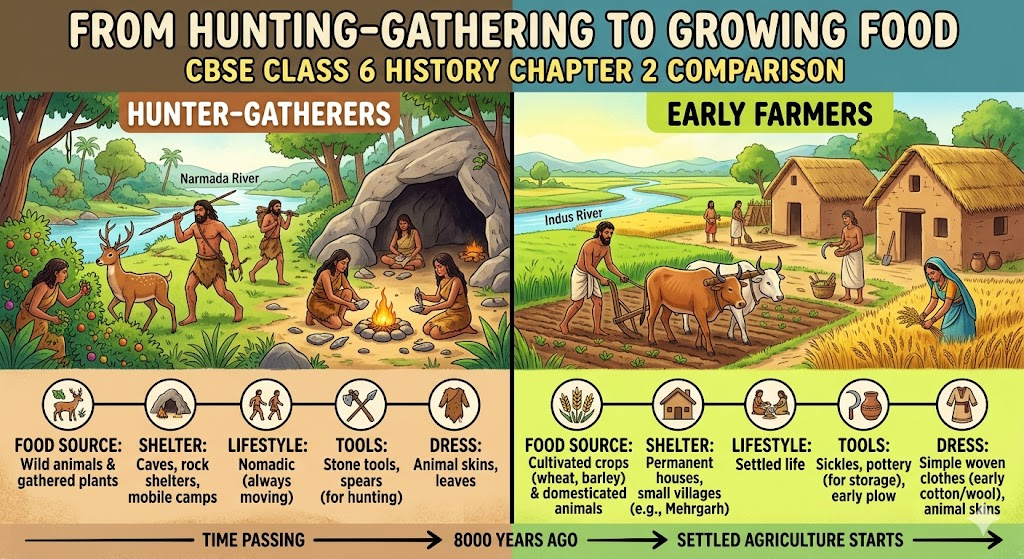
- Differences between hunter-gatherers and farmers
- Causes of the agricultural revolution
This all-in-one guide gives you NCERT-based notes, exam-style Q&A, MCQs, revision tricks, previous year trends, and board-wise focus. Let’s dive in!
Chapter Overview
| Aspect | Details |
|---|---|
| Chapter Name | From Hunting–Gathering to Growing Food |
| Chapter Number | 2 (NCERT Our Pasts – I) |
| Time Period | Approx. 12,000 years ago to 4,000 years ago |
| Main Theme | Transition from Paleolithic to Neolithic Age |
| Key Concepts | Domestication, herding, farming, Neolithic tools, Mehrgarh, Burzahom, Daojali Hading |
| Exam Weightage | High – MCQs, short & long answers, source-based questions |
| Boards | CBSE, UP Board, Bihar Board, RBSE, MPBSE, JAC, CGBSE, Haryana, Himachal, Uttarakhand |
Historical Background
For millions of years, humans lived as hunter-gatherers. They:
- Ate wild fruits, nuts, roots, and meat from hunting animals
- Moved from place to place (nomadic life)
- Lived in caves or temporary shelters
- Used stone tools (Paleolithic Age)
Then, around 12,000 years ago, the climate began to change. The earth became warmer. Grasses like wheat and barley started growing in large amounts. People noticed that seeds thrown on the ground grew into new plants. This was the beginning of farming.
At the same time, some animals like wild sheep, goats, cattle, and pigs started living closer to human camps. People realized that keeping them alive (instead of killing all at once) gave them regular milk, meat, and wool. This was domestication.
These twin revolutions – farming and herding – changed everything. This period is called the Neolithic Age (New Stone Age).
Important Dates
| Event | Approximate Time |
|---|---|
| Beginning of domestication | Around 12,000 years ago |
| Earliest known village (Mehrgarh) | Around 8,000 years ago |
| Burzahom settlement (Kashmir) | Around 4,700 years ago |
| Daojali Hading (Assam) | Around 2,500 years ago |
⏰ Memory Trick: “Mehrgarh = 8000 years ago” – Think: Mehrgarh has 8 letters? No – just remember: 8,000 = Eight thousand = M E H R G A R H (8 letters? Actually 8! M-e-h-r-g-a-r-h = 8 letters) ✅
Important Events
- Climate change after Ice Age → warmer conditions
- Wild grains (wheat, barley) grew naturally
- Humans observed seed germination
- Deliberate farming began
- Domestication of sheep, goat, cattle, pig
- Permanent villages emerged
- New stone tools (polished axes, mortars, pestles)
- Pottery invented for storing grains and cooking
- Weaving and clothing developed
- Burial practices showed social differences
Important Personalities (No specific historical figures – but key sites & discoverers)
| Site / Person | Role |
|---|---|
| V. Gordon Childe | Coined term “Neolithic Revolution” |
| Mehrgarh (Pakistan) | Earliest farming village in South Asia |
| Burzahom (Kashmir) | Pit-dwellings, buried dogs with humans |
| Daojali Hading (Assam) | Stone tools, pottery, jadeite evidence |
| Koldihwa (UP) | Earliest rice evidence in India |
Detailed Explanation of the Chapter
1. Who were Hunter-Gatherers?
Hunter-gatherers were people who:
- Hunted wild animals (deer, bison, boar)
- Gathered wild fruits, berries, nuts, seeds, roots
- Caught fish and birds
- Had no permanent home – moved every few weeks
Why did they move?
- Animals moved away – they followed them
- Plants/fruits got over in one area
- Different seasons had different foods
- Water sources dried up in summers
Tools they used: Hand axes, cleavers, scrapers, bone needles, spear throwers (all stone or bone).
2. Why Did Farming Begin?
Around 12,000 years ago, the world became warmer after the Ice Age. New grasses like wheat and barley grew in large wild fields.
Accidental discovery: People saw that grains falling near their camps grew into new plants. This idea spread – and soon people started deliberately sowing seeds.
Why farming was better?
- Steady food supply
- No need to move constantly
- Could feed more people
- Extra food could be stored for winter or bad times
3. What is Domestication?
Domestication = Taming wild animals and plants for human use.
Animal Domestication:
First domesticated animals (around 12,000–10,000 years ago):
- Sheep and goats (for meat, milk, wool/hair)
- Cattle (milk, meat, ploughing later)
- Pigs (meat)
- Dogs (hunting companions – domesticated earlier)
🐕 Dog fact: Dogs were probably the first domesticated animal – they helped in hunting and guarding camps.
Plant Domestication:
- Wheat, barley (Middle East & Mehrgarh area)
- Rice (Koldihwa, UP, India)
- Millet, pulses (grams, lentils)
Effects of Domestication:
- ✅ Regular food
- ✅ Permanent settlements
- ✅ Population growth
- ✅ New jobs (potters, weavers, tool makers)
- ✅ Trade between villages
4. The Neolithic Age (New Stone Age)
| Feature | Paleolithic (Old Stone Age) | Neolithic (New Stone Age) |
|---|---|---|
| Lifestyle | Nomadic (moving) | Settled (villages) |
| Food | Hunting + gathering | Farming + herding |
| Tools | Rough, chipped stones | Polished, sharp, specialized |
| Shelter | Caves, rock shelters | Mud-brick houses, pit-houses |
| Pottery | No | Yes – for storage & cooking |
| Society | Small groups (20–50 people) | Larger villages (100–500+) |
New Stone Tools:
- Polished axes (cutting trees, clearing land)
- Mortars and pestles (grinding grains)
- Sickles (harvesting crops)
- Bone needles (sewing clothes)
- Fishing hooks
5. How Did People Live in Neolithic Villages?
Houses:
- Rectangular or circular mud-brick houses
- Pit-houses (Burzahom, Kashmir) – dug into ground with steps, warm in winter
- Thatched roofs
Food:
- Grew: wheat, barley, rice, millet, pulses
- Domestic animals: sheep, goat, cattle, pig
- Also hunted and gathered wild foods
Daily Life:
- Women ground grain on stone slabs (called grinding stones)
- Men tended animals and cleared fields
- Both worked in fields
- Children collected firewood, water
Crafts:
- Pottery – clay pots baked in fire, used for cooking, storing grain, water
- Weaving – cloth from wool, cotton? (cotton came later)
- Bead-making – from shell, bone, stone
6. Finding Out About Early Farmers – Archaeological Evidence
Archaeologists find traces of the past:
| Find | What it tells us |
|---|---|
| Charred seeds | What crops they grew |
| Bones of animals (wild vs domesticated) | Which animals they herded/hunted |
| Tools (sickles, mortars) | Farming practiced |
| Pottery with grain impressions | Storage of grains |
| House remains | Permanent settlement |
| Burials | Beliefs, social differences |
Important Neolithic Sites in India & Pakistan:
| Site | Location | Key Findings |
|---|---|---|
| Mehrgarh | Balochistan (now Pakistan) | Earliest village (8000 yrs ago), wheat, barley, sheep, goats, mud-brick houses, burials with goats |
| Burzahom | Kashmir | Pit-houses, buried dogs with humans, bone tools, red pottery |
| Daojali Hading | Assam (hills) | Stone tools, pottery, jadeite (from China – trade!) |
| Koldihwa | Uttar Pradesh | Earliest rice in India |
| Chirand | Bihar | Neolithic settlement, bone tools |
| Gufkral | Kashmir | Pit-houses, early farming |
7. Mehrgarh – Our Best Example
Mehrgarh (in present-day Pakistan) is one of the earliest villages in South Asia (8000 years ago).
What did they have?
- Square/rectangular mud-brick houses with 4–6 rooms
- Storage pits for grain
- Domesticated wheat, barley, sheep, goat, cattle
- Polished stone tools, bone tools
- Female figurines (probably mother goddess worship)
- Burials – bodies laid with goats, tools, beads (belief in afterlife?)
Why Mehrgarh is important? It shows a continuous history from early village farming to later Indus Valley Civilization.
8. Burzahom – Pit-House Dwellers
Burzahom (means “place of birch trees”) in Kashmir is unique.
Features:
- Pit-houses – dug 1–2 meters deep, steps leading down
- Warm in extreme cold
- Dogs buried with their masters (special bond)
- Bone tools, red pottery, stone axes
- Later period – mud-brick houses above ground
9. Daojali Hading – Hills and Forests
This site in Assam (North-East India) shows that Neolithic culture also spread to hilly areas.
Finds:
- Stone tools (polished axes, adzes)
- Pottery
- Jadeite (a green stone) – not found locally, so must have come from China or Central Asia – proof of long-distance trade.
Timeline Section
12,000 years ago  →  Climate warms, wild grasses spread
10,000–8,000 YA   →  Domestication begins (sheep, goat, wheat, barley)
8,000 YA          →  Mehrgarh village established
7,000 YA          →  Burzahom pit-houses (Kashmir)
6,000–4,000 YA    →  Farming spreads across India
4,500 YA          →  Daojali Hading (Assam)
Important Terms & Definitions
| Term | Definition |
|---|---|
| Hunter-Gatherers | People who survive by hunting animals and gathering wild plants |
| Domestication | Taming wild plants/animals for human use |
| Neolithic Age | New Stone Age – period of farming, herding, polished tools |
| Paleolithic Age | Old Stone Age – period of hunting-gathering, chipped tools |
| Mesolithic Age | Middle Stone Age (transition phase, not in detail here) |
| Grinding Stone | Stone slab used to crush grains into flour |
| Mortar & Pestle | Bowl-shaped stone (mortar) and crushing stone (pestle) |
| Sickle | Curved stone/blade tool for harvesting crops |
| Polished Axe | Axe ground smooth – used to clear forests for farming |
| Pit-House | House dug into ground with steps – warm in cold climates |
| Jadeite | Precious green stone – used for ornaments, traded long-distance |
Causes and Effects of the Neolithic Revolution
| Causes | Effects |
|---|---|
| Climate change (warmer after Ice Age) | New plants (wheat, barley) grew naturally |
| Population increase | Need for more reliable food |
| Observation of seed growth | Invention of farming |
| Wild animals became less fearful | Domestication of animals |
| Need for storage | Invention of pottery and granaries |
| Permanent food surplus | Villages, population growth, trade, specialized work |
Significance of the Chapter
This chapter is NOT just history – it is the story of YOU. Every time you eat roti, dal, rice, or milk your cow/buffalo, or pet a dog – you are living the Neolithic Revolution.
Why boards love this chapter:
- Connects geography (river valleys, climate) with history
- Compares hunting vs farming lifestyles
- Introduces archaeological evidence (how do we know?)
- Easy to make MCQs and short answers
- Links to Indus Valley Civilization (next chapter)
Board-Wise Exam Focus
| Board | Most Important Topics |
|---|---|
| CBSE | Domestication definition, Mehrgarh, differences between Paleolithic & Neolithic, reasons for moving from hunting to farming |
| UP Board | Neolithic tools, Burzahom pit-houses, causes of domestication |
| Bihar Board (BSEB) | Mehrgarh (location & findings), animal domestication list, advantages of farming over hunting |
| RBSE (Rajasthan) | Neolithic sites in India, difference between hunter-gatherers & farmers |
| MPBSE | What is domestication? Tools of Neolithic Age, Koldihwa rice evidence |
| JAC (Jharkhand) | Daojali Hading findings, stone tools, jadeite trade |
| All Boards Common | Define domestication (3 marks), why did people move? (2 marks), name any two Neolithic sites (1 mark) |
Important Maps / Visual Suggestions
Images to include in your notes/book:
- Map showing Neolithic sites – Mark: Mehrgarh, Burzahom, Daojali Hading, Koldihwa, Chirand
- Comparison chart – Hunter-Gatherer vs Farmer (pictures: cave vs mud house, hand axe vs polished axe)
- Neolithic tools diagram – Label: polished axe, sickle, mortar & pestle, grinding stone
- Mehrgarh village reconstruction – Mud-brick houses, storage pits, people grinding grain
- Burzahom pit-house cross-section – Steps leading down, hearth inside
- Domesticated animals – Sheep, goat, cattle, pig, dog (with wild ancestors on other side)
- Pottery evolution – From plain handmade to painted pottery
- Timeline chart – 12,000 ya to 4,000 ya (color-coded)
Board Exam Important Questions
Very Short Answer Questions (1 Mark)
- Q: What does “domestication” mean?
A: Taming of wild plants and animals for human use. - Q: Name any two Neolithic tools.
A: Polished axe and sickle. - Q: Where is Mehrgarh located?
A: In present-day Pakistan (Balochistan). - Q: What were pit-houses?
A: Houses dug into the ground with steps – found in Burzahom. - Q: Which grain was found at Koldihwa (UP)?
A: Rice. - Q: Write the full form of “YA” used in dates.
A: Years Ago. - Q: What is a mortar and pestle used for?
A: Grinding grains.
Short Answer Questions (3 Marks)
- Q: Why did hunter-gatherers move from place to place? Give three reasons.
A: (1) Animals moved away (2) Plants became scarce (3) Water sources dried up seasonally. - Q: How did domestication lead to village life?
A: Domestication gave regular food → people didn’t need to move → built permanent houses → villages formed → population grew. - Q: What evidence tells us that Mehrgarh people grew crops?
A: Archaeologists found charred seeds of wheat and barley, and storage pits in houses.
Long Answer Questions (5 Marks)
- Q: Compare the lifestyle of hunter-gatherers and early farmers.
A: (Write in table form)Aspect Hunter-Gatherers Early Farmers Movement Nomadic Settled Food Wild animals & plants Domesticated crops & animals Tools Chipped stone Polished stone Shelter Caves, rock shelters Mud-brick houses, pit-houses Storage No Yes (pottery, pits) - Q: Describe the findings at Mehrgarh that show it was an early farming village.
A: Mehrgarh (8000 years ago) had:- Mud-brick houses (4–6 rooms)
- Storage pits for grain
- Charred seeds of wheat and barley
- Bones of domesticated sheep, goat, cattle
- Polished stone tools & bone tools
- Burials with goats and tools (belief in afterlife)
Competency-Based Questions
- Q: “Farming was a better way of life than hunting-gathering.” Do you agree? Justify.
A: Yes – farming gave regular food, allowed permanent homes, larger families, stored food for bad times, and led to villages and trade. - Q: If you lived 10,000 years ago, would you choose to be a hunter-gatherer or a farmer? Why?
A: (Open-ended) Farmer – safer food supply, don’t have to walk long distances, can live with family.
Assertion and Reason Questions
- Assertion (A): Hunter-gatherers moved frequently.
Reason (R): Animals and plants were not available in the same place all year.
Answer: Both A and R are true, and R is the correct explanation of A. - Assertion (A): Mehrgarh is one of the earliest villages in South Asia.
Reason (R): It had mud-brick houses, storage pits, and domesticated plants/animals.
Answer: Both A and R are true, and R supports A.
Source-Based (Picture/Passage) Question
Passage:
“At Mehrgarh, archaeologists found square and rectangular houses made of mud-brick. Each house had 4–6 rooms. In some houses, they found storage pits filled with charred grains of wheat and barley.”
Q1: What were houses made of?
A: Mud-brick.
Q2: How do we know they stored grains?
A: Storage pits with charred grains.
Q3: Name the grains found.
A: Wheat and barley.
MCQs with Answers
- Which animal was domesticated first?
a) Cow b) Dog c) Goat d) Pig
Ans: b) Dog - Daojali Hading is in which state?
a) Kashmir b) Bihar c) Assam d) UP
Ans: c) Assam - What is jadeite?
a) A tool b) A green stone c) A grain d) A house type
Ans: b) A green stone - Which site has pit-houses?
a) Mehrgarh b) Burzahom c) Daojali Hading d) Koldihwa
Ans: b) Burzahom - The word “Neolithic” means:
a) Old Stone b) New Stone c) Middle Stone d) Metal
Ans: b) New Stone
HOTS Questions (Higher Order Thinking)
- What if farming had never been discovered?
Hint: Humans would still be hunter-gatherers – no cities, no schools, no technology. - Why did people in Burzahom build pit-houses?
Ans: To protect from extreme cold of Kashmir winters.
Case Study Question
Case Study – Mehrgarh Burials:
At Mehrgarh, bodies were buried with goats, stone tools, and bead necklaces. One burial had 8 goats placed around the body.
Q1: What does this suggest about their belief system?
A: They believed in an afterlife – the person would need animals and tools.
Q2: Why were goats chosen?
A: Goats were domesticated and valuable – a sign of wealth or love.
Q3: How does this differ from hunter-gatherer burials?
A: Hunter-gatherers buried with fewer items; farmers showed social differences.
Previous Year Question Trends (Across NCERT Boards)
| Question Type | Frequency | Example Boards |
|---|---|---|
| Define domestication | Every year | CBSE, UP, Bihar, Rajasthan |
| Two differences: hunter-gatherers vs farmers | Very common | All boards |
| Name two Neolithic sites with locations | Very common | MP, Bihar, UP, CBSE |
| What were pit-houses? | Often | JAC, Himachal, Uttarakhand |
| Mehrgarh findings (3–5 points) | Often | CBSE, Bihar, Rajasthan |
| Neolithic tools names | Often | All boards |
| Why did people move? (3 reasons) | Common | UP, MP, Haryana |
| Daojali Hading special find (jadeite) | Occasionally | Assam, Jharkhand, CBSE |
Common Mistakes Students Make
❌ Mistake 1: Writing “Neolithic” as “Neolitic” or “Niolithic” – spell carefully!
✅ Correction: N-E-O-L-I-T-H-I-C
❌ Mistake 2: Confusing Mehrgarh location (present-day Pakistan, not India)
✅ Correction: In exams, write “present-day Pakistan” – shows accuracy.
❌ Mistake 3: Saying “domestication means keeping animals at home” – incomplete
✅ Correction: Domestication = taming PLUS breeding for human use (plants + animals)
❌ Mistake 4: Forgetting