
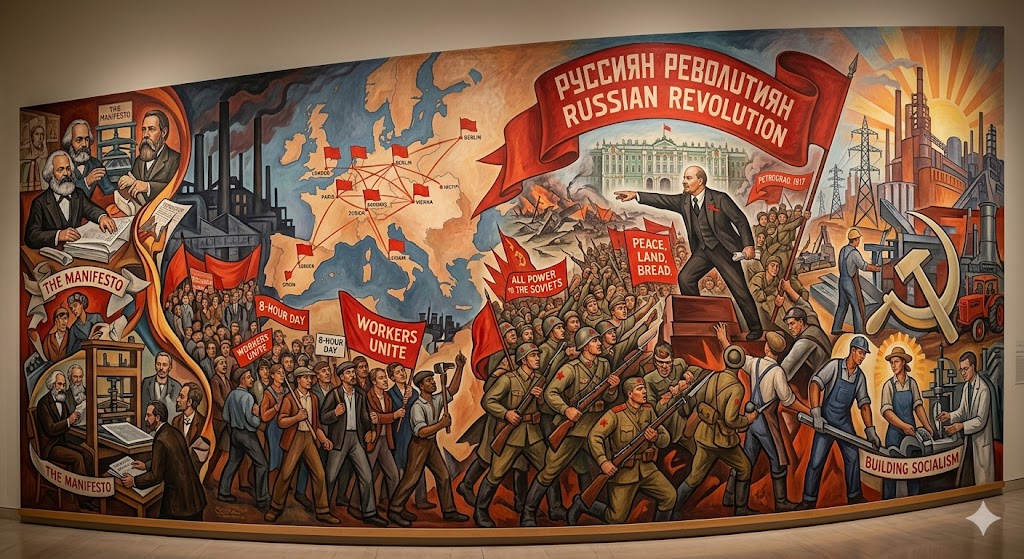
If you are a Class 9 student preparing for your History board exams under UP Board, Bihar Board, RBSE (Rajasthan), MP Board, Jharkhand Board, Chhattisgarh Board, Haryana Board, or Uttarakhand Board, this comprehensive guide on Socialism in Europe and the Russian Revolution is exactly what you need. This chapter (History Chapter 2) is not just a syllabus requirement—it is a gateway to understanding how the modern world was shaped by revolutionary ideas.
Why is this chapter important for your board exam? Every year, questions from Class 9 History Chapter 2 appear in board papers as short answers, long answers, MCQs, and source-based questions. Understanding the Russian Revolution of 1917, the rise of socialism in Europe, and the differences between Bolsheviks and Mensheviks can easily fetch you full marks.
In this 3000+ word SEO-optimized guide, we cover everything: chapter overview, timelines, key personalities, causes and effects, important questions and answers, previous year board questions, memory tricks, and quick revision notes. Let’s dive in!
Chapter Overview: Socialism in Europe and the Russian Revolution Class 9
Socialism in Europe and the Russian Revolution introduces students to the Age of Social Change in 19th-century Europe. It explains how the French Revolution sparked debates about individual rights and societal transformation. The chapter then focuses on three major political groups—Liberals, Radicals, and Conservatives—and their visions for society.
The core of the chapter shifts to Russia, exploring why the Russian Revolution of 1917 happened, how the Bolsheviks under Lenin seized power, and what changes the new Soviet government introduced. From Bloody Sunday (1905) to the October Revolution, from the Duma to Stalin’s Collectivisation, this chapter is packed with high-weightage topics for your Class 9 board exam 2026.
Historical Background: The Age of Social Change
The French Revolution and Its Impact
The French Revolution (1789) opened up the possibility of dramatic social change. People across Europe began questioning the traditional structures of society where the nobility and church controlled power. However, not everyone wanted complete transformation.
Three Political Groups in 19th Century Europe
| Group | Key Beliefs | View on Change |
|---|---|---|
| Liberals | Wanted religious tolerance, elected parliamentary government, independent judiciary | Wanted change but not universal adult franchise; only men of property should vote |
| Radicals | Wanted government based on majority of population, supported women’s suffrage | Wanted rapid change, opposed privileges of wealthy landowners |
| Conservatives | Respected past traditions, believed in slow, gradual change | Opposed radicals and liberals initially; later accepted inevitable change |
Important for Exams: Liberals were not democrats—they did not believe in universal voting rights. Radicals supported women’s suffragette movements. Conservatives believed the past must be respected even while accepting change.
The Industrial Revolution and Social Change
The Industrial Revolution transformed European society. New cities emerged, railways expanded, and factories became centers of employment. However, this progress came at a human cost:
- Long working hours (often 12-14 hours daily)
- Poor wages and unsafe conditions
- Child labor in factories and mines
- Unemployment during economic slowdowns
Liberals and Radicals who owned factories believed that if individuals had freedom and the poor could work, society would develop. However, Socialists disagreed fundamentally.
Socialism in Europe: Key Thinkers and Ideas
What Did Socialists Believe?
Socialists were against private property, viewing it as the root of all social evils. They believed in cooperatives where people worked collectively and shared profits.
Major Socialists of the 19th Century
| Socialist | Contribution |
|---|---|
| Robert Owen | Built cooperative community called ‘New Harmony’; believed in individual initiative for cooperatives |
| Louis Blanc | Wanted government to encourage cooperatives to replace capitalist enterprises; guaranteed employment for urban poor |
| Karl Marx & Friedrich Engels | Authors of ‘The Communist Manifesto’; argued industrial society = capitalist society; predicted socialist revolution by workers |
Karl Marx (1818-1883) is considered the father of Communism. He believed that a socialist society would free workers from capitalism, leading to a classless communist society with collective ownership of land and factories.
Support for Socialism Grows
By the late 19th century:
- Workers in Germany formed associations linked to the Social Democratic Party (SPD)
- In Britain, the Labour Party was formed (1905)
- In France, the Socialist Party emerged
- The Second International (1889) coordinated socialist efforts across Europe
The Russian Empire Before 1914
Geography and Society
In 1914, the Russian Empire was vast, including:
- Current-day Finland, Latvia, Lithuania, Estonia
- Parts of Poland, Ukraine, Belarus
- Central Asian states: Georgia, Armenia, Azerbaijan
Religion: Majority followed Russian Orthodox Christianity; minorities included Catholics, Protestants, Muslims, and Buddhists.
Economy: About 85% of the population earned their living from agriculture. The Tsar (Emperor), nobility, and Orthodox Church owned most of the land.
Russian Peasants: Unique Features
Unlike other European peasants, Russian peasants practiced the ‘Commune’ (Mir) system:
- They pooled their land together periodically
- The commune redistributed land according to family needs
- This created a sense of collective living but also poverty
The 1905 Revolution: The Dress Rehearsal
Causes of the 1905 Revolution
<
- Autocracy: Russia was ruled by Tsar Nicholas II with absolute power—no parliament could question him.
- Economic hardship: Prices rose; real wages declined by 20%.
- Bloody Sunday (22 January 1905): Workers led by Father Gapon marched to the Winter Palace to present a petition. The Tsar’s troops fired on them, killing over 100 workers and wounding 300+. This sparked nationwide outrage.
- Strikes and uprisings: Universities closed; lawyers and doctors formed the Union of Unions.
Results of the 1905 Revolution
- The Tsar created the Duma—an elected consultative parliament.
- However, the First Duma was dismissed within 75 days; the Second Duma within 3 months.
- The Tsar changed voting laws to pack the Third Duma with conservatives.
- Most worker committees and unions were declared illegal.
Political Parties in Russia
| Party | Year | Ideology | Leader |
|---|---|---|---|
| Russian Social Democratic Workers Party (RSDWP) | 1898 | Marxist socialism | Founded on Marx’s ideas; later split |
| Socialist Revolutionary Party | 1900s | Peasant rights | Fought for land transfer from nobles to peasants |
| Bolsheviks | 1903 | Revolutionary socialism | Vladimir Lenin—believed in disciplined, elite party |
| Mensheviks | 1903 | Democratic socialism | Believed in open party, parliamentary methods |
Key Difference: Bolsheviks (majority) wanted revolutionary methods; Mensheviks (minority) wanted democratic elections and alliances with liberals.
The First World War and the Russian Revolution
Russia Enters WWI (1914)
Russia joined the Allied Powers (France, Britain, later Italy and Romania) against the Central Powers (Germany, Austria-Hungary, Turkey).
Impact of WWI on Russia
- Military disasters: Russian army lost badly against Germany and Austria (1914-1916).
- Economic collapse: Industrial equipment disintegrated; railway lines broke down by 1916.
- Food shortages: Army destroyed crops to prevent enemy use; bread riots became common by winter 1916.
- Casualties: Over 7 million casualties by 1917.
- Discredited monarchy: Tsar Nicholas II refused to consult the Duma; Tsarina Alexandra (of German origin) was unpopular.
The February Revolution 1917
Immediate Causes
- Severe food shortages in Petrograd (formerly St. Petersburg—renamed to sound more Russian).
- Strikes by industrial workers; women led many demonstrations.
- Soldiers refused to fire on protesters and joined them.
Events
- February 1917: Workers and soldiers revolted in Petrograd.
- Tsar Nicholas II abdicated (gave up the throne).
- The monarchy was abolished.
Results
- Provisional Government formed by Duma leaders under Prince Lvov, later Alexander Kerensky.
- Petrograd Soviet formed simultaneously—council of soldiers and striking workers.
- Russia became a republic, but the Provisional Government continued the war.
Lenin’s Return and the April Theses
In April 1917, Vladimir Lenin returned from exile and issued the ‘April Theses’ with three demands:
<
- Peace—End the war immediately.
- Land—Transfer land to the peasants.
- Bread—Nationalize banks to control economy.
Bolshevik slogan: “Peace, Land, and Bread!” This resonated with soldiers, workers, and peasants.
The October Revolution 1917
Planning
- 16 October 1917: Lenin persuaded the Petrograd Soviet and Bolshevik Party to seize power.
- Military Revolutionary Committee formed under Leon Trotsky to organize the uprising.
The Uprising
- 24 October 1917: Bolsheviks seized government offices, arrested ministers.
- Kerensky fled the city to summon troops.
- By nightfall, Petrograd was under Bolshevik control.
- By December 1917, Moscow-Petrograd area was secured.
Immediate Changes by Bolsheviks
<
- Nationalized most industries and banks (November 1917).
- Declared land as social property—peasants could seize nobles’ land.
- Partitioned large houses in cities according to family size.
- Banned old aristocratic titles.
- Renamed Bolshevik Party as Russian Communist Party (Bolshevik).
- Formed secret police ‘Cheka’ (later OGPU, NKVD) to punish critics.
The Civil War and Aftermath (1918-1920)
Opposing Groups
- Reds: Bolsheviks (Communists)
- Whites: Pro-Tsarists, landlords, church officials
- Greens: Socialist Revolutionaries (peasant-based)
Brest-Litovsk Treaty (March 1918)
Bolsheviks signed peace with Germany at Brest-Litovsk, accepting harsh territorial losses to exit WWI.
Civil War Outcome
By 1920, the Bolsheviks controlled most of the Russian Empire. The USSR (Union of Soviet Socialist Republics) was formed in 1922.
Stalin and Collectivisation (1929 onwards)
After Lenin’s death in 1924, Joseph Stalin came to power.
Collectivisation Programme
- 1929: Forced all peasants into collective farms (Kolkhoz).
- Land and implements transferred to collective ownership.
- Profit shared among peasants working the land.
- Kulaks (well-to-do peasants) were eliminated; resisting peasants were deported or exiled.
- Peasants destroyed livestock in protest.
Five Year Plans
- Centralized planning introduced.
- Targets set for 5-year periods.
- Industrial production doubled for oil, coal, and steel.
- New factory cities emerged.
Important Dates and Events
| Date | Event |
|---|---|
| 1789 | French Revolution sparks debates on social change |
| 1815 | Conservatives, Liberals, Radicals emerge as distinct groups |
| 1848 | Karl Marx publishes ‘The Communist Manifesto’ |
| 1889 | Second International formed |
| 1898 | Russian Social Democratic Workers Party founded |
| 1903 | Bolshevik-Menshevik split |
| 22 Jan 1905 | Bloody Sunday |
| 1905 | 1905 Revolution; Duma created |
| 1914 | WWI begins; Russia joins Allied Powers |
| Feb 1917 | February Revolution; Tsar abdicates |
| April 1917 | Lenin’s April Theses |
| 24 Oct 1917 | October Revolution begins |
| Nov 1917 | Banks and industries nationalized |
| March 1918 | Treaty of Brest-Litovsk |
| 1918-1920 | Russian Civil War |
| 1922 | USSR formed |
| 1924 | Lenin dies; Stalin rises |
| 1929 | Collectivisation begins |
Key Personalities
| Personality | Role |
|---|---|
| Karl Marx | Father of Communism; wrote ‘The Communist Manifesto’ |
| Vladimir Lenin | Leader of Bolsheviks; architect of October Revolution |
| Leon Trotsky | Organized Military Revolutionary Committee |
| Joseph Stalin | Succeeded Lenin; introduced Collectivisation and Five Year Plans |
| Tsar Nicholas II | Last Emperor of Russia; abdicated 1917 |
| Alexander Kerensky | Prime Minister of Provisional Government |
| Father Gapon | Led workers’ procession on Bloody Sunday |
| Robert Owen | Socialist; built ‘New Harmony’ cooperative |
| Louis Blanc | French socialist; advocated government-supported cooperatives |
Causes and Effects of the Russian Revolution
Causes (Why Did It Happen?)
<
- Autocratic rule of Tsar Nicholas II
- Economic inequality—nobles and church owned most land
- Industrialization created exploited working class
- Bloody Sunday (1905) destroyed faith in Tsar
- WWI disasters—military defeats, food shortages, casualties
- Influence of socialist ideas—Marxism, Bolshevik propaganda
- Weak Provisional Government continued unpopular war
Effects (What Changed?)
<
- End of 300-year Romanov dynasty
- World’s first socialist state established
- Private property abolished; banks and industries nationalized
- Land redistribution to peasants
- Russia exits WWI (Brest-Litovsk)
- Civil War (1918-1920) between Reds and Whites
- USSR formed (1922)—first communist nation
- Inspired global communist movements (China, Cuba, Vietnam)
- Cold War rivalry with USA begins post-WWII
Key Terms and Definitions
| Term | Definition |
|---|---|
| Autocracy | Government by one person with absolute power |
| Duma | Elected consultative parliament in Russia (1905) |
| Soviet | Council of workers and soldiers |
| Bolsheviks | Majority revolutionary socialists led by Lenin |
| Mensheviks | Minority democratic socialists favoring parliamentary methods |
| Bloody Sunday | 22 Jan 1905 massacre of workers by Tsar’s troops |
| April Theses | Lenin’s three demands: Peace, Land, Bread |
| Cheka | Bolshevik secret police |
| Kulaks | Well-to-do peasants eliminated during Collectivisation |
| Kolkhoz | Collective farm in USSR |
| Comintern | Communist International—union of pro-Bolshevik parties |
| Brest-Litovsk | Treaty ending Russia’s participation in WWI (1918) |
Important Questions and Answers
Section A: MCQs (1 Mark)
Q1. Tsarina Alexandra was of ___________.
(A) German Origin
(B) French Origin
(C) Dutch Origin
(D) Russian Origin
Ans: (A) German Origin
Q2. In the context of Russia, Duma refers to:
(A) A judicial body
(B) An executive body
(C) An elected Consultative Parliament
(D) An army establishment
Ans: (C) An elected Consultative Parliament
Q3. Jadidists were __________ within the Russian Empire?
(A) Muslim Reformers
(B) Muslim educationists
(C) Parsi Reformers
(D) German refugees
Ans: (A) Muslim Reformers
Q4. Which countries formed the Central Powers during WWI?
(A) England, Germany, Italy
(B) Austria, Germany, Turkey
(C) Turkey, Germany, France
(D) France, England, Russia
Ans: (B) Austria, Germany, Turkey
Q5. Which group was against any political or social change?
(A) Nationalists
(B) Conservatives
(C) Liberals
(D) Radicals
Ans: (B) Conservatives
Section B: Very Short Answer (2 Marks)
Q1. Who were the Bolsheviks?
Ans: Bolsheviks were the majority group of revolutionary socialists led by Vladimir Lenin. They believed in overthrowing the capitalist system through revolution, establishing a disciplined party, and creating a socialist state. After the October Revolution, they renamed themselves the Russian Communist Party.
Q2. What was ‘Bloody Sunday’?
Ans: On 22 January 1905, workers led by Father Gapon marched to the Winter Palace to present a petition to Tsar Nicholas II. The Tsar’s troops fired on the peaceful procession, killing over 100 workers and wounding 300+. This sparked the 1905 Revolution.
Q3. What was Lenin’s ‘April Theses’?
Ans: In April 1917, Lenin demanded: (1) The war be brought to a close, (2) Land be transferred to peasants, and (3) Banks be nationalized. These three demands were called the April Theses.
Q4. What was the Duma?
Ans: The Duma was an elected consultative parliament created by Tsar Nicholas II after the 1905 Revolution. However, it had limited powers as the Tsar dismissed the first two Dumas quickly and manipulated elections for the third.
Q5. What is ‘Comintern’?
Ans: Comintern (Communist International) was an international union of pro-Bolshevik socialist parties formed to spread communist revolution worldwide.
Section C: Short Answer (3-4 Marks)
Q1. Explain the impact of the First World War on the Russian economy.
Ans:
- Industrial equipment disintegrated faster than in any other European country.
- Railway lines broke down by 1916 due to lack of maintenance.
- Able-bodied men were called to war, causing labor shortages.
- Small workshops producing essential goods shut down.
- Army destroyed crops and buildings to deny resources to the enemy.
- Bread and flour became scarce in cities; riots at bread shops were common by winter 1916.
- Over 7 million casualties discredited the Tsar’s government completely.
Q2. What changes were brought by the Bolsheviks immediately after the October Revolution?
Ans:
<
- Most industries and banks were nationalized in November 1917.
- Land was declared social property; peasants allowed to seize nobles’ land.
- Large houses in cities were partitioned according to family requirements.
- Old aristocratic titles were banned.
- The Bolshevik Party was renamed the Russian Communist Party.
- Secret police ‘Cheka’ was formed to punish critics.
- Russia made peace with Germany through the Treaty of Brest-Litovsk (March 1918).
Q3. Why did the February Revolution of 1917 happen?
Ans:
- Severe food shortages in Petrograd due to WWI disruptions.
- Industrial workers went on strike demanding bread.
- Women led many demonstrations on International Women’s Day.
- Soldiers refused to fire on protesters and joined the revolution.
- The Tsar’s autocracy and refusal to reform had already created deep resentment.
- The Provisional Government that formed continued the unpopular war.
Section D: Long Answer (5 Marks)
Q1. Describe the events leading to the October Revolution of 1917.
Ans: The October Revolution was the result of years of accumulated grievances:
Background: Russia under Tsar Nicholas II was an autocracy. The 1905 Revolution and Bloody Sunday had exposed the regime’s brutality. WWI proved disastrous—millions died, the economy collapsed, and food shortages plagued cities.
February Revolution 1917: Workers and soldiers revolted in Petrograd. The Tsar abdicated, and a Provisional Government was formed under Kerensky. However, it continued the war, losing popular support.
Lenin’s Return (April 1917): Lenin issued the April Theses demanding “Peace, Land, and Bread.” The Bolsheviks gained massive support among workers, soldiers, and peasants.
July Days: Bolshevik-led demonstrations were crushed; Lenin fled to Finland. But by September, Bolsheviks won majorities in Petrograd and Moscow Soviets.
The Seizure of Power (24 Oct 1917): Lenin persuaded the Petrograd Soviet to seize power. Trotsky organized the Military Revolutionary Committee. Bolsheviks captured government offices, arrested ministers, and took control of Petrograd by nightfall. By December, they controlled the Moscow-Petrograd area.
Significance: It established the world’s first socialist government and inspired communist movements globally.
Q2. Explain Stalin’s Collectivisation Programme and its consequences.
Ans:
Introduction: After Lenin’s death (1924), Stalin introduced Collectivisation in 1929 to modernize agriculture and eliminate capitalist peasants (Kulaks).
Programme:
- All peasants were forced to cultivate in collective farms (Kolkhoz).
- Land and implements were transferred to collective ownership.
- Profit was shared among members.
- Kulaks were eliminated; their land confiscated.
- Those who resisted were deported, exiled, or sent to labor camps.
Consequences:
- Peasants resisted fiercely, destroying livestock rather than surrendering.
- Widespread famine occurred, particularly in Ukraine (Holodomor).
- Forced industrialization did occur—steel, coal, and oil production doubled.
- Millions died due to starvation and repression.
- Agriculture remained inefficient despite mechanization.
- Established Stalin’s totalitarian control over Soviet society.
Assertion and Reason Questions
Q1. Assertion (A): The Bolsheviks renamed themselves the Russian Communist Party after the October Revolution.
Reason (R): They wanted to indicate their new radical aim of establishing a socialist state.
Ans: Both (A) and (R) are true, and (R) is the correct explanation of (A).
Q2. Assertion (A): The Provisional Government under Kerensky lost support quickly.
Reason (R): It continued Russia’s participation in the First World War.
Ans: Both (A) and (R) are true, and (R) is the correct explanation of (A).
Source-Based Questions
Source: “The war be brought to a close, land be transferred to the peasants, and banks be nationalized.”
Q1. Who issued these demands and when?
Ans: Vladimir Lenin issued these demands in April 1917, known as the April Theses.
Q2. What was the name of the party Lenin led?
Ans: The Bolshevik Party (later renamed Russian Communist Party).
Q3. Why were these demands popular among the Russian people?
Ans: Because they promised an end to the unpopular war, land to the land-hungry peasants, and economic security through bank nationalization.
Previous Year Board Questions (Hindi Belt NCERT Boards)
UP Board Style Questions
Q1. What was Bloody Sunday? Explain its impact on the Russian Revolution. (3 Marks)
Q2. Differentiate between Bolsheviks and Mensheviks. (2 Marks)
Q3. Describe the causes of the February Revolution of 1917. (5 Marks)
Bihar Board Style Questions
Q1. What was the Duma? Why was it unsuccessful? (3 Marks)
Q2. Explain Lenin’s April Theses. (2 Marks)
Q3. How did the First World War lead to the Russian Revolution? (5 Marks)
RBSE (Rajasthan Board) Style Questions
Q1. What changes did the Bolsheviks make after the October Revolution? (4 Marks)
Q2. Who were Kulaks? Why were they eliminated? (2 Marks)
Q3. Describe the role of Stalin in Soviet Russia. (3 Marks)
MP Board Style Questions
Q1. Explain the term ‘Collectivisation’. (2 Marks)
Q2. What was the Treaty of Brest-Litovsk? (2 Marks)
Q3. Describe the impact of the Russian Revolution on the world. (5 Marks)
Important Exam Notes
Answer Presentation Tips for Board Exams
<
- Always write dates—examiners love specific dates (e.g., 22 January 1905, 24 October 1917).
- Use bullet points for causes, effects, and changes.
- Draw timelines if the question asks for chronological events.
- Define terms in your own words before explaining them.
- Write in paragraphs for long answers; use headings and subheadings.
- Mention key personalities—Lenin, Stalin, Trotsky, Kerensky, Nicholas II.
- Compare and contrast when asked about Bolsheviks vs. Mensheviks or Liberals vs. Radicals.
High-Weightage Topics
- Bloody Sunday and 1905 Revolution
- February Revolution 1917
- October Revolution 1917
- Lenin’s April Theses
- Changes by Bolsheviks after 1917
- Stalin’s Collectivisation
Common Mistakes Students Make
<
- Confusing February and October Revolutions: February ended the monarchy; October brought Bolsheviks to power.
- Mixing up Bolsheviks and Mensheviks: Remember—Bolsheviks = Majority, Revolution; Mensheviks = Minority, Democracy.
- Forgetting dates: 1905, 1917 (Feb & Oct), 1918, 1922 are crucial.
- Not explaining ‘why’: Always explain causes, not just events.
- Ignoring economic causes: WWI’s economic impact is a major cause of revolution.
- Writing vague answers: Be specific about nationalization, land reforms, and secret police.
Memory Tricks and Mnemonics
Remembering the Three Political Groups
- Liberals: “Live and Let Live”—tolerant, but only for property owners.
- Radicals: “Radical Change Right Now”—majority rule, women’s rights.
- Conservatives: “Conserve the Past”—slow change, respect tradition.
Remembering Bolsheviks vs. Mensheviks
- Bolsheviks = Big Revolution (Both start with ‘B’)
- Mensheviks = Minority, Mild, Democratic
Remembering Lenin’s April Theses
- Peace
- Land
- Bread
- PLB = “Peace Loving Bolsheviks”
Remembering Important Dates
- 1905: Bloody Sunday = “Oh No, Bloody Mess!”
- 1917 Feb: Tsar Falls = “February Freeze-out”
- 1917 Oct: Bolsheviks Win = “October Overthrow”
Chapter Summary / Quick Revision Notes
In 50 Words
The chapter covers the rise of socialism in 19th-century Europe, the three political ideologies (Liberal, Radical, Conservative), and the Russian Revolution of 1917. It explains how WWI, autocracy, and economic hardship led to the fall of Tsar Nicholas II and the rise of the Bolsheviks under Lenin, establishing the world’s first communist state.
In 100 Words
Socialism emerged in Europe as a response to industrial capitalism. In Russia, autocratic rule under Tsar Nicholas II, combined with disastrous WWI participation, led to the February Revolution (1917) and the abdication of the Tsar. The Provisional Government failed to address war and land issues. Lenin’s Bolsheviks seized power in the October Revolution, nationalized industries, redistributed land, and made peace with Germany. Stalin later introduced Collectivisation and Five Year Plans, transforming the USSR into an industrial power but at enormous human cost.
Key Points for Last-Minute Revision
- 3 Political Groups: Liberals (property owners’ rights), Radicals (majority rule), Conservatives (slow change)
- 2 Revolutions: February 1917 (end monarchy), October 1917 (Bolshevik power)
- 3 Key Demands: Peace, Land, Bread
- 2 Major Leaders: Lenin (Revolution), Stalin (Collectivisation)
- 1 Treaty: Brest-Litovsk (1918)
- 1 Secret Police: Cheka
FAQs (People Also Ask)
Q1. What is Socialism in Europe and the Russian Revolution Class 9?
Ans: It is History Chapter 2 in the Class 9 NCERT syllabus, covering the rise of socialist ideas in 19th-century Europe and the revolutionary events in Russia (1905-1929) that led to the world’s first communist state.
Q2. What are the main causes of the Russian Revolution of 1917?
Ans: Autocratic rule of Tsar Nicholas II, economic inequality, Bloody Sunday (1905), disastrous WWI participation (7 million casualties, food shortages), and influence of Marxist ideas spread by the Bolsheviks.
Q3. Who were the Bolsheviks and Mensheviks?
Ans: Bolsheviks (majority) were revolutionary socialists led by Lenin who believed in overthrowing the government. Mensheviks (minority) wanted gradual change through democratic elections and parliamentary methods.
Q4. What was Bloody Sunday in the Russian Revolution?
Ans: On 22 January 1905, Tsar’s troops fired on peaceful workers marching to the Winter Palace, killing 100+ people. This sparked the 1905 Revolution and destroyed the people’s faith in the Tsar.
Q5. What were Lenin’s April Theses?
Ans: Lenin’s three demands in April 1917: (1) End the war, (2) Transfer land to peasants, (3) Nationalize banks. These became the rallying cry for the October Revolution.
Q6. What changes did the Bolsheviks make after the October Revolution?
Ans: They nationalized industries and banks, declared land as social property, banned aristocratic titles, formed the secret police (Cheka), renamed their party as Communist Party, and signed the Treaty of Brest-Litovsk to exit WWI.
Q7. What was Stalin’s Collectivisation?
Ans: Stalin forced peasants to work on collective farms (Kolkhoz) from 1929, eliminated wealthy peasants (Kulaks), and introduced Five Year Plans to industrialize the USSR rapidly.
Q8. How did WWI cause the Russian Revolution?
Ans: Russia suffered 7 million casualties, faced severe food shortages, railway breakdowns, and economic collapse. The Tsar’s refusal to reform and continued war participation discredited the monarchy completely.
Q9. What is the difference between the February and October Revolutions?
Ans: February Revolution (1917) ended the 300-year Romanov dynasty and established a Provisional Government. October Revolution (1917) overthrew this government and brought the Bolsheviks (Communists) to power.
Q10. Where can I download Socialism in Europe and the Russian Revolution Class 9 notes PDF?
Ans: You can bookmark this page for complete notes. For official NCERT PDFs, visit the NCERT website or use educational platforms like BYJU’S, Vedantu, and LearnCBSE for chapter-wise PDF downloads.
Conclusion
Socialism in Europe and the Russian Revolution is one of the most scoring chapters in Class 9 History. By understanding the causes, events, and effects of the Russian Revolution, and by memorizing key dates, personalities, and terms, you can easily secure full marks in your board exams.
Remember:
- Practice writing answers using the formats given above.
- Revise the timeline regularly.
- Solve previous year questions from UP, Bihar, RBSE, and MP boards.
- Use the memory tricks provided to recall difficult concepts.
Your board exam success is just consistent revision away! Keep studying, stay confident, and ace your Class 9 History board exam 2026. If you found this guide helpful, share it with your classmates and bookmark it for last-minute revision.