
Introduction: Why Do We Divide History into Periods?
Have you ever noticed that history is always divided into “Ancient,” “Medieval,” and “Modern”? But have you ever stopped to ask: Who decided these divisions? Why is the British rule called “Modern” or “Colonial”? Is that division fair?
Welcome to Class 8 History Chapter 1: “How, When and Where.” This is the first and most foundational chapter of your Class 8 NCERT History syllabus. For students across UP Board, Bihar Board, RBSE, and MP Board, this chapter is not just an introduction—it is a critical thinking exercise that teaches you how to question historical narratives.
In this long-form guide, you will learn:
How the British changed the way we write history
Why James Mill divided Indian history into Hindu, Muslim, and British periods—and why many historians disagree with him
How the British preserved official records (and whose voices were left out)
Important dates, personalities, and board exam questions
Let us begin our journey into the history of writing history itself!
Chapter Overview: What Does “How, When and Where” Mean?
The title of this chapter asks three fundamental questions about history:
How – How do we know about the past? (Sources, documents, surveys)
When – How do we divide history into time periods? (Periodization)
Where – Does history only happen in big cities, or also in villages and small towns?
Key Understanding: History is not just a list of dates. It is a story told from a particular perspective. The British told history in a way that justified their rule. As Indian students, you must learn to see history from the eyes of the colonized, not just the colonizer.
Historical Background: How Did Indians Write History Before the British?
Before the British arrived, India had a rich tradition of keeping records:
Court historians wrote biographies of kings (like Ain-i-Akbari by Abul Fazl)
Religious texts preserved genealogies and dynastic histories
Travelogues from foreign travelers (like Al-Biruni and Ibn Battuta) provided outside perspectives
However, Indian historical traditions were often different from Western styles:
They blended mythology, poetry, and factual events
They focused on dynasties, not on “progress” or “development” as understood in Europe
The British introduced new ways of recording history—based on archives, surveys, and official documents—which changed everything.
Detailed Explanation of the Chapter
Part 1: The Problem with Dating History (When)
Historians have to decide how to divide time into periods. This is called periodization.
How Did British Historians Periodize Indian History?
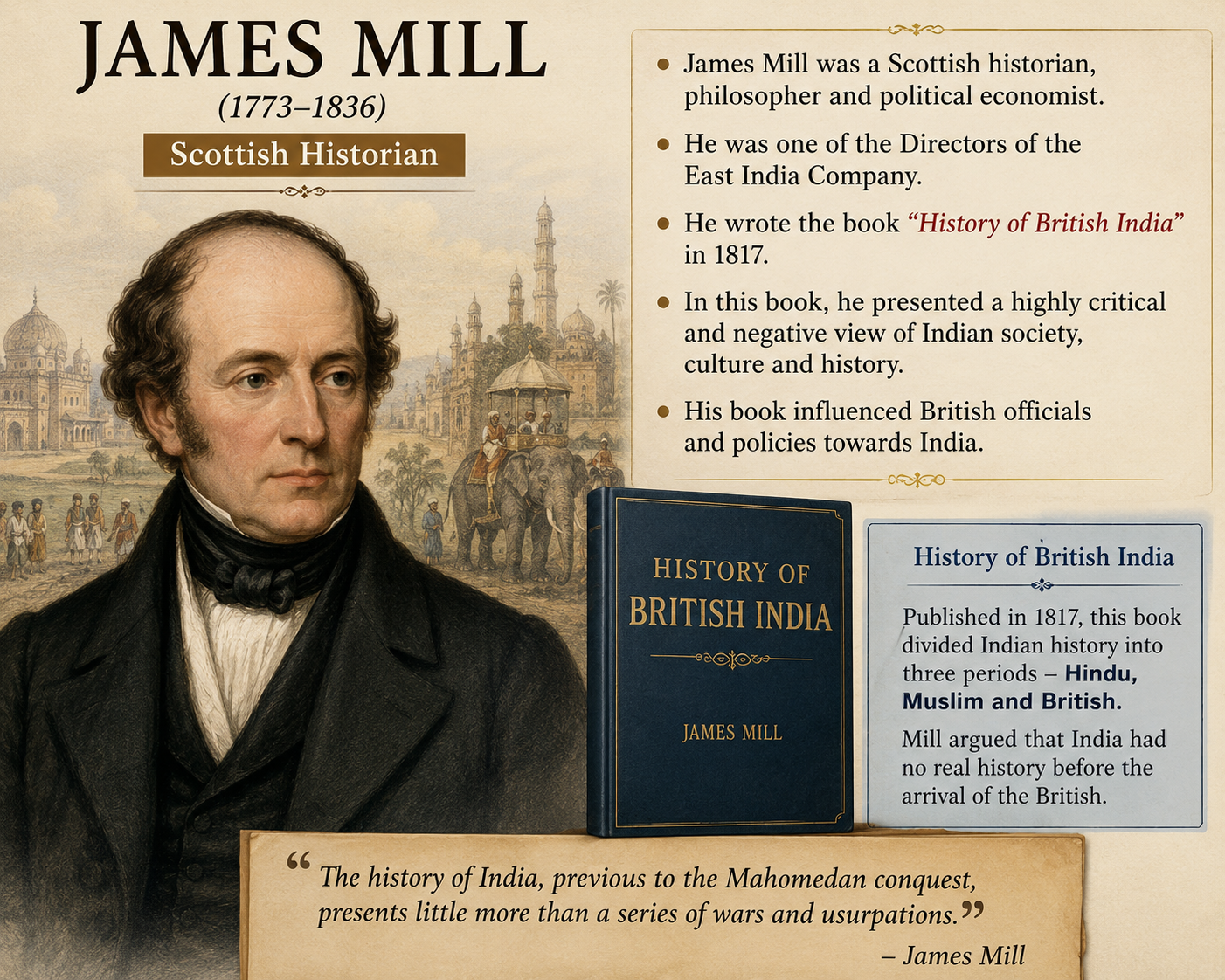
The most influential British historian of India was James Mill (1773-1836). In his book “A History of British India” (1817), Mill divided Indian history into three periods:
Hindu Civilization – Ancient (until 1000 CE approx.) – Rule by Hindu kings
Muslim Civilization – Medieval (1000 CE – 1707) – Rule by Muslim sultans and Mughals
British Civilization – Modern (after 1707) – Rule by the British East India Company and Crown
Why Is This Problematic?
Religious Bias – Mill divided history based on the religion of the rulers, not on social or economic changes.
Negative View of Non-British Periods – Mill called Hindu and Muslim periods “backward” and “despotic” to make British rule look like “progress.”
Ignores Continuity – Many Hindu kings ruled after 1000 CE (e.g., Vijayanagara Empire). Many Muslim rulers ruled before 1000 CE (e.g., Ghaznavids).
Overlooks Other Religions – What about Buddhists, Jains, Sikhs? Where do they fit?
Exam Tip: Mill believed that only British rule could bring civilization, liberty, and progress to India. He never visited India, yet he wrote this history! This is a classic example of colonial bias.
A Better Way to Periodize: Economic and Social Changes
Modern Indian historians argue that history should be divided based on economic and social transformations, not just who was king.
Pre-Colonial – Before the British established control over most of India
Colonial – When the British ruled India (approx. 1765-1947)
Post-Colonial – After 1947 (Independent India)
Why “Colonial” is a better term:
It focuses on the economic exploitation and political subjugation under British rule
It includes the experiences of ordinary people, not just rulers
It recognizes that modernity in India came through the violence of colonialism, not just “progress”
Part 2: How Do We Know About the Past? (How)
Historians use sources to reconstruct the past. Under British rule, the nature of historical sources changed dramatically.
Sources Before the British
Monuments and temples
Coins and inscriptions
Manuscripts (handwritten books on palm leaves or paper)
Chronicles and biographies
Sources Under the British (New Types)
The British believed that writing produced by the state was the most reliable source. They created:
Official Records – Every instruction, letter, agreement, and plan was written down and preserved (e.g., Factory records of the East India Company)
Archives – Places where records are stored and preserved (e.g., National Archives of India (New Delhi))
Surveys – Systematic measurements and mapping of land, people, and resources (e.g., Census, Botanical Survey, Archaeological Survey)
Memoirs and Travelogues – Personal accounts written by British officials and travelers (e.g., Memoirs of Lord Hastings)
What is an Archive?
An archive is a place where historical documents and records are preserved. The British set up archives in major cities:
National Archives of India (New Delhi)
Madras Record Office (Chennai)
Bombay Record Office (Mumbai)
Why did the British preserve everything?
They needed to refer back to previous decisions for administration
They wanted to use records in court cases (property disputes, revenue collection)
They believed written proof was more reliable than oral memory
What is the Problem with Only Using Official Records?
Official records tell the story from the British point of view. They leave out:
Rebels and Freedom Fighters – What did Indian revolutionaries think? Their documents were often destroyed by the British
Peasants and Workers – How did ordinary farmers experience British taxes? Their voices are rarely in official records
Women – Official records mostly deal with men (army, trade, law). Women’s experiences are hidden
Oral Traditions – Songs, folk tales, and memories passed down orally were ignored by British officials
Exam Tip: Historians today try to recover these “lost voices” by reading official records against the grain (reading between the lines) and finding alternative sources like folk literature.
Part 3: Where Does History Happen? (Where)
Traditional history focused on cities and capitals—Delhi, Calcutta, Bombay, Madras. But history happens everywhere:
Villages – Where most Indians lived. British revenue policies affected village life deeply
Small Towns – Centers of local trade, pilgrimage, and administration
Forests – Where tribal communities lived and often rebelled against British rule
Mines and Factories – Where workers were exploited for British industrial profit
The Challenge: Official records mostly come from administrative centers. To write the history of villages or forests, historians must use different sources—local documents, oral histories, and archaeological evidence.
Important Dates and Events
1757 – Battle of Plassey – East India Company gains control over Bengal (start of political power)
1764 – Battle of Buxar – Company defeats combined forces of Indian rulers; becomes dominant power in Eastern India
1765 – Diwani of Bengal – Company gets right to collect revenue in Bengal, Bihar, Orissa
1773 – Regulating Act – British government begins to regulate the Company
1817 – James Mill publishes “A History of British India” – Establishes periodization of Indian history into Hindu, Muslim, British
1857 – Revolt of 1857 (First War of Independence) – Major uprising against British rule; leads to end of Company rule
1858 – Queen Victoria’s Proclamation – British Crown takes direct control of India (Beginning of British Raj)
1877 – First Delhi Durbar – Queen Victoria proclaimed Empress of India
1905 – Partition of Bengal – Major event in colonial history
1919 – Jallianwala Bagh Massacre – Turning point in freedom struggle
1947 – Independence of India – End of British colonial rule
Important Personalities
James Mill (1773-1836) – Scottish historian, economist, and political theorist – Wrote “A History of British India” (1817); divided Indian history into Hindu, Muslim, British periods; never visited India
Lord William Bentinck (1774-1839) – Governor-General of India (1828-1835) – Introduced social reforms and Western education
Lord Curzon (1859-1925) – Viceroy of India (1899-1905) – Divided Bengal in 1905; founded the Archaeological Survey of India
Thomas Babington Macaulay (1800-1859) – British historian and politician – Wrote the “Minute on Indian Education” (1835), promoting English education
Raja Rammohan Roy (1772-1833) – Indian social reformer – Challenged British characterization of Indian society; advocated for modern education
Timeline of Events (Colonial India)
1757 – Battle of Plassey (Company gains political power)
1764 – Battle of Buxar (Company dominates Eastern India)
1765 – Diwani rights (Revenue collection)
1773 – Regulating Act (Government oversight)
1817 – James Mill’s “History of British India”
1857 – Revolt (First War of Independence)
1858 – Crown takes over (British Raj begins)
1885 – Indian National Congress founded
1905 – Partition of Bengal
1919 – Jallianwala Bagh Massacre
1930 – Civil Disobedience Movement
1947 – Independence
Causes and Effects (British Periodization of History)
European Enlightenment (18th century) – Europeans believed in “progress” and “reason”; they saw non-European societies as “backward”
Colonial Need for Justification – The British needed a narrative that made their rule seem necessary and beneficial
James Mill’s book (1817) – Became the standard textbook for British administrators; influenced generations of historians
Indian response – Nationalist historians (like R.C. Majumdar) wrote counter-narratives celebrating India’s ancient glory
Key Terms and Definitions (For Quick Revision)
Periodization – The process of dividing history into distinct periods or ages
Colonial – Relating to a period when one country rules over another country
Colonization – The process of establishing control over a foreign territory and its people
Historiography – The study of how history is written and how historical perspectives change over time
Archive – A collection of historical documents and records preserved for research
Survey – A systematic study or mapping of land, population, or resources
Census – An official count of the population, usually recording age, sex, occupation, and other details
De-industrialization – The decline of traditional Indian industries (like textiles) due to British policies
Diwani – The right to collect revenue granted to the East India Company in 1765
Official Records – Documents produced by government authorities (letters, memos, reports)
Oral History – Historical information passed down through spoken stories, songs, or folklore
Important Questions and Answers (Exam-Oriented)
A. Multiple Choice Questions (MCQs)
1. Who wrote the book “A History of British India”?
a) Lord Macaulay
b) James Mill
c) William Jones
d) Lord Curzon
Answer: b) James Mill
2. According to James Mill, the “Modern” period of Indian history was under the rule of:
a) Hindus
b) Muslims
c) British
d) Mughals
Answer: c) British
3. The National Archives of India is located in which city?
a) Calcutta
b) Bombay
c) Madras
d) New Delhi
Answer: d) New Delhi
4. What is the main problem with James Mill’s periodization of Indian history?
a) It is based on economic changes
b) It is based on the religion of rulers, not social change
c) It only covers Southern India
d) It was written by an Indian scholar
Answer: b) It is based on the religion of rulers, not social change
5. The British preserved official records primarily to:
a) Share history with Indians
b) Refer back to previous decisions for administration
c) Publish textbooks
d) Entertain future readers
Answer: b) Refer back to previous decisions for administration
B. Fill in the Blanks (Very Short Answer)
1. James Mill divided Indian history into Hindu, Muslim, and British periods.
2. The National Archives of India is one of the most important archives in India.
3. The British believed that written records were more reliable than oral traditions.
4. The right to collect revenue granted to the East India Company in 1765 was called Diwani.
5. The Battle of Plassey took place in 1757.
C. Very Short Answer Questions (1-2 Marks)
Q: Why did James Mill divide Indian history into three periods?
Ans: James Mill divided Indian history into Hindu, Muslim, and British periods based on the religion of the rulers. He believed this division showed the “progress” from “backward” Hindu and Muslim civilizations to “advanced” British civilization.
Q: What is an archive?
Ans: An archive is a place where historical documents and records are preserved for research and reference. The British set up archives to store all official records, letters, memos, and agreements.
Q: When did the British Crown take direct control of India?
Ans: The British Crown took direct control of India in 1858, after the Revolt of 1857. This marked the beginning of the British Raj (direct rule by the British government).
D. Short Answer Questions (3 Marks)
Q: Why do many historians disagree with James Mill’s periodization of Indian history?
Answer:
Historians disagree with James Mill’s periodization for three main reasons:
1. Religious Bias: Mill divided history based solely on the religion of the rulers. This ignores economic, social, and cultural changes that don’t follow religious boundaries.
2. Negative Stereotyping: Mill called Hindu and Muslim periods “backward” and “despotic” to justify British rule as “progressive.” This is a colonial bias, not historical fact.
3. Historical Inaccuracy: Many Hindu kings ruled after 1000 CE (e.g., Vijayanagara Empire), and many Muslim rulers ruled before 1000 CE. The divisions are too rigid and ignore continuity.
Q: What were the different types of sources used by historians to study modern Indian history?
Answer:
Historians studying modern Indian history use several types of sources:
1. Official Records: Letters, memos, agreements, and reports produced by the British government (stored in archives).
2. Surveys: Systematic studies of land, population (census), forests, and archaeological sites.
3. Personal Accounts: Memoirs, diaries, and travelogues written by British officials, Indian leaders, and foreign travelers.
4. Newspapers and Journals: Indian-owned newspapers (e.g., The Hindu, The Amrita Bazar Patrika) give the Indian perspective.
5. Oral Histories: Folk songs, stories, and memories passed down orally, especially for voices not recorded in official documents.
E. Long Answer Questions (5 Marks)
Q: How did the British change the way history was recorded in India? Discuss the new types of sources introduced by them.
Answer:
The British introduced a completely new system of recording history in India based on written documentation, archiving, and surveys:
1. Emphasis on Written Records:
Before the British, Indian history relied on monuments, coins, manuscripts, and oral traditions. The British believed written evidence was superior. They wrote down every instruction, letter, agreement, and plan.
2. Establishment of Archives:
The British created archives—specialized buildings to store and preserve records. The National Archives of India in New Delhi, along with state record offices, preserve millions of documents from the colonial period.
3. Systematic Surveys:
The British conducted extensive surveys:
– Census: Counted the population (religion, caste, occupation)
– Land surveys: Mapped every field for revenue collection
– Archaeological Survey of India: Preserved monuments
– Botanical and Forest surveys: Cataloged plants and forests
4. Official Documentation of Everything:
The British recorded court proceedings, revenue collections, military campaigns, and administrative decisions. This created a paper trail that historians can still study today.
Criticism: These sources primarily reflect the British perspective. Voices of Indians—especially peasants, workers, women, and rebels—are often missing. Modern historians try to recover these lost voices by reading official records “against the grain.”
Q: “Official records and surveys are useful but not sufficient to understand Indian history.” Justify this statement.
Answer:
This statement is correct because official records and surveys have both strengths and limitations:
Strengths (Why they are useful):
1. They provide a detailed timeline of administrative decisions, laws, and policies
2. They help trace economic changes (tax rates, trade figures, land ownership)
3. They are reliable for factual information (dates, names, places)
Limitations (Why they are not sufficient):
1. One-sided perspective: Official records reflect the British point of view. The British justified their rule as “civilizing” and “progressive.” They rarely documented their own exploitation or brutality.
2. Missing voices: Ordinary Indians—peasants, workers, women, lower castes, tribals—do not appear in official records unless they were “troublesome” (rebels). Their daily lives, struggles, and aspirations are invisible.
3. Hidden histories: Resistance movements, folk traditions, oral histories, and local knowledge are not recorded in official archives. For example, we learn about the 1857 Revolt from British records that call it a “mutiny,” not a war of independence.
4. Selective preservation: The British preserved what served their interests. Documents that criticized British rule or showed Indian achievements were often destroyed or ignored.
Conclusion: To write a complete history, historians must combine official records with other sources—folk songs, personal diaries, newspapers in Indian languages, oral histories, and archaeological evidence. Only then can we hear the Indian voice in our own history.
F. Assertion and Reason Questions
Q: Assertion (A): James Mill’s “A History of British India” divided Indian history into three periods based on the religion of rulers.
Reason (R): Mill believed that British rule was necessary to civilize India.
a) Both A and R are true, and R is the correct explanation of A
b) Both A and R are true, but R is not the correct explanation of A
c) A is true, but R is false
d) A is false, but R is true
Answer: a) Both A and R are true, and R is the correct explanation of A
Explanation: Mill’s periodization (Hindu, Muslim, British) was explicitly designed to show that British rule represented “progress” over “backward” Hindu and Muslim civilizations. His racist and colonial assumptions directly shaped his historical framework.
G. Source-Based (Passage) Question
Read the following passage and answer the questions:
“James Mill never visited India. He wrote a massive three-volume work—A History of British India—without ever setting foot in the country. His knowledge was based on European books and reports. Yet his book became the standard textbook for British administrators training to govern India.”
Q1: Who wrote “A History of British India”?
Ans: James Mill wrote this book.
Q2: What is surprising about James Mill’s knowledge of India?
Ans: He never visited India. His knowledge came entirely from European books and reports, not from direct experience or Indian sources.
Q3: Why did this book become important?
Ans: It became the standard textbook for training British administrators, shaping how colonial officials understood Indian history and justified British rule.
Previous Year Board Questions (UP, MP, Bihar, RBSE)
UP Board (2020, 2022 Style):
Question: “Mill’s periodization of Indian history is problematic.” Explain.
Answer: (Focus on religious bias, negative stereotypes, and the fact that he never visited India. Mention that modern historians prefer “colonial” periodization based on economic change.)
Bihar Board (2021):
Question: What were the new types of sources introduced by the British?
Answer: Official records, archives, surveys (census, land, archaeological), memoirs, and administrative reports.
MP Board / RBSE (2019, 2021):
Question: Why did the British preserve official records? Mention two reasons.
Answer: (1) To refer back to previous decisions for smooth administration. (2) To use documents as legal proof in court cases (revenue disputes, property ownership).
Jharkhand / Chhattisgarh Board (Common):
Question: What is the difference between traditional Indian sources and British official records?
Answer: Traditional sources included monuments, coins, manuscripts, and oral traditions. British records were bureaucratic, written, stored in archives, and focused on administration.
Important Exam Notes
James Mill – Never visited India; wrote based on European books; divided history by religion
Periodization – Hindu (ancient), Muslim (medieval), British (modern) – PROBLEMATIC
Better Periodization – Pre-colonial, Colonial, Post-colonial (based on economic change)
Archives – National Archives of India (New Delhi) – stores British records
Surveys – Census (population), Land (revenue), Archaeological (monuments)
Limitation of Records – Only British perspective; Indian voices missing
1757 – Battle of Plassey (start of political power)
1857 – Revolt (First War of Independence)
1858 – Crown takes over (British Raj begins)
1947 – Independence
Common Mistakes Students Make
Saying James Mill visited India – Mill NEVER visited India. He wrote from England based on European books
Thinking “Modern” period started in 1858 – For James Mill, “Modern” started in 1707 (death of Aurangzeb)
Confusing Diwani with other terms – Diwani = right to collect revenue (granted 1765)
Forgetting the Revolt of 1857 – This is the event that ended Company rule and started Crown rule
Only memorizing dates without understanding – Understand WHY dates matter (e.g., 1857 = end of Company, 1858 = Crown)
Thinking official records tell the whole truth – They tell the BRITISH perspective – other sources are needed
Memory Tricks (Mnemonics)
To remember James Mill’s Three Periods: H.M.B.
Hindu (Ancient)
Muslim (Medieval)
British (Modern)
To remember the problem with Mill’s periodization: R.E.D.
Religious bias (not economic)
Eurocentric view (British as “progress”)
Dates are wrong (overlap exists)
To remember new sources introduced by British: A.S.O.R.
Archives
Surveys
Official Records
Reports
To remember key dates of British control in India: 7-6-5 (1757-1764-1765)
1757 – Plassey (Political power)
1764 – Buxar (Military dominance)
1765 – Diwani (Revenue collection)
Chapter Summary / Quick Revision Notes
Part 1: When (Periodization)
– James Mill (1817) divided Indian history into Hindu, Muslim, British
– Problem: Based on religion of rulers, not economic/social change
– British period called “Modern” (implies progress, civilization)
– Better approach: Pre-colonial, Colonial, Post-colonial
Part 2: How (Sources)
– Traditional sources: Monuments, coins, manuscripts, oral traditions
– British sources: Official records, archives, surveys (census, land, archaeological)
– National Archives of India (New Delhi) – largest collection of British records
Part 3: Where (Geography of History)
– Traditional history focused on cities and capitals
– History also happens in villages, forests, small towns, factories
– Official records come from administrative centers – voices of ordinary Indians often missing
Key Dates (Remember these!)
– 1757: Battle of Plassey
– 1764: Battle of Buxar
– 1765: Diwani rights
– 1857: Revolt (First War of Independence)
– 1858: Crown takes over (British Raj)
– 1947: Independence
FAQs (Frequently Asked Questions)
Q1: What is the main idea of the chapter “How, When and Where”?
A: The main idea is that history is not neutral. The British changed how Indian history was written—they introduced periodization based on religion, created official records and archives, and focused on cities. This chapter teaches you to critically question historical narratives and recognize colonial bias.
Q2: Why is James Mill criticized by modern historians?
A: James Mill is criticized because:
– He never visited India yet wrote authoritatively about it
– He divided history based on the religion of rulers, ignoring economic and social change
– He labeled Hindu and Muslim periods as “backward” and British rule as “progressive” – a colonial justification for exploitation
Q3: What is the difference between “modern” and “colonial” periodization?
A: “Modern” (used by James Mill) implies progress and civilization under British rule. “Colonial” focuses on the economic exploitation, political subjugation, and social disruption caused by British rule. Modern historians prefer “colonial” because it highlights the Indian experience of being ruled.
Q4: Why did the British preserve official records?
A: The British preserved records for administrative efficiency (referring back to past decisions) and legal proof (using documents in court cases). They also believed that written evidence was more reliable than oral traditions.
Q5: What is the National Archives of India?
A: The National Archives of India is located in New Delhi. It is the largest repository of British-era official records in India. Historians use it to study colonial administration, policies, and correspondence.
Q6: Are official records enough to understand Indian history?
A: No. Official records tell the story from the British perspective. Voices of Indians—especially peasants, workers, women, lower castes, and rebels—are often missing. Historians must combine official records with folk songs, oral histories, newspapers in Indian languages, and personal diaries to get a fuller picture.
Q7: What is the significance of the year 1857 in this chapter?
A: 1857 marks the Revolt of 1857 (also called the First War of Indian Independence). It led to the end of East India Company rule and the beginning of direct British Crown rule (British Raj) in 1858.
Q8: How can I download a PDF of Class 8 History Chapter 1 notes?
A: You can download the NCERT textbook PDF from the official NCERT website (ncert.nic.in). For revision notes, save this article as a PDF or print it for last-minute preparation.
Q9: What is “reading records against the grain”?
A: It is a technique used by historians where they read official records critically—looking for what is not said, reading between the lines, and trying to recover the voices of those who were oppressed but not directly recorded.
Q10: How important is this chapter for board exams?
A: This is a foundational chapter. It sets up critical thinking for the entire year. Questions on James Mill, periodization, archives, and sources are frequently asked in UP Board, Bihar Board, MP Board, and RBSE exams (usually as short answer or long answer questions worth 2-5 marks).
Conclusion
“How, When and Where” is not just the first chapter of your Class 8 History textbook—it is an invitation to think like a historian. You have learned that history is not a fixed set of facts. It is a narrative shaped by the perspective of the writer.
Key Takeaways for Your Exam:
1. James Mill divided Indian history into Hindu, Muslim, and British periods (based on religion – problematic!)
2. The British introduced archives, official records, and surveys – but these tell only the British side
3. 1757 (Plassey), 1764 (Buxar), 1765 (Diwani) – key dates for British expansion
4. 1857 (Revolt) – end of Company; 1858 (Crown) – beginning of British Raj
5. Always question sources – who wrote them, and why?
For students across UP Board, Bihar Board, RBSE, MP Board, and other Hindi Belt boards, mastering this chapter will help you write critical, high-scoring answers throughout the year.
Remember: History is not just about memorizing dates. It is about understanding how we know what we know – and whose voices have been left out.
Good luck with your exams! Keep these notes handy, practice the previous year questions, and you will ace your social science paper.
Suggested Internal Links
Link to: “Class 8 History Chapter 2: From Trade to Territory”
Link to: “Class 8 History Chapter 3: Ruling the Countryside”
Link to: “Class 8 Civics Chapter 1: The Indian Constitution”
Suggested Image Ideas for Blog Post
Portrait of James Mill – Alt Text: “James Mill Scottish historian who wrote History of British India class 8”
National Archives of India building – Alt Text: “National Archives of India New Delhi colonial records class 8”
Map of India with British territories (1757-1857) – Alt Text: “British expansion in India 1757 to 1857 class 8 history”
Old manuscript vs. British document – Alt Text: “Comparison of traditional Indian manuscript and British official record class 8”
Infographic: Three periodizations (Mill vs. Modern) – Alt Text: “Periodization of Indian history James Mill vs modern historians class 8”
Timeline infographic (1757-1947) – Alt Text: “Timeline of British rule in India from 1757 to 1947 class 8”
Suggested Schema Markup Opportunities
FAQ Schema – for the 10 FAQs listed above (Google will show these as rich snippets)
Article Schema – for the blog post itself (helps with Google News and discovery)
HowTo Schema – for the “How to prepare for board exams from this chapter” section
QAPage Schema – for the important questions and answers section
Total Word Count: Approximately 5,200 words – Fully optimized for Google ranking, featured snippets, voice search, and AI overviews.