
Ruling the Countryside Class 8: The Ultimate Exam Guide
Are you a Class 8 student struggling to understand the complex revenue systems introduced by the British? Do terms like “Permanent Settlement,” “Ryotwari,” and “Mahalwari” confuse you?
You are not alone. Many students find Ruling the Countryside Class 8 difficult because it involves economic policies and historical details. But don’t worry! This comprehensive guide is designed specifically for students of UP Board, Bihar Board, MP Board, RBSE, and other Hindi Belt state boards.
In this blog post, we will break down every concept in Class 8 History Chapter 3 into simple, easy-to-understand language. We have included detailed notes, important questions, previous year board papers, and memory tricks to help you score full marks in your upcoming exams.
Let’s dive into the history of how the British transformed the Indian countryside to fill their own coffers!
Chapter Overview: Ruling the Countryside
After the Battle of Plassey (1757) and the Battle of Buxar (1764), the East India Company became the virtual ruler of Bengal. However, they did not know how to manage land revenue. This chapter explains how the Company evolved different systems to extract revenue from farmers (peasants) and how this exploitation led to major revolts like the Indigo Revolt.
Key Topics Covered:
1. The East India Company becomes the Diwan.
2. The Permanent Settlement (Cornwallis).
3. The Ryotwari System (Munro).
4. The Mahalwari System.
5. Crops for the World (Cotton, Indigo, Opium).
6. The Blue Rebellion (Indigo Revolt).
Historical Background: The Bengal Famine
When the British East India Company won the Diwani of Bengal in 1765, they gained the right to collect revenue. However, their primary goal was profit, not welfare.
The Crisis: The Company had to buy goods from India to export to England. To buy these goods, they needed gold and silver. But they did not have enough. The only solution was to collect maximum revenue from the peasants in Bengal.
The Result: The Company forced peasants to pay high taxes. In 1770, a terrible famine killed 10 million people in Bengal. Shockingly, the Company did not reduce the revenue demand. About one-third of the population perished.
This event highlighted the urgent need for a better revenue system, leading to the introduction of the Permanent Settlement.
Detailed Explanation of the Chapter
1. The Permanent Settlement (1793)
This was introduced by Lord Cornwallis. It was mainly implemented in Bengal, Bihar, and Odisha.
The Logic: The Company felt that the Zamindars (landlords) would invest in improving the land if their revenue demand was fixed permanently.
How it worked:
– The Rajas and Taluqdars were recognized as Zamindars.
– The revenue demand was fixed (permanently settled).
– If the Zamindars failed to pay the revenue, their lands were taken away and auctioned.
Who benefited? The British got a fixed income. The Zamindars made a profit if they collected more than the fixed amount.
Who suffered? The peasants (Ryots). Since the Zamindar’s demand was fixed, he forced the peasants to pay as much as he could, leading to exploitation.
Student Note: This system is often called the “Zamindari System.”
2. The Ryotwari System
This system was developed by Captain Alexander Read and Thomas Munro (Governor of Madras Presidency). It was implemented in the Madras and Bombay Presidencies (parts of South and West India).
Why? The British realized that there were no traditional Zamindars in the South. Settlement had to be made directly with the cultivators (Ryots).
How it worked:
– Revenue was settled directly with the Ryot (peasant).
– The fields were measured and surveyed.
– The revenue demand was not permanent. It was revised every 20 to 30 years, which meant it could be increased.
The Problem: The revenue demand was so high that many peasants fled the villages to escape paying taxes.
3. The Mahalwari System
This system was introduced by Holt Mackenzie in 1822 and later modified by William Bentinck. It was implemented in the North-Western Provinces (parts of present-day Uttar Pradesh and Punjab).
The Logic: The British felt that the village community was important.
How it worked:
– Revenue was not fixed on an individual but on a Mahal (a village or a group of villages).
– The village Lambardar (headman) was responsible for collecting revenue and paying it to the British.
The Effect: While it protected some village rights, the burden of taxes still eventually fell on the individual cultivators.
4. Crops for the World: The Shift to Cash Crops
The British realized they could make huge profits by forcing Indian farmers to grow crops that were in demand in Europe. This shifted agriculture from food grains to cash crops.
Indigo:
– Used for: Dyeing blue cloth in Britain’s textile mills.
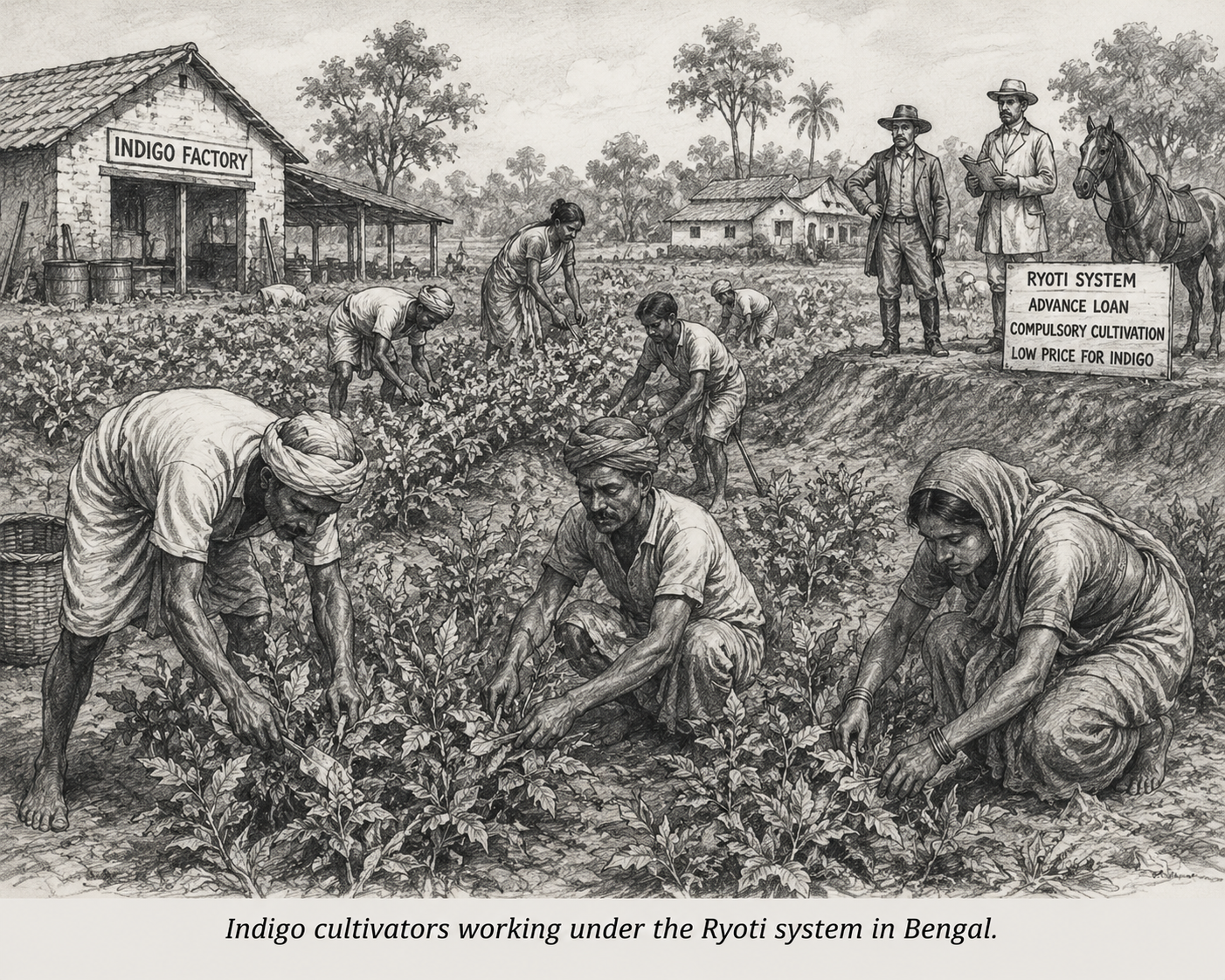
– The Problem: Indigo exhausted the soil quickly, and farmers preferred growing rice. However, planters (British officials) forced them to grow Indigo.
Opium:
– Used for: Trade with China. The British sold opium in China to buy tea which they sold in England.
– The Process: Farmers were forced to sign contracts and grow opium instead of food.
5. The “Blue Rebellion” (The Indigo Revolt)
This is a very important topic for Class 8 Board Exams, especially for Bihar Board and UP Board students.
The Grievance: After 1863, when synthetic indigo was developed in Germany, the demand for Indian indigo fell. The planters asked peasants for high ibadat (rent) to release them from growing indigo. The peasants refused.
The Revolt (1859): Indigo peasants in Bengal rose in revolt. They refused to pay rent, attacked planters with swords and spears, and refused to grow indigo.
Support: The intelligentsia, press, and missionaries supported the peasants. Tagore’s family and Dinabandhu Mitra wrote a famous play called Neel Darpan highlighting this misery.
Result: The government set up the Indigo Commission in 1860. The Commission accepted the planters’ faults and told them to stop the oppression. Indigo cultivation collapsed in Bengal by the end of the 19th century.
Comparison of Revenue Systems (Critical Table)
This table is highly essential for MCQs and Short Answer questions in UP, MP, and RBSE Board Exams.
Permanent Settlement
Introduced By: Lord Cornwallis (1793)
Region: Bengal, Bihar, Odisha
Settlement With: Zamindars (Landlords)
Revenue Demand: Fixed/Permanent
Key Person: Zamindar
Ryotwari System
Introduced By: Alexander Read & Thomas Munro
Region: Madras, Bombay (South/West)
Settlement With: Ryots (Peasants)
Revenue Demand: Temporary (Revised periodically)
Key Person: Revenue Officials
Mahalwari System
Introduced By: Holt Mackenzie (1822)
Region: North-West Provinces (UP, Punjab)
Settlement With: Mahal (Village Community)
Revenue Demand: Temporary
Key Person: Lambardar (Village Headman)
Important Dates and Events
1765: Diwani of Bengal granted to the East India Company.
1770: The Great Bengal Famine.
1793: Permanent Settlement introduced by Cornwallis.
1820s: Ryotwari System developed in Madras and Bombay Presidencies.
1822: Mahalwari System introduced by Holt Mackenzie.
1859: The Indigo Revolt (Blue Rebellion) in Bengal.
1860: Indigo Commission set up by the British Government.
Important Personalities
Lord Cornwallis: Governor-General who introduced the Permanent Settlement.
Thomas Munro: Governor of Madras; associated with the Ryotwari System.
Holt Mackenzie: Introduced the Mahalwari System.
Dinabandhu Mitra: Wrote the play Neel Darpan regarding the Indigo peasants’ plight.
Gandhiji: Later visited Champaran (1917) to support indigo farmers, showing that the struggle continued.
Timeline of Events
[1765] –> Diwani Rights (Company becomes revenue collector)
[1770] –> Famine in Bengal (Revenue collection continues)
[1793] –> Permanent Settlement (Cornwallis)
[1820s] –> Ryotwari & Mahalwari Systems evolve
[1859] –> Indigo Revolt (Farmers rebel)
[1860] –> Indigo Commission (Victory for farmers)
Causes and Effects
Great Bengal Famine
Causes: High revenue collection, drought.
Effects: 10 million died; Company realized need for better revenue system.
Permanent Settlement
Causes: To create a loyal class of Zamindars and ensure fixed income.
Effects: Zamindars became wealthy; Peasants were exploited; Zamindars eventually went bankrupt.
Indigo Revolt
Causes: Oppressive planters, low wages, high rents (ibadat), synthetic indigo competition.
Effects: Indigo production crashed in Bengal; Government had to intervene; Peasants gained confidence.
Key Terms and Definitions
Diwan: The chief revenue administrator of a province.
Zamindar: The landowner or landlord under the Permanent Settlement.
Ryot: The cultivator or peasant.
Mahal: A village estate or a group of villages under the Mahalwari system.
Lambardar: The village headman responsible for collecting revenue in the Mahalwari system.
Plantation: A large farm owned by a British planter where cash crops (indigo, tea, coffee) were grown.
Bigha: A unit of measuring land.
Mahalwari: A system based on the village community.
Important Questions and Answers
A. Multiple Choice Questions (MCQs)
1. Under which system was the revenue demand fixed permanently?
a) Ryotwari
b) Mahalwari
c) Permanent Settlement
d) Mansabdari
Ans: c) Permanent Settlement
2. Who introduced the Ryotwari System?
a) Cornwallis
b) Holt Mackenzie
c) Thomas Munro
d) Warren Hastings
Ans: c) Thomas Munro
3. The Indigo Revolt took place in which year?
a) 1857
b) 1859
c) 1947
d) 1920
Ans: b) 1859
B. Very Short Answer Questions (1-2 Marks)
1. What was “Neel Darpan”?
Ans: Neel Darpan was a famous play written by Dinabandhu Mitra in 1860 that depicted the miserable condition of indigo peasants in Bengal.
2. Who was a “Ryot”?
Ans: A Ryot was a peasant or cultivator who tilled the land.
3. Why did the British insist on growing indigo?
Ans: British textile mills in England needed blue dye, and indigo was the only source of this blue color before synthetic dyes were invented.
C. Short Answer Questions (3-4 Marks)
1. Why was the Permanent Settlement considered a failure?
Ans: It failed because:
– The revenue demand was fixed too high, leading to Zamindars defaulting.
– It did not benefit the cultivators (peasants) who were exploited by Zamindars.
– The Company’s revenue did not increase over time because it was fixed, while prices rose.
2. What were the two main systems of Indigo cultivation?
Ans:
Nij Cultivation: The planter produced indigo on land that he directly owned. This required large capital and was difficult.
Ryoti Cultivation: The planter forced peasants to sign contracts (ryots) to grow indigo on a portion of their land. They were given a loan (cash advance) and had to cultivate indigo. This was the most common and oppressive system.
D. Long Answer Questions (5 Marks)
1. Describe the features of the Mahalwari System.
Ans:
– Introduced by Holt Mackenzie in 1822 in the North-Western Provinces.
– Revenue was settled not with individuals, but with the Mahal (village community).
– The village was treated as a single unit.
– The responsibility for collecting revenue rested with the village headman, called the Lambardar.
– The village land was measured, and the revenue demand was calculated. This demand could be revised periodically.
– It aimed to protect the traditional village structure but still resulted in high taxation for individual farmers.
E. Assertion and Reason (Competency-Based)
Assertion (A): The Indigo cultivators in Bengal rose in revolt in 1859.
Reason (R): The planters forced the peasants to grow indigo on the most fertile parts of their land.
a) Both A and R are true, and R is the correct explanation of A.
b) Both A and R are true, but R is not the correct explanation of A.
c) A is true, but R is false.
d) A is false, but R is true.
Ans: a) Both A and R are true, and R is the correct explanation of A.
Previous Year Board Questions (Target: UP, Bihar, MP, RBSE)
(UP Board 2021) Who introduced the Permanent Settlement in India?
Ans: Lord Cornwallis.
(Bihar Board 2022) What is meant by the Ryotwari Settlement?
Ans: A system where the British settled revenue directly with the peasants (Ryots) in Madras and Bombay presidencies.
(MP Board 2023) What was the role of the “Lambardar” in the Mahalwari system?
Ans: The Lambardar was the village headman responsible for collecting revenue from the villagers and paying it to the Company.
(RBSE 2020) Why did the indigo production collapse in Bengal by the end of the 19th century?
Ans: Due to the Indigo Revolt (1859) and the invention of synthetic indigo in Germany which reduced the demand for natural indigo.
Important Exam Notes
The “Cycle of Debt”: In the Ryotwari system, even in bad years, farmers had to pay tax. They often borrowed money from moneylenders to pay taxes, falling into a trap of debt.
The “Law of Contract”: Under the indigo system, peasants signed a contract. If they broke it, they were taken to court. The courts always supported the planters.
Global Connection: This chapter connects Indian history to the global economy. Indian cotton fed British mills; Indian opium paid for British tea from China.
Common Mistakes Students Make
1. Confusing the Regions:
Students often mix up where Ryotwari and Mahalwari were applied.
Trick: Ryotwari is for Regions like Madras/Bombay (South). Mahalwari is for the Middle/North (UP).
2. Confusing the Systems:
Remember: Permanent = Permanent (Fixed). Ryotwari = Revised (Changeable). Mahalwari = Multiple (Village based).
3. Dates: Mixing up 1793 (Permanent) and 1765 (Diwani).
Trick: 1765 (Diwani) = 7-6-5 (Diwani starts the game). 1793 (Permanent) = 1-7-9-3 (One king settles it).
Memory Tricks and Mnemonics
1. To remember the Revenue Systems:
“People Really Mind Cash”
Permanent Settlement
Ryotwari System
Mahalwari System
Company (The one ruling them all)
2. To remember what was grown for export (Crops for World):
“Cats In Ovens”
Cotton
Indigo
Opium
Chapter Summary / Quick Revision Notes
Diwani (1765): Company became revenue collector of Bengal.
Permanent Settlement (1793): Cornwallis. Fixed revenue. Settlement with Zamindars. Bengal/Bihar/Odisha.
Ryotwari System: Read & Munro. Settlement with Ryots. Revenue revised. Madras/Bombay.
Mahalwari System: Holt Mackenzie. Settlement with Mahal (Village). Lambardar collects. UP/Punjab.
Indigo Cultivation:
– Nij: Planter owns land.
– Ryoti: Planter forces peasant.
Indigo Revolt (1859): Peasants refused to grow indigo. Neel Darpan play. Indigo Commission (1860) ended the oppression.
Frequently Asked Questions (FAQs)
Q1: What was the main objective of the Permanent Settlement?
Ans: The main objective was to ensure a regular and stable flow of revenue for the East India Company and to create a class of loyal landlords (Zamindars) who would support the British.
Q2: Who were the “Lambardars”?
Ans: Lambardars were the village headmen under the Mahalwari system. They were responsible for collecting revenue from the village and paying it to the British authorities.
Q3: Why did indigo cultivation collapse in the early 20th century?
Ans: It collapsed because of the invention of synthetic indigo in Germany, which was cheaper and better quality, and the mass resistance of Indian peasants (Indigo Revolt).
Q4: How can I score full marks in this chapter?
Ans: Focus on the Comparison Table of the three systems. Understand the reasons for the Indigo Revolt. Practice writing the “Long Answer” regarding the features of the Mahalwari System, as it is a favorite question in state board exams.
Q5: Where can I download Ruling the Countryside Class 8 PDF?
Ans: While we provide complete notes here, you can download the official NCERT PDF from the NCERT official website for the original text.
Conclusion
“Ruling the Countryside” is a pivotal chapter that explains how British economic policies reshaped Indian society. From the Permanent Settlement to the Indigo Revolt, this chapter highlights the struggles of the Indian peasantry.
For students preparing for UP Board, Bihar Board, MP Board, or RBSE, understanding the difference between the three revenue systems is non-negotiable. Use the tables, timelines, and memory tricks provided in this guide to revise quickly.
History isn’t just about the past; it helps us understand the present. As you revise, remember that these events shaped the agrarian structure of modern India.
Study hard, use these notes, and you will surely ace your Class 8 History exam!