
Welcome, young historians! If you are a student of Class 8 preparing for your UP Board, Bihar Board, RBSE, MP Board, or any other NCERT-based exam, you have arrived at the most comprehensive guide to one of the most exciting chapters in Indian History: When People Rebel – 1857 and After.
The Revolt of 1857, often called the First War of Independence, was the moment when the foundation of the British Empire in India was shaken for the first time. Why did the sepoys pick up arms? Why did queens like Rani Lakshmi Bai fight until their last breath? And what happened after the dust settled? This blog post will answer all these questions with easy-to-understand notes, a clear timeline, and board-exam-style questions.
Chapter Overview
In this chapter, we explore:
- The policies of the East India Company and how they affected different sections of society (Kings, Queens, Peasants, and Sepoys).
- The immediate and long-term causes of the rebellion.
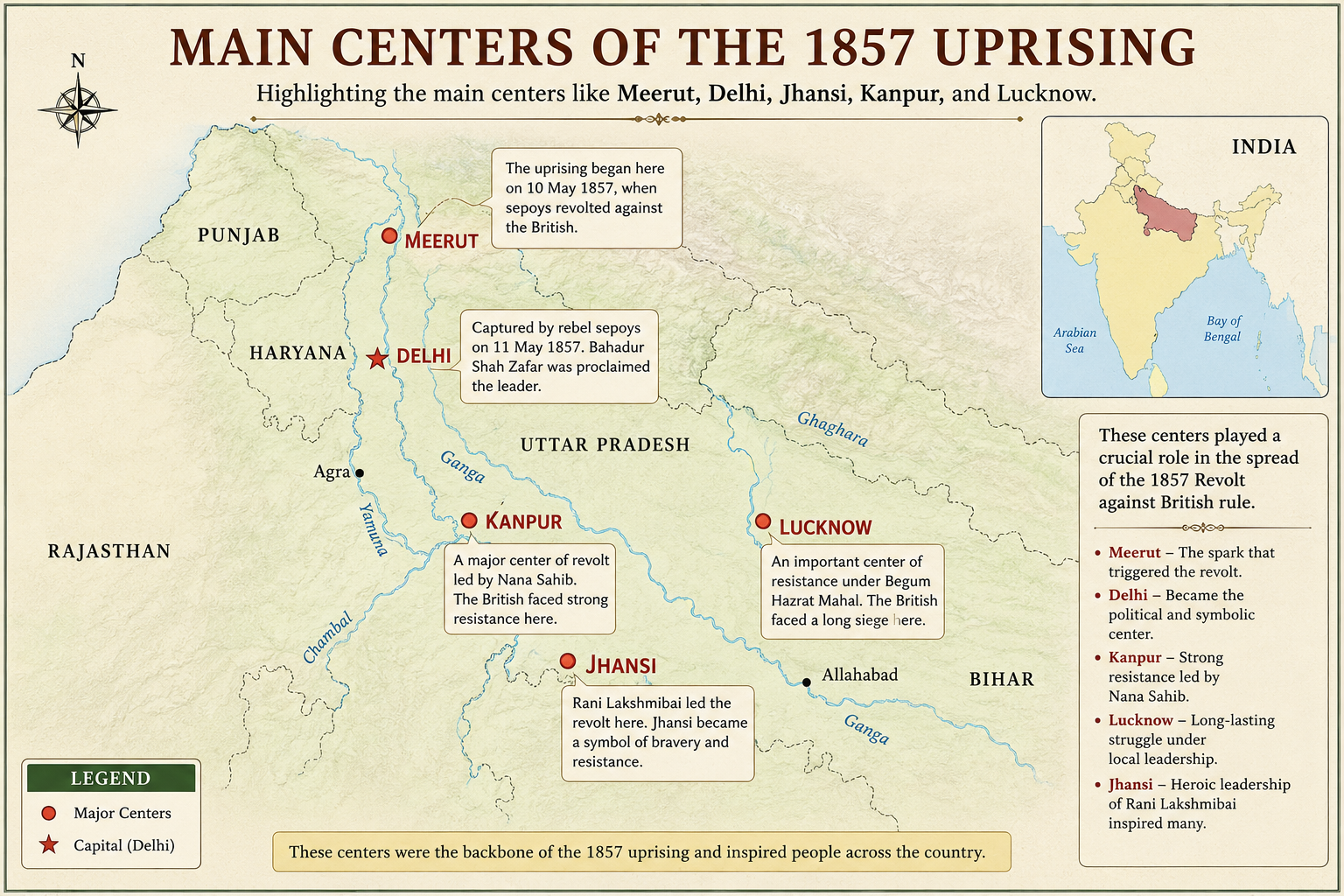
- The spread of the movement from Meerut to Delhi and beyond.
- The brutal suppression of the revolt by the British.
- The massive changes the British made to their administration after 1857 to ensure such a rebellion never happened again.
Historical Background: Policies and Popular Resistance
By the mid-19th century, the British East India Company had expanded its power across India. However, their policies were not just about trade anymore; they were about control.
- Nawabs and Rajas: Many lost their power. The British refused to recognize adopted heirs (e.g., Nana Saheb, the adopted son of Peshwa Baji Rao II).
- Peasants and Zamindars: They were burdened with high taxes and rigid methods of revenue collection. Many lost their ancestral lands to moneylenders.
- The Sepoys: Indian soldiers in the Company’s army were unhappy about their pay, allowances, and service conditions. New rules even forced them to cross the sea, which was against their religious beliefs at the time.
Detailed Explanation: The Causes of the Revolt
History doesn’t happen in a vacuum. There were four main categories of causes that led to the blast of 1857.
A. Political Causes
- Doctrine of Lapse: Introduced by Lord Dalhousie, this policy stated that if an Indian ruler died without a male heir, his kingdom would “lapse” into British hands. Satara, Sambalpur, and Jhansi were taken this way.
- Annexation of Awadh (1856): Awadh was taken over on the grounds of “misgovernment.” This deeply hurt the sentiments of the people, especially since many sepoys came from Awadh.
B. Social and Religious Causes
- The British began passing laws to stop Sati and encourage the remarriage of widows.
- English-language education was actively promoted.
- The activities of Christian missionaries were viewed with suspicion.
- The Law of 1850 allowed a Christian convert to inherit ancestral property, which many Indians saw as an attack on their religion.
C. Economic Causes
- High land revenue and harsh collection methods.
- The decline of Indian handicrafts because of cheap British machine-made goods.
D. The Immediate Cause: The Greased Cartridges
The spark that set the fire was the introduction of the Enfield Rifle. It was rumored that the cartridges were greased with the fat of cows and pigs.
- Cows are sacred to Hindus.
- Pigs are considered unclean by Muslims.
To load the rifle, soldiers had to bite off the ends of these cartridges. This united Hindu and Muslim soldiers against the British.
The Spread of the Rebellion: From Meerut to Delhi
The rebellion began on March 29, 1857, when a young soldier named Mangal Pandey attacked his officers in Barrackpore. He was later hanged.
- May 10, 1857: Sepoys in Meerut mutinied, killed officers, and marched to Delhi.
- May 11, 1857: They reached the Red Fort and proclaimed the aging Mughal Emperor, Bahadur Shah Zafar, as the Emperor of India. This gave the revolt a symbol of national unity.
Centers of the Revolt and Their Leaders
The revolt spread like wildfire across North India. Below is a table you must memorize for your exams:
| Center of Revolt | Leader | British Officer who Suppressed it |
|---|---|---|
| Delhi | Bahadur Shah Zafar & Bakht Khan | John Nicholson |
| Kanpur | Nana Saheb | Colin Campbell |
| Lucknow | Begum Hazrat Mahal | Colin Campbell |
| Jhansi | Rani Lakshmi Bai | Hugh Rose |
| Bareilly | Khan Bahadur | Colin Campbell |
| Bihar (Arrah) | Kunwar Singh | William Taylor |
The British Fight Back: Suppression
The British were shaken but not defeated. They brought in reinforcements from England and passed new laws to easily convict rebels.
- Delhi was recaptured in September 1857.
- Bahadur Shah Zafar was tried in court, sentenced to life imprisonment, and sent to Rangoon (Burma), where he died in 1862. His sons were shot before his eyes.
- Rani Lakshmi Bai was defeated and killed in June 1858.
- Tantia Tope escaped to the jungles but was later betrayed, captured, and executed in April 1859.
Aftermath: Changes in British Policy (1858 and After)
After the revolt, the British realized they could not rule India the same way. The Government of India Act of 1858 was passed.
Key Changes:
- Transfer of Power: Power was transferred from the East India Company to the British Crown.
- The Secretary of State: A member of the British Cabinet was appointed as the Secretary of State for India.
- Viceroy: The Governor-General was now called the Viceroy (the personal representative of the Crown).
- No More Annexations: The British promised they would no longer annex Indian states. Rulers were allowed to pass their kingdoms to heirs, including adopted sons.
- Military Changes: The proportion of Indian soldiers was reduced, and the number of European soldiers was increased. Regiments were recruited based on “martial races” (Sikhs, Gurkhas, Pathans).
- Religious Respect: The British decided to stop interfering in the social and religious customs of Indians.
Important Dates and Timeline
- 1848–1856: Lord Dalhousie implements the Doctrine of Lapse.
- 1856: Annexation of Awadh.
- March 29, 1857: Mangal Pandey’s incident at Barrackpore.
- May 10, 1857: Mutiny begins at Meerut.
- May 11, 1857: Rebels reach Delhi; Zafar proclaimed Emperor.
- September 1857: Delhi recaptured by the British.
- June 1858: Death of Rani Lakshmi Bai.
- August 1858: British Parliament passes the Act for better government of India.
- 1862: Death of Bahadur Shah Zafar in Rangoon.
Key Terms & Definitions
- Mutiny: When soldiers as a group disobey their officers in the army.
- Rebellion: Armed resistance against an established government or ruler.
- Firangis: A term used for foreigners (often in a derogatory sense for the British).
- Martial Races: A British theory that some groups of people were naturally more warlike than others (used for recruitment).
Important Questions and Answers (Exam Special)
Section A: MCQs
Q1. Who was the last Mughal Emperor of India?
A) Akbar II
B) Bahadur Shah Zafar
C) Shah Alam
D) Aurangzeb
Answer: B
Q2. Which state was annexed in 1856 on the grounds of misgovernment?
A) Jhansi
B) Satara
C) Awadh
D) Nagpur
Answer: C
Section B: Very Short Answer (1 Mark)
Q1. Who led the revolt in Bihar?
Answer: Kunwar Singh.
Q2. Who was the Governor-General during the 1857 revolt?
Answer: Lord Canning.
Section C: Short Answer (3 Marks)
Q1. What was the immediate cause of the 1857 revolt?
Answer: The immediate cause was the introduction of the Enfield Rifle. Rumors spread that the cartridges were greased with cow and pig fat. This offended both Hindu and Muslim religious sentiments, leading to a widespread mutiny.
Q2. List three centers of the revolt and their leaders.
Answer:
1. Jhansi: Rani Lakshmi Bai
2. Kanpur: Nana Saheb
3. Lucknow: Begum Hazrat Mahal
Section D: Long Answer (5 Marks)
Q1. Discuss the major changes introduced by the British after the 1857 revolt.
Answer: (Include points from Section 10: Transfer of power to the Crown, appointment of Viceroy, end of Doctrine of Lapse, restructuring the army, and policy of non-interference in religion).
Previous Year Board Questions (PYQs)
- UP Board: “1857 की क्रांति के मुख्य कारणों का वर्णन करें।” (Describe the main causes of the 1857 revolution.)
- Bihar Board: “रानी लक्ष्मीबाई ने अंग्रेजों के खिलाफ क्यों युद्ध किया?” (Why did Rani Lakshmi Bai fight against the British?)
- MP Board: “1857 के विद्रोह की असफलता के क्या कारण थे?” (What were the reasons for the failure of the 1857 revolt?)
Common Mistakes Students Make
- Confusing Leaders: Don’t mix up Nana Saheb (Kanpur) with Kunwar Singh (Bihar).
- The Date: Many students write that the revolt started in 1858. Remember, it ended or transformed in 1858; it started in May 1857.
- The Title: Bahadur Shah Zafar was the “Emperor,” not the “Viceroy.”
Memory Tricks (Mnemonics)
To remember the main leaders:
“Laxmi in Jhansi, Nana in Kan, Hazrat in Luck, Kunwar in Arrah.”
- Laxmi (Lakshmi Bai) – Jhansi
- Nana (Nana Saheb) – Kanpur
- Hazrat (Begum Hazrat Mahal) – Lucknow
- Kunwar (Kunwar Singh) – Arrah/Bihar
Chapter Summary / Quick Revision
- The revolt was a result of long-standing political, social, and economic grievances.
- The greased cartridges were the immediate spark.
- Meerut and Delhi were the initial hotspots.
- The revolt failed because it lacked a centralized plan and modern weapons, and many Indian rulers supported the British.
- 1858 marked the end of Company rule and the beginning of direct British Crown rule.
FAQs (People Also Ask)
Q1. Why is the 1857 revolt called the First War of Independence?
It was the first time that people from various sections (kings, sepoys, peasants) united across a large part of India to overthrow foreign rule.
Q2. Why did the 1857 revolt fail?
It lacked a unified leadership, modern weaponry, and support from all parts of India (South India and many princely states remained loyal to the British).
Q3. Who was the first martyr of the 1857 revolt?
Mangal Pandey is considered the first major martyr of the movement.
Conclusion
The Revolt of 1857 was a turning point in Indian history. Though it was suppressed, it planted the seeds of nationalism that eventually led to India’s independence in 1947. Keep revising these notes, practice the map work (locating Meerut, Delhi, Jhansi), and you will surely ace your history exam!
Keep Learning, Keep Growing!