
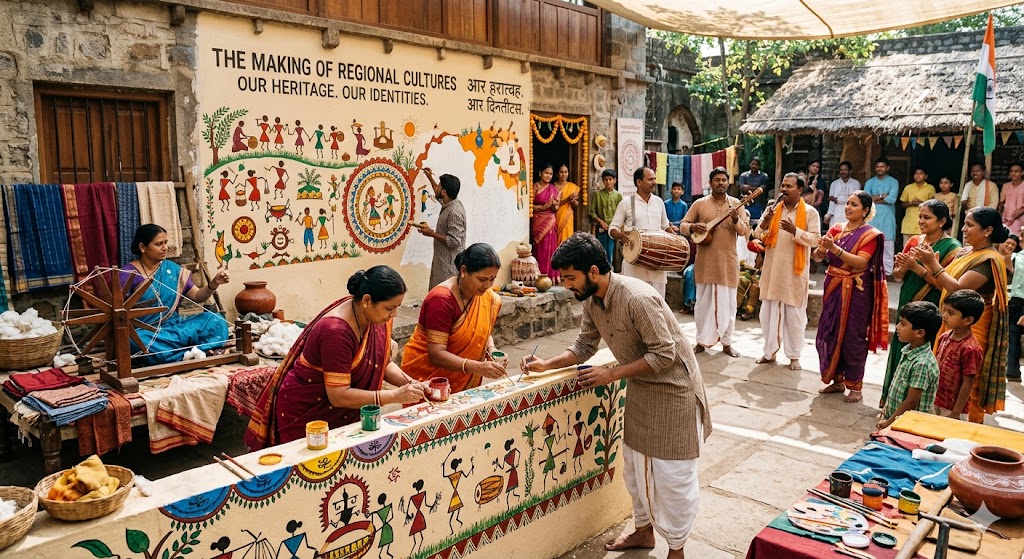
Introduction: Why Do We Speak Different Languages and Eat Different Foods?
Have you ever wondered why your friend from Kerala speaks Malayalam while you speak Hindi? Or why Bengal is famous for fish and rice, while Rajasthan is known for its spicy curries and heroic folk songs?
Welcome to Class 7 History Chapter 7: “The Making of Regional Cultures.” This chapter is a fascinating journey into how the diverse cultures of India—our languages, foods, dances, paintings, and religious traditions—developed over centuries.
For students across UP Board, Bihar Board, RBSE, and MP Board, this chapter is crucial for your social science exams because it connects history with the everyday life you see around you. The clothes we wear, the stories our grandparents tell, and even the design of our local temples have fascinating historical roots.
In this long-form guide, we will explore how Malayalam emerged as a language, why the Jagannath Temple in Puri is so powerful, how Kathak dance moved from temples to courts, and why Bengali Brahmins eat fish.
Chapter Overview: What Are Regional Cultures?
We often associate specific regions with specific things—Punjab with Bhangra, Kerala with Kathakali, Rajasthan with heroic ballads. But did these cultures exist forever? No!
Key Understanding: Regional cultures today are actually the result of complex intermixing of local traditions with ideas from other parts of the subcontinent. Some traditions are unique to one region, others are shared, and many have evolved over time, taking new forms.
This chapter covers six major themes:
1. The Cheras and the development of Malayalam
2. The Jagannatha cult in Puri, Odisha
3. Rajput traditions of heroism in Rajasthan
4. The story of Kathak dance
5. The tradition of miniature paintings
6. A closer look at Bengal—language, literature, pirs, temples, and food
Historical Background: How Did Regional Identities Form?
Before we explore each region, let us understand the broader historical processes that shaped regional cultures.
Part 1: The Cheras and the Development of Malayalam
The Chera Kingdom
When: 9th century CE
Where: Mahodayapuram, in present-day Kerala
What happened: The Chera rulers introduced the Malayalam language and script in their official inscriptions.
Why was this revolutionary? This was one of the earliest examples of a regional language being used in official records in the Indian subcontinent. Before this, most rulers used Sanskrit or Persian for administration.
The Sanskrit Connection
The Cheras did not reject Sanskrit; they drew upon Sanskritic traditions.
Kerala’s temple theatre borrowed stories from the Sanskrit epics (Ramayana and Mahabharata).
The first literary works in Malayalam were heavily influenced by Sanskrit.
A 14th-century text called the Lilatilakam was composed in Manipravalam.
What is Manipravalam?
Manipravalam literally means “diamonds and corals.”
It refers to the mixture of Sanskrit and Malayalam.
This shows how local and classical traditions blended together.
Exam Tip: Remember Manipravalam = Sanskrit + Malayalam.
Part 2: Rulers and Religious Traditions – The Jagannatha Cult
Who is Jagannatha?
Jagannatha literally means “Lord of the World.”
He is considered a form of Lord Vishnu.
Even today, the wooden image of Jagannatha is made by local tribal people, showing the deity’s connection with tribal traditions.
Why Did Conquerors Want Control of the Temple?
The temple had gained immense political authority. Whoever controlled the temple could claim legitimacy to rule over the local people.
Exam Tip: Conquerors tried to control the Jagannatha temple to gain political legitimacy and acceptance.
Part 3: The Rajputs and Traditions of Heroism
In the 19th century, the British called most of present-day Rajasthan “Rajputana”, meaning “land of the Rajputs.”
Who Were the Rajputs?
Rajput rulers cherished the ideal of the heroic warrior who fought bravely and preferred death over defeat.
Prithviraj Chauhan is one famous example.
How Were Their Stories Preserved?
Specially trained minstrels recited poems and songs about Rajput heroes.
These stories highlighted loyalty, friendship, bravery, and sacrifice.
Part 4: Beyond Regional Frontiers – The Story of Kathak
Origin of Kathak
The term Kathak comes from the word Katha, meaning “story.”
The Kathaks were originally storytellers in North Indian temples.
Evolution of Kathak
During the Bhakti movement, Kathak evolved into a distinct dance form.
Under Mughal patronage, it moved to royal courts and gained new artistic features.
Under Wajid Ali Shah of Lucknow, Kathak became a major art form.
Main Gharanas of Kathak
Jaipur Gharana: Known for complex dance patterns.
Lucknow Gharana: Famous for graceful expression and thumri.
Part 5: Painting for Patrons – The Tradition of Miniatures
Miniatures are small-sized paintings made using watercolours on paper or cloth.
Early Miniatures
The earliest miniatures were painted on palm leaves or wood and illustrated Jaina texts.
Mughal Patronage
Mughal emperors like Akbar, Jahangir, and Shah Jahan encouraged miniature painting.
Paintings included court scenes, battles, hunting scenes, and illustrations of manuscripts.
Basohli and Kangra Schools
Basohli: Bold colours and intense style.
Kangra: Soft blues and greens with lyrical themes inspired by Vaishnavism.
Part 6: A Closer Look – Bengal
The Growth of Bengali Language
Bengali developed gradually through Sanskrit influence, trade connections, and political developments.
By the 15th century, Bengali dialects united into a common literary language.
Early Bengali Literature
One category was influenced by Sanskrit and included translations of epics and Mangalakavyas.
The second category circulated orally and included Nath literature, fairy tales, and folk ballads.
Pirs and Temples
Pirs were spiritual leaders and teachers in Bengal.
Bengal temple architecture copied the roofs of thatched huts, resulting in do-chala and chauchala structures.
Fish as Food
Bengal’s riverine geography made fish an important part of the diet.
Because fish was central to Bengali life, even Bengali Brahmins accepted fish as food.
Important Dates and Events
9th century: Chera kingdom established; Malayalam introduced in inscriptions.
12th century: Jagannatha temple built at Puri.
1230 CE: Anangabhima III dedicated his kingdom to Jagannatha.
15th-16th century: Kathak evolved into a distinct dance form.
1739 CE: Nadir Shah invaded Delhi, leading to the development of the Kangra school.
Key Terms and Definitions
Regional Cultures: Distinctive traditions associated with specific regions.
Manipravalam: A blend of Sanskrit and Malayalam.
Jagannatha: A form of Vishnu worshipped in Puri.
Kathak: Classical dance form derived from storytelling traditions.
Miniatures: Small watercolour paintings.
Pir: Spiritual leader in Bengal.
Important Questions and Answers
What is Manipravalam?
Manipravalam literally means “diamonds and corals.” It refers to the mixture of Sanskrit and Malayalam. The Lilatilakam was written in this language.
Who were the Kathaks?
The Kathaks were storytellers in North Indian temples. Their storytelling traditions later developed into the classical dance form Kathak.
Why did conquerors try to control the Jagannatha temple?
Conquerors wanted to control the Jagannatha temple because it had become a symbol of political authority and legitimacy.
Chapter Summary / Quick Revision Notes
Kerala: Malayalam developed under the Cheras; Manipravalam blended Sanskrit and Malayalam.
Odisha: Jagannatha temple became a religious and political centre.
Rajasthan: Rajput heroism and minstrel traditions became famous.
Kathak: Evolved from temple storytelling to Mughal court dance.
Miniatures: Flourished under Mughal and regional patronage.
Bengal: Developed unique literature, temple styles, and food traditions.
Conclusion
“The Making of Regional Cultures” beautifully explains how India’s diversity evolved over centuries through the interaction of local traditions, royal patronage, religious practices, and everyday life.
From Malayalam literature to Kathak dance, from Rajput heroism to Bengal’s fish culture, every region developed its own unique identity while remaining connected to the wider Indian cultural tradition.
For students preparing for UP Board, Bihar Board, RBSE, and MP Board exams, this chapter is extremely important for understanding India’s cultural diversity and scoring well in history examinations.