
If you are a Class 7 student preparing for your History board exams under UP Board, Bihar Board, RBSE (Rajasthan), MP Board, Jharkhand Board, Chhattisgarh Board, Haryana Board, or Uttarakhand Board, this comprehensive guide on “Tracing Changes Through a Thousand Years” (NCERT Our Pasts-II, Chapter 1) is exactly what you need.
This chapter is not just an introduction to medieval Indian history—it is the foundation upon which your entire Class 7 History syllabus is built. Understanding how historians study the past, how meanings of words change over time, and how Indian society transformed between 700 CE and 1750 CE will help you score excellent marks in your board exams.
In this article, you will find:
- Complete chapter summary and detailed explanations
- Important dates, personalities, and events
- MCQs, short answers, long answers, assertion-reason, and source-based questions
- Previous year board exam style questions for Hindi Belt boards
- Memory tricks and mnemonics for quick revision
- Common mistakes students make and how to avoid them
Let’s dive into this fascinating journey through a thousand years of Indian history!
Chapter Overview: What is “Tracing Changes Through a Thousand Years”?
Tracing Changes Through a Thousand Years is the first chapter of NCERT Class 7 History (Our Pasts-II). It introduces students to the medieval period of Indian history, spanning from approximately 700 CE to 1750 CE.
The chapter explains:
- How historians study and divide history into periods
- Why the meanings of historical terms change over time
- What new social, political, religious, and technological developments occurred during this period
- How new groups like the Rajputs, Marathas, Sikhs, and Jats emerged
- The importance of manuscripts, archives, cartography, and chronicles as historical sources
Board Exam Relevance: This chapter is extremely important because it sets the conceptual foundation for all subsequent chapters. Questions from this chapter appear regularly in UP Board, Bihar Board, RBSE, and MP Board exams in various formats—MCQs, fill-in-the-blanks, short answers (2-3 marks), and long answers (5 marks).
Historical Background: Understanding the Medieval Period
What is the Medieval Period in Indian History?
The period from the second half of the 8th century (around 700 CE) to the first half of the 18th century (around 1750 CE) is known as the medieval period of Indian history.
During these 1000 years, Indian society witnessed dramatic transformations:
- Technological advancements like the Persian wheel, spinning wheel, and firearms
- New crops and beverages such as potatoes, corn, chillies, tea, and coffee
- Religious developments including the Bhakti movement and the spread of Islam
- Political changes with the rise of pan-regional empires like the Cholas, Khaljis, Tughluqs, and Mughals
- Social restructuring with the emergence of new groups like Rajputs and the regulation of Jatis
Why Did British Historians Divide History into “Hindu,” “Muslim,” and “British” Periods?
In the middle of the 19th century, British historians divided Indian history into three periods:
- Hindu Period (Ancient India)
- Muslim Period (Medieval India)
- British Period (Modern India)
This division was based on the religion of the rulers and was highly problematic because:
- It ignored the rich diversity of Indian culture
- It suggested that only religion mattered, not economic or social changes
- It created a false impression that all rulers of a particular religion were the same
Today, historians use economic, social, and cultural factors to divide history, not just religion.
Detailed Explanation of the Chapter
1. New and Old Terminologies
One of the most fascinating aspects of studying history is discovering how the meanings of words change over time. Let’s explore some important terms:
The Changing Meaning of “Hindustan”
Key Point: The term “Hindustan” was NEVER used in the political and national sense as “India” is used today. South India was never included in the medieval concept of Hindustan.
“Foreigner” in the Past vs. Today
Medieval Meaning: Any stranger who was not part of a specific society or village. A city-dweller might consider a forest-dweller a “foreigner” (called Pardesi in Hindi or Ajnabi in Persian).
Modern Meaning: Someone who is not a citizen of India.
Other Important Terms
Rajput: Son of a ruler (Rajaputra); warriors claiming Kshatriya status → A caste/community from Rajasthan and North India.
Jati: Sub-caste based on occupation and economic status → Often used interchangeably with caste.
Patron: Wealthy supporter of artists, scholars, or nobles → Someone who supports a cause or person.
Archive: Place where manuscripts and documents were stored → Official repository of historical records.
2. Historians and Their Sources
Archaeological Sources: Monuments and Temples (Qutub Minar, temples of Khajuraho), Coins, Inscriptions (writings on stone, pillars, copper plates), Paintings (miniature paintings used in manuscripts).
Literary Sources: Manuscripts (hand-written scripts on palm leaf, bark, or paper), Chronicles (records of kings’ rules and court life, e.g., Tarikh-i-Firoz Shahi by Ziyauddin Barani), Travelogues (accounts of foreign travelers like Ibn Battuta and Marco Polo), Archives (places where manuscripts and documents are preserved).
Important: Paper became cheaper and widely available after the 13th century, leading to a dramatic increase in textual records. Before paper, a scholar might wash off writing from an old manuscript to reuse it! By the 14th century, paper was so common that shopkeepers used it to wrap food.
3. Difficulties Historians Face with Manuscripts
Historians face several challenges when using manuscripts:
- Hand-written copies: Scribes copied manuscripts by hand, introducing small changes—sometimes a word, sometimes entire sentences
- No original copies: The author’s original manuscript is rarely found; historians must compare multiple copies to guess the original text
- Deterioration: Many manuscripts are in pathetic condition when discovered
- Language changes: Medieval Persian is different from modern Persian in grammar and vocabulary
4. New Social and Political Groups
The Rajputs
Name derived from “Rajaputra” (son of a ruler). Between the 8th and 14th centuries, applied to warriors claiming Kshatriya caste status. Known for chivalry, bravery, and loyalty. Included rulers, chieftains, soldiers, and commanders.
Other Important Groups
Marathas: Asserted political importance during this period.
Sikhs: Emerged as a distinct religious and political community.
Jats: Agricultural community that gained political importance.
Ahoms: Ruled Assam and parts of Northeast India.
Kayasthas: Scribes and secretaries who became politically important.
Jatis and Jati Panchayat
Jatis were sub-castes arranged hierarchically based on occupation and economic status. Ranks were not permanent and varied by region. Each Jati framed its own rules enforced by an assembly of elders called the Jati Panchayat. Jatis also had to follow village rules governed by a chieftain.
5. Region and Empire: Understanding Pan-Regional Empires
A pan-regional empire is an empire that spans several diverse regions with different cultures, languages, and geographies.
Examples of Pan-Regional Empires in India: Cholas (9th-13th century, South India, Sri Lanka, Southeast Asia), Khaljis (1290-1320, North India, parts of South India), Tughluqs (1320-1414, large parts of India including South), Mughals (1526-1857, almost entire Indian subcontinent).
Key Characteristics: These empires were not always stable or successful. Regions maintained their distinctiveness while sharing administrative and cultural traditions. Local languages and cultures continued to flourish alongside imperial culture.
6. Technological and Agricultural Changes
Persian Wheel: Irrigation → Improved agriculture, increased food production.
Spinning Wheel: Weaving → Boosted textile production and trade.
Firearms: Combat → Changed warfare and military tactics.
New Crops and Beverages Introduced: Potatoes, Corn, Chillies, Tea, Coffee. These came from different parts of the world through trade and migration.
7. Religious Developments
Changes in Hinduism
Worship of new deities, construction of temples by royalty, growing importance of Brahmanas (priests) due to their Sanskrit knowledge, emergence of Bhakti movement—the idea of a loving, personal deity reachable without priests or elaborate rituals.
Arrival of Islam
Merchants and migrants brought the Quran’s teachings to India in the 7th century.
Two main sects:
- Shia Muslims: Believed Prophet Muhammad’s son-in-law Ali was the legitimate leader
- Sunni Muslims: Accepted the authority of early leaders (Khalifas)
Ulama (Ulemas): Learned theologians and jurists who advised rulers.
8. Maps and Cartography
Al-Idrisi’s Map (1154 CE)
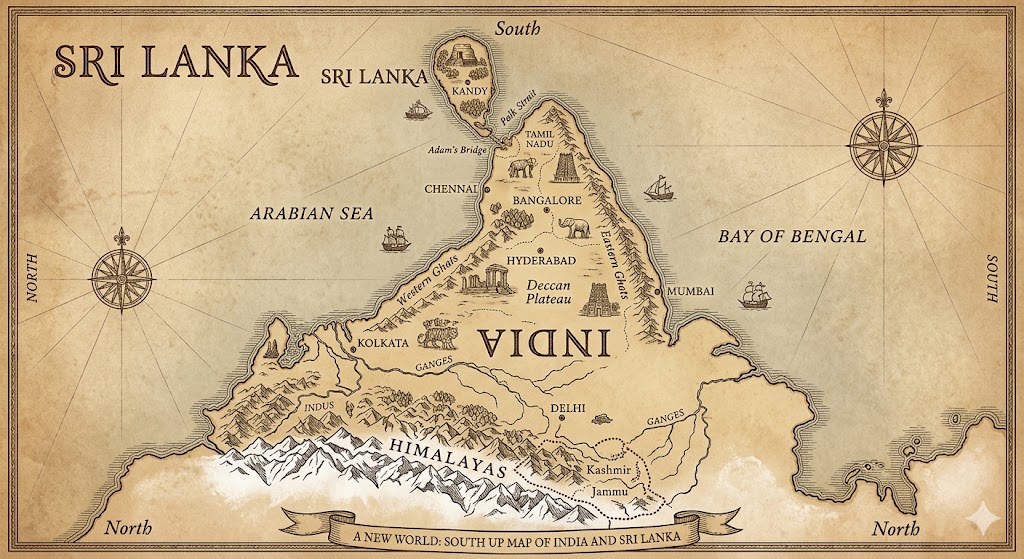
Arab geographer who made a world map. Placed South India where North India should be. Sri Lanka was shown at the top. Place names in Arabic (e.g., Kanauj spelled as Qanauj).
French Cartographer’s Map (1720s)
Made about 600 years later. Much more detailed, especially coastal areas. Used by European sailors and merchants. More familiar to modern eyes.
Important: The science of cartography was different in different periods. Historians must be sensitive to the historical background when reading old maps.
Important Dates and Events
700 CE – Beginning of medieval period in India
7th Century – Islam reached India through merchants and migrants
1154 CE – Al-Idrisi made his famous map
13th Century – Minhaj-i-Siraj first used the term “Hindustan”
1356 – Ziyauddin Barani wrote his chronicle
14th Century – Amir Khusrau used the word “Hind”
16th Century – Babur used “Hindustan” to describe the subcontinent
1720s – French cartographer made detailed map of India
Mid-19th Century – British historians divided Indian history into Hindu, Muslim, and British periods
1750 CE – End of medieval period; beginning of modern period
Important Personalities
Al-Idrisi – Arab cartographer who made map in 1154 CE
Minhaj-i-Siraj – 13th-century Persian chronicler; first to use “Hindustan”
Amir Khusrau – 14th-century poet; used the word “Hind”
Babur – Mughal emperor; used “Hindustan” to describe geography and culture
Ziyauddin Barani – 14th-century chronicler; wrote Tarikh-i-Firoz Shahi in 1356
Ghiyasuddin Balban – Delhi Sultan; empire stretched from Bengal to Afghanistan
Kalhana – Wrote Rajatarangini (history of Kashmir kings)
Guillaume de l’Isle – French cartographer (1720s)
Timeline of Events (700 CE – 1750 CE)
700 CE ──┬── Beginning of Medieval Period
├── Islam reaches India
800 CE ──┤
├── Rise of Rajputs as warrior class
900 CE ──┤
├── Chola Empire becomes pan-regional
1000 CE ──┤
│
1100 CE ──┤
├── Al-Idrisi makes world map (1154)
│
1200 CE ──┤
├── Delhi Sultanate established
├── Minhaj-i-Siraj uses “Hindustan”
│
1300 CE ──┤
├── Ziyauddin Barani writes chronicle (1356)
├── Amir Khusrau uses “Hind”
│
1400 CE ──┤
│
1500 CE ──┤
├── Babur establishes Mughal Empire (1526)
├── Babur describes “Hindustan” in memoirs
│
1600 CE ──┤
├── Mughal Empire at its peak
│
1700 CE ──┤
├── French cartographer makes map (1720s)
│
1750 CE ──┴── End of Medieval Period
Causes and Effects
Major Causes of Changes (700-1750 CE)
Interaction with foreigners: Trade, migration, and invasions brought new ideas, technologies, and religions.
Technological innovations: Persian wheel, spinning wheel, firearms transformed agriculture, economy, and warfare.
Religious movements: Bhakti movement and Sufism challenged orthodox practices.
Rise of new social groups: Rajputs, Jats, Marathas, Sikhs claimed political power.
Availability of paper: Led to increased record-keeping and literary production.
Patronage by rulers: Kings supported scholars, artists, and religious institutions.
Major Effects of These Changes
Formation of pan-regional empires: Cholas, Khaljis, Tughluqs, Mughals unified large territories.
Cultural synthesis: Blending of Hindu and Islamic traditions in art, architecture, music.
Economic prosperity: Agriculture and trade flourished, attracting European trading companies.
Social stratification: Jati system became more complex and regulated.
Increased documentation: More historical sources available for this period than ancient period.
Regional distinctiveness: Local languages and cultures maintained their identity.
Key Terms and Definitions
Medieval Period: Period from 700 CE to 1750 CE in Indian history
Cartographer: A person who makes maps
Manuscript: Hand-written script/document on palm leaf, bark, or paper
Archive: Place where manuscripts and documents are preserved
Chronicle: Record of a king’s rule and court life
Scribe: Person who copied manuscripts by hand
Patron: Wealthy supporter of artists, scholars, or nobles
Pan-Regional Empire: Empire spanning several diverse regions
Jati: Sub-caste based on occupation and economic status
Jati Panchayat: Assembly of elders regulating Jati affairs
Bhakti: Devotion to a loving, personal deity
Ulama/Ulema: Learned theologians and jurists in Islam
Shikaste: A dense, difficult writing style in Persian
Prashasti: Record written in praise of rulers
Numismatics: Study of coins
Epigraphy: Study of inscriptions
Ajnabi: Persian word for foreigner
Pardesi: Hindi word for foreigner/stranger
Important Questions and Answers
A. Multiple Choice Questions (MCQs)
Q1. When did Arab geographer Al-Idrisi make the map of the world?
A. 1177 CE B. 1154 CE ✓ C. 1274 CE D. 1264 CE
Q2. Who is a cartographer?
A. A person who studies geography B. A person who studies maps C. A person who makes maps ✓ D. A person who studies typography
Q3. How is Medieval Persian different from modern Persian?
A. In terms of spelling B. In meanings C. In script D. In grammar and vocabulary ✓
Q4. The thirteenth-century chronicler Minhaj-i-Siraj wrote in:
A. Urdu B. Arabic C. Persian ✓ D. Sanskrit
Q5. What was Hindustan according to Minhaj-i-Siraj?
A. Indian subcontinent B. Himalayas to Nilgiris C. Coastal belt of India D. Areas of Punjab, Haryana, and lands between Ganga and Yamuna ✓
Q6. Which emperor used the term Hindustan to describe the geography, fauna, and culture of the subcontinent?
A. Babur ✓ B. Humayun C. Akbar D. Jahangir
Q7. Fourteenth-century poet Amir Khusrau used the word:
A. Hindustan B. Hind ✓ C. Bharat D. India
Q8. In the medieval period, a “foreigner” was:
A. Someone from another country B. Anybody who was not Hindustani C. Any stranger who was not part of a specific society or culture ✓ D. Someone from another continent
Q9. A place where documents and manuscripts are stored is called:
A. Library B. Archive ✓ C. Temple D. Museum
Q10. The fourteenth-century chronicler Ziyauddin Barani wrote his chronicle first in:
A. 1356 ✓ B. 1420 C. 1234 D. 1435
Q11. Between 700 and 1750, which group became particularly important?
A. Marathas B. Rajputs ✓ C. Mughals D. British
Q12. A group of warriors who claimed Kshatriya caste status:
A. Brahmanas B. Vaishyas C. Kshatriyas ✓ D. Shudras
Q13. The ‘Persian wheel’ was used in:
A. Warfare B. Weaving C. Irrigation ✓ D. Mining
Q14. Who divided Indian history into Hindu, Muslim, and British periods in the 19th century?
A. Indian historians B. Muslim historians C. Mughal historians D. British historians ✓
Q15. Which of the following is the holy book of Muslims?
A. Gita B. Ramayan C. Guru Granth Sahib D. Quran ✓
Q16. Who accepted the authority of early Muslim leaders (Khalifas)?
A. Sunnis ✓ B. Shias C. Both D. None
Q17. What does the term “pan-regional empire” mean?
A. Empire of one religion B. Empire spanning diverse regions ✓ C. Economic organization D. Small kingdom
Q18. Which new crops arrived in the subcontinent during this period?
A. Corn B. Coffee C. Potatoes D. All of these ✓
Q19. The word “Rajput” was derived from:
A. Rajasthan B. Rajputra ✓ C. Rajputana D. Rajya
Q20. Who used to copy down manuscripts?
A. Scribes ✓ B. Archaeologists C. Cartographers D. Historians
(Sources: SuccessCDs, StudiesToday, TheStudyPath)
B. Very Short Answer Questions (1 Mark)
Q1. Who was Al-Idrisi?
Ans: Al-Idrisi was an Arab geographer who made a map of the world in 1154 CE.
Q2. What is an archive?
Ans: An archive is a place where old and new documents and manuscripts are collected and preserved.
Q3. Who used the term “Hindustan” for the first time?
Ans: Minhaj-i-Siraj, a 13th-century Persian chronicler.
Q4. What were scribes?
Ans: Scribes were people who copied manuscripts by hand before the invention of the printing press.
Q5. What is a chronicle?
Ans: A chronicle is a record of the rule of kings and life at the court.
Q6. Name the new crops introduced during this period.
Ans: Potatoes, corn, chillies, tea, and coffee.
Q7. What is the meaning of “Bhakti”?
Ans: The idea of a loving, personal deity that devotees could reach without priests or elaborate rituals.
Q8. Who were the Ulama?
Ans: The learned theologians and jurists in Islam.
Q9. What is a “Jati Panchayat”?
Ans: An assembly of elders that regulated the affairs of a Jati (sub-caste).
Q10. When did the medieval period begin in India?
Ans: The 8th century (around 700 CE).
C. Short Answer Questions (2-3 Marks)
Q1. How did scribes copy manuscripts? What was the drawback?
Ans: Scribes copied manuscripts by hand as there was no printing press. Drawback: As they copied, they introduced small changes—a word here, a sentence there. Over centuries, these differences grew so much that different versions of the same text became significantly different.
Q2. List some technological changes associated with this period.
Ans: 1. Persian wheel in irrigation, 2. Spinning wheel in weaving, 3. Firearms in combat.
Q3. What does “pan-regional empire” mean? Give examples.
Ans: A pan-regional empire is an empire spanning diverse regions with different cultures and geographies. Examples: Cholas, Khaljis, Tughluqs, and Mughals.
Q4. How were the affairs of Jatis regulated?
Ans: Jatis framed their own rules and regulations. These were enforced by an assembly of elders called the Jati Panchayat. Jatis also had to follow the rules of their villages, governed by a chieftain.
Q5. Who was considered a “foreigner” in the past? Give an example.
Ans: In the medieval period, a foreigner was any stranger not belonging to a specific society or village. For example, a city-dweller might regard a forest-dweller as a foreigner, even though both lived in the same region.
Q6. What is the difference between Al-Idrisi’s map and the French cartographer’s map?
Ans: Al-Idrisi (1154 CE): South India at the top, Sri Lanka at the top, names in Arabic, less detailed. French Cartographer (1720s): More familiar orientation, detailed coastal areas, used by European sailors, more accurate and detailed.
Q7. How have the meanings of “Hindustan” changed over the centuries?
Ans: See the table in the “New and Old Terminologies” section above.
Q8. What difficulties do historians face in using manuscripts?
Ans: 1. Manuscripts were hand-written, making them difficult to read, 2. No original copies available—only copies made by scribes, 3. Scribes introduced changes while copying, 4. Historians must read different versions to guess the original text.
D. Long Answer Questions (5 Marks)
Q1. Explain how the term “Hindustan” changed over time.
Ans: The meaning of “Hindustan” evolved significantly over centuries: 13th Century: Minhaj-i-Siraj, a Persian chronicler, first used the term. For him, it meant the areas of Punjab, Haryana, and the lands between the Ganga and Yamuna rivers—territories under the Delhi Sultanate. It was a political and geographical term, not a national one. South India was never included. 14th Century: The poet Amir Khusrau used the word “Hind” to describe the culture and people of the Indus region. 16th Century: Babur, the Mughal emperor, used “Hindustan” to describe the geography, fauna, flora, and culture of the entire subcontinent. Modern Times: Today, “Hindustan” refers to the entire nation of India, often used with patriotic sentiment. Important Point: Unlike modern “India,” the medieval “Hindustan” never carried political or national meanings. Its meaning expanded from a specific region to the entire subcontinent over time.
Q2. Describe the major religious developments during the medieval period.
Ans: The medieval period witnessed significant religious transformations: In Hinduism: Worship of new deities emerged, temples were constructed by royalty (e.g., Khajuraho temples), Brahmanas gained importance due to their Sanskrit knowledge and received patronage from rulers, the Bhakti movement emerged—the idea that devotees could reach a loving, personal deity without priests or elaborate rituals. In Islam: Merchants and migrants brought the Quran’s teachings to India in the 7th century, Islam spread gradually across the subcontinent, two main sects developed: Shia (believing Ali was the rightful leader) and Sunni (accepting early Khalifas), Ulama (learned theologians) advised rulers on religious matters. Sufism (mystical Islam) also gained followers. Impact: These developments led to both religious synthesis and occasional conflict, shaping Indian culture profoundly.
Q3. How do historians divide the past into periods? Do they face any problems?
Ans: Historians divide the past into periods based on: Economic factors (agriculture, trade, industry), Social factors (caste, class, gender relations), Cultural factors (religion, art, literature), Political factors (types of government, empires). Problems faced: 1. No clear boundaries: Economic and social changes happen gradually, making it hard to draw definite lines between periods, 2. British classification flaws: The Hindu-Muslim-British division ignored India’s diversity and focused only on rulers’ religion, 3. Regional variations: Changes happened at different times in different regions, 4. Modern bias: The term “medieval” sometimes carries negative connotations of being “backward,” which is misleading as this period saw significant progress.
Q4. Explain the rise and importance of Rajputs during the medieval period.
Ans: The Rajputs were one of the most important groups to emerge during the medieval period: Etymology: The word comes from “Rajaputra” (son of a ruler), Time period: Between the 8th and 14th centuries, the term was applied to a group of warriors claiming Kshatriya caste status, Composition: Included not just rulers and chieftains but also soldiers and commanders who served in armies across the subcontinent, Code of conduct: Known for chivalry, extreme bravery, and loyalty, Political importance: Many Rajput kingdoms emerged across North and Central India, playing crucial roles in resisting foreign invasions and maintaining regional power.
Q5. Why is our information about the medieval period much more than the ancient period?
Ans: We know more about the medieval period because: 1. Increased textual records: The number and variety of written records increased dramatically between 700-1750 CE, 2. Availability of paper: Paper became cheaper and more widely available, replacing palm leaf and bark, 3. Types of records: People wrote holy texts, chronicles, letters, saints’ teachings, petitions, judicial records, and tax registers, 4. Preservation: Manuscripts were collected by wealthy people, rulers, monasteries, and temples and placed in libraries and archives, 5. Foreign accounts: Many foreign travelers visited India and wrote detailed travelogues about politics, trade, and society, 6. Archaeological evidence: More monuments, coins, and inscriptions survive from this period.
E. Assertion and Reason Questions
Q1. Assertion (A): The British historians divided Indian history into Hindu, Muslim, and British periods.
Reason (R): This division was based on the religion of the rulers and ignored other developments.
(a) Both A and R are true, and R is the correct explanation of A ✓
(b) Both A and R are true, but R is not the correct explanation of A
(c) A is true, but R is false
(d) A is false, but R is true
Q2. Assertion (A): Original manuscripts of authors are rarely found today.
Reason (R): Scribes introduced changes while copying manuscripts by hand.
(a) Both A and R are true, and R is the correct explanation of A ✓
(b) Both A and R are true, but R is not the correct explanation of A
(c) A is true, but R is false
(d) A is false, but R is true
Q3. Assertion (A): The term “Hindustan” in the 13th century did not include South India.
Reason (R): Minhaj-i-Siraj used it only for areas under the Delhi Sultanate.
(a) Both A and R are true, and R is the correct explanation of A ✓
(b) Both A and R are true, but R is not the correct explanation of A
(c) A is true, but R is false
(d) A is false, but R is true
Q4. Assertion (A): Jatis had their own rules and regulations.
Reason (R): Jati Panchayat enforced these regulations.
(a) Both A and R are true, and R is the correct explanation of A ✓
(b) Both A and R are true, but R is not the correct explanation of A
(c) A is true, but R is false
(d) A is false, but R is true
F. Source-Based Questions
Source 1: “In the middle of the thirteenth century, a scholar wanted to copy a book. But he did not have enough paper. So he washed the writing off a manuscript he did not want, dried the paper, and used it.”
Q1. What does this source tell us about the value of paper in the 13th century?
Ans: Paper was extremely valuable and scarce in the 13th century. Scholars had to reuse old manuscripts by washing off previous writing.
Q2. How did the situation change by the 14th century?
Ans: By the 14th century, paper became so common that shopkeepers used it to wrap food, showing it was no longer precious.
Source 2: “The term ‘Hindustan’ was used in the 13th century by Minhaj-i-Siraj to denote areas of Punjab, Haryana, and the lands between the Ganga and Yamuna.”
Q1. Who was Minhaj-i-Siraj?
Ans: A 13th-century Persian chronicler who wrote about the Delhi Sultanate.
Q2. Did his definition of Hindustan include South India?
Ans: No, South India was never included in the medieval concept of Hindustan.
Source 3: “As scribes copied manuscripts, they also introduced small changes—a word here, a sentence there.”
Q1. Why did scribes copy manuscripts?
Ans: Because there was no printing press, and books had to be reproduced by hand.
Q2. What problem did this create for historians?
Ans: Over centuries, copies became significantly different from the original, making it difficult to know what the author actually wrote.
Previous Year Board Questions (Hindi Belt Boards Style)
UP Board Style Questions
Q1. (2 Marks) What is meant by “pan-regional empire”? Give two examples.
Ans: A pan-regional empire spans several diverse regions. Examples: Mughal Empire and Chola Empire.
Q2. (3 Marks) How did the meaning of “Hindustan” change from the 13th to the 16th century?
Ans: (Refer to the long answer above)
Q3. (5 Marks) Describe the difficulties historians face in using manuscripts as sources.
Ans: (Refer to the long answer above)
Bihar Board Style Questions
Q1. (1 Mark each)
(a) Who wrote Tarikh-i-Firoz Shahi? Ans: Ziyauddin Barani
(b) What is the Persian word for foreigner? Ans: Ajnabi
(c) When did the medieval period begin? Ans: 8th century/700 CE
Q2. (3 Marks) Explain the role of Jati Panchayat in medieval society.
Ans: Jati Panchayat was the assembly of elders that framed and enforced rules for Jati members, regulating social conduct and maintaining caste boundaries.
RBSE (Rajasthan Board) Style Questions
Q1. (2 Marks) Who were the Rajputs? How did they emerge as an important group?
Ans: Rajputs were warriors claiming Kshatriya status, derived from “Rajaputra.” They emerged between the 8th-14th centuries as rulers, soldiers, and commanders known for bravery.
Q2. (5 Marks) “The British classification of Indian history is problematic.” Explain.
Ans: (Discuss the Hindu-Muslim-British division, its focus on rulers’ religion, ignoring diversity and other developments)
MP Board Style Questions
Q1. (1 Mark) Fill in the blanks:
(a) The spinning wheel was used in _______. Ans: Weaving
(b) Archives are places where _______ are kept. Ans: Manuscripts
(c) The holy book of Muslims is _______. Ans: Quran
Q2. (3 Marks) What technological changes occurred between 700-1750 CE? How did they affect society?
Ans: Persian wheel (irrigation), spinning wheel (weaving), firearms (combat). These improved agriculture, boosted textile trade, and changed warfare.
Important Exam Notes
How to Write Perfect Answers in Board Exams
For 1-Mark Questions: Be precise and direct, use correct spellings of names (e.g., “Minhaj-i-Siraj” not “Minhaj Siraj”), mention dates where possible.
For 2-3 Mark Questions: Write 3-4 points, use bullet points for clarity, include at least one example.
For 5-Mark Questions: Write an introduction, 4-5 main points with explanations, and a conclusion, use paragraphs or numbered points, include dates, names, and examples to show depth.
Key Points to Remember
1. “Hindustan” NEVER included South India in medieval times
2. Babur used “Hindustan” for geography/culture, NOT in a political sense
3. Scribes introduced changes—original manuscripts are rarely found
4. Paper became common after the 13th century
5. British periodization is outdated—modern historians use economic/social factors
6. Jati ranks were NOT permanent—they varied by region and occupation
7. Rajputs included soldiers and commanders, not just kings
Common Mistakes Students Make
Mistake: Writing “Hindustan” always meant India → Correct Approach: Explain how the meaning changed over time
Mistake: Saying medieval period had no progress → Correct Approach: Highlight technological and cultural advancements
Mistake: Confusing “scribe” with “author” → Correct Approach: Scribes COPIED; authors ORIGINALLY wrote
Mistake: Thinking Jati = Caste → Correct Approach: Jatis were sub-castes based on occupation
Mistake: Believing British periodization is correct → Correct Approach: Explain why it is problematic
Mistake: Forgetting dates → Correct Approach: Memorize key dates: 700 CE, 1154, 1356, 1526
Mistake: Mixing up Shia and Sunni → Correct Approach: Shia = Ali’s authority; Sunni = Khalifas’ authority
Memory Tricks and Mnemonics
Remembering Key Dates: “7-11-13-14-16”: 700 CE (start), 1154 (Al-Idrisi), 1356 (Barani), 14th century (Amir Khusrau), 16th century (Babur)
Remembering the Three Technologies: “PSF”: Persian wheel, Spinning wheel, Firearms. Or: “Paani, Kapda, Larai” (Water, Cloth, Fight)
Remembering British Periodization: “HMB”: Hindu, Muslim, British (like “Hindi Medium Board” 😊)
Remembering “Hindustan” Users: “MBA”: Minhaj-i-Siraj, Babur, Amir Khusrau (in order of time)
Remembering New Crops: “PCTC”: Potatoes, Corn, Tea, Coffee, Chillies
Remembering Pan-Regional Empires: “ChKTuM”: Cholas, Khaljis, Tughluqs, Mughals
Chapter Summary / Quick Revision Notes
In Just 10 Points:
1. Period: 700 CE to 1750 CE is the medieval period of Indian history
2. Sources: Manuscripts, inscriptions, coins, monuments, chronicles, and travelogues
3. Terminologies: Meanings of words like “Hindustan” and “foreigner” changed over time
4. Technology: Persian wheel, spinning wheel, firearms transformed society
5. Crops: Potatoes, corn, chillies, tea, coffee arrived in India
6. Social Groups: Rajputs, Marathas, Sikhs, Jats, and Kayasthas emerged
7. Jatis: Sub-castes regulated by Jati Panchayat; ranks varied by occupation
8. Empires: Cholas, Khaljis, Tughluqs, and Mughals built pan-regional empires
9. Religion: Bhakti movement in Hinduism; Islam spread with Shia-Sunni divisions
10. Historiography: British Hindu-Muslim-British division is outdated; modern historians use economic-social factors
Frequently Asked Questions (FAQs)
Q1. Who was considered a “foreigner” in the past?
Ans: In the medieval period, a foreigner was any stranger who did not belong to a specific society or village. For example, a city-dweller might regard a forest-dweller as a foreigner. Two people from the same village were not foreigners, even if they had different religions or castes.
Q2. What is the difference between ancient and medieval periods in Indian history?
Ans: The ancient period (before 700 CE) saw early empires like Mauryas and Guptas, while the medieval period (700-1750 CE) witnessed pan-regional empires, new technologies, religious movements like Bhakti, and increased documentation.
Q3. Why do historians face difficulties with manuscripts?
Ans: Because they were hand-copied by scribes who introduced changes, original copies are rarely found, and different versions of the same text exist, making it hard to determine the author’s original words.
Q4. What is a pan-regional empire?
Ans: An empire that spans several diverse regions with different cultures, languages, and geographies, such as the Mughal or Chola empires.
Q5. How did paper change historical record-keeping?
Ans: As paper became cheaper after the 13th century, people wrote more records—chronicles, letters, tax registers, and religious texts—dramatically increasing available historical information.
Q6. What were the major religious developments in the medieval period?
Ans: Worship of new deities, temple construction by royalty, growing Brahmana importance, emergence of Bhakti, and the spread of Islam with its Shia-Sunni divisions.
Q7. Who were the Rajputs?
Ans: Warriors claiming Kshatriya status, derived from “Rajaputra.” They included rulers, soldiers, and commanders known for bravery and loyalty between the 8th-14th centuries.
Q8. What is the importance of archives?
Ans: Archives preserve manuscripts and documents, allowing historians to study primary sources and reconstruct the past accurately.
Q9. Why is the British classification of Indian history criticized?
Ans: It divided history based only on rulers’ religion (Hindu, Muslim, British), ignoring economic, social, and cultural developments, and India’s rich diversity.
Q10. Where can I download Tracing Changes Through a Thousand Years notes PDF?
Ans: You can find free PDF notes on educational websites like Vedantu, BYJU’S, and LearnCBSE. Always prefer NCERT-based notes for board exam preparation.
Conclusion
Tracing Changes Through a Thousand Years is a foundational chapter that opens the door to understanding medieval Indian history. By mastering the concepts of changing terminologies, new social groups, technological advancements, religious developments, and historical sources, you build a strong base for the entire Class 7 History syllabus.
Key Takeaways for Board Exams: Focus on how meanings change over time (Hindustan, foreigner), remember the three key technologies (Persian wheel, spinning wheel, firearms), understand the problems with British periodization, practice MCQs and assertion-reason questions thoroughly, learn dates and names precisely.
Final Motivation: History is not about memorizing dates—it’s about understanding how our society evolved. When you grasp these changes, you don’t just prepare for exams; you develop a deeper appreciation for India’s rich and complex past. Keep revising, stay confident, and you will surely score excellent marks in your board exams!
Best of luck to all UP Board, Bihar Board, RBSE, MP Board, Jharkhand Board, Chhattisgarh Board, Haryana Board, and Uttarakhand Board students!