
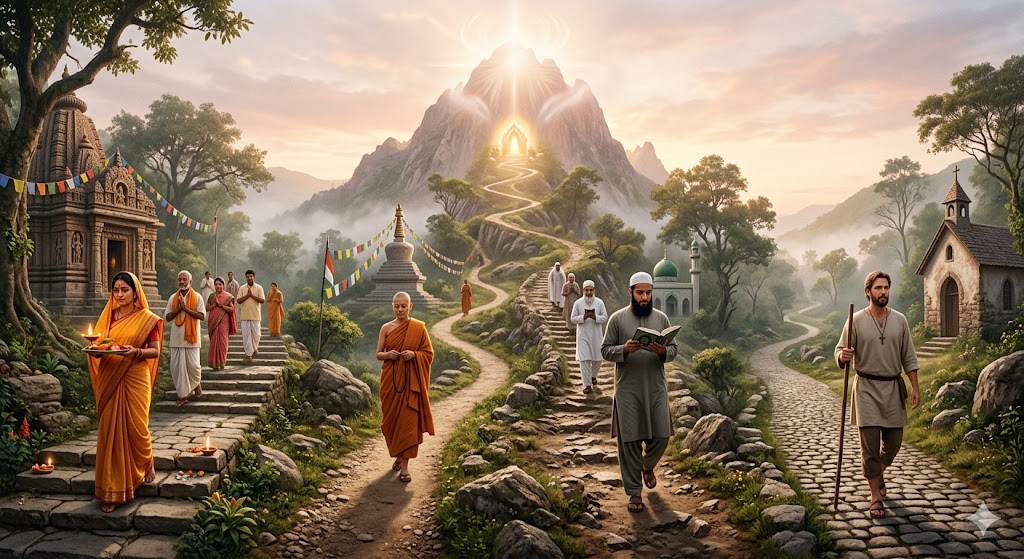
Introduction: The Search for a Direct Connection with God
Have you ever wondered why your grandparents sing Bhajans or why people visit Dargahs and Gurudwaras? Why did people in ancient India start rejecting complex Sanskrit rituals and instead choose to sing simple songs in their own language?
Welcome to Class 7 History Chapter 6: “Devotional Paths to the Divine.” This chapter is one of the most spiritual and social reform-oriented sections of your NCERT syllabus. For students across UP Board, Bihar Board, RBSE, and MP Board, understanding this chapter is crucial not only for scoring high marks in exams but also for understanding the secular fabric of India.
This chapter tells the story of the Bhakti Movement and the Sufi Movement—two powerful waves of devotion that swept across India between the 7th and 17th centuries. These movements broke the chains of the caste system, promoted equality, and taught that God is accessible to everyone—not just priests or kings.
In this long-form guide, we will explore the lives of saints like Kabir, Mirabai, Guru Nanak, and Basavanna. We will look at their philosophies, their fight against social evils, and their relevance in your board exams.
Chapter Overview: What are Devotional Paths?
“Devotional Paths” refers to the various movements where people turned to intense love and personal worship of a single God (Bhakti) or mystical union with the divine (Sufism), rather than performing complicated fire sacrifices or caste-based rituals.
Key Points of the Chapter:
- The Idea of a Supreme God: Before the rise of large kingdoms, people worshipped nature and local gods. As trade grew, so did the idea of a single Supreme God who could deliver humans from the cycle of birth and rebirth.
- Rejection of Rituals: Many saints felt that external worship (like idol worship or specific prayers) was a distraction. They focused on internal love.
- Social Equality: The biggest impact of these movements was the challenge to the Caste System. Saints like Kabir and Ravidas were from lower castes or Muslim families, yet they became gurus to upper-caste Hindus.
Historical Background: Why Did Bhakti & Sufism Emerge?
To understand this chapter, you must understand the “Mood of the Time” during the Medieval Period (700-1750 AD).
- Complexity of Religion: Hinduism had become highly ritualistic. The common man could not understand Sanskrit mantras. Moreover, the caste system (Brahmins at the top, Shudras and untouchables at the bottom) made lower-caste people feel alienated.
- Rise of Islam: The arrival of the Turks and Mughals brought Islam to India. Islam believed in Monotheism (One God) and Equality of all believers. This idea appealed to lower-caste Hindus.
- The Need for a Universal God: People wanted a “Majestic God” who could save them, not the local spirits they previously worshipped.
This environment gave birth to the Nayanars and Alvars in the South, which later spread to the North.
Detailed Explanation of the Chapter (Devotional Paths to the Divine)
Part 1: The Southern Beginning (7th – 9th Century)
The earliest seeds of the Bhakti movement were planted in South India by two groups of saints who traveled from temple to temple singing praises.
1. The Nayanars and Alvars
- Nayanars: There were 63 Nayanars. They were saints devoted to Lord Shiva.
- Alvars: There were 12 Alvars. They were saints devoted to Lord Vishnu.
The Revolution They Brought:
- Rejection of Caste: They came from all castes. Some were Brahmin scholars, but some were “untouchables” (like the Pulaiyar and Panars).
- Language: They did not write in Sanskrit. They composed beautiful poems in Tamil which common people could sing.
- Temple Worship: The Chola and Pandya kings built grand temples at the places where these saints sang.
2. The Philosophers: Shankara and Ramanuja
As this devotion grew, philosophers tried to make sense of it:
- Shankara (8th Century – Kerala): He was an advocate of Advaita (meaning “not two”). He believed that the individual soul (Atman) and the Supreme God (Brahman) are one and the same. The world we see is an illusion (Maya). He believed knowledge (Jnana) was the path to salvation.
- Ramanuja (11th Century – Tamil Nadu): He was deeply influenced by the Alvars. He believed in Vishishtadvaita (Qualified oneness). He said that even when the soul unites with God, it remains slightly distinct to experience the joy of devotion. For him, intense devotion (Bhakti) to Vishnu was the path, not just knowledge.
Part 2: The Virashaiva Movement (Karnataka)
In the 12th century, a new movement started in Karnataka led by Basavanna.
- Who was Basavanna? He was a minister in the court of King Bijjala, but he became a saint and poet.
- What did they preach? They were called Virashaivas (Heroes of Shiva) or Lingayats (wearers of the Ishtalinga—a small personal linga).
The Radical Ideas:
- Equality: They strongly argued for the equality of all human beings. They rejected the caste system completely.
- Against Rituals: They opposed idol worship and animal sacrifice.
- Women: They questioned the poor treatment of women.
Part 3: The Saints of Maharashtra (13th – 17th Century)
The Bhakti movement moved west to Maharashtra. The focal point was the Vitthala Temple in Pandharpur (a form of Lord Vishnu/Krishna).
Important Poet-Saints:
- Dnyaneshwar (Gyaneshwar): Wrote Dnyaneshwari (a commentary on the Bhagavad Gita in Marathi).
- Namdev: Tailor by profession. Composed songs focusing on a personal god.
- Tukaram: A farmer and trader who became a great saint. He rejected all forms of ritualism and social differences.
- Chokhamela: He belonged to the “untouchable” Mahar caste. His songs express the pain of social discrimination.
Key Belief of Maharashtra Saints:
They rejected the idea of renouncing the world. They said one should live with family, earn a livelihood honestly, and share the pain of others. They believed God lives in the hearts of all people, high or low.
Part 4: Nathpanthis, Siddhas, and Yogis
While Bhakti was growing, there were other groups who rejected the social order.
- Who were they? They were groups who advocated renunciation of the world.
- Practices: They focused on intense physical and mental training through Yogasanas, breathing exercises (Pranayama), and meditation.
- Belief: They believed in a formless ultimate reality. They criticized conventional religion and paved the way for the popularity of devotional religions in North India.
Part 5: Islam and Sufism
Parallel to Bhakti, the Sufi movement grew within Islam.
- Who were Sufis? They were Muslim mystics. They rejected the outward religiosity (show-off prayers) and focused on love and devotion to God.
- The Lover and Beloved Concept: Sufis sought union with God as a lover seeks his beloved, caring nothing for the world.
- Methods: They used Zikr (chanting), Sama (singing), and Raqs (dancing) to feel closeness to God.
- Silsilas: They organized themselves into orders (Silsilas). Famous Sufis include Khwaja Muinuddin Chishti (Ajmer) and Nizamuddin Auliya (Delhi). They preached tolerance and made many Hindus their followers.
Part 6: The Northern Renaissance (14th – 17th Century)
By the 14th century, this wave reached North India. Saints here were highly critical of orthodox religion.
1. Kabir (15th – 16th Century)
- Background: He was raised by a Muslim weaver (Julaha) family in Benares (Varanasi).
Major Ideas:
- Rejection of both Hindus and Muslims. He said, “If God is in Mecca, does he not live in the heart of the Hindu?”
- He believed in a formless Supreme God (Nirguna Bhakti).
- He criticized the priestly classes, the caste system, and idol worship.
- Path to Salvation: Only Bhakti (Devotion).
Expression:
He expressed his ideas through Sakhis (verses) and Pads (songs) in simple Hindi (a mix of Awadhi, Braj, and Bhojpuri).
2. Guru Nanak (1469 – 1539)
- Background: Born in Talwandi (now in Pakistan).
Major Teachings:
- One God: “There is no Hindu, no Muslim” – everyone is equal before one God.
- Rejection of Caste: Caste, creed, or gender is irrelevant for liberation.
- Three Pillars: He taught three things:
- Nam Japna: Chanting God’s name.
- Kirat Karo: Earning a living honestly.
- Vand Chakko: Sharing with the community.
Institutions:
He set up Langar (common kitchen) where everyone eats together, breaking caste rules. His followers established Gurudwaras (places of worship). His teachings are compiled in the Guru Granth Sahib.
3. Mirabai (16th Century)
- Background: A Rajput princess married into the royal family of Mewar.
- Devotion: She was a devotee of Krishna. She considered herself “married” to Krishna and refused to accept her earthly husband.
- Legacy: She composed hundreds of Bhajans full of intense love. She openly challenged the norms of upper castes and royalty. Ordinary people preserved her memory because she proved that love for God is greater than social rules.
4. Shankardeva (Assam – Late 15th Century)
- Focus: Devotion to Vishnu.
- Contribution: He wrote plays and poems in Assamese. He started the tradition of Namghars (houses of recitation and prayer).
Important Dates and Events
- 7th – 9th Century: Nayanars and Alvars spread Bhakti in South India.
- 8th Century: Shankara (Advaita philosopher) is born.
- 11th Century: Ramanuja is born.
- 12th Century: Basavanna starts Virashaiva movement in Karnataka.
- 13th – 17th Century: Saints of Maharashtra (Dnyaneshwar, Tukaram).
- 12th – 14th Century: Sufis gain influence (Nizamuddin Auliya).
- 15th – 16th Century: Kabir and Guru Nanak are active in North India.
- 1469: Birth of Guru Nanak Dev.
- 16th Century: Mirabai composes her Bhajans.
- 1604: Compilation of the Adi Granth (later Guru Granth Sahib).
Comparison Table: Nirguna vs. Saguna Bhakti
| Feature | Nirguna Bhakti | Saguna Bhakti |
|---|---|---|
| God’s Form | Formless, abstract. | With form (Sakar) – Rama, Krishna, Shiva. |
| Focus | Inner meditation and love. | Idol worship, temple rituals, stories. |
| Key Saints | Kabir, Guru Nanak. | Tulsidas (Rama), Surdas (Krishna), Mirabai. |
| Caste view | Completely rejected caste and religious labels. | Accepted existing beliefs but made them accessible. |
Important Questions and Answers (Exam-Oriented)
A. Multiple Choice Questions (MCQs)
- Who advocated the doctrine of Advaita?
- a) Ramanuja
- b) Basavanna
- c) Shankara
- d) Tukaram
Answer: c) Shankara
- The saints devoted to Lord Shiva were known as:
- a) Alvars
- b) Nayanars
- c) Sufis
- d) Vaishnavas
Answer: b) Nayanars
- Who were the Virashaivas?
- a) Worshippers of Vishnu
- b) Worshippers of Shiva
- c) Worshippers of the Sun
- d) Worshippers of Shakti
Answer: b) Worshippers of Shiva (Led by Basavanna)
B. Fill in the Blanks (Very Short)
- Shankara was an advocate of Advaita.
- Ramanuja was influenced by the Alvars.
- Pandharpur was an important centre of the Bhakti tradition in Maharashtra.
- Kabir expressed his ideas through Sakhis and Pads.
C. Long Answer Type (Board Exams – 5 Marks)
Q: Describe the major beliefs and practices of the Sufis.
Answer:
The Sufis were Islamic mystics who emerged as a reaction to the religious orthodoxy. Their major beliefs and practices were:
- Love for God: They rejected outward religiosity and emphasized love and devotion to God. They sought union with God just as a lover seeks his beloved.
- Compassion: They stressed compassion towards all fellow human beings, regardless of religion.
- Rejection of Rituals: They rejected elaborate rituals and legal codes.
- Methods of Training: They developed specific methods to train the heart, including Zikr (chanting), Sama (singing), Raqs (dancing), and contemplation.
- Brotherhood: Sufi saints like Nizamuddin Auliya preached religious tolerance, which attracted many Hindu followers, fostering social harmony.
Q: How did the Bhakti movement challenge the caste system?
Answer:
The Bhakti movement was a revolutionary force against social evils:
- Universal Equality: Saints like Kabir and Guru Nanak declared that everyone, irrespective of birth, was equal before God.
- Rejection of Untouchability: Nayanars and Alvars included “untouchables” like the Pulaiyar. Chokhamela, a saint from the Mahar caste, inspired many.
- Common Kitchens: Guru Nanak started the Langar (common kitchen) where upper castes and lower castes sat and ate together, breaking the taboo of food sharing.
- Language of the People: Saints composed in local languages (Tamil, Marathi, Hindi), not Sanskrit, making religion accessible to the lower castes who were denied Sanskrit education.
Previous Year Board Questions (UP, MP, Bihar, RBSE)
UP Board (Important):
- Question: What is the importance of the Vitthala temple in Pandharpur?
- Answer: It was the central focus of the Bhakti tradition in Maharashtra, associated with saints like Namdev and Tukaram, symbolizing a personal God residing in the hearts of all people.
Bihar Board:
- Question: Write a short note on the teachings of Guru Nanak.
- Answer: (Focus on Ek Omkar (One God), Sangat (congregation), Pangat (Langar), and rejection of caste).
RBSE / MP Board:
- Question: Differentiate between the Nayanars and the Alvars.
- Answer: Nayanars were devotees of Shiva; Alvars were devotees of Vishnu. Both emerged in South India between the 7th and 9th centuries.
Important Exam Notes
- Advaita vs. Vishishtadvaita: Remember Advaita = Shankara (Non-duality). Vishishtadvaita = Ramanuja (Qualified oneness).
- Kabir’s Language: He used a spoken form of Hindi known as Sadukkar or Sant Bhasha.
- Nirguna vs. Saguna: If the question asks for a saint who believed in a formless God, write Kabir or Guru Nanak. If it asks for a saint who believed in Rama/Krishna, write Tulsidas/Surdas or Mirabai.
- Sufism terms: Silsila (Order of Sufis), Pir (Guru/Master), Murid (Disciple).
Common Mistakes Students Make
- Mixing Dates: Do not confuse the timeline. Shankara (8th C) came before Ramanuja (11th C).
- Incorrect Associations: Remember, Kabir was a weaver, not a king. Mirabai was a princess, not a commoner.
- Spelling Errors: “Nayanar” (Not Naynar), “Basavanna” (Not Basva).
Memory Tricks (Mnemonics)
To remember the sequence of Bhakti movements:
S.A.S.T.
- South: Nayanars/Alvars
- Advaita: Shankara
- Syncretism: Kabir/Guru Nanak
- Tukaram: Maharashtra
To remember Guru Nanak’s three principles:
K.K.V.
- Kirat Karo (Work)
- K Name Japo (Pray)
- Vand Chakko (Share)
Chapter Summary / Quick Revision Notes
- Nayanars (Shiva) & Alvars (Vishnu): 7th-9th century, Tamil Nadu, anti-caste, sung in Tamil.
- Shankara: Advaita (Non-duality), world is Maya.
- Ramanuja: Vishishtadvaita (Qualified oneness), Bhakti path.
- Virashaivas (Basavanna): 12th Century Karnataka, against caste and idol worship.
- Maharashtra Saints (Tukaram, Namdev): Worshipped Vitthala, rejected ritualism.
- Nathpanthis: Believed in formless God, meditation/Yoga.
- Sufis: Muslim mystics, love for God, Sama (singing).
- Kabir: Formless God, rejection of Hindu/Muslim identity, weaver.
- Guru Nanak: One God, equality, Langar, Sikhism.
- Mirabai: Krishna devotee, Rajput princess.
FAQs (Frequently Asked Questions)
Q1: What is the main idea of the chapter “Devotional Paths to the Divine”?
A: The main idea is that during medieval times, saints and poets started new movements (Bhakti & Sufi) that emphasized personal love for God, rejected caste discrimination, and used local languages for worship.
Q2: How did the Bhakti movement promote equality?
A: It promoted equality by declaring that all people, whether Brahmin or Shudra, man or woman, could attain God through love and devotion. It criticized the rigid caste hierarchy.
Q3: Why is Pandharpur important in this chapter?
A: Pandharpur is a town in Maharashtra that houses the famous Vitthala Temple (a form of Vishnu). It was the central pilgrimage site for saints like Namdev and Tukaram.
Q4: What is meant by “Nirguna” and “Saguna”?
A: Nirguna means worshipping a formless, abstract God (Kabir, Nanak). Saguna means worshipping God with a specific form and attributes (Ram, Krishna, Shiva).
Q5: Who was the Guru of Mirabai?
A: Mirabai was a disciple of Ravidas, a saint who was from a caste considered “untouchable”.
Conclusion
The “Devotional Paths to the Divine” were not just religious movements; they were social revolutions. They gave a voice to women, peasants, and lower castes who had been silenced for centuries. As you prepare for your UP Board, Bihar Board, or RBSE exams, remember that these saints wanted to make God accessible to everyone.
By learning about Kabir’s sharp poetry, Guru Nanak’s wisdom, and Mirabai’s courage, you are learning about the inclusive soul of India. Keep these notes handy, practice the previous year questions, and you will score excellent marks.