
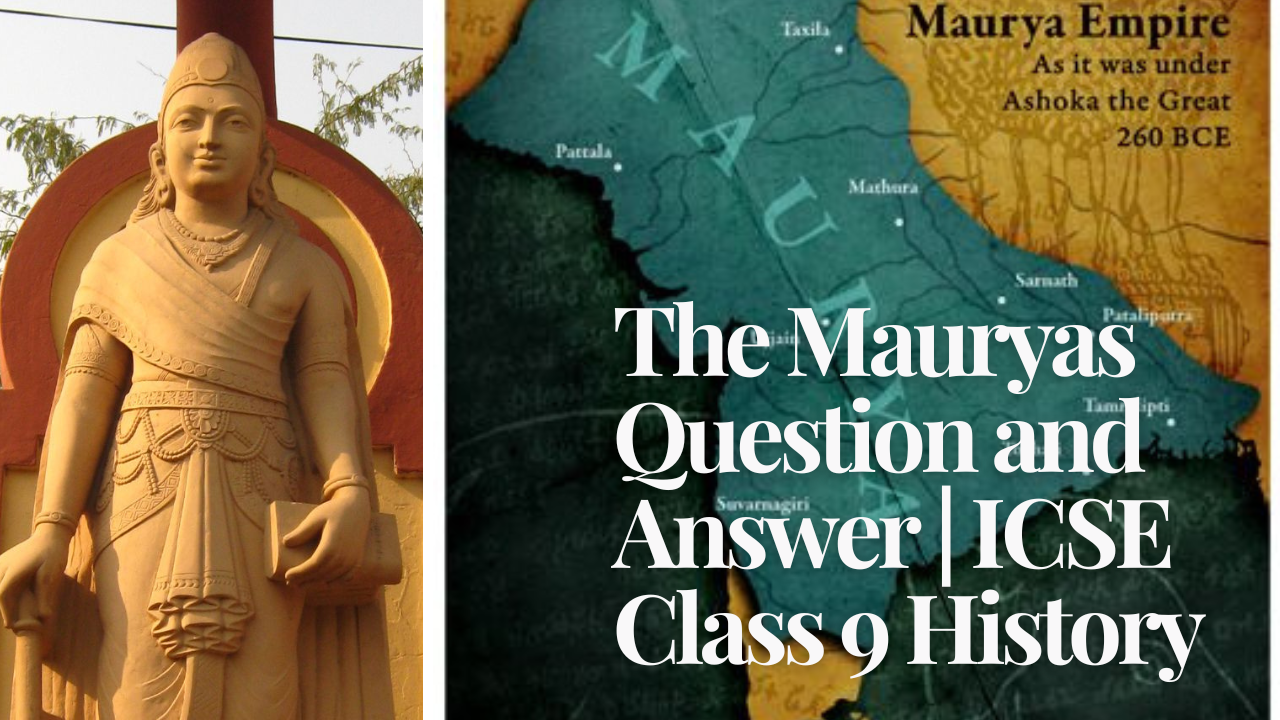
Introduction
Why this chapter matters for your ICSE exams
Imagine ruling almost the entire Indian subcontinent – from the snow-capped Hindu Kush to the sun-baked Deccan plateau. That was the Mauryan Empire, the first pan-Indian empire that changed the course of Indian history forever.
For ICSE Class 9 students, the Mauryan Empire is not just another chapter. It is one of the most frequently tested topics in Term 1 and Term 2 exams, prelims, and the board papers. Questions ranging from 1-mark MCQs to 8-mark long answers appear regularly.
In this guide, you will learn:
- ✅ Exactly who the Mauryan rulers were (with dates you cannot miss)
- ✅ How the empire was run – from the king to the village headman
- ✅ Why Ashoka is called “Devanampriya Priyadarshi” (Beloved of the Gods)
- ✅ Kalinga War: causes, effects, and why Ashoka changed overnight
- ✅ 100+ exam-style questions with answers
- ✅ Memory tricks, mnemonics, and last-minute revision notes
Let us turn this vast chapter into a high-scoring revision tool.
Chapter Overview
The Mauryan Empire (322 BCE – 185 BCE) was founded by Chandragupta Maurya with the guidance of his brilliant teacher and advisor, Chanakya (also known as Kautilya or Vishnugupta). The empire reached its greatest geographical extent under Ashoka the Great, who later renounced war and embraced non-violence after the bloodshed of the Kalinga War.
Key themes you will master:
- Political unification – For the first time, most of India was one empire.
- Centralized administration – A sophisticated bureaucracy with spies, ministers, and local bodies.
- Economic prosperity – Trade with Hellenistic (Greek) worlds, agriculture, and state monopolies.
- Art and architecture – Stupas, pillars, rock-cut caves, and the famous Ashokan edicts.
- Decline – Why this mighty empire collapsed after 137 years.
Learning Objectives
After reading this guide, you will be able to:
- ✔ List the three major Mauryan rulers and their achievements.
- ✔ Explain the administrative divisions (from empire to district).
- ✔ Describe Ashoka’s Dhamma in simple words with examples.
- ✔ Analyze the causes and effects of the Kalinga War.
- ✔ Differentiate between the Mauryan administration and later empires.
- ✔ Answer any ICSE-style question – factual, analytical, or source-based.
Detailed Explanation of the Chapter
Sources of Mauryan History – How do we know about them?
Historians rely on two types of sources: Literary and Archaeological.
Literary Sources (Books and Texts)
| Source | Author | What it tells us |
|---|---|---|
| Arthashastra | Chanakya/Kautilya | Statecraft, economics, spy network, punishment, foreign policy |
| Indica | Megasthenes (Greek ambassador) | Daily life in Pataliputra, 7 castes (Indian and Greek view), municipal system |
| Deepavamsa & Mahavamsa | Buddhist monks | Ashoka’s role in spreading Buddhism |
| Mudrarakshasa | Vishakhadatta (drama) | Political intrigue during Chandragupta’s rise |
Archaeological Sources (Physical Evidence)
- Ashokan Edicts – 33 inscriptions on rocks and pillars. Written in Prakrit (Brahmi script), Greek, and Aramaic.
- Pataliputra excavations – Remains of a massive wooden palisade hall (80 pillars).
- Stupas – Sanchi, Bharhut, Sarnath (Dharmarajika Stupa).
- Punch-marked coins – Silver and copper coins with symbols of the peacock and hill.
Remember this box ⭐
ICSE often asks: “Name two literary sources and two archaeological sources of the Mauryan Empire.”
Answer: Literary – Arthashastra, Indica. Archaeological – Ashokan edicts, Sanchi Stupa.
The Mauryan Rulers – Chandragupta, Bindusara, Ashoka
1. Chandragupta Maurya (322–298 BCE)
- Founder of the Mauryan dynasty.
- Overthrew the last Nanda ruler (Dhana Nanda) with Chanakya’s strategy.
- Defeated Seleucus Nicator (Alexander’s general) in 305 BCE. The treaty gave Chandragupta Kandahar, Kabul, Herat, and Balochistan. In return, Seleucus received 500 war elephants.
- Married Seleucus’s daughter Helen (diplomatic marriage).
- Megasthenes stayed in his court and wrote Indica.
- Accepted Jainism in later life and performed Sallekhana (fast unto death) at Shravanabelagola (Karnataka).
Exam tip: Always connect Chandragupta to Chanakya, Megasthenes, and the war against Seleucus.
2. Bindusara (298–273 BCE)
- Also called Amitraghata (Slayer of foes).
- He extended the empire southwards – up to Mysore.
- Asked the Greek king Antiochus I for sweet wine, dried figs, and a philosopher (the philosopher refused).
- His chief advisor was Chanakya (in early years).
- Remembered mostly as the father of Ashoka.
3. Ashoka the Great (273–232 BCE)
The most famous Mauryan ruler. Initially cruel (called Chandashoka), later transformed into Dharmashoka.
Important events under Ashoka:
- Kalinga War (261 BCE) – Conquered Kalinga (modern Odisha). The violence caused 1,00,000 deaths and 1,50,000 deportations.
- Transformation – Seeing bloodshed, he adopted Buddhism under the monk Upagupta.
- Dhamma policy – A set of moral and social principles (not just religion).
- Edicts – Rock Edict XIII describes his remorse and decision to preach Dhamma.
Did You Know? Ashoka’s name in the edicts is “Devanampriya Priyadarshi” – meaning “Beloved of the Gods” and “one of gracious mien”.
The Kalinga War (261 BCE) – Cause, Effect, and Detailed Analysis
| Aspect | Details |
|---|---|
| Cause | Kalinga was a prosperous maritime power controlling trade with Southeast Asia. It also blocked Ashoka’s route to the south. |
| Immediate trigger | Kalinga refused to accept Mauryan suzerainty. |
| Result | Mauryan victory. Complete annexation of Kalinga. |
| Effects on Ashoka | Personal transformation. Gave up Bherighosha (war drum) for Dhammaghosha (drum of Dhamma). |
| Effects on Empire | No more wars of conquest. Spread of Buddhism to Sri Lanka, Burma, and Central Asia. |
| Economic effect | Resources that previously went to war were used for public welfare (hospitals, roads, wells). |
ICSE key link: Always mention Rock Edict XIII when describing Ashoka’s change of heart.
Ashoka’s Dhamma – The Heart of the Chapter
What is Dhamma?
A code of conduct based on tolerance, non-violence, respect for all religions, and social welfare. It is not Buddhism, but Buddhist principles influenced it.
Main Principles (Memorize using acronym DR. SIR)
- D – Daya (compassion towards servants, slaves, and prisoners)
- R – Respect for parents, teachers, and elders
- S – Satya (truthfulness) and Ahimsa (non-violence)
- I – Inter-religious tolerance (avoid glorifying one’s own sect)
- R – Righteous conduct (donating to Brahmins and monks)
Why did Ashoka need Dhamma?
- The empire had diverse religions (Buddhism, Jainism, Ajivikas, Brahmins).
- Tribal communities resisted Mauryan rule.
- Slaves and servants were treated badly.
- Animal sacrifice was common (Ashoka banned it gradually).
How did Ashoka spread Dhamma?
- Edicts – Carved on rocks and pillars in public places.
- Dharma Mahamatras – Special officers to teach Dhamma.
- Missionaries – Sent to Sri Lanka (Mahendra & Sanghamitta), Burma, and even Greece.
Common Mistake: Students write “Ashoka forced everyone to become Buddhist.” Wrong! He promoted Dhamma, not conversion.
Mauryan Administration – How did they rule such a large empire?
Central Government (King + Council of Ministers – Mantri Parishad)
The king was supreme, but he took advice from ministers like:
- Mantri (Chief Minister)
- Senapati (Commander-in-chief)
- Purohita (Chief priest)
- Samaharta (Tax collector – very important role)
Provincial Administration
The empire was divided into 4 provinces:
| Province | Capital | Governor |
|---|---|---|
| Northern | Taxila | Kumaras (princes) |
| Western | Ujjain | Kumaras |
| Eastern | Tosali | Kumaras |
| Southern | Suvarnagiri | Kumaras |
Local Administration (City and Village level)
- City – Pataliputra had a 6-member municipal board handling: industry, foreign affairs, birth/death registration, trade, weights & measures, and taxation.
- Village – Headman (Gramika) and Gopa (supervisor of 5-10 villages).
Revenue System
- Main tax: 1/4th of agricultural produce (Bhaga).
- Toll tax on goods entering cities.
- Taxes on mines, forests, and trade.
- Samaharta – Chief collector of revenue.
Judicial System
- King was the highest court of appeal.
- Courts at district, city, and provincial levels.
- Punishments were harsh (mutilation for perjury) but Ashoka introduced reforms, parole, and humane treatment of prisoners.
Spy Network (Guptacharas)
- Chanakya’s Arthashastra details a complex spy system.
- Spies reported on ministers, generals, and foreign ambassadors.
Mauryan Economy – Sources of Wealth
- Agriculture – Main occupation. State provided irrigation, seeds, and draught animals.
- Trade – Internal (Ganges to Punjab) and external (with Egypt, Syria, Greece).
- State Monopoly – Mining, salt, liquor, shipbuilding.
- Guilds (Shrenis) – Groups of artisans and merchants advanced loans.
- Taxation – Efficient collection funded the army, bureaucracy, and edicts.
Mauryan Art and Architecture
| Feature | Example | Importance |
|---|---|---|
| Pillars | Sarnath Lion Capital (National Emblem of India) | Polished sandstone, inscribed with edicts |
| Stupas | Sanchi, Bharhut | Dome-shaped structures containing Buddhist relics |
| Rock-cut caves | Barabar Caves (Lomas Rishi) | Donated to Ajivika monks |
| Palace | Pataliputra (modern Patna) | Wooden architecture, inspired by Persian palaces |
Remember: The Lion Capital of Sarnath has four lions back-to-back. The Dharma Chakra (wheel) below represents Ashoka’s Dhamma.
Causes of Decline of the Mauryan Empire
| Cause | Explanation |
|---|---|
| Weak successors after Ashoka | Last ruler Brihadratha was killed by his general Pushyamitra Shunga |
| Financial crisis | Heavy expenditure on army and bureaucracy |
| Provincial revolts | Governors (Kumaras) declared independence |
| Foreign invasions | Greeks (Demetrius), Parthians, Bactrians |
| Ashoka’s pacifist policies | Reduced military strength → border invasions increased |
Exam-Oriented Study Material
Important Dates and Events
- 322 BCE – Chandragupta Maurya founds the empire.
- 305 BCE – Chandragupta defeats Seleucus Nicator.
- 298 BCE – Chandragupta abdicates; Bindusara becomes king.
- 273 BCE – Ashoka crowned (actually 269 BCE, but 273 is widely used).
- 261 BCE – Kalinga War.
- 232 BCE – Ashoka dies; decline begins.
- 185 BCE – Last Mauryan king (Brihadratha) killed. Shunga dynasty begins.
Important Terms and Definitions
| Term | Meaning |
|---|---|
| Dhamma | Ashoka’s moral and social code |
| Dharma Mahamatra | Officers in charge of spreading Dhamma |
| Edicts | Royal orders carved on stone or pillars |
| Bherighosha | War drum |
| Dhammaghosha | Drum of Dhamma (peace) |
| Tirthas | Pilgrimage places |
| Sallekhana | Jain ritual of fasting unto death |
| Kumaras | Provincial governors (usually princes) |
Important Personalities with Roles
| Personality | Role |
|---|---|
| Chandragupta Maurya | Founder, defeated Seleucus, converted to Jainism |
| Chanakya (Kautilya) | Author of Arthashastra, political strategist |
| Megasthenes | Greek ambassador, wrote Indica |
| Bindusara | Father of Ashoka, called Amitraghata |
| Ashoka | Dhamma policy, Kalinga War, spread of Buddhism |
| Upagupta | Buddhist monk who guided Ashoka after Kalinga |
| Samudragupta (not Mauryan – but note) | Not to confuse – Samudragupta is Gupta empire |
Flowchart: Mauryan Administrative Hierarchy
King (Samrat)
    ↓
Mantri Parishad (Council of Ministers)
    ↓
4 Provincial Governors (Kumaras)
    ↓
Districts (Janapadas) → Officers (Rajukas)
    ↓
Cities (Paura) → Municipal Board (6 members)
    ↓
Villages (Grama) → Gramika + Gopa
Mnemonics for Easy Learning
Mnemonic for 3 main Mauryan rulers: C – B – A (Chandragupta → Bindusara → Ashoka)
“Chota Baccha Ashok” – easy to remember!
Mnemonic for Dhamma principles: 4 R’s
- Respect for elders
- Right conduct
- Religious tolerance
- Renunciation of war (non-violence)
Questions & Answers Section
Very Short Answer Questions (1 Mark)
Q1. Who founded the Mauryan Empire?
Ans. Chandragupta Maurya.
Q2. Who wrote the Arthashastra?
Ans. Chanakya (also Kautilya or Vishnugupta).
Q3. Name the Greek ambassador who visited Chandragupta’s court.
Ans. Megasthenes.
Q4. In which year did the Kalinga War take place?
Ans. 261 BCE.
Q5. What is Bherighosha?
Ans. The war drum.
Q6. What does “Devanampriya Priyadarshi” mean?
Ans. Beloved of the Gods and one of gracious mien (referring to Ashoka).
Q7. Where did Chandragupta Maurya spend his last days?
Ans. Shravanabelagola (Karnataka).
Q8. Who killed the last Mauryan king?
Ans. Pushyamitra Shunga.
Q9. What is the Indica?
Ans. A book written by Megasthenes describing Mauryan India.
Q10. Name any one Ashokan pillar capital that became the National Emblem of India.
Ans. The Sarnath Lion Capital.
Short Answer Questions (2–3 Marks)
Q11. Why did Ashoka fight the Kalinga War?
Ans. Kalinga controlled important trade routes to Southeast Asia. It was a wealthy and powerful kingdom that refused to accept Mauryan suzerainty, which Ashoka could not tolerate in his ambition to unify India.
Q12. What are the main principles of Ashoka’s Dhamma?
Ans. (1) Non-violence (Ahimsa), (2) Respect for parents, teachers, and elders, (3) Tolerance towards all religions and sects, (4) Kindness to servants, slaves, and prisoners, (5) Truthfulness and charity.
Q13. How did Ashoka spread Dhamma?
Ans. (1) By carving edicts on rocks and pillars, (2) Appointing Dharma Mahamatras (special officers), (3) Sending missionaries to Sri Lanka, Burma, and Central Asia, (4) Organizing religious tours (pilgrimages).
Q14. Describe the central administration under the Mauryas.
Ans. The king was the supreme head, assisted by a council of ministers called the Mantri Parishad. Important ministers included the Mantri (chief), Senapati (army chief), Samaharta (tax collector), and Purohita (priest). The king was advised on all matters.
Q15. What were the duties of the municipal board in Pataliputra?
Ans. The 6-member board looked after: (1) Industry and crafts, (2) Foreigners, (3) Birth and death registration, (4) Trade and commerce, (5) Sale of manufactured goods, (6) Collection of toll taxes.
Descriptive Questions (5 Marks)
Q16. Explain the causes and effects of the Kalinga War.
Ans.
Causes: Kalinga was a prosperous kingdom controlling maritime trade with Southeast Asia. It refused to accept Mauryan authority, and its strategic location blocked Ashoka’s expansion southwards.
Effects:
- On Ashoka: He witnessed 1 lakh deaths and 1.5 lakh deportations. He felt deep remorse and converted to Buddhism under Upagupta.
- On the empire: Ashoka replaced Bherighosha (war drum) with Dhammaghosha (Dhamma drum).
- On society: Animal sacrifice was reduced, hospitals were built, and a welfare state emerged.
- On Buddhism: It spread to Sri Lanka, Nepal, and beyond through missionaries.
Q17. Describe the provincial and local administration of the Mauryan Empire.
Ans.
Provincial: The empire was divided into four provinces – Taxila (north), Ujjain (west), Tosali (east), Suvarnagiri (south). Each was ruled by a Kumara (royal prince) assisted by ministers and spies.
Local (City): Pataliputra had a 6-member municipal board.
Local (Village): Villages were the smallest units, headed by Gramika (village headman) and supervised by Gopa (in charge of 5-10 villages). The Samaharta collected land revenue (1/6th to 1/4th of produce).
Long Answer Questions (8–10 Marks)
Q18. “The Mauryan administration was highly centralized and efficient.” Justify with reference to the king, council, revenue, spy system, and local governance. (10 marks)
Answer Framework:
| Aspect | How it was centralized & efficient |
|---|---|
| King | Supreme authority; all officers reported to him. |
| Council | Mantri Parishad ensured collective advice; no region could act independently. |
| Revenue | Samaharta collected taxes uniformly; state owned mines, forests, salt. |
| Spy system | Guptacharas reported on all officials, preventing rebellion. |
| Local governance | Gramika, Gopa, and Nagarika followed direct orders from Pataliputra. |
| Communication | Excellent roads with Rajbahas (royal highways) allowed quick movement of army and orders. |
Conclusion: For the first time in India, a uniform administration applied from the Hindu Kush to the Deccan.
Q19. Compare and contrast Ashoka’s Dhamma with the principle of non-violence in Buddhism. (8 marks)
| Parameter | Ashoka’s Dhamma | Buddhism |
|---|---|---|
| Religious basis | Social-ethical code, not a religion | Religion with Four Noble Truths and Eightfold Path |
| Non-violence | Recommended but with exceptions (killing fish/meat for certain castes was allowed initially) | Absolute Ahimsa (no killing any living being) |
| Target audience | Entire empire (Hindus, Jains, Ajivikas, Greeks) | Followers of Buddha |
| Spread method | State officers (Dharma Mahamatras) | Monks and nuns |
| Afterlife focus | Stressed moral life in this world | Stressed Nirvana (end of rebirth) |
| Animal sacrifice | Banned on specific days; discouraged | Completely forbidden |
Final note: Dhamma was practical state policy; Buddhism was a spiritual path.
Assertion and Reason Questions
Q20. Assertion (A): Ashoka gave up war after the Kalinga War.
Reason (R): He saw immense suffering and converted to Buddhism.
(a) Both A and R are true and R explains A.
(b) Both A and R are true but R does not explain A.
(c) A is true, R is false.
(d) A is false, R is true.
Ans. (a) Both A and R are true and R explains A.
Q21. Assertion (A): The Arthashastra is an important source for the Mauryan Empire.
Reason (R): It describes the economic and military strategies of the Mauryan court.
Ans. (a) Both A and R are true and R explains A.
Q22. Assertion (A): The Mauryan empire declined soon after Ashoka’s death.
Reason (R): Ashoka’s policy of non-violence made the military weak.
Ans. (a) Both A and R are true and R explains A.
Match the Following
| Column A | Column B |
|---|---|
| 1. Arthashastra | a. Megasthenes |
| 2. Indica | b. Kalinga War |
| 3. 261 BCE | c. Chanakya |
| 4. Amitraghata | d. Bindusara |
| 5. Sarnath Lion Capital | e. National Emblem |
Ans: 1-c, 2-a, 3-b, 4-d,
Mauryan Empire and Ashoka – Rise, Kalinga War, Dhamma, and Administration Explained
Short Question Answers Set I
Question 1: Who succeeded Bindusara and when?
Ans: Bindusara was succeeded by Emperor Ashoka in 219 BC, marking an important phase in the Mauryan Empire.
Question 2: Discuss the sources that help us to know about Ashoka’s reign.
Ans: Much of our knowledge about the history of Ashoka’s reign in the Mauryan Empire is based on Ashokan inscriptions engraved on rocks and pillars. These Mauryan edicts provide information about his policies and administration but do not shed light on his early life.
Question 3: Why do historians believe that Ashoka’s ascension to the throne was not a smooth affair?
Ans: According to some literary sources, Ashoka ascended the throne by eliminating rivals, including his 99 brothers. While this may be exaggerated, historians agree that Ashoka’s rise to power in the Mauryan dynasty was not a peaceful transition.
Question 4: When was the Kalinga War fought?
Ans: The Kalinga War, a significant event in Mauryan history, was fought in 211 BC.
Question 5: What factors prompted Ashoka to conquer Kalinga?
Ans: The conquest of Kalinga in 261 BC was prompted by several factors:
- Kalinga had asserted its independence after the fall of the Nanda dynasty.
- Its military strength posed a challenge to the Mauryan Empire.
Short Question Answers Set II
Question 6: Why is the Kalinga War regarded as a turning point in Ashoka’s life?
Ans: The Kalinga War was a turning point in Ashoka’s life. The bloodshed and destruction filled the Mauryan emperor with remorse. Although further conquests, like the Tamil states, could have expanded the Mauryan Empire, Ashoka abandoned military expansion. Buddhism and Ashoka Dhamma then became central to his reign, as he focused on peace and ethical governance.
Question 7: What was the impact of the Kalinga War?
Ans: The impact of the Kalinga War on the Mauryan Empire was profound. The large-scale loss of life and property shocked Ashoka, leading him to renounce violence. This marked the beginning of Ashoka’s Dhamma policies and a focus on moral governance and welfare.
Question 8: What did Ashoka replace Digvijay with?
Ans: Ashoka replaced Digvijaya (world conquest) with Dhammavijaya, conquest through Ashoka Dhamma, reflecting the shift from military expansion to moral and ethical leadership in the Mauryan Empire.
Question 9: What do you understand by Ashoka’s Dhamma?
Ans: Dhamma, synonymous with Dharma, signified virtue, morality, law, and duty. It was a code of conduct followed during the Mauryan period, guiding the emperor’s governance and welfare policies.
Question 10: What are the tenets of Dhamma?
Ans: The tenets of Ashoka Dhamma include:
- Obeying elders
- Being kind to all, including servants and slaves
- Respecting other religions
- Following ahimsa (non-violence)
- Salvation through morality and kindness
Short Question Answers Set III
Question 11: What steps did Ashoka take to spread Dhamma?
Ans: Ashoka took several steps to spread Dhamma:
- Created a class of officers called Dhamma Mahamattas to ensure public welfare.
- Undertook Dhammayatra, royal tours to preach moral policies.
- Sent missionaries, including his children Mahendra and Sanghamitra, to Ceylon, helping to spread Buddhism internationally.
Question 12: How did Dhamma influence the art of the Mauryan period?
Ans: Ashoka Dhamma influenced Mauryan art and architecture. Tall polished pillars crowned with animals, such as the Sarnath Pillar, Bhopal Pillar, and Lauriya Nanadangarh Pillar, became symbols of moral authority and spiritual guidance.
Question 13: What prompted Ashoka to promote welfare measures?
Ans: Influenced by Ashoka Dhamma, the emperor adopted a paternal attitude towards his subjects. His edicts show that he wanted the welfare and happiness of all people, reflecting the importance of Mauryan welfare measures.
Question 14: Enumerate the welfare measures adopted by Ashoka.
Ans: Ashoka implemented several Mauryan welfare measures:
- Built roads, wells, and rest houses
- Planted trees like banyan and mango for the benefit of men and animals
- Imported and planted medicinal plants
- Ensured the happiness and welfare of his people
Question 15: Who was the last Mauryan ruler?
Ans: The last Mauryan emperor was Brihadratha, killed by Pushyamitra Sunga in 185 BC.
Short Question Answers Set IV
Question 16: Discuss the sources that tell us about the Mauryan administration.
Ans: The Mauryan administration is documented in Megasthenes’s Indica and Kautilya’s Arthashastra, which describe governance, taxation, law, and bureaucracy.
Question 17: Under what heads can the Mauryan administration be studied?
Ans: The Mauryan administration can be studied under: central, provincial, district, and village administration.
Question 18: Which Mauryan king never kept his petitioners waiting? Why?
Ans: Chandragupta Maurya, the founder of the Mauryan Empire, never kept petitioners waiting, reflecting efficient governance and administrative discipline.
Question 19: Discuss the officers who assisted the king in administering the empire.
Ans: The king was assisted by the Mantri Parishad (Council of Ministers), who helped implement policies across the Mauryan Empire.
Question 20: Who were the Pulisani and the Prativedakas?
Ans: Pulisani reported public opinion to the emperor, while Prativedakas acted as special reporters, enhancing the efficiency of the Mauryan administration.
Short Question Answers Set V
Question 21: What was the unique feature of the Mauryan administration?
Ans: The espionage system was unique to the Mauryan administration, with spies appointed from among loyal citizens to maintain security.
Question 22: Into how many provinces was the Mauryan Empire divided?
Ans: The Mauryan Empire was divided into four provinces with capitals: Taxila (North), Ujjain (West), Tosali (East), and Suvarnagiri (South).
Question 23: Who looked after the provincial administration?
Ans: Provincial administration was managed by a Kumara or Aryaputra, ensuring effective governance throughout the Mauryan Empire.
Question 24: Who were Pradeshika, Rajuka, and Yuktas?
Ans:
- Pradeshika: Officers in charge of overall administration
- Rajuka: Managed law, order, and revenue collection
- Yuktas: Subordinate officers responsible for records
Question 25: Who was Gopa? What was his function?
Ans: Gopa was a village official responsible for maintaining population consensus and local administration, reflecting the efficiency of Mauryan local governance.
Long Question Answers
The early life of Ashoka is a study in contrast to his later life. To show the difference, throw light on:
a: His early conquests:
- The Kalinga War in 211 BC marked Ashoka’s military ambitions.
- Kalinga’s prior independence under the Nandas and its strong military prompted the conquest.
b: His welfare measures:
- Ashoka focused on Mauryan welfare measures, building roads, wells, rest houses, and planting trees and medicinal plants.
c: Ashoka and Dhamma:
- Replaced Digvijaya with Dhammavijaya, promoting conquest through Ashoka Dhamma.
- Tenets of Dhamma: obey elders, kindness to all, respect other religions, follow ahimsa, and achieve salvation through morality.
FAQ: The Mauryan Empire
1. Who founded the Mauryan Empire and when?
The Chandragupta Maurya founded the Mauryan Empire around 322 BCE after defeating the Nanda dynasty with the guidance of Chanakya, also known as Kautilya. Chandragupta established one of the largest empires in ancient India, with its capital at Pataliputra.
2. What is the importance of the Arthashastra?
The Arthashastra is an important ancient text written by Chanakya. It explains principles of:
Government administration
Economic policies
Military strategy
Diplomacy and espionage
The book provides valuable information about the political and administrative system of the Mauryan period and is considered one of the earliest works on statecraft and governance.
3. Why did Ashoka fight the Kalinga War?
Ashoka fought the Kalinga War to conquer the independent state of Kalinga (present-day Odisha) and expand the Mauryan Empire. Although Ashoka won the war, the massive loss of life and destruction deeply affected him. After the war, he adopted Buddhism and promoted peace, non-violence, and moral values.
4. What are the main principles of Ashoka’s Dhamma?
The main principles of Ashoka’s Dhamma included:
Non-violence (Ahimsa)
Respect for all religions
Kindness towards humans and animals
Obedience to parents and teachers
Truthfulness and moral living
Religious tolerance and harmony
Ashoka spread these ideas through inscriptions known as the Edicts of Ashoka.
5. How was the Mauryan administration organized?
The Mauryan Empire had a highly centralized administration. The emperor was the supreme authority, assisted by ministers and officials. The empire was divided into provinces, districts, and villages for efficient governance.
Key features included:
A strong bureaucracy
Efficient tax collection system
Large standing army
Network of spies and officials
Provincial governors to manage regions
The administration helped maintain law, order, and unity across the vast empire.