
The Reformation: Complete ICSE Class 9 History Study Guide (Notes, Q&A, MCQs)
Introduction
Imagine living in 16th-century Europe, where the most powerful institution in the world — the Catholic Church — controlled not just religion, but politics, education, and the economy. Now imagine a single monk, armed with nothing but a hammer, some nails, and a list of 95 arguments, challenging the might of this empire. That monk was Martin Luther, and that moment changed the course of world history forever. Welcome to The Reformation — one of the most transformative chapters in your ICSE Class 9 History syllabus!
The Reformation was not merely a religious movement. It was a revolution that shattered the unity of medieval Christianity, gave birth to Protestantism, reshaped European politics, and laid the intellectual foundations for the modern world. For ICSE students, this chapter is crucial because it connects the Renaissance with the Age of Revolutions. Questions from this topic appear regularly in exams — from 1-mark MCQs about the 95 Theses to 10-mark essays on the causes and consequences of the Reformation.
In this comprehensive study guide, you will find everything you need to master this chapter: the meaning and significance of the Reformation, detailed causes including Church corruption and the new learning of the Renaissance, Martin Luther’s groundbreaking contributions, the Catholic Church’s response through the Counter Reformation, important dates, comparison tables, memory tricks, and a massive collection of practice questions. Whether you are preparing for unit tests, prelims, or the final ICSE board examination, this guide is your one-stop solution.
Let’s travel back to 16th-century Europe and witness the birth of a new era!
Chapter Overview
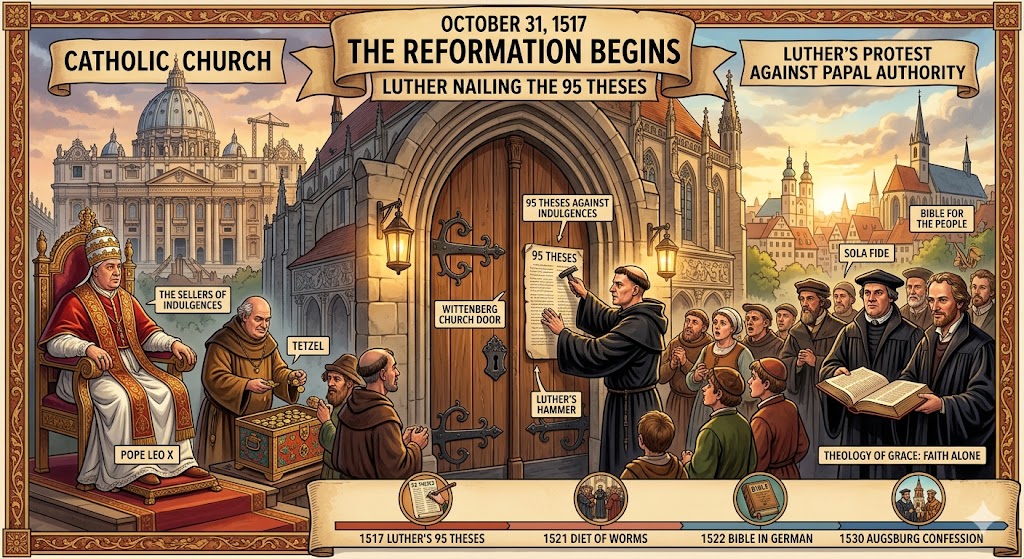
The Reformation (also called the Protestant Reformation) was a 16th-century religious movement that began as an attempt to reform the Roman Catholic Church but ultimately led to the permanent division of Western Christianity. It started in 1517 when Martin Luther, a German monk and professor, nailed his 95 Theses to the door of the Wittenberg Castle Church, challenging the Church’s sale of indulgences.
The movement was driven by two major forces:
- Dissatisfaction with the practices of the Catholic Church — corruption, sale of indulgences, simony, nepotism, immoral lives of clergy
- New Learning — Renaissance humanism, printing press, translation of the Bible into vernacular languages, scientific spirit of inquiry
Martin Luther’s ideas spread rapidly across Europe thanks to the printing press, leading to the establishment of Lutheranism and inspiring other reformers like John Calvin and Huldrych Zwingli. In response, the Catholic Church launched the Counter Reformation (also called the Catholic Reformation), which included the Council of Trent, the establishment of the Jesuit order, and the Inquisition.
Key Themes of the Chapter:
- Meaning and significance of the Reformation
- Causes: Church corruption and the new learning
- Martin Luther’s life, 95 Theses, and contributions
- Spread of Protestantism and other reformers
- The Counter Reformation: Council of Trent, Jesuits, Inquisition
- Results and impact of the Reformation on Europe
Learning Objectives
After studying this chapter thoroughly, you should be able to:
- Define the Reformation and explain why it is called a religious revolution
- Analyze the causes of the Reformation, especially Church corruption and the new learning
- Describe Martin Luther’s role and explain the significance of the 95 Theses
- Compare the teachings of the Catholic Church with Luther’s Protestant ideas
- Explain the Counter Reformation and its key measures
- Evaluate the results and impact of the Reformation on European society
- Answer all types of exam questions confidently, from MCQs to long-answer questions
Detailed Explanation of the Chapter
1. Meaning of the Reformation
The term “Reformation” literally means reform or improvement. In the context of European history, it refers to the great religious movement of the 16th century that aimed to reform the Roman Catholic Church. However, when the Church refused to reform itself, the movement developed into a full-scale revolt that created a new branch of Christianity called Protestantism.
The Reformation is also called the Protestant Reformation because the reformers “protested” against the authority and practices of the Pope and the Catholic Church. It began in Germany in 1517 and gradually spread to Switzerland, France, England, Scotland, and other parts of Europe.
Remember This: The Reformation was not originally meant to break away from the Catholic Church. Martin Luther only wanted to reform it. The split happened because the Church excommunicated him and refused to accept his reforms.
2. Causes of the Reformation
The Reformation did not happen overnight. It was the result of centuries of growing dissatisfaction combined with new intellectual movements. The causes can be broadly divided into two categories as per your ICSE syllabus:
A. Dissatisfaction with the Practices of the Catholic Church
By the 16th century, the Catholic Church had become extremely powerful but also deeply corrupt. Several practices angered ordinary Christians:
1. Sale of Indulgences
This was the most hated practice. The Church claimed that indulgences were certificates that could reduce the punishment for sins — either for the living or for souls in purgatory. Pope Leo X needed money to rebuild St. Peter’s Basilica in Rome, so he authorized the sale of indulgences across Europe. Johann Tetzel, a Dominican friar, famously sold indulgences in Germany with the slogan: “As soon as the coin in the coffer rings, the soul from purgatory springs.” This reduced salvation to a commercial transaction and disgusted sincere believers like Martin Luther.
2. Simony
Simony was the practice of . Bishops and priests paid money to obtain their positions, and then used their positions to collect money from the people. Spiritual leadership had become a business.
3. Nepotism
High Church officials appointed their relatives (nephews, sons, brothers) to important Church positions regardless of merit or religious devotion. Pope Alexander VI, for example, appointed his own son Cesare Borgia as a cardinal.
4. Immoral Lives of the Clergy
Many priests, monks, bishops, and even popes led scandalous lives. They kept mistresses, drank excessively, gambled, and lived in luxury. The vow of celibacy (not marrying) was widely violated. This destroyed the moral authority of the Church.
5. Worldliness of the Popes
The Renaissance Popes — such as Alexander VI, Julius II, and Leo X — behaved more like worldly princes than spiritual leaders. They engaged in wars, political conspiracies, and lavish spending on art and palaces. Pope Leo X reportedly said: “God has given us the papacy — let us enjoy it.”
6. Heavy Taxes
The Church collected numerous taxes from the common people — tithes (one-tenth of income), fees for baptisms, marriages, and funerals. Much of this money flowed to Rome, leaving local populations impoverished.
7. The Pope’s Claim to Absolute Authority
The Pope claimed to be the supreme head of the Church with the power to interpret the Bible, forgive sins, and even dethrone kings. Many rulers and intellectuals resented this interference in political matters.
B. New Learning (Renaissance Humanism and Other Factors)
While the Church was rotting from within, Europe was experiencing an intellectual awakening:
1. Renaissance Humanism
The Renaissance (14th–16th centuries) revived interest in classical Greek and Roman literature, philosophy, and art. Humanist scholars like Erasmus of Rotterdam and Thomas More criticized Church corruption and urged a return to simple, original Christianity. Erasmus wrote “In Praise of Folly” (1511), a satire that mocked the superstitions and corruption of the clergy.
2. The Printing Press
Johannes Gutenberg invented the movable-type printing press around 1440. By the 16th century, books could be printed cheaply and quickly. Luther’s 95 Theses and his translated Bible spread across Europe within weeks. Knowledge was no longer the monopoly of the Church.
3. Translation of the Bible
The Catholic Church kept the Bible in Latin, which ordinary people could not read. Humanist scholars began translating the Bible into vernacular languages (German, English, French). When people read the Bible themselves, they realized that many Church practices — like indulgences — had no basis in scripture.
4. Rise of Nation-States
Strong monarchs in England, France, and Spain resented the Pope’s interference in their political affairs. They saw the Reformation as an opportunity to break free from papal control and seize Church wealth and lands within their territories.
5. Scientific Spirit and Rationalism
The Renaissance encouraged people to question authority and think for themselves. The scientific discoveries of Copernicus and others weakened blind faith in Church teachings. People began demanding rational explanations.
6. Economic Changes
The rise of a wealthy merchant class in towns challenged the feudal order supported by the Church. The merchants resented paying heavy Church taxes and supported reformers who promised economic freedom.
| Cause Category | Specific Cause | Explanation |
|---|---|---|
| Church Corruption | Sale of Indulgences | Selling certificates to forgive sins; used to fund St. Peter’s Basilica |
| Simony | Buying and selling Church offices | |
| Nepotism | Appointing relatives to Church positions | |
| Immoral Clergy | Popes and priests living luxurious, sinful lives | |
| New Learning | Renaissance Humanism | Scholars like Erasmus criticized Church practices |
| Printing Press | Allowed rapid spread of reformist ideas | |
| Vernacular Bible | People could read scripture themselves | |
| Rise of Nation-States | Kings wanted freedom from papal control |
3. Martin Luther and His Contribution
Martin Luther (1483–1546) was a German monk, professor of theology at the University of Wittenberg, and the father of the Protestant Reformation. His contribution to world history is immeasurable.
A. Early Life
- Born in Eisleben, Germany, in 1483 to a poor but strict peasant family.
- His father wanted him to become a lawyer, but Luther decided to become a monk after a terrifying thunderstorm experience. He vowed to become a monk if he survived.
- He joined the Augustinian monastery and became deeply troubled by the question: “How can a sinful man be saved?”
- He studied the Bible intensely and found his answer in St. Paul’s Epistle to the Romans: “The just shall live by faith.” This became the foundation of his theology.
B. The 95 Theses (1517)
- On October 31, 1517, Luther nailed his 95 Theses (arguments) to the door of the Wittenberg Castle Church. This was a common way to invite academic debate.
- The Theses primarily attacked the sale of indulgences. Luther argued that:
- Salvation cannot be bought with money.
- The Pope has no power to release souls from purgatory.
- True repentance comes from the heart, not from purchasing certificates.
- The Bible alone is the ultimate authority — not the Pope or Church traditions.
- Thanks to the printing press, the 95 Theses were printed and distributed across Europe within weeks. They caused an explosion of debate.
C. Luther’s Main Teachings
Luther’s ideas formed the basis of Lutheranism and Protestantism:
- Sola Fide (Faith Alone): A person is saved only by faith in Jesus Christ, not by good works, rituals, or buying indulgences.
- Sola Scriptura (Scripture Alone): The Bible is the only source of religious truth. The Pope’s decrees and Church traditions are not equal to the Bible.
- Priesthood of All Believers: Every Christian can approach God directly through prayer. There is no need for priests as intermediaries.
- Two Sacraments: Luther recognized only two sacraments — Baptism and the Eucharist (Holy Communion). The Catholic Church had seven sacraments.
- Vernacular Bible: Luther translated the New Testament into German (1522) and later the entire Bible. This allowed ordinary Germans to read God’s word in their own language.
- Rejection of Papal Authority: Luther denied that the Pope was the supreme head of the Church.
- Rejection of Monasticism: He believed that monks and nuns should be allowed to marry. He himself married Katharina von Bora, a former nun.
D. Conflict with the Catholic Church
- In 1520, Pope Leo X issued a papal bull (decree) called “Exsurge Domine” condemning Luther’s teachings and demanding that he recant.
- Luther publicly burned the papal bull — an act of open defiance.
- In 1521, Pope Leo X excommunicated Luther.
- The Holy Roman Emperor Charles V summoned Luther to the Diet of Worms (an imperial assembly). He demanded that Luther take back his teachings.
- Luther gave his famous reply: “Here I stand. I can do no other. God help me. Amen.”
- Charles V declared Luther an outlaw, but Frederick the Wise (Elector of Saxony) protected him by hiding him in Wartburg Castle.
E. Luther’s Later Contributions
- At Wartburg, Luther translated the New Testament into German.
- He wrote hymns (including “A Mighty Fortress Is Our God”), catechisms, and pamphlets.
- He organized the Lutheran Church with simple services in German instead of Latin.
- He encouraged education, leading to the establishment of schools and universities.
F. Impact of Luther’s Work
- His ideas inspired other reformers: John Calvin in Switzerland (Calvinism), Huldrych Zwingli in Zurich, and Henry VIII in England (Anglican Church).
- The Peasants’ War (1524–1525) in Germany was partly inspired by Luther’s ideas, though Luther himself opposed the violent revolt.
- The religious map of Europe was permanently divided into Catholic and Protestant regions.
4. Spread of the Reformation (Other Reformers)
Luther was not alone. The Reformation spread across Europe through several leaders:
John Calvin (1509–1564)
- French theologian who established a Protestant theocracy in Geneva, Switzerland.
- Taught the doctrine of predestination — God has already decided who will be saved and who will be damned.
- Emphasized strict moral discipline, simple worship, and education.
- His followers were called Calvinists or Huguenots (in France).
Huldrych Zwingli (1484–1531)
- Swiss reformer in Zurich who challenged Catholic doctrines even more radically than Luther.
- Rejected all practices not found in the Bible, including images in churches and organ music.
- Died in battle against Catholic forces.
Henry VIII and the English Reformation
- Initially, King Henry VIII of England wrote against Luther and was given the title “Defender of the Faith” by the Pope.
- But when the Pope refused to grant him a divorce from Catherine of Aragon, Henry broke with Rome.
- In 1534, he passed the Act of Supremacy, making himself the head of the Church of England (Anglican Church).
- He dissolved monasteries and seized Church wealth.
5. The Counter Reformation (Catholic Reformation)
The Catholic Church initially dismissed the Reformation as a minor problem. But as Protestantism spread rapidly, the Church realized it needed serious reform. The Catholic response is called the Counter Reformation or the Catholic Reformation. It had three main aspects:
A. The Council of Trent (1545–1563)
- A series of meetings held in Trent, Italy, over 18 years.
- Pope Paul III called the Council to reform the Church and define Catholic doctrine clearly.
- Key Decisions:
- Reaffirmed Catholic doctrines: The Council upheld the authority of the Pope, the seven sacraments, the doctrine of transubstantiation, and the importance of good works along with faith.
- Rejected Protestant teachings: It condemned Luther’s ideas of “faith alone” and “Bible alone.”
- Reformed Church discipline: Bishops must reside in their dioceses. Priests must be properly trained in seminaries. The sale of indulgences was strictly regulated (not abolished).
- Index of Prohibited Books: A list of books that Catholics were forbidden to read, including works by Luther and Calvin.
- The Council of Trent saved the Catholic Church from collapse and defined Catholicism for the next 400 years.
B. The Society of Jesus (Jesuits)
- Founded by St. Ignatius Loyola in 1540, with papal approval.
- The Jesuits were a new religious order with strict discipline, military-style organization, and absolute obedience to the Pope.
- Mission: To combat Protestantism, spread Catholic education, and undertake missionary work.
- Education: They established excellent schools and universities across Europe.
- Missions: Jesuit missionaries traveled to Asia (India, China, Japan), Africa, and the Americas to spread Catholicism. Francis Xavier and Robert de Nobili were famous Jesuit missionaries in India.
- The Jesuits became the intellectual and missionary army of the Counter Reformation.
C. The Inquisition
- The Inquisition was a Church court established to find and punish heresy (beliefs contrary to Church doctrine).
- It was revived and strengthened during the Counter Reformation.
- It used torture, imprisonment, and execution to suppress Protestantism.
- The Spanish Inquisition (under King Ferdinand and Queen Isabella) was particularly notorious for its cruelty.
- The Inquisition created an atmosphere of fear that prevented the spread of Protestantism in countries like Spain, Italy, and Portugal.
D. Other Measures
- Reform of the Papacy: After the Council of Trent, popes became more spiritual and less worldly. They stopped the worst abuses like simony and nepotism.
- Baroque Art: The Church used magnificent art, architecture, and music (like that of Bernini and Bach) to inspire religious devotion and win back people’s hearts.
6. Results and Impact of the Reformation
- Religious Division: Europe was divided into Catholic (Southern Europe) and Protestant (Northern Europe) regions.
- End of Papal Supremacy: The Pope’s political power declined. Nation-states became stronger.
- Rise of Nationalism: Vernacular languages replaced Latin in worship and literature, strengthening national identities.
- Education: Both Protestants and Catholics established schools and universities, leading to increased literacy.
- Individualism: The idea that every person could read the Bible and interpret it encouraged independent thinking.
- Capitalism: The Protestant work ethic (especially Calvinism) encouraged hard work, savings, and investment.
- Religious Wars: The division led to over a century of wars, including the Thirty Years’ War (1618–1648).
- Scientific Revolution: The spirit of questioning authority helped pave the way for modern science.
Exam-Oriented Study Material
Important Dates and Events
| Date/Event | Significance |
|---|---|
| 1440s | Gutenberg invents the printing press |
| 1511 | Erasmus writes “In Praise of Folly” |
| 1517 | Luther nails the 95 Theses to Wittenberg Church door |
| 1520 | Pope Leo X issues bull “Exsurge Domine” against Luther |
| 1521 | Diet of Worms; Luther excommunicated and outlawed |
| 1522 | Luther translates the New Testament into German |
| 1524–1525 | Peasants’ War in Germany |
| 1534 | Henry VIII passes Act of Supremacy; Jesuits founded by Ignatius Loyola |
| 1540 | Pope approves the Society of Jesus (Jesuits) |
| 1545–1563 | Council of Trent |
| 1546 | Death of Martin Luther |
| 1618–1648 | Thirty Years’ War |
Important Terms and Definitions
| Term | Definition |
|---|---|
| Reformation | The 16th-century religious movement to reform the Catholic Church, leading to Protestantism |
| Indulgences | Certificates sold by the Church claiming to reduce punishment for sins |
| Simony | The buying and selling of Church offices |
| Nepotism | Appointing relatives to positions of power |
| 95 Theses | Luther’s 95 arguments against indulgences, nailed in 1517 |
| Excommunication | Expulsion from the Church and denial of sacraments |
| Diet of Worms | Imperial assembly (1521) where Luther refused to recant |
| Sola Fide | “Faith alone” — Luther’s teaching that faith saves, not works |
| Sola Scriptura | “Scripture alone” — the Bible is the only religious authority |
| Counter Reformation | The Catholic Church’s response to the Reformation |
| Council of Trent | Catholic council (1545–1563) that reformed Church discipline and defined doctrine |
| Jesuits | Society of Jesus founded by Ignatius Loyola to spread Catholicism and education |
| Inquisition | Church court to detect and punish heresy |
| Predestination | Calvin’s doctrine that God has already chosen who will be saved |
| Vernacular | The native language of a country (as opposed to Latin) |
Important Personalities
| Personality | Role/Contribution |
|---|---|
| Martin Luther | German monk; nailed 95 Theses; founder of Lutheranism |
| Pope Leo X | Pope who authorized indulgences and excommunicated Luther |
| Johann Tetzel | Dominican friar who sold indulgences in Germany |
| Erasmus | Dutch humanist; criticized Church in “In Praise of Folly” |
| Charles V | Holy Roman Emperor who outlawed Luther |
| Frederick the Wise | Elector of Saxony who protected Luther |
| John Calvin | French reformer; doctrine of predestination; Geneva theocracy |
| Huldrych Zwingli | Swiss reformer in Zurich |
| Henry VIII | King of England; broke with Rome; founded Anglican Church |
| Ignatius Loyola | Founder of the Jesuit order |
| Pope Paul III | Called the Council of Trent |
| Francis Xavier | Jesuit missionary who came to India |
Timeline of Events
1440s — Gutenberg invents printing press
1511 — Erasmus writes “In Praise of Folly”
1517 — Luther nails 95 Theses at Wittenberg
1520 — Pope Leo X issues “Exsurge Domine”
1521 — Diet of Worms; Luther excommunicated
1522 — Luther’s German New Testament
1524–1525 — Peasants’ War
1534 — Act of Supremacy (Henry VIII); Jesuits founded
1540 — Jesuits officially approved
1545–1563 — Council of Trent
1546 — Death of Martin Luther
1618–1648 — Thirty Years’ War
Cause and Effects Table
| Cause | Effect |
|---|---|
| Sale of indulgences to fund St. Peter’s Basilica | Luther wrote the 95 Theses; Reformation began |
| Corruption among clergy (simony, nepotism) | Loss of faith in Church; people supported reformers |
| Printing press invention | Rapid spread of Luther’s ideas across Europe |
| Translation of Bible into vernacular languages | People questioned Church teachings; literacy increased |
| Renaissance humanism | Critical thinking; questioning of authority |
| Luther’s excommunication | Permanent split between Catholic and Protestant churches |
| Spread of Protestantism | Catholic Church launched Counter Reformation |
| Council of Trent | Church discipline reformed; Catholic doctrines reaffirmed |
Differences Between Important Concepts
Catholic Church vs. Luther’s Teachings
| Aspect | Catholic Church | Luther’s Teachings |
|---|---|---|
| Authority | Pope and Church traditions | Bible alone (Sola Scriptura) |
| Salvation | Faith + Good works + Sacraments | Faith alone (Sola Fide) |
| Sacraments | Seven sacraments | Two sacraments (Baptism, Eucharist) |
| Language of worship | Latin | Vernacular (German, etc.) |
| Clergy | Priests as intermediaries | Priesthood of all believers |
| Celibacy | Mandatory for priests and nuns | Allowed to marry |
| Indulgences | Accepted and sold | Rejected completely |
| Papal authority | Supreme | Rejected |
Reformation vs. Counter Reformation
| Feature | Reformation | Counter Reformation |
|---|---|---|
| Nature | Protest against Catholic Church | Catholic response and reform |
| Leaders | Luther, Calvin, Zwingli, Henry VIII | Pope Paul III, Ignatius Loyola |
| Key events | 95 Theses, Diet of Worms | Council of Trent, Jesuits, Inquisition |
| Approach | Breaking away from Rome | Reforming from within and fighting heresy |
| Result | Birth of Protestantism | Revival and strengthening of Catholicism |
Comparison Tables
Luther vs. Calvin
| Feature | Martin Luther | John Calvin |
|---|---|---|
| Nationality | German | French |
| Base | Wittenberg, Germany | Geneva, Switzerland |
| Main doctrine | Justification by faith alone | Predestination |
| View of Eucharist | Christ is present “in, with, and under” the bread and wine | Symbolic/spiritual presence |
| Church organization | State-controlled churches | Theocracy (church-controlled state) |
Flowcharts and Memory Tricks
Cause-and-Effect Flowchart:
Church Corruption (Indulgences, Simony, Nepotism) + New Learning (Humanism, Printing Press, Vernacular Bible) → Luther’s 95 Theses (1517) → Spread of Protestantism → Catholic Counter Reformation (Council of Trent, Jesuits, Inquisition)
Mnemonics for Easy Learning
🧠 Causes of Reformation — “SIN-PRV”
- Simony, Indulgences, Nepotism
- Printing press, Renaissance humanism, Vernacular Bible
- Remember: “Sin Prevails”
🧠 Luther’s Teachings — “FSPT”
- Faith alone, Scripture alone, Priesthood of all believers, Two sacraments
- Remember: “Faith Saves People Today”
🧠 Counter Reformation Measures — “CJI”
- Council of Trent, Jesuits, Inquisition
- Remember: “Counter Jesuits Investigate”
🧠 The 3 Key Reformers — “LCH”
- Luther (Germany), Calvin (Switzerland), Henry VIII (England)
- Remember: “Luther Calvin Henry”
Summary Notes for Quick Revision
📌 The Reformation (16th Century)
- Religious movement to reform the Catholic Church; led to Protestantism
- Began in 1517 with Luther’s 95 Theses at Wittenberg
📌 Causes:
- Church corruption: indulgences, simony, nepotism, immoral clergy, worldly popes
- New learning: Renaissance humanism, printing press, vernacular Bible, nation-states
📌 Martin Luther:
- German monk; 95 Theses (1517); excommunicated (1521); Diet of Worms
- Teachings: Sola Fide, Sola Scriptura, Priesthood of all believers, Two sacraments
- Translated Bible into German
📌 Other Reformers:
- Calvin — Predestination, Geneva
- Zwingli — Zurich, rejected images
- Henry VIII — Act of Supremacy (1534), Church of England
📌 Counter Reformation:
- Council of Trent (1545–1563) — reaffirmed doctrines, reformed discipline
- Jesuits (1540) — Ignatius Loyola; education and missions
- Inquisition — Church court to punish heresy
Questions & Answers Section
Very Short Answer Questions (1 Mark)
Q1. What does the term “Reformation” mean?
Ans. Reformation means reform or improvement; specifically, the 16th-century religious movement to reform the Catholic Church.
Q2. Who started the Reformation?
Ans. Martin Luther.
Q3. When did Luther nail the 95 Theses?
Ans. October 31, 1517.
Q4. Where did Luther nail the 95 Theses?
Ans. On the door of the Wittenberg Castle Church in Germany.
Q5. What were indulgences?
Ans. Certificates sold by the Catholic Church claiming to reduce punishment for sins.
Q6. Who was Johann Tetzel?
Ans. A Dominican friar who sold indulgences in Germany.
Q7. What is simony?
Ans. The buying and selling of Church offices.
Q8. Name the Pope who excommunicated Martin Luther.
Ans. Pope Leo X.
Q9. What was the Diet of Worms?
Ans. The imperial assembly of 1521 where Luther was ordered to recant his teachings.
Q10. What does “Sola Fide” mean?
Ans. “Faith alone” — Luther’s teaching that salvation comes through faith, not works.
Q11. What does “Sola Scriptura” mean?
Ans. “Scripture alone” — the Bible is the only authority in matters of faith.
Q12. Who protected Martin Luther after he was outlawed?
Ans. Frederick the Wise, Elector of Saxony.
Q13. Who founded the Jesuits?
Ans. St. Ignatius Loyola.
Q14. When was the Council of Trent held?
Ans. 1545 to 1563.
Q15. Which English king broke away from the Catholic Church?
Ans. Henry VIII.
Short Answer Questions (2–3 Marks)
Q1. Mention any three corrupt practices of the Catholic Church that led to the Reformation.
Ans.
- Sale of indulgences — certificates sold to forgive sins.
- Simony — buying and selling of Church offices.
- Nepotism — appointing relatives to Church positions.
- Immoral lives of clergy — popes and priests living in luxury.
Q2. What was the role of the printing press in the Reformation?
Ans. The printing press, invented by Gutenberg around 1440, allowed Luther’s 95 Theses, pamphlets, and translated Bible to be printed and distributed quickly and cheaply across Europe. This helped his ideas spread within weeks, making the Reformation possible.
Q3. What was the significance of Luther’s translation of the Bible?
Ans. Luther translated the New Testament into German in 1522. This allowed ordinary Germans to read the Bible in their own language for the first time. They discovered that many Church practices had no basis in scripture, strengthening the Reformation.
Q4. Write a short note on the Council of Trent.
Ans. The Council of Trent (1545–1563) was called by Pope Paul III to reform the Catholic Church and counter Protestantism. It reaffirmed Catholic doctrines (seven sacraments, papal authority, transubstantiation), rejected Protestant teachings, reformed Church discipline (seminaries for priests, bishops must reside in dioceses), and created the Index of Prohibited Books.
Q5. Who were the Jesuits and what was their role?
Ans. The Jesuits (Society of Jesus) were founded by Ignatius Loyola in 1540. They were a disciplined religious order loyal to the Pope. They established schools, fought Protestantism through education, and undertook missionary work in Asia, Africa, and the Americas.
Q6. Differentiate between the Reformation and the Counter Reformation.
Ans. The Reformation was the Protestant movement led by Luther and others to reform the Catholic Church. The Counter Reformation was the Catholic Church’s response to revive itself and combat Protestantism through the Council of Trent, Jesuits, and Inquisition.
Q7. What was the Inquisition?
Ans. The Inquisition was a Church court established to detect, try, and punish heresy (beliefs against Church doctrine). During the Counter Reformation, it was strengthened and used torture and execution to suppress Protestantism, especially in Spain.
Q8. Name two reformers other than Martin Luther and mention one contribution of each.
Ans.
- John Calvin: French reformer who established a Protestant theocracy in Geneva and taught the doctrine of predestination.
- Henry VIII: King of England who broke with Rome and established the Church of England through the Act of Supremacy (1534).
Descriptive Questions (5 Marks)
Q1. Explain the causes of the Reformation.
Ans. The Reformation was caused by a combination of Church corruption and new intellectual movements:
Dissatisfaction with Church Practices:
- Sale of Indulgences: The Church sold certificates claiming to forgive sins. Johann Tetzel’s slogan — “As soon as the coin in the coffer rings, the soul from purgatory springs” — disgusted sincere Christians.
- Simony: Church offices were bought and sold, making spiritual leadership a business.
- Nepotism: Popes appointed relatives to high positions regardless of merit.
- Immoral Clergy: Many priests and popes lived luxurious, sinful lives, violating vows of celibacy.
- Worldly Popes: Renaissance popes like Leo X behaved like princes, spending on art and wars.
- Heavy Taxes: Tithes and fees burdened common people while wealth flowed to Rome.
New Learning:
- Renaissance Humanism: Scholars like Erasmus criticized Church corruption and urged a return to original Christianity.
- Printing Press: Allowed rapid spread of reformist ideas.
- Vernacular Bible: People could read scripture themselves and question Church teachings.
- Rise of Nation-States: Kings resented papal interference in politics.
- Scientific Spirit: People began demanding rational explanations instead of blind faith.
Q2. Describe Martin Luther’s contribution to the Reformation.
Ans. Martin Luther was the father of the Protestant Reformation:
- 95 Theses (1517): He nailed 95 arguments against indulgences to the Wittenberg Church door, sparking the Reformation.
- Teachings: He taught Sola Fide (faith alone saves), Sola Scriptura (Bible alone is authority), priesthood of all believers, and recognized only two sacraments.
- Bible Translation: He translated the New Testament into German (1522), making scripture accessible to common people.
- Courage: At the Diet of Worms (1521), he refused to recant, saying “Here I stand. I can do no other.”
- Organization: He established the Lutheran Church with simple German-language services, hymns, and catechisms.
- Inspiration: His work inspired Calvin, Zwingli, Henry VIII, and other reformers across Europe.
Q3. What were the main decisions of the Council of Trent?
Ans. The Council of Trent (1545–1563) was the most important event of the Counter Reformation:
- Doctrinal Decisions: It reaffirmed the authority of the Pope, the seven sacraments, the doctrine of transubstantiation, and the importance of both faith and good works. It rejected Protestant teachings like “faith alone” and “Bible alone.”
- Disciplinary Reforms: Bishops must reside in their dioceses. Priests must be trained in seminaries. The sale of indulgences was strictly regulated.
- Index of Prohibited Books: A list of books Catholics were forbidden to read, including works by Luther and Calvin.
- Significance: It saved the Catholic Church from collapse, ended the worst abuses, and defined Catholic doctrine for centuries.
Q4. Explain the Counter Reformation.
Ans. The Counter Reformation (also called Catholic Reformation) was the Catholic Church’s response to the Protestant Reformation. It had three main aspects:
- The Council of Trent (1545–1563): Reaffirmed Catholic doctrines, reformed Church discipline, and rejected Protestantism.
- The Jesuits (1540): Founded by Ignatius Loyola, this disciplined order spread Catholic education and undertook missionary work worldwide.
- The Inquisition: A Church court strengthened to detect and punish heresy, creating fear that prevented Protestantism in Southern Europe.
Additionally, the Papacy became more spiritual, and the Church used Baroque art to inspire devotion. The Counter Reformation successfully revived Catholicism and stopped its decline.
Long Answer Questions (8–10 Marks)
Q1. Discuss the causes of the Reformation in detail.
Ans. The Reformation of the 16th century was one of the most significant events in world history. It was caused by a powerful combination of religious corruption and intellectual awakening.
I. Dissatisfaction with the Practices of the Catholic Church
By the 1500s, the Catholic Church was the most powerful institution in Europe, but it was also deeply corrupt. Several practices alienated the faithful:
1. Sale of Indulgences: This was the immediate trigger. The Church claimed that indulgences could reduce punishment for sins or free souls from purgatory. Pope Leo X needed money to rebuild St. Peter’s Basilica, so he authorized their sale across Europe. Johann Tetzel sold them in Germany with the shameless slogan about coins and souls. This commercialization of salvation outraged Martin Luther and many others.
2. Simony: Church offices were bought and sold like commodities. A man could become a bishop by paying money, not because of religious devotion.
3. Nepotism: Popes appointed their sons, nephews, and brothers to powerful positions. Pope Alexander VI made his son Cesare Borgia a cardinal.
4. Immoral Lives of Clergy: Many priests kept mistresses, gambled, and lived in luxury. The vow of celibacy was widely ignored. The moral authority of the Church collapsed.
5. Worldly Popes: Renaissance popes acted like secular princes. Leo X spent fortunes on art and entertainment, reportedly saying that God had given him the papacy to enjoy.
6. Heavy Taxation: Tithes, fees for sacraments, and other taxes drained the poor while enriching Rome.
7. Papal Claims: The Pope claimed absolute authority over all Christians and even the right to interfere in politics. Kings and intellectuals resented this.
II. New Learning
While the Church rotted, Europe experienced an intellectual revolution:
1. Renaissance Humanism: Scholars like Erasmus and Thomas More used classical learning to criticize Church superstitions and corruption. Erasmus’s “In Praise of Folly” (1511) satirized the clergy.
2. The Printing Press: Gutenberg’s invention (c. 1440) allowed ideas to spread rapidly. Luther’s 95 Theses were printed and distributed across Europe within weeks.
3. Vernacular Bible: When the Bible was translated into German, English, and other languages, people discovered that indulgences and papal supremacy had no scriptural basis.
4. Rise of Nation-States: Strong monarchs wanted freedom from papal control and saw the Reformation as a chance to seize Church wealth.
5. Scientific Spirit: The Renaissance encouraged questioning authority. People began to demand evidence and reason.
Conclusion: The Reformation was not caused by a single event but by centuries of accumulated corruption meeting centuries of accumulated knowledge. The Church had lost both moral and intellectual authority.
Q2. Give an account of Martin Luther’s life and contribution to the Reformation.
Ans. Martin Luther (1483–1546) was a German monk, theologian, and the founding father of the Protestant Reformation. His courage, intellect, and determination changed the religious map of Europe forever.
Early Life: Luther was born in Eisleben, Germany, in 1483 to a strict peasant family. His father wanted him to study law, but a terrifying thunderstorm experience led him to vow that he would become a monk if he survived. He joined the Augustinian monastery and became deeply troubled by the question of how a sinful man could be saved.
Spiritual Crisis and Breakthrough: Luther studied the Bible intensely and found his answer in St. Paul’s Epistle to the Romans: “The just shall live by faith.” This became the cornerstone of his theology — salvation comes through faith in Christ alone, not through good works, rituals, or money.
The 95 Theses (1517): When Pope Leo X authorized the sale of indulgences to fund St. Peter’s Basilica, Luther was outraged. On October 31, 1517, he nailed his 95 Theses to the door of the Wittenberg Castle Church. The Theses attacked indulgences and argued that the Bible alone is the ultimate authority. Printed copies spread across Europe like wildfire.
Conflict with the Church: In 1520, Pope Leo X issued the bull “Exsurge Domine,” condemning Luther’s teachings. Luther publicly burned the bull. In 1521, he was excommunicated. The Holy Roman Emperor Charles V summoned him to the Diet of Worms and demanded recantation. Luther gave his immortal reply: “Here I stand. I can do no other. God help me. Amen.” Charles declared him an outlaw, but Frederick the Wise of Saxony protected him at Wartburg Castle.
Luther’s Teachings: Luther developed the core doctrines of Protestantism:
- Sola Fide: Faith alone saves.
- Sola Scriptura: The Bible alone is the authority.
- Priesthood of All Believers: Every Christian can approach God directly.
- Two Sacraments: Only Baptism and Eucharist are valid.
- Vernacular Worship: Services should be in the language of the people.
Later Work: At Wartburg, Luther translated the New Testament into German. He wrote hymns, catechisms, and organized the Lutheran Church. He married Katharina von Bora, a former nun, proving that clergy could marry.
Impact: Luther inspired reformers across Europe — Calvin in Switzerland, Zwingli in Zurich, and Henry VIII in England. He gave ordinary people the right to read the Bible and think for themselves. The Reformation he started led to religious freedom, the rise of nation-states, modern education, and eventually the scientific revolution.
Conclusion: Martin Luther was not merely a religious reformer. He was a revolutionary who challenged the most powerful institution of his age and won. His legacy lives on in every church that worships in the vernacular, every Bible translated into a modern language, and every person who believes in the freedom of conscience.
Assertion and Reason Questions
Q1. Assertion (A): Martin Luther nailed the 95 Theses to the church door at Wittenberg.
Reason (R): He wanted to protest against the sale of indulgences.
Ans. Both A and R are true, and R is the correct explanation of A.
Q2. Assertion (A): The printing press helped the Reformation spread rapidly.
Reason (R): It allowed Luther’s ideas to be printed and distributed cheaply across Europe.
Ans. Both A and R are true, and R is the correct explanation of A.
Q3. Assertion (A): The Council of Trent abolished the sale of indulgences.
Reason (R): It accepted all Protestant teachings.
Ans. A is partially true (it strictly regulated indulgences), but R is false. The Council rejected Protestant teachings.
Q4. Assertion (A): Henry VIII broke away from the Catholic Church.
Reason (R): He wanted to reform the Church according to Lutheran principles.
Ans. A is true, but R is false. Henry broke away because the Pope refused to grant him a divorce, not because he accepted Lutheranism.
Q5. Assertion (A): The Jesuits played a major role in the Counter Reformation.
Reason (R): They were founded to spread Catholic education and combat Protestantism.
Ans. Both A and R are true, and R is the correct explanation of A.
Match the Following
Q1.
| Column A | Column B |
|---|---|
| 1. Martin Luther | a. Council of Trent |
| 2. Pope Leo X | b. 95 Theses |
| 3. Ignatius Loyola | c. Excommunicated Luther |
| 4. Pope Paul III | d. Jesuits |
| 5. Johann Tetzel | e. Sold indulgences |
Ans. 1-b, 2-c, 3-d, 4-a, 5-e
Q2.
| Column A | Column B |
|---|---|
| 1. Sola Fide | a. Bible alone |
| 2. Sola Scriptura | b. Faith alone |
| 3. Diet of Worms | c. 1545–1563 |
| 4. Council of Trent | d. 1521 |
| 5. Act of Supremacy | e. 1534 |
Ans. 1-b, 2-a, 3-d, 4-c, 5-e
Fill in the Blanks
Q1. The Reformation began in the year ______.
Ans. 1517
Q2. Martin Luther nailed his 95 Theses to the door of the ______ Church.
Ans. Wittenberg Castle
Q3. The sale of ______ was the immediate cause of Luther’s protest.
Ans. indulgences
Q4. The Pope who excommunicated Luther was ______.
Ans. Leo X
Q5. Luther was protected by ______ the Wise of Saxony.
Ans. Frederick
Q6. The Council of Trent was held from ______ to ______.
Ans. 1545, 1563
Q7. The Jesuits were founded by ______.
Ans. Ignatius Loyola
Q8. The doctrine of predestination was taught by ______.
Ans. John Calvin
Q9. Henry VIII passed the ______ in 1534.
Ans. Act of Supremacy
Q10. The Church court to punish heresy was called the ______.
Ans. Inquisition
True or False
Q1. Martin Luther wanted to break away from the Catholic Church from the beginning.
Ans. False (He originally wanted to reform it, not break away.)
Q2. The printing press helped spread Reformation ideas.
Ans. True
Q3. The Council of Trent accepted Protestant teachings.
Ans. False (It rejected Protestant teachings and reaffirmed Catholic doctrines.)
Q4. The Jesuits were founded to combat Protestantism.
Ans. True
Q5. Henry VIII became a Protestant because he agreed with Luther’s teachings.
Ans. False (He broke with Rome for political reasons — he wanted a divorce.)
Q6. Simony means appointing relatives to Church offices.
Ans. False (Simony is buying and selling Church offices; nepotism is appointing relatives.)
Q7. Luther recognized all seven sacraments.
Ans. False (He recognized only two — Baptism and Eucharist.)
Q8. The Counter Reformation was successful in reviving Catholicism.
Ans. True
Choose the Correct Option (MCQs)
Q1. The Reformation began in:
a) France
b) Germany
c) England
d) Switzerland
Ans. b) Germany
Q2. Who among the following sold indulgences in Germany?
a) Erasmus
b) Johann Tetzel
c) Ignatius Loyola
d) Zwingli
Ans. b) Johann Tetzel
Q3. “Here I stand. I can do no other” was said by:
a) John Calvin
b) Henry VIII
c) Martin Luther
d) Ignatius Loyola
Ans. c) Martin Luther
Q4. The Council of Trent was called by:
a) Pope Leo X
b) Pope Paul III
c) Pope Alexander VI
d) Pope Julius II
Ans. b) Pope Paul III
Q5. Which of the following was NOT a cause of the Reformation?
a) Sale of indulgences
b) Simony
c) Translation of Bible into vernacular
d) Strict moral life of the clergy
Ans. d) Strict moral life of the clergy
Q6. The doctrine of predestination is associated with:
a) Luther
b) Calvin
c) Zwingli
d) Henry VIII
Ans. b) Calvin
Q7. The Act of Supremacy was passed in:
a) 1517
b) 1521
c) 1534
d) 1545
Ans. c) 1534
Q8. Who wrote “In Praise of Folly”?
a) Martin Luther
b) Erasmus
c) Thomas More
d) John Calvin
Ans. b) Erasmus
Q9. The Index of Prohibited Books was created by:
a) The Council of Trent
b) The Jesuits
c) The Inquisition
d) The Diet of Worms
Ans. a) The Council of Trent
Q10. Which sacraments did Luther accept?
a) All seven
b) Only Baptism and Eucharist
c) Only Baptism
d) Only Eucharist
Ans. b) Only Baptism and Eucharist
Case Study-Based Questions
Read the following passage and answer the questions:
“A young German monk was deeply troubled by the question of salvation. He fasted, prayed, and confessed for hours, yet found no peace. One day, while studying the Epistle to the Romans, he read: ‘The just shall live by faith.’ It was a revelation. He realized that no amount of good works, penance, or money could save a soul — only faith in God’s grace could. This insight would soon shake the foundations of the most powerful institution in Europe.”
Q1. Who is the German monk described in this passage?
Ans. Martin Luther.
Q2. Which book of the Bible gave him his revelation?
Ans. The Epistle to the Romans (St. Paul’s letter to the Romans).
Q3. What was his main teaching based on this revelation?
Ans. That salvation comes through faith alone (Sola Fide), not through good works, penance, or money.
Q4. Which “powerful institution” is referred to in the passage?
Ans. The Roman Catholic Church.
Q5. How did this revelation lead to a major historical event?
Ans. This revelation became the theological foundation of Luther’s 95 Theses and the Protestant Reformation, which challenged the Catholic Church’s teachings on salvation, indulgences, and papal authority.
Source-Based Questions
Source: “As soon as the coin in the coffer rings, the soul from purgatory springs.”
Q1. Who is believed to have used this slogan?
Ans. Johann Tetzel, the Dominican friar who sold indulgences in Germany.
Q2. What does this slogan reveal about the practice of indulgences?
Ans. It reveals that indulgences were being sold as a commercial transaction, suggesting that salvation could be bought with money.
Q3. How did Martin Luther react to this practice?
Ans. Luther was outraged. He argued that salvation cannot be bought and that the Pope had no power to release souls from purgatory. This led him to write the 95 Theses.
Q4. What does this source tell us about the moral condition of the Church?
Ans. It shows that the Church had commercialized religion, exploiting people’s fear of hell and purgatory for financial gain.
HOTS Questions (Higher Order Thinking Skills)
Q1. The Reformation was as much a political revolution as a religious one. Do you agree?
Ans. Yes, the Reformation had profound political dimensions. While it began as a religious protest, it became a tool for kings like Henry VIII to break free from papal control and establish national churches. German princes supported Luther to resist the Holy Roman Emperor. The rise of nation-states was accelerated as rulers seized Church wealth and lands. The Reformation ended the medieval unity of Christendom under the Pope and created sovereign nation-states with their own state religions. Thus, it was both a religious reformation and a political revolution.
Q2. Why is the Reformation considered a turning point in the history of education?
Ans. The Reformation revolutionized education in several ways. Luther insisted that every Christian should read the Bible, which created massive demand for literacy. Protestants established schools and universities to teach people to read. Catholics responded through the Jesuits, who founded some of the finest educational institutions in Europe. The translation of the Bible into vernacular languages made literature and learning accessible to common people. The emphasis on individual reading and interpretation encouraged critical thinking. Thus, the Reformation transformed education from a Church monopoly into a widespread social necessity.
Q3. Could the Reformation have happened without the printing press? Explain.
Ans. It is unlikely. Before the printing press, books were handwritten and extremely expensive. Ideas spread slowly and remained confined to small intellectual circles. Luther’s 95 Theses were printed and distributed across Europe within weeks. His pamphlets, translated Bibles, and hymns reached thousands of ordinary people. Without the printing press, his ideas would have remained a local academic debate in Wittenberg. The printing press democratized knowledge, bypassed Church censorship, and created a public sphere of debate. The Reformation was the first mass movement made possible by print technology.
Competency-Based Questions
Q1. You are a citizen of Wittenberg in 1517. Write a diary entry describing the day Martin Luther nailed the 95 Theses.
Ans. (Sample answer) October 31, 1517. Dear Diary, Today something extraordinary happened. Brother Martin, the monk from the university, nailed a long list of arguments to the church door. He says the Church is wrong to sell indulgences. He says the Pope cannot forgive sins for money. People are talking excitedly in the marketplace. The printer has already made copies. I wonder what the bishops will do. Is Brother Martin very brave or very foolish? Only time will tell.
Q2. Create a poster for a debate between a Catholic priest and a Lutheran reformer in 1520.
Ans. (Sample answer) GRAND DEBATE AT WITTENBERG! Topic: Can the Pope forgive sins? Catholic Position: The Pope is Christ’s representative on Earth. Indulgences are valid. Seven sacraments are necessary for salvation. Lutheran Position: The Bible alone is authority. Faith alone saves. The Pope has no power over purgatory. Come and witness the clash of ideas!
Picture-Based Questions
Q1. [Picture of Wittenberg Church door with a document] Identify the event shown. When did it happen?
Ans. This shows Martin Luther nailing the 95 Theses to the door of the Wittenberg Castle Church. It happened on October 31, 1517.
Q2. [Picture of a printing press] How did this invention help the Reformation?
Ans. This is Gutenberg’s printing press. It allowed Luther’s 95 Theses, pamphlets, and translated Bible to be printed and distributed quickly and cheaply across Europe, helping his ideas spread rapidly.
Q3. [Picture of the Council of Trent] Identify this event. What were its main outcomes?
Ans. This is the Council of Trent (1545–1563). It reaffirmed Catholic doctrines, reformed Church discipline, rejected Protestant teachings, and created the Index of Prohibited Books.
Previous Year ICSE Questions (with answers)
Q1. (ICSE 2022) Mention any two causes of the Reformation.
Ans.
- Sale of indulgences by the Catholic Church.
- Corruption among clergy (simony, nepotism, immoral lives).
- New learning of the Renaissance (humanism, printing press).
Q2. (ICSE 2021) What were the 95 Theses?
Ans. The 95 Theses were 95 arguments written by Martin Luther in 1517. They protested against the sale of indulgences and challenged the Pope’s authority to forgive sins. They were nailed to the Wittenberg Church door and sparked the Reformation.
Q3. (ICSE 2020) Name two measures of the Counter Reformation.
Ans.
- The Council of Trent (1545–1563) reaffirmed Catholic doctrines and reformed discipline.
- The Jesuits were founded by Ignatius Loyola to spread Catholic education and combat Protestantism.
Q4. (ICSE 2019) What was the Counter Reformation?
Ans. The Counter Reformation was the Catholic Church’s response to the Protestant Reformation. It included the Council of Trent, the establishment of the Jesuit order, and the strengthening of the Inquisition to combat heresy and revive Catholicism.
Q5. (ICSE 2018) Mention two contributions of Martin Luther to the Reformation.
Ans.
- He wrote the 95 Theses in 1517, challenging indulgences and papal authority.
- He translated the Bible into German, making scripture accessible to common people.
Expected Questions for Exams
Q1. What was the role of the printing press in the Reformation? (3 Marks)
Q2. Write a short note on the Jesuits. (3 Marks)
Q3. Explain the meaning and significance of the Reformation. (5 Marks)
Q4. Discuss the new learning as a cause of the Reformation. (5 Marks)
Q5. Compare the teachings of the Catholic Church with those of Martin Luther. (8 Marks)
Most Important Questions ⭐
⭐ Q1. Explain the causes of the Reformation. (8-10 Marks)
⭐ Q2. Describe Martin Luther’s contribution to the Reformation. (5-8 Marks)
⭐ Q3. What were the 95 Theses? Why were they significant? (3-5 Marks)
⭐ Q4. Discuss the Counter Reformation and its measures. (5-8 Marks)
⭐ Q5. What was the Council of Trent? What were its decisions? (5 Marks)
⭐ Q6. Who were the Jesuits? What was their role? (3 Marks)
⭐ Q7. Differentiate between the Reformation and the Counter Reformation. (5 Marks)
⭐ Q8. Explain the results of the Reformation. (5 Marks)
Special Student-Friendly Features
Exam Tips 🎯
- Remember the date 1517: This is the most important date. Luther + 95 Theses + Wittenberg.
- Causes are two-fold: Always mention both Church corruption AND new learning.
- Luther’s teachings: Memorize Sola Fide, Sola Scriptura, Priesthood of all believers, Two sacraments.
- Counter Reformation = CJI: Council of Trent, Jesuits, Inquisition.
- Comparison questions: Practice comparing Catholic vs. Protestant teachings — this is a favorite 8-mark question.
Common Mistakes Students Make ❌
- Confusing Reformation and Counter Reformation: Reformation = Protestant revolt; Counter Reformation = Catholic response.
- Henry VIII’s motive: He did NOT become Protestant for religious reasons — he wanted a divorce!
- Indulgences vs. Simony: Indulgences = certificates for sins; Simony = buying Church offices.
- Council of Trent: It did NOT accept Protestantism — it rejected it and reformed the Catholic Church from within.
- Luther’s intention: He originally wanted to REFORM the Church, not break away from it.
Smart Revision Strategies 🧠
- Timeline card: Write 1517 → 1521 → 1522 → 1534 → 1540 → 1545 on a card with events.
- Luther’s teachings acronym: FSPT — Faith, Scripture, Priesthood, Two sacraments.
- Cause categories: Make two columns — Church Corruption and New Learning.
- Teach others: Explain indulgences to a friend using the “coin in the coffer” example.
- Practice 10-markers: Write full answers on “Causes of Reformation” and “Luther’s contribution” within 20 minutes.
Frequently Confused Concepts 🤔
| Confusion | Clarification |
|---|---|
| Reformation = Counter Reformation? | No! Reformation was the Protestant movement; Counter Reformation was the Catholic response. |
| Luther wanted to destroy the Church? | No — he wanted to reform it. The split happened because the Church excommunicated him. |
| Henry VIII was a Lutheran? | No — he rejected the Pope’s authority but kept many Catholic doctrines. |
| Jesuits were Protestant? | No — they were Catholic missionaries who fought Protestantism. |
| The Council of Trent accepted Protestant ideas? | No — it rejected them and reaffirmed Catholic doctrines. |
Teacher Tips 👨🏫
- Connect to India: Mention that Jesuit missionaries like Francis Xavier came to India during the Counter Reformation. This helps students connect European history to Indian history.
- Cause and effect: Always ask “Why?” Why did Luther succeed? Because of the printing press. Why did the Counter Reformation succeed? Because it combined reform with repression.
- Critical thinking: Ask students: Was Luther a revolutionary or a conservative? (He was both — he wanted to return to original Christianity, which was a radical idea.)
- Use primary sources: Quote Luther’s “Here I stand” and Tetzel’s indulgence slogan. Primary sources make history come alive.
Last-Minute Revision Notes 📋
In 5 Minutes:
- Reformation = 16th-century religious movement to reform Catholic Church; began 1517
- Causes: Church corruption (indulgences, simony, nepotism, immoral clergy) + New learning (humanism, printing press, vernacular Bible, nation-states)
- Martin Luther: 95 Theses (1517), Sola Fide, Sola Scriptura, translated Bible into German, Diet of Worms (1521)
- Other reformers: Calvin (predestination, Geneva), Zwingli (Zurich), Henry VIII (Act of Supremacy, 1534)
- Counter Reformation: Council of Trent (1545–1563), Jesuits (Ignatius Loyola, 1540), Inquisition
- Results: Religious division, end of papal supremacy, rise of nationalism, education, individualism
FAQ Schema Questions with Answers (Reformation)
1. What was the Reformation in ICSE Class 9 History?
The Reformation was a religious movement in 16th-century Europe that aimed to reform the practices and beliefs of the Roman Catholic Church. It led to the rise of Protestantism and reduced the authority of the Pope in many European countries. The movement brought important religious, political, and social changes in Europe.
2. Who was Martin Luther and what did he do?
Martin Luther was a German monk and religious reformer who challenged the corrupt practices of the Roman Catholic Church. In 1517, he published the famous 95 Theses against the sale of indulgences. His ideas led to the beginning of the Protestant Reformation and the formation of the Lutheran Church.
3. What were the main causes of the Reformation?
The main causes of the Reformation included corruption in the Church, the sale of indulgences, the luxurious lifestyle of the clergy, heavy taxes imposed by the Church, and the desire for religious reforms. The spread of Renaissance ideas and the invention of the printing press also helped spread reformist ideas across Europe.
4. What is the Counter Reformation?
The Counter Reformation was the movement started by the Roman Catholic Church to stop the spread of Protestantism and reform the Church from within. It included steps such as improving church discipline, ending corruption, and spreading Catholic teachings. The Council of Trent played a major role in the Counter Reformation.
5. What were the 95 Theses?
The 95 Theses were a list of arguments written by Martin Luther in 1517. In these statements, he criticized the sale of indulgences and other corrupt practices of the Church. The 95 Theses became the foundation of the Protestant Reformation and encouraged people to question Church authority.
Conclusion
The Reformation was one of the most transformative events in world history. What began as a single monk’s protest against the sale of indulgences grew into a movement that reshaped Christianity, politics, education, and society across Europe. Martin Luther’s courage in standing before emperors and popes, his insistence that ordinary people could read the Bible, and his revolutionary idea that faith alone saves — these concepts changed the world forever.
The Catholic Church, through the Counter Reformation, reformed itself from within, clarified its doctrines at the Council of Trent, and launched the Jesuit order to spread education and faith worldwide. The struggle between Reformation and Counter Reformation created the religious map of modern Europe — Protestant North and Catholic South.
For you as an ICSE Class 9 student, this chapter teaches more than dates and names. It teaches the power of ideas, the importance of questioning authority, and the courage to stand by one’s convictions. Whether you are answering a 1-mark MCQ or a 10-mark essay, remember that the Reformation was fundamentally about freedom — the freedom to read, to think, and to believe.
As you prepare for your exams, remember that understanding beats memorization. Know WHY Luther protested, WHY the Church was corrupt, and WHY the Counter Reformation succeeded. Use the mnemonics, tables, and flowcharts in this guide. Practice writing answers within the time limit. Discuss the ideas with your friends. The Reformation empowered ordinary people to think for themselves — and that is exactly what you should do as you prepare for your exams.
You’ve got this! The Reformation changed the world, and you can conquer this chapter. Keep revising, stay curious, and approach your exams with confidence. Your success is just around the corner!
Best of luck for your exams! 🌟
Did you find this guide helpful? Share it with your classmates and bookmark it for quick revision before your exams!