The Renaissance ICSE Class 9: Complete One-Stop Study Guide for 2026 Exams
INTRODUCTION
Why this chapter is the bridge from medieval to modern world
Imagine a time when people believed the Earth was the centre of the universe. When art was only about religious figures. When books had to be copied by hand – one at a time. Then, everything changed.
That change is called the Renaissance – a French word meaning “rebirth”. It was a period of tremendous intellectual, artistic, and scientific awakening that transformed Europe between the 14th and 17th centuries. It marks the end of the Medieval Age and the beginning of the Modern Age.
For ICSE Class 9 students, the chapter “The Renaissance” is a fascinating journey into the minds of geniuses like Leonardo da Vinci, William Shakespeare, and Copernicus. Questions about the causes of the Renaissance, impact on art/literature/science, and the consequences are common in school exams, prelims, and board papers.
In this guide, you will learn:
- ✅ The definition of Renaissance – what “rebirth” really means
- ✅ The 5 main causes – capture of Constantinople, decline of feudalism, new trade routes, spirit of enquiry, and printing press
- ✅ Impact on art – Leonardo da Vinci (Mona Lisa, The Last Supper)
- ✅ Impact on literature – William Shakespeare (Romeo and Juliet, Hamlet)
- ✅ Impact on science – Copernicus (heliocentric theory)
- ✅ Consequences of the Renaissance – humanism, scientific revolution, reformation, exploration
- ✅ 100+ exam-style questions with answers
Let us turn this chapter into your high-scoring revision tool.
CHAPTER OVERVIEW
The Renaissance (meaning “rebirth” in French) was a period of great cultural, intellectual, and scientific change that began in Italy in the 14th century and spread across Europe until the 17th century. It marked the transition from the Medieval Age (dominated by feudalism and the Church) to the Modern Age (dominated by reason, science, and humanism).
Key themes you will master:
- Definition of Renaissance – Why it is called “rebirth”.
- Causes of the Renaissance – Five major causes explained in detail.
- Impact on Art – Leonardo da Vinci (the “Renaissance Man”) and his masterpieces.
- Impact on Literature – William Shakespeare (the greatest playwright in English history).
- Impact on Science – Copernicus and the heliocentric theory that changed everything.
- Consequences of the Renaissance – Humanism, Scientific Revolution, Reformation, and Age of Exploration.
LEARNING OBJECTIVES
After reading this guide, you will be able to:
- ✔ Define the term “Renaissance” and explain why it is called a rebirth.
- ✔ List and explain the 5 causes of the Renaissance – capture of Constantinople, decline of feudalism, new trade routes, spirit of enquiry, invention of printing press.
- ✔ Describe the impact of the Renaissance on art – with reference to Leonardo da Vinci and his works.
- ✔ Describe the impact of the Renaissance on literature – with reference to William Shakespeare and his works.
- ✔ Describe the impact of the Renaissance on science – with reference to Copernicus and the heliocentric theory.
- ✔ Explain the consequences of the Renaissance – humanism, scientific revolution, reformation, exploration.
- ✔ Answer any ICSE-style question – from 1-mark MCQs to 8-mark long answers.
DETAILED EXPLANATION OF THE CHAPTER
What is the Renaissance? – Definition and Meaning
The word Renaissance comes from the French word meaning “rebirth” (Italian: Rinascimento). It refers to the revival of interest in the learning, art, literature, and culture of ancient Greece and Rome.
In simple words: Between 1300 and 1600 CE, Europeans suddenly became very curious about everything – science, art, geography, the human body, and the world around them. This curiosity led to incredible discoveries, inventions, and masterpieces.
Why was it a “rebirth”?
- Rebirth of classical learning: Scholars rediscovered Greek and Roman texts that had been lost for centuries.
- Rebirth of art: Artists broke away from only painting religious figures and started painting realistic people, nature, and mythology.
- Rebirth of science: People began using observation and experimentation instead of blindly accepting Church teachings.
- Rebirth of human spirit: Humanism – the belief that humans are capable of great things – replaced the medieval focus on the afterlife.
Remember This Box ⭐
Renaissance = Rebirth (French). It began in Italy (Florence, Venice, Rome) in the 14th century and spread across Europe.
Causes of the Renaissance – Why Did It Happen?
ICSE expects you to know five main causes of the Renaissance. Let us explain each one clearly.
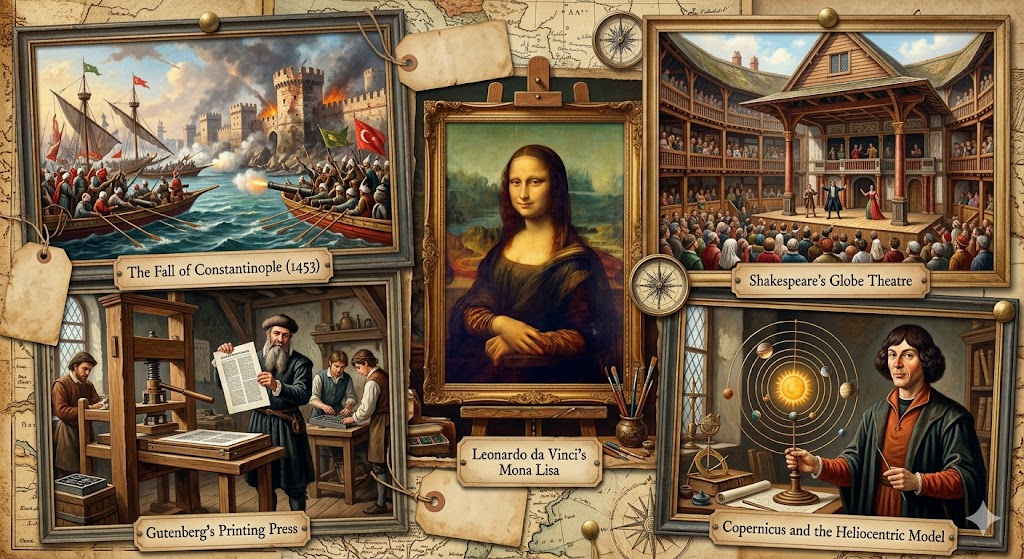
Cause 1: Capture of Constantinople (1453 CE) – The Most Important Cause
What happened?
In 1453 CE, the Ottoman Turks led by Sultan Mehmed II captured Constantinople (capital of the Byzantine Empire, modern-day Istanbul).
How did this cause the Renaissance?
- Many Greek and Roman scholars living in Constantinople fled to Italy with their precious books and manuscripts.
- These scholars brought with them ancient texts of Plato, Aristotle, Euclid, Ptolemy, and other classical writers.
- Italian scholars (like Petrarch, who is called the “Father of Humanism”) studied these texts and became inspired by the wisdom of ancient Greece and Rome.
Exam Tip: This is the most important cause. Remember: Constantinople fell in 1453 → Greek scholars fled to Italy → brought classical texts → Renaissance began.
Cause 2: Decline of Feudalism
What was feudalism?
A social and economic system in medieval Europe where powerful lords owned land, and peasants (serfs) worked on the land in exchange for protection.
Why did feudalism decline?
- The Black Death (plague) killed nearly one-third of Europe’s population, leading to labour shortages.
- Peasants could demand higher wages. Many moved to towns for better opportunities.
- The power of feudal lords weakened, and towns (urban centres) grew.
- In towns, people became wealthier and had time and money to spend on art, learning, and travel.
How did this help the Renaissance?
Wealthy merchants and bankers (like the Medici family in Florence) became patrons of artists and scholars. They sponsored painters, sculptors, poets, and scientists.
Cause 3: New Trade Routes and the Rise of Wealthy City-States
What happened?
The Crusades (holy wars between Christians and Muslims) opened up trade between Europe and the East (Arab world, India, China). Italian cities like Venice, Genoa, and Florence became very wealthy as trading centres.
How did this help the Renaissance?
- Wealthy merchants became patrons of art and learning.
- They wanted beautiful paintings, sculptures, and buildings to show their wealth and status.
- They also sponsored scholars to translate ancient Greek and Arabic texts.
The Medici Family (Florence): The most famous patrons. They spent enormous amounts of money on art and built libraries. Without them, the Renaissance might not have happened as it did.
Cause 4: Spirit of Enquiry (Reason and Rational Thinking)
What was the spirit of enquiry?
During the medieval period, people accepted whatever the Church said without question. But during the Renaissance, a new spirit of curiosity and enquiry arose. People started asking questions like:
- “Is the Earth really the centre of the universe?”
- “Why do people get sick?”
- “How does the human body work?”
Who led this?
Scholars like Petrarch (Father of Humanism) encouraged people to study classical texts and use reason, not just faith.
How did this help the Renaissance?
People stopped accepting everything blindly. They began to observe, experiment, and think for themselves. This led to scientific discoveries and new ways of looking at the world.
Cause 5: Invention of the Printing Press (Johannes Gutenberg, c. 1440 CE)
What was the printing press?
A machine invented by Johannes Gutenberg in Germany around 1440 CE that allowed books to be printed quickly and cheaply. Before this, every book had to be copied by hand (a monk might take a year to copy one book).
How did this help the Renaissance?
- Books became cheap and widely available. Many more people could read.
- Knowledge spread rapidly across Europe.
- The Bible was printed in local languages (not just Latin), so ordinary people could read and interpret it themselves.
- New ideas (including Renaissance ideas) travelled faster.
- Literacy rates increased.
Did You Know? Gutenberg’s printing press is often called the “greatest invention of the second millennium.” Without it, the Reformation, Scientific Revolution, and even modern education would have been impossible.
Impact of the Renaissance on Art, Literature, and Science
For ICSE Class 9, you need to know three key figures representing each field:
- Art: Leonardo da Vinci (Italy)
- Literature: William Shakespeare (England)
- Science: Copernicus (Poland)
Impact on Art – Leonardo da Vinci (1452–1519)
Leonardo da Vinci is considered the greatest genius of the Renaissance. He was not just a painter – he was also a scientist, inventor, engineer, anatomist, and musician. He is called the “Renaissance Man” because he excelled in so many fields.
His famous paintings (you must know these for ICSE):
- Mona Lisa – A portrait of a woman with a mysterious smile. It is the most famous painting in the world. Housed in the Louvre Museum (Paris).
- The Last Supper – A mural painting showing Jesus Christ’s last meal with his disciples. Famous for its composition and the emotional expressions of the disciples.
Leonardo’s contributions to art – what made him special?
- Realism: He studied human anatomy by dissecting dead bodies. This allowed him to paint the human body with perfect proportions and muscles.
- Sfumato technique: A painting technique that creates soft, smoky transitions between colours (used in Mona Lisa).
- Perspective: He used linear perspective to create depth in paintings.
- Chiaroscuro: Use of strong contrasts between light and dark.
Leonardo’s inventions/scientific work (just know for context):
- Designed flying machines, tanks, and diving suits (long before they were built).
- Made detailed drawings of the human heart, muscles, and skeleton.
- Wrote his notes in mirror writing (left to right) – possibly to keep his ideas secret.
Exam Tip: For a 2-mark question on Leonardo, mention Mona Lisa and The Last Supper. For a 5-mark question, add realism, sfumato, anatomy studies, and “Renaissance Man”.
Impact on Literature – William Shakespeare (1564–1616)
William Shakespeare is the greatest playwright and poet in the English language. His works are still performed today, 400 years after his death.
Why is Shakespeare important?
- He wrote 37 plays (comedies, tragedies, histories) and 154 sonnets (poems).
- His plays explore universal human emotions – love, jealousy, ambition, revenge, grief.
- He invented hundreds of English words and phrases that we still use today (e.g., “break the ice,” “wild goose chase,” “fair play”).
Famous plays you must know for ICSE:
- Romeo and Juliet – A tragedy about two young lovers from feuding families.
- Hamlet – A tragedy about a prince seeking revenge for his father’s murder (“To be, or not to be”).
- Macbeth – A tragedy about ambition and guilt.
- A Midsummer Night’s Dream – A comedy.
- Julius Caesar – A historical play about the assassination of Julius Caesar.
How did the Renaissance influence Shakespeare?
- The Renaissance spirit of humanism focused on human emotions and individual choices – exactly what Shakespeare wrote about.
- The printing press spread his plays widely – otherwise his works might have been lost.
- He borrowed stories from Greek and Roman classics (Renaissance revival of classical learning).
Remember This Box ⭐
Shakespeare = England = Renaissance literature = Romeo and Juliet, Hamlet
Impact on Science – Nicolaus Copernicus (1473–1543)
What did Copernicus do?
He proposed the heliocentric theory – the idea that the Sun (helios = sun) is the centre of the universe, and the Earth and other planets revolve around the Sun.
What was the old belief?
Before Copernicus, the Church and most people believed the geocentric theory (geo = Earth) – that the Earth was the centre of the universe, and the Sun, Moon, and stars revolved around it. This idea came from the Greek astronomer Ptolemy (2nd century CE).
Why was Copernicus revolutionary?
- His theory challenged the Church – because the Bible seemed to suggest that God placed Earth at the centre.
- He did not publish his book On the Revolutions of the Heavenly Spheres until the year of his death (1543), fearing persecution.
- His ideas were later proved by Galileo (who used a telescope) and Kepler.
Impact of Copernicus:
- Started the Scientific Revolution – a period of major scientific discoveries.
- Encouraged scientists to observe nature and experiment, rather than relying on ancient texts or Church teachings.
- Other scientists like Galileo, Kepler, and Newton built on his work.
Exam Tip: Remember Copernicus = Heliocentric (Sun-centred) theory. Don’t confuse with Ptolemy = Geocentric (Earth-centred).
Consequences of the Renaissance
The Renaissance did not just change art and science – it changed the entire way people thought about the world. Here are the major consequences (long-term effects):
1. Rise of Humanism
- Humanism is a philosophy that focuses on human potential and achievements rather than religious matters.
- Instead of thinking “I am a sinner waiting for the afterlife,” people started thinking “I can achieve great things in this life.”
- This led to more confident, curious, and creative societies.
2. Scientific Revolution
- Copernicus, Galileo, Kepler, Newton – all were products of Renaissance thinking.
- The scientific method (observation, hypothesis, experimentation) replaced blind faith in ancient texts.
- Led to discoveries in astronomy, physics, medicine, chemistry, and biology.
3. The Reformation (Protestant Reformation)
- The printing press spread Renaissance ideas AND criticism of the Catholic Church.
- Martin Luther (1517 CE) started the Reformation – a movement to “reform” the Church.
- Result: Protestantism (Lutheranism, Calvinism, Church of England) broke away from the Catholic Church.
4. Age of Exploration (Discovery of New Lands)
- The Renaissance spirit of curiosity and adventure led to exploration.
- New navigation instruments (compass, astrolabe) and better ship designs were developed.
- Columbus discovered America (1492), Vasco da Gama reached India (1498), Magellan’s crew circumnavigated the globe (1522).
- Europeans colonised Americas, Africa, and Asia – leading to the modern globalised world.
5. Development of Vernacular Literature
- Before the Renaissance, most books were written in Latin (only priests and scholars could read).
- Renaissance writers like Shakespeare (English), Dante (Italian), Cervantes (Spanish) wrote in local languages.
- Literacy increased dramatically.
6. Rise of Nation-States
- Feudalism declined; powerful kings in England, France, Spain, and Portugal created strong, centralised governments.
- People started identifying themselves as “English” or “French” rather than “Christian” only.
EXAM-ORIENTED STUDY MATERIAL
Important Dates and Events
- 1453 CE – Capture of Constantinople by Ottoman Turks (Greek scholars fled to Italy).
- c. 1440 CE – Gutenberg invents the printing press.
- 1452–1519 CE – Life of Leonardo da Vinci.
- 1473–1543 CE – Life of Nicolaus Copernicus.
- 1543 CE – Copernicus publishes On the Revolutions of the Heavenly Spheres.
- 1564–1616 CE – Life of William Shakespeare.
- 14th–17th centuries – Renaissance period (approx.).
Important Terms and Definitions
| Term | Meaning |
|---|---|
| Renaissance | French word meaning “rebirth”; period of cultural and intellectual awakening in Europe (14th–17th century) |
| Humanism | A philosophy that focuses on human potential and achievements rather than religious matters |
| Feudalism | Medieval social and economic system based on land ownership and loyalty |
| Patron | A wealthy person who supports artists, writers, and scholars financially |
| Printing Press | Machine invented by Gutenberg (c.1440) that allowed mass production of books |
| Sfumato | Painting technique with soft, smoky transitions between colours (used by Leonardo) |
| Chiaroscuro | Use of strong contrasts between light and dark in paintings |
| Heliocentric Theory | Sun-centred model of the universe (proposed by Copernicus) |
| Geocentric Theory | Earth-centred model of the universe (Ptolemy; Church’s position before Copernicus) |
| Scientific Revolution | Period of major scientific discoveries that began with Copernicus |
| Reformation | 16th-century movement to reform the Catholic Church, led by Martin Luther |
| Vernacular | Local/common language of a region (e.g., English, French, Italian) |
Important Personalities with Roles
| Personality | Field | Contribution |
|---|---|---|
| Leonardo da Vinci | Art & Science | Painter of Mona Lisa and The Last Supper; “Renaissance Man”; studied anatomy; invented many machines |
| William Shakespeare | Literature | Greatest English playwright; wrote Romeo and Juliet, Hamlet, Macbeth; invented hundreds of English words |
| Nicolaus Copernicus | Science | Proposed heliocentric theory (Sun-centred universe); started the Scientific Revolution |
| Johannes Gutenberg | Technology | Invented the printing press (c.1440 CE) |
| Petrarch | Literature | Father of Humanism; encouraged study of classical texts |
| Medici Family | Patrons | Wealthy banking family of Florence; sponsored Renaissance artists and scholars |
Timeline of Events (Visual Format)
c.1440  ─► Gutenberg invents printing press
1453    ─► Fall of Constantinople → Greek scholars flee to Italy
1452-1519 ─► Leonardo da Vinci (Mona Lisa, The Last Supper)
1473-1543 ─► Copernicus (heliocentric theory, published 1543)
1564-1616 ─► William Shakespeare (Romeo and Juliet, Hamlet)
14th-17th c. ─► Renaissance period
Cause and Effects Table
| Cause | How it caused the Renaissance | Effect/Consequence |
|---|---|---|
| Capture of Constantinople (1453) | Greek scholars fled to Italy with classical texts | Revival of Greek/Roman learning |
| Decline of Feudalism | Towns grew; wealthy merchants became patrons | Patrons sponsored art and learning |
| New trade routes & wealthy city-states | Italian cities like Florence, Venice became rich | Merchants sponsored Renaissance artists |
| Spirit of enquiry | People started questioning Church teachings | Scientific discoveries; humanism |
| Invention of printing press | Books became cheap and widely available | Spread of ideas; literacy increased; Reformation |
Differences Between Important Concepts
Difference between Heliocentric and Geocentric Theories:
| Aspect | Heliocentric Theory | Geocentric Theory |
|---|---|---|
| Meaning | Sun-centred universe | Earth-centred universe |
| Proposed by | Copernicus (Renaissance) | Ptolemy (Ancient Greece) |
| Supported by Church? | No (condemned initially) | Yes |
| Scientific accuracy | Correct (with later refinements by Galileo, Kepler) | Incorrect |
Difference between Medieval Art and Renaissance Art:
| Aspect | Medieval Art | Renaissance Art |
|---|---|---|
| Subjects | Mostly religious (God, Christ, saints) | Religious + mythology + portraits + nature |
| Realism | Flat, unrealistic, no perspective | Realistic, 3D perspective, accurate anatomy |
| Artists’ status | Unknown craftsmen | Celebrated individuals (da Vinci, Michelangelo) |
| Techniques | Tempera on wood | Oil painting, sfumato, chiaroscuro |
Flowchart: Causes of the Renaissance
                    CAUSES OF THE RENAISSANCE
                            │
        ┌───────────────────┼───────────────────┐
        │                   │                   │
   Capture of          Decline of           New Trade Routes
   Constantinople      Feudalism             & Wealthy Cities
   (1453 CE)                │                      │
        │                   │                      │
   Greek scholars      Merchants became      Italian city-states
   flee to Italy       patrons of art        (Florence, Venice)
        │                   │                      │
        └───────────────────┼───────────────────┘
                            │
                    SPREAD OF NEW IDEAS
                            │
        ┌───────────────────┴───────────────────┐
        │                                       │
   Spirit of Enquiry                    Printing Press
   (questioning Church)                 (Gutenberg, c.1440)
        │                                       │
   → Humanism                           → Cheap books
   → Scientific observation              → Rapid spread of ideas
   → Challenge to authority               → Literacy increased
Mnemonic for 5 Causes of Renaissance
“C D N S P” (Remember as “Chocolates Don’t Need Sugar Please”)
- C – Capture of Constantinople
- D – Decline of Feudalism
- N – New trade routes
- S – Spirit of enquiry (reason)
- P – Printing press
Summary Notes for Quick Revision (One Page)
- Renaissance: French word meaning “rebirth”; 14th–17th century; began in Italy.
- 5 Causes: (C)apture of Constantinople (1453); (D)ecline of Feudalism; (N)ew trade routes; (S)pirit of enquiry; (P)rinting press (Gutenberg).
- Impact on Art – Leonardo da Vinci: Mona Lisa, The Last Supper; realism, sfumato, anatomy; called “Renaissance Man”.
- Impact on Literature – William Shakespeare: Romeo and Juliet, Hamlet; greatest English playwright.
- Impact on Science – Copernicus: Heliocentric theory (Sun-centred); started Scientific Revolution.
- Consequences: Humanism, Scientific Revolution, Reformation, Age of Exploration, Vernacular literature, Rise of nation-states.
QUESTIONS & ANSWERS SECTION (MASSIVE BANK)
Very Short Answer Questions (1 Mark)
Q1. What does the word “Renaissance” mean?
Ans. Rebirth (French word).
Q2. In which country did the Renaissance begin?
Ans. Italy (specifically Florence, Venice, Rome).
Q3. Who invented the printing press?
Ans. Johannes Gutenberg (Germany, c.1440 CE).
Q4. In which year was Constantinople captured by the Ottoman Turks?
Ans. 1453 CE.
Q5. Who painted the Mona Lisa?
Ans. Leonardo da Vinci.
Q6. Who painted The Last Supper?
Ans. Leonardo da Vinci.
Q7. Who wrote Romeo and Juliet?
Ans. William Shakespeare.
Q8. Who wrote Hamlet?
Ans. William Shakespeare.
Q9. What is the heliocentric theory?
Ans. The theory that the Sun is the centre of the universe, and
FAQ Schema Questions with Answers (Renaissance)
1. What is the Renaissance?
The Renaissance was a cultural, artistic, intellectual, and scientific movement that began in Italy during the 14th century and later spread across Europe. The word “Renaissance” means “rebirth.” It marked the revival of interest in the art, literature, and knowledge of ancient Greece and Rome and brought major changes in European society.
2. What are the main causes of the Renaissance?
The main causes of the Renaissance were the growth of trade and cities, the rise of wealthy patrons, the decline of feudalism, the revival of classical learning, the invention of the printing press, and the fall of Constantinople in 1453. These factors encouraged people to focus on education, art, science, and humanism.
3. How did the capture of Constantinople (1453) cause the Renaissance?
The capture of Fall of Constantinople by the Ottoman Turks forced many Greek scholars to migrate to Italy with valuable Greek manuscripts and classical knowledge. This helped revive the study of ancient Greek and Roman literature and greatly contributed to the growth of Renaissance learning in Europe.
4. What was the role of the printing press in the Renaissance?
The printing press, invented by Johannes Gutenberg, played a major role in spreading Renaissance ideas. Books became cheaper and more easily available, which increased literacy and helped spread knowledge, scientific discoveries, and humanist ideas throughout Europe.
5. Who was Leonardo da Vinci and what did he contribute?
Leonardo da Vinci was one of the greatest artists and thinkers of the Renaissance. He painted famous works such as Mona Lisa and The Last Supper. He also contributed to science, engineering, anatomy, and architecture through his innovative ideas and sketches.
6. Who was William Shakespeare and why is he important?
William Shakespeare was a famous English playwright and poet of the Renaissance period. He wrote important plays such as Hamlet, Macbeth, and Romeo and Juliet. He is important because his works greatly influenced English literature and drama.
7. What did Copernicus discover?
Nicolaus Copernicus proposed the heliocentric theory, which stated that the Earth and other planets revolve around the Sun. This discovery challenged traditional beliefs and brought major changes in astronomy and scientific thinking.
8. What was the impact of the Renaissance on art, literature, and science?
The Renaissance brought major developments in art, literature, and science. Artists focused on realism, perspective, and human emotions. Writers promoted humanism and individualism. Scientists encouraged observation and experimentation, leading to important discoveries in astronomy, medicine, and physics. The Renaissance transformed European culture and learning.
9. What are the consequences of the Renaissance?
The Renaissance led to the growth of modern science, the spread of education, the rise of humanism, and the development of new artistic styles. It weakened the control of the Church over intellectual life and encouraged independent thinking. The movement also contributed to the Reformation, geographical discoveries, and the beginning of the modern age in Europe.