
Forest and Wildlife Resources Class 10 Complete Guide: Notes, Questions & Exam Tips
Are you preparing for your Class 10 Board Exams? Whether you are a student of CBSE, UP Board, Bihar Board, or RBSE, Geography Chapter 2: Forest and Wildlife Resources is a high-scoring chapter that is often overlooked. This chapter is not just about memorizing facts; it is about understanding the delicate balance of our ecosystem and why we need to protect it.
In this comprehensive study guide, we have broken down the entire NCERT syllabus into easy-to-digest notes. We cover everything from the concept of biodiversity to the different types of forest conservation in India. This guide is specifically designed to help students from the Hindi Belt (UP, Bihar, MP, Rajasthan, etc.) who are looking for clear, concise, and exam-oriented English explanations.
Why is this chapter important?
- Exam Weightage: It covers crucial concepts frequently asked in VSA, SA, and Long Answer questions.
- Competitive Exams: The concepts form the base for future UPSC and State PSC preparations.
- Awareness: It helps you understand environmental issues, a key component of modern education.
Let’s dive into the ultimate notes for Forest and Wildlife Resources Class 10!
Chapter Overview: Forest and Wildlife Resources
This chapter deals with the biodiversity of India. It explains the rich variety of flora and fauna in the country and the threats they face due to human activities. It further discusses the conservation steps taken by the government and local communities to protect these precious resources.
Key Concepts to Master:
- Biodiversity: The variety of plant and animal life.
- Conservation: Protection and preservation of natural resources.
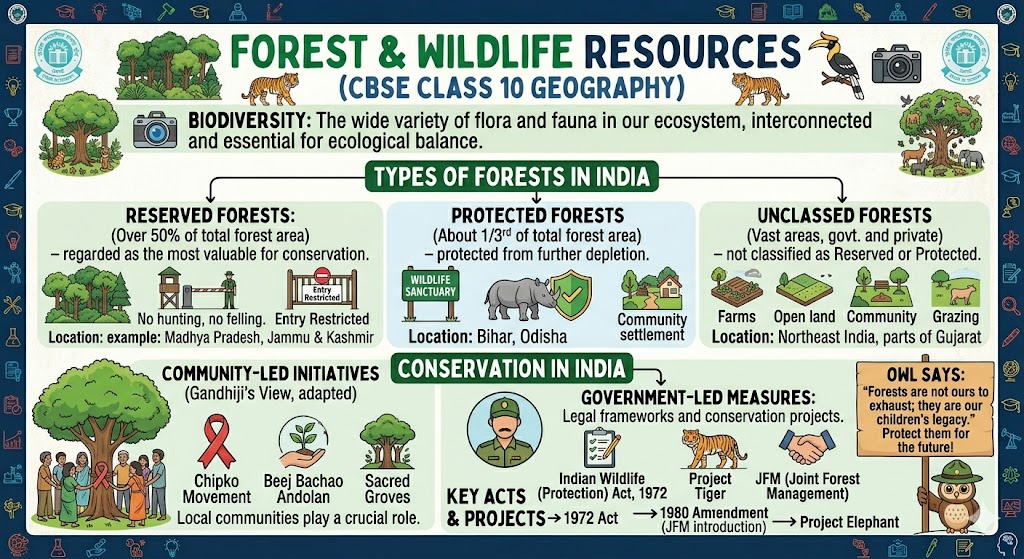
- Forest Classification: Reserved, Protected, and Unclassed Forests.
- Community Conservation: The role of local people in saving forests (e.g., Chipko Movement).
Detailed Explanation of the Chapter
1. Biodiversity: The Wealth of India
India is one of the world’s richest countries in terms of biological diversity.
- Flora: Over 47,000 plant species are found in India.
- Fauna: India is home to nearly 90,000 animal species and a huge variety of fish and insects.
Why is Biodiversity Important?
Biodiversity maintains the ecological balance. Plants purify the air, animals help in pollination, and decomposers clean the environment. Losing even a single species can disrupt the entire food chain.
2. Classification of Forests in India
According to the Forest Survey of India and NCERT, forests in India are classified based on their management status. This is a very important topic for board exams.
| Type of Forest | Description | Ownership & Rights | Percentage (approx.) |
|---|---|---|---|
| Reserved Forests | These are the most valuable forests. More than half of the total forest land is declared “Reserved.” | The government owns these. No local activity is allowed without permission. | > 50% |
| Protected Forests | These are protected from further depletion. | Government owns the land, but local people are allowed to take some wood with permissions. | Nearly 1/3rd |
| Unclassed Forests | These are government and private lands. | These are often degraded forests or wastelands. Access is less restricted. | Remainder |
Exam Tip: For UP Board and Bihar Board, questions often ask the difference between Reserved and Protected forests. Memorize the ownership and restriction levels.
3. The Status of Forests in India
- Deforestation: The cutting down of trees for agriculture, mining, and urbanization.
- Depletion: Since independence, a significant amount of forest land has been lost for various developmental projects.
- Loss of Biodiversity: Hunting, poaching, and habitat destruction have led to animals like the Cheetah going extinct in India.
4. Conservation of Forest and Wildlife in India
To combat depletion, the Indian government has taken several steps:
A. Legal and Institutional Framework
- Wildlife Protection Act, 1972: This was a landmark act. It provided legal protection to wildlife and initiated Project Tiger.
- Project Tiger (1973): Started to save the tiger population. It aimed at protecting the habitat (the tiger’s home) rather than just the animal.
- CITES (Convention on International Trade in Endangered Species): India is a signatory to this international treaty which restricts trade in rare species.
- Indian Wildlife Protection Act (Amendment 1991/2002): Included plants and insects in the protection list.
B. Conservation Categories (IUCN)
Students often confuse these terms. Here is a simple breakdown:
- Normal Species: Whose population levels are considered normal (e.g., Cattle, Rodents).
- Endangered Species: Those in danger of extinction (e.g., Black Buck, Crocodile, Indian Wild Ass).
- Vulnerable Species: Those declining in numbers (e.g., Blue Sheep, Gangetic Dolphin).
- Rare Species: Small population in restricted areas (e.g., Himalayan Brown Bear, Wild Asiatic Buffalo).
- Endemic Species: Found only in a specific geographical area (e.g., Nicobar Pigeon, Andaman Wild Pig).
- Extinct Species: Not found anymore (e.g., Asiatic Cheetah).
5. Role of Local Communities in Conservation
Conservation is not just the government’s job; local people play a huge role.
- Sacred Groves: In many parts of India (Rajasthan, MP, Maharashtra), forests are considered sacred. No one is allowed to cut trees or hunt animals there. These are called Sarana or Deorai.
- Chipko Movement (1970s): Started in Reni village (Garhwal Himalayas) by Sunderlal Bahuguna. Villagers hugged the trees to prevent contractors from cutting them down.
- Beej Bachao Andolan: Tehri (Uttarakhand). Famous for saving traditional seeds.
- Joint Forest Management (JFM): The government involves local communities in protecting and managing forests. In return, they get a share of the benefits (timber, bamboo).
Important Terms & Definitions
- Biodiversity: The variety of living organisms in a specific habitat.
- Deforestation: The large-scale removal of trees.
- Ecosystem: A biological community of interacting organisms and their physical environment.
- Poaching: Illegal hunting or capturing of wild animals.
- Reserved Forests: Forests where commercial activities are banned.
- Chipko Movement: A movement where people hugged trees to save them from being cut.
- Flora: Plant life of a particular region.
- Fauna: Animal life of a particular region.
Mnemonics & Memory Tricks
To remember the Conservation Categories (IUCN), use the mnemonic:
“EVER”
- E – Extinct
- V – Vulnerable
- E – Endangered
- R – Rare + Endemic (and Remember the Normal species are safe!)
Board-Wise Exam Focus
For CBSE Students
- Focus on Case Studies: Questions often ask about the impact of industrial projects on the Narmada River or similar examples.
- Competency-Based Questions: You might get a map-based question or a passage about the Chipko movement and be asked to analyze the people’s role.
For UP Board & Bihar Board
- Focus on Definitions: Define terms like Biodiversity, Poaching, and Reserved Forests.
- Direct Questions: “What are the three types of forests?” or “Write the full form of CITES.”
- Hindi Context: Remember to mention examples relevant to North India, like the Sariska Tiger Reserve (Rajasthan) and Dudhwa National Park (UP).
Board Exam Important Questions
Multiple Choice Questions (MCQs)
- Which of the following is an endangered species?
a. Lion
b. Black Buck
c. Goat
d. Cow
Ans: b. Black Buck - The famous Chipko Movement was started in:
a. Rajasthan
b. Himachal Pradesh
c. Garhwal Himalayas
d. Bihar
Ans: c. Garhwal Himalayas - Which type of forest is the most restricted?
a. Unclassed Forests
b. Protected Forests
c. Reserved Forests
d. Private Forests
Ans: c. Reserved Forests - The Cheetah in India is an example of:
a. Endangered Species
b. Vulnerable Species
c. Extinct Species
d. Rare Species
Ans: c. Extinct Species
Very Short Answer Questions (VSA) – 2 Marks
- What is biodiversity?
Ans: Biodiversity refers to the variety of flora (plants) and fauna (animals) in a given region. It is essential for the stability of the ecosystem. - Differentiate between Flora and Fauna.
Ans: Flora refers to the plant life of a region, whereas Fauna refers to the animal life of a region. - Define Reserved Forests.
Ans: Reserved Forests are the most valuable forests where commercial activities like grazing and tree cutting are strictly prohibited.
Short Answer Questions (SA) – 3 Marks
- Explain three main causes of depletion of biodiversity in India.
Habitat destruction: Due to expanding agriculture, mining, and urbanization, forests are being cleared.
Poaching: Illegal hunting of animals for fur, skin, or medicinal purposes threatens their survival.
Pollution: Air and water pollution harm sensitive plant and animal species. - What are Sacred Groves? Why are they important?
Ans: Sacred Groves are patches of forest that are worshipped by local communities. Cutting trees or hunting animals here is forbidden by religious beliefs. They play a crucial role in conserving rare and endangered species.
Long Answer Questions (LA) – 5 Marks
- Describe the role of local communities in the conservation of forests and wildlife.
Introduction: Conservation is not solely the job of the government; local communities have a deep connection with the forest.
Traditional Protection: In many areas, villages have protected forests for ages. They are known as Sacred Groves.
Movements: The Chipko Movement in the Himalayas is a classic example where women hugged trees to save them. The Beej Bachao Andolan in the Himalayas protects traditional crop varieties.
JFM: The government launched Joint Forest Management (JFM) to involve local people in restoring degraded forests. In return, villagers get timber, bamboo, and fodder.
Conclusion: These efforts show that when people benefit directly, they protect the environment better. - Discuss the various steps taken by the Indian government to protect wildlife.
Wildlife Protection Act 1972: Provided legal protection to animals.
Project Tiger: Started to save tigers and their habitat.
CITES: India joined the convention to ban international trade in wildlife products.
Amendments: The Wildlife Protection Act was amended to include plants and insects.
National Parks and Sanctuaries: Many areas are declared as protected zones where human interference is minimal.
Smart Revision Notes (One-Day Revision)
- Biodiversity = Variety.
- India = One of the 12 mega-biodiversity countries.
- Forest Types: Reserved (Restricted) > Protected (Restricted) > Unclassed (Open).
- Species Types: Normal → Vulnerable → Endangered → Rare → Endemic → Extinct.
- Act 1972: Wildlife Protection.
- Project 1973: Tiger.
- Chipko Movement: Hug trees.
- Sacred Groves: Religious conservation.
- JFM: Joint Forest Management (Govt + People).
Frequently Asked Questions (FAQs)
1. What is the difference between endemic and endangered species?
Endemic species are found only in a specific area (e.g., Lemurs in Madagascar), while Endangered species are at high risk of extinction (e.g., Tigers).
2. Why are forests called ‘Biodiversity Hotspots’?
Because they contain a huge variety of plant and animal species that are not found anywhere else, and they are threatened by human activity.
3. What is the ‘Chipko Movement’ famous for?
It is famous for the method of hugging trees to prevent them from being cut down.
4. How does deforestation affect the climate?
Deforestation leads to global warming and an increase in CO2 levels, causing climate change.
5. What was the main objective of Project Tiger?
To ensure a viable population of the tiger in its natural habitat and to protect it from extinction.
Conclusion
Forest and Wildlife Resources is a vital chapter that teaches us to respect nature. For your Class 10 Board Exams (CBSE, UP Board, Bihar Board, etc.), this chapter offers easy marks if you understand the classifications and the conservation movements.
Make sure you revise the IUCN categories and the Forest types thoroughly. Use the provided notes and questions to test your knowledge. Good luck with your exams—go score high and protect the environment!


