
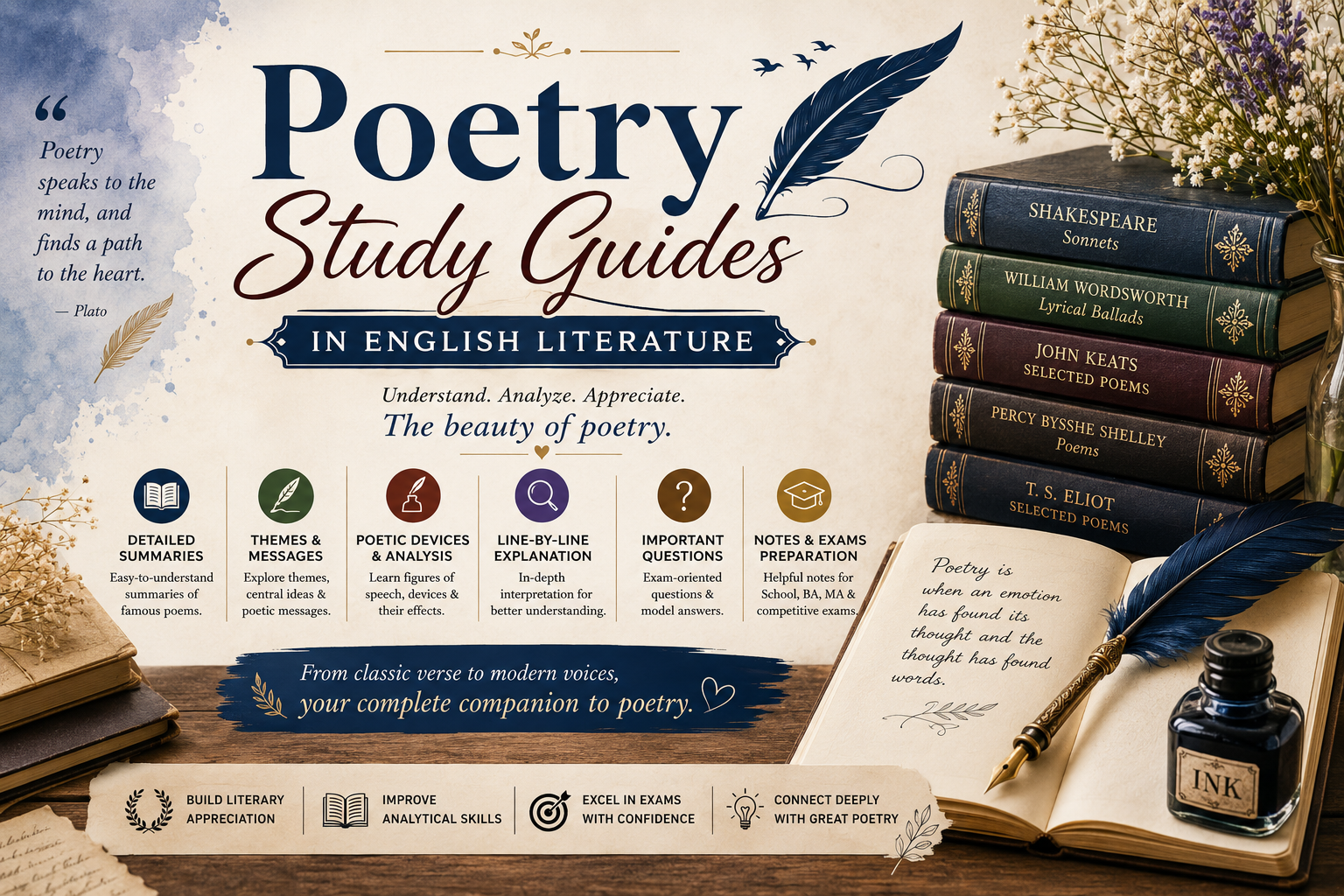
Welcome to the CreativeAkademy’s Poetry Study Guides!!
What is Poetry?
Poetry is a form of Literature that uses vocabulary that are crafted artistically capturing human emotions, imagination, nature, love, society, and philosophy.
This Poetry Study Guides Hub serves as a central navigation page where students, researchers, teachers, and literature enthusiasts can access comprehensive study materials on poems from different literary periods and traditions.
Whether you are preparing for university examinations, competitive exams such as UGC NET, or simply exploring the beauty of poetry, this hub provides organized access to poem summaries, themes, critical analyses, literary devices, and detailed explanations. The Creative Akademy poetry section includes study guides on Romantic poetry, Metaphysical poetry, Victorian poetry, Modern poetry, American poetry, and prescribed school and college texts. Examples include poems by poets such as William Wordsworth, John Donne, Emily Dickinson, and William Shakespeare.
For a more detailed study on Poetry Click Here-
What You’ll Find in Each Study Guide
Every poetry guide is designed to provide:
- Summary of the poem
- Line-by-line explanation
- Major themes
- Literary devices and figures of speech
- Author and historical background
- Examination questions and answers
Explore Poetry Study Guides
British Poetry
Elizabethan Poetry
Edmund Spenser(1552-1599)
Edmund Spenser was one of the greatest English poets of the Elizabethan Age. He is often called the Poet’s Poet because of his influence on later English poets, including John Milton and John Keats. His poetry is known for its rich imagery, musical language, allegory, and moral significance.
His most famous work is The Faerie Queene, an allegorical epic poem written in praise of Queen Elizabeth I. Other important works include The Shepheardes Calender and Amoretti. He developed the Spenserian stanza, a nine-line stanza form used in The Faerie Queene.
Philip Sidney(1554-1586)
Sir Philip Sidney was an English poet, courtier, soldier, and literary critic of the Elizabethan Age. He was regarded as an ideal Renaissance gentleman because he combined literary talent, military courage, and intellectual ability.
His major works include Astrophel and Stella, a famous sonnet sequence; The Defence of Poesy, an important work of literary criticism; and Arcadia, a pastoral romance. In The Defence of Poesy, Sidney argues that poetry teaches and delights its readers. He helped establish the sonnet sequence as an important form in English literature.
Queen Elizabeth I (1553-1603)
Queen Elizabeth I was the Queen of England from 1558 to 1603. Although she was not primarily known as a poet, she was an important literary figure and patron of the arts. Her reign is known as the Elizabethan Age, a period of remarkable growth in English drama, poetry, and exploration.
Elizabeth supported writers, poets, and dramatists, creating an environment in which figures such as William Shakespeare, Edmund Spenser, and Christopher Marlowe flourished. She also wrote speeches, letters, and occasional poetry. Her reign witnessed the development of English Renaissance literature and the flourishing of the English theatre.
William Shakespeare(1564-1616)
William Shakespeare was an English poet, playwright, and actor, widely regarded as one of the greatest writers in world literature. He wrote during the late Elizabethan and Jacobean periods. His works explore universal themes such as love, ambition, jealousy, power, revenge, fate, and human nature.
His famous tragedies include Hamlet, Macbeth, Othello, and King Lear. His comedies include A Midsummer Night’s Dream, Twelfth Night, and As You Like It. His historical plays include Richard III and Henry V. He also wrote 154 sonnets and two major narrative poems, Venus and Adonis and The Rape of Lucrece. His mastery of language, characterization, dramatic structure, and blank verse made a lasting contribution to English literature.
- Sonnet 73 by William Shakespeare Study Guide
- Sonnet 130 by William Shakespeare Study Guide
- Sonnet 65 by William Shakespeare Study Guide
- Let Me Not to the Marriage of True Minds(Sonnet 116) Study Guide
Metaphysical Poetry
John Donne (1573-1631)
John Donne was an English poet, preacher, and the leading representative of the Metaphysical School of Poetry. His poetry is famous for intellectual complexity, wit, paradox, and the use of unusual comparisons known as conceits. His works explore love, religion, death, and spirituality. He wrote both secular love poetry and religious poems.
Andrew Marvell(1621-1678)
Andrew Marvell was an English metaphysical poet, politician, and satirist. His poetry combines intellectual reasoning, wit, imagery, and philosophical reflection. He explored themes of love, time, nature, political freedom, and mortality. His poetry is particularly admired for its balance between emotion and reason.
- Critical Appreciation of “To His Coy Mistress”
- Critically comment on “To His Coy Mistress” by Andrew Marvell as a metaphysical poem.
- Explanation of To His Coy Mistress by Andrew Marvell or To His Coy Mistress by Andrew Marvell – Summary, Analysis & Themes
Neoclassical Period (1660-1785)
John Dryden(1631-1700)
John Dryden was an influential English poet, dramatist, translator, and literary critic. He became the leading literary figure of the Restoration Age and was appointed England’s first official Poet Laureate in 1668. His writing is known for clarity, balance, satire, and the effective use of heroic couplets. He helped establish neoclassical principles in English literature.
MacFlecknoe Study Guide
Oliver Goldsmith (1728-1774)
Oliver Goldsmith was an Irish-born English writer, poet, novelist, and dramatist. He belonged to the eighteenth-century literary tradition and was associated with Samuel Johnson’s literary circle. His works combine humour, sentiment, social observation, and sympathy for ordinary people. He often criticized social inequality and the destructive effects of commercial progress on rural life.
William Blake (1757-1827)
William Blake was an English poet, painter, and printmaker who is regarded as one of the early pioneers of Romanticism. His poetry emphasizes imagination, spiritual vision, individual freedom, and criticism of social injustice. Blake challenged established religious and political institutions and explored the contrast between innocence and experience.
- The Tyger by William Blake: Complete Analysis, Themes, Summary and Symbolism
- The Lamb by William Blake: Summary, Themes & Analysis| Study Guide
Romantic poetry
William Wordsworth (1770-1850)
William Wordsworth was one of the principal founders of English Romantic poetry. Along with Samuel Taylor Coleridge, he helped launch the Romantic movement through the publication of Lyrical Ballads in 1798. Wordsworth believed that poetry should express powerful feelings through ordinary language and that nature plays an essential role in human development and spiritual understanding.
Percy Bysshe Shelley (1792-1822)
Percy Bysshe Shelley, commonly known as P. B. Shelley, was a major English Romantic poet. His poetry is distinguished by lyrical beauty, idealism, revolutionary spirit, and a strong belief in liberty and human progress. He opposed tyranny, oppression, and social injustice. Nature often appears in his poetry as a symbol of transformation, renewal, and freedom.
Samuel Taylor Coleridge (1772-1834)
Samuel Taylor Coleridge was an English Romantic poet, literary critic, and philosopher. Along with Wordsworth, he played a crucial role in establishing English Romanticism. His poetry is famous for supernatural elements, vivid imagination, mystery, symbolism, and psychological depth. He believed that imagination transforms ordinary experiences into artistic creations.
Lord Byron(1788-1824)
Lord Byron, whose full name was George Gordon Byron, was a leading English Romantic poet. His poetry is known for passion, satire, individualism, political criticism, and the portrayal of rebellious and emotionally complex heroes. The Byronic hero, an influential literary type, is typically mysterious, proud, rebellious, and troubled by an inner conflict.
John Keats(1795-1821)
John Keats was one of the major second-generation Romantic poets. Despite his short life, he produced some of the most celebrated poems in English literature. His poetry is characterized by sensuous imagery, beauty, rich language, classical references, and reflections on mortality and the relationship between art and life. He developed the concept of negative capability, the ability to remain with uncertainty and mystery without insisting on definite answers.
- Ode on a Grecian Urn by John Keats: Summary, Analysis, Themes & Literary Devices
- To Autumn by John Keats: Summary, Analysis, Themes & Literary Devices
- Ode to a Nightingale by John Keats: Summary, Analysis, Themes & Literary Devices
Walter Scott (1771-1832)
Sir Walter Scott was a Scottish novelist, poet, and historical writer associated with the Romantic Age. He is widely regarded as one of the pioneers of the historical novel in English literature. His writings draw inspiration from Scottish history, folklore, medieval traditions, and chivalry. His works often explore patriotism, heroism, honour, and the conflict between tradition and social change.
Leigh Hunt (1784-1859)
Leigh Hunt was an English poet, essayist, critic, and journalist associated with the Romantic movement. He was known for his liberal political views, literary criticism, and support for younger Romantic poets, particularly John Keats and Percy Bysshe Shelley. His poetry often celebrates beauty, nature, friendship, and the pleasures of everyday life. He also helped popularize Italian literature in England through his translations and critical writing.
- The Glove and the Lions Summary, Analysis & Study Guide
- Abou Ben Adhem Reference to the Context ICSE Class 9 & 10
Thomas Hood(1799-1845)
Thomas Hood was an English poet, humorist, and journalist famous for combining humour, wordplay, and social criticism. Although many of his works are comic, he also wrote deeply moving poems about poverty, suffering, and the hardships faced by ordinary people. His poetry frequently uses puns, clever language, irony, and satire. He is remembered for exposing the harsh conditions of workers and the poor during the Industrial Revolution.
- I Remember I Remember Summary, Analysis and Themes
- Answer of I Remember I Remember Poem English Literature Class 6
Victorian Period (1830-1901)
Alfred Lord Tennyson(1809-92)
Alfred, Lord Tennyson was one of the most prominent poets of the Victorian Age. His poetry is known for its musical language, vivid imagery, emotional depth, and exploration of faith, doubt, death, and human progress. His works reflect the intellectual and spiritual anxieties of nineteenth-century England. He succeeded William Wordsworth as Poet Laureate in 1850.
Elizabeth Barret Browning
Elizabeth Barrett Browning was a major Victorian poet known for her lyrical poetry, emotional intensity, and concern for social justice. Her writing explores love, freedom, women’s rights, slavery, and human suffering. She was one of the most respected female poets of the nineteenth century and was married to the poet Robert Browning.
Robert Browning(1812-89)
Robert Browning was an influential Victorian poet famous for developing and mastering the dramatic monologue. His poetry explores human psychology, moral conflicts, ambition, jealousy, and the complexity of human character. He often reveals a speaker’s personality through their own words, allowing readers to discover the difference between what the speaker says and what the speaker actually reveals.
Matthew Arnold(1822-188)
Matthew Arnold was a Victorian poet, cultural critic, and educational thinker. His poetry frequently explores religious uncertainty, the decline of traditional beliefs, isolation, and the search for meaning in a changing society. As a critic, he emphasized the importance of culture, intellectual discipline, and the disinterested pursuit of critical judgment.
Modern Period (1901-45)
Gerarld Manley Hopkins (1844-1889)
Gerard Manley Hopkins was an English poet and Jesuit priest whose innovative poetry became highly influential in modern literature. His work combines religious faith, close observation of nature, and experimental language. He developed the concept of inscape, the distinctive inner pattern or individuality of a thing, and used sprung rhythm, a rhythmic system that emphasizes stressed syllables.
TS Eliot (1888-1965)
Thomas Stearns Eliot, commonly known as T. S. Eliot, was one of the most influential poets, dramatists, and literary critics of the twentieth century. A central figure in Modernism, he experimented with fragmented structure, multiple literary allusions, shifting voices, and complex symbolism. His works often portray spiritual emptiness, alienation, cultural decline, and the difficulties of modern life.
WH Auden (1907-1973)
Wystan Hugh Auden, known as W. H. Auden, was a major twentieth-century poet whose work combines technical mastery, intellectual depth, political awareness, and psychological insight. His poetry explores love, war, morality, religion, individual responsibility, and the anxieties of modern society. He experimented with a wide range of poetic forms and styles.
- The Night Mail Questions and Answers | MCQs & Workbook Solutions
- Night Mail by W. H. Auden Summary, Analysis & Study Guide
DH Lawrence (1885-1930)
David Herbert Lawrence, known as D. H. Lawrence, was an English novelist, poet, essayist, and literary critic. He is best known for exploring human relationships, sexuality, emotional experience, industrial society, and the relationship between human beings and nature. His writing challenges conventional morality and examines the conflicts between instinct and modern civilization.
RL Stevenson (1850-1894)
Robert Louis Stevenson, commonly known as R. L. Stevenson, was a Scottish novelist, poet, essayist, and travel writer. He is particularly famous for adventure fiction, suspense, and psychological exploration. His works often examine the duality of human nature, the struggle between good and evil, and the tension between respectability and hidden desires.
War Poets
Roald Dahl(1916-1990)
World Poetry in English
Indian Poetry
Ilango Adigal: Cilappatikaram (Selection:The Book of Vanci)
Ilango Adigal was an ancient Tamil poet traditionally regarded as the author of Silappatikaram, one of the Five Great Epics of Tamil literature. Tradition identifies him as a Jain ascetic and a Chera prince who renounced royal life. His epic narrates the tragic story of Kannagi and Kovalan and explores justice, morality, love, and the consequences of political wrongdoing. Major work: Silappatikaram (The Tale of the Anklet).
- Cilappatikaram: Plot, Structure,Kannaki, Feminism, Chastity and the Tamil Epic Tradition
- Introduction to Tamil Poetry with Reference to Cilappatikaram: Akam, Puram and Tamil Epic Tradition
Toru Dutt(1856-1877)
Toru Dutt was an Indian poet and translator who wrote in English and French. She is regarded as one of the early pioneers of Indian English literature. Her poetry combines Indian mythology, cultural heritage, nature, memory, and personal emotion with European literary influences. Despite dying at the age of 21, she left a significant literary legacy. Major works: A Sheaf Gleaned in French Fields, Ancient Ballads and Legends of Hindustan, The Lotus, Our Casuarina Tree, and Bianca, or The Young Spanish Maiden.
Rabindranath Tagore(1861-1941)
Rabindranath Tagore was a Bengali poet, novelist, dramatist, composer, philosopher, and educator. He became the first non-European Nobel laureate in Literature in 1913 for Gitanjali (Song Offerings), particularly its English version. His works explore spirituality, humanism, nature, freedom, nationalism, and the relationship between humanity and the divine. He also founded Visva-Bharati University at Santiniketan.Major works: Gitanjali, Gora, Ghare-Baire (The Home and the World), The Post Office, and Chokher Bali.
- “Gitanjali 63″by Rabindranath Tagore Study Guide
- Where the Mind is Without Fear Poem Question Answer ICSE
Sarojini Naidu(1879-1949)
Sarojini Naidu was an Indian English poet, political activist, and prominent leader of the Indian independence movement. Known as the Nightingale of India, she is celebrated for the musical quality, vivid imagery, colourful descriptions, and lyrical beauty of her poetry. Her works frequently draw upon Indian landscapes, festivals, occupations, traditions, and cultural life. Major works: The Golden Threshold, The Bird of Time, The Broken Wing, Palanquin Bearers, and In the Bazaars of Hyderabad.
- “Coromandel Fishers” Question Answers ALTE WBCHSE 11
- Bangle sellers Reference to the Context ICSE Class 9 & 10
- In the Bazaars of Hyderabad Question Answer for class 8 , 9, 10 English Literature
Nissim Ezekiel(1924-2004)
Nissim Ezekiel was an influential Indian English poet, playwright, editor, and critic who played a major role in shaping modern Indian English poetry. His poetry explores urban life, identity, alienation, relationships, cultural belonging, and the tensions between Indian and Western influences. He is known for his conversational tone, irony, self-examination, and controlled use of language. Major works: The Unfinished Man, The Exact Name, Hymns in Darkness, Night of the Scorpion, and Enterprise.
- The Professor Reference to the Context Class 9& 10 ICSE
- Summary of the Poem “The Professor” | English Literature ICSE
Vikram Seth(1952-)
Vikram Seth is an Indian novelist and poet celebrated for his versatility, narrative skill, and mastery of poetic forms. His writing ranges from epic-length novels to formal verse and travel writing. His works explore family relationships, love, identity, social expectations, and cultural diversity. He is particularly admired for combining accessible storytelling with sophisticated literary technique. Major works: A Suitable Boy, The Golden Gate, An Equal Music, From Heaven Lake, and Beastly Tales from Here and There.
- A Doctor’s Journal Entry Summary, Analysis and Themes
- “The Monkey & the Crocodile” Question Answer ENG A WBCHSE
- Reference to the Context Doctor’s Journal English Literature Poem Class 10
American Poetry and Other World Poetry in English
Phillis Wheatley (1773-1784)
Phillis Wheatley was an African-born American poet who became the first African American woman to publish a book of poetry. Enslaved as a child and brought to colonial America, she received an education that enabled her to write poetry influenced by classical literature, Christianity, and eighteenth-century poetic conventions. Her work addresses religion, morality, freedom, and human dignity. Major works: Poems on Various Subjects, Religious and Moral and To His Excellency General Washington.
Emily Dickinson (1830-1886)
Emily Dickinson was one of the most original American poets of the nineteenth century. Her poetry explores death, immortality, nature, consciousness, faith, and the complexities of human emotion. She is known for short lines, unconventional punctuation, unusual capitalization, slant rhyme, and compressed expression. Most of her poems were published after her death.
Major works: “Because I could not stop for Death,” “Hope is the thing with feathers,” “I’m Nobody! Who are you?” and “I heard a Fly buzz—when I died—”.
Henry Cuyler Bunner(1855-1896)
Henry Cuyler Bunner was an American poet, novelist, and editor associated with late nineteenth-century American literature. He was particularly known for his humorous verse, short stories, and observations of everyday life. As editor of the literary magazine Puck, he contributed to American humour and satirical writing. Major works: Airs from Arcady and Elsewhere, The Way to Arcady, and “The Heart of the Tree.”
Robert Frost(1874-1963)
Robert Frost was one of the most celebrated American poets of the twentieth century. His poetry frequently depicts rural New England life, nature, human relationships, choices, isolation, and mortality. Although his language often appears simple and conversational, his poems contain complex philosophical meanings. He frequently used traditional poetic forms and rhythms. Major works: “The Road Not Taken,” “Stopping by Woods on a Snowy Evening,” “Mending Wall,” “Birches,” and “Fire and Ice.”
- A Considerable Speck Summary, Analysis and Themes
- Reference to the Context Stopping by Woods on a Snowy Evening Class 9 & 10 ICSE
Michael Mark(1886-1975)
Pablo Neruda (1904-1973)
Pablo Neruda was a Chilean poet, diplomat, and political figure, widely regarded as one of the major poets of the twentieth century. His poetry explores love, nature, political struggle, ordinary objects, and human solidarity. His style ranges from passionate and intimate love poetry to politically committed writing and experimental imagery.
Major works: Twenty Love Poems and a Song of Despair, Residence on Earth, Canto General, and Odes to Common Things.
Sylvia Plath (1932-1963)
Sylvia Plath was an American poet and novelist associated with Confessional Poetry, a movement characterized by personal and psychologically intense writing. Her work explores identity, relationships, death, psychological suffering, gender expectations, and social pressures. She is celebrated for her striking imagery, powerful metaphors, and emotionally intense poetic voice. Major works: Ariel, The Colossus, Daddy, Lady Lazarus, and the novel The Bell Jar.
Eunice De Souza (1940-2017)
Eunice de Souza was an influential Indian English poet, literary critic, editor, and academic. She was known for her direct, ironic, conversational style and her sharp observations of gender inequality, religion, family relationships, social conventions, and women’s experiences. Her poetry often challenges patriarchal values and exposes the contradictions of middle-class life, particularly within the Catholic community in Goa and Mumbai. She is regarded as an important voice in modern Indian English poetry.
Major works: Fix (1979), Women in Dutch Painting (1988), Ways of Belonging (1990), Selected and New Poems (1994), and Learn from Your Mistakes (1997).
Rainer Maria Rilke(1875-1926)
Rainer Maria Rilke was a Bohemian-Austrian poet and novelist who wrote primarily in German. He is regarded as one of the most significant lyrical poets of modern European literature. His work explores solitude, love, death, spirituality, art, and the relationship between human beings and the world. His poetry is known for philosophical depth, symbolic imagery, and careful attention to inner experience.
Major works: Duino Elegies, Sonnets to Orpheus, The Book of Hours, and Letters to a Young Poet.
Marge Piercy (1936-)
Marge Piercy is an American poet, novelist, and social activist known for her feminist and politically engaged writing. Her works explore women’s experiences, gender inequality, class, labour, environmental concerns, and the possibilities of social transformation. Her poetry often combines everyday language with direct political commentary and personal reflection.
Major works: The Moon Is Always Female, Circles on the Water, Woman on the Edge of Time, and He, She and It.
Maya Angelou (1928-2014)
Maya Angelou was an American poet, memoirist, performer, and civil rights activist. Her writing celebrates resilience, dignity, identity, and the struggle against racism and gender discrimination. Drawing on African American cultural traditions and personal experience, she developed a powerful, accessible style marked by rhythm, repetition, oral storytelling, and affirmations of human strength.
Major works: I Know Why the Caged Bird Sings, “Still I Rise,” “Phenomenal Woman,” and “On the Pulse of Morning.”