
English Grammar
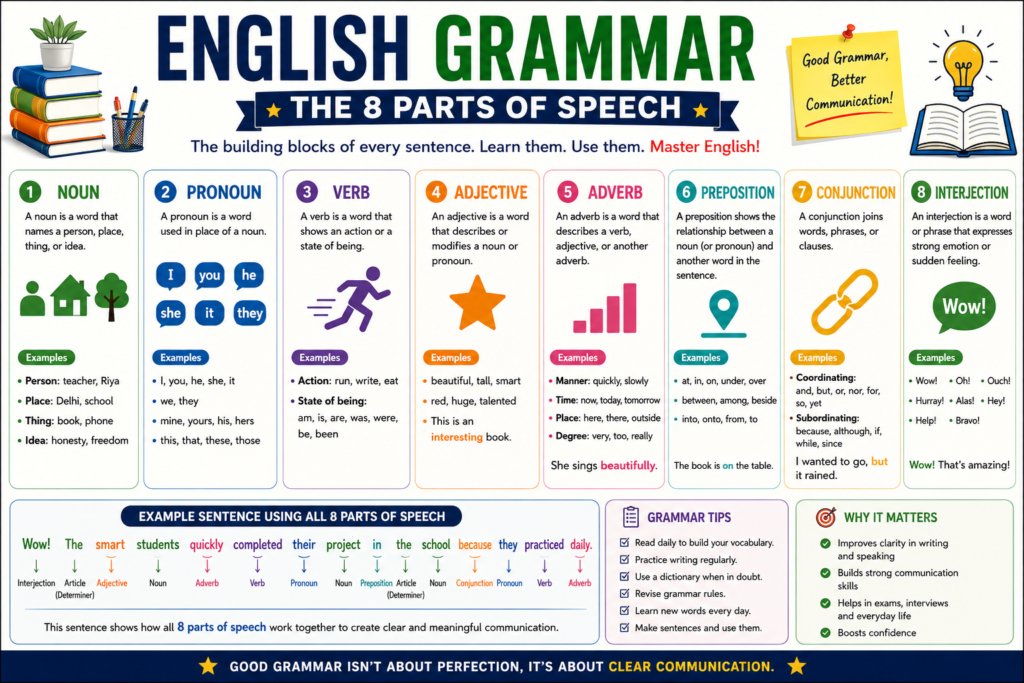
English grammar forms the foundation of effective communication. Whether you are a school student, competitive exam aspirant, or language learner, understanding the parts of speech is essential for improving writing, speaking, and comprehension skills. The parts of speech help us understand how words function in sentences and how they work together to create meaning.
In this guide, you will learn all the major parts of speech in English grammar with definitions, examples, and easy explanations.
What Are Parts of Speech?
Parts of speech are categories of words based on their function in a sentence. Every word in English belongs to one of these categories. Learning them helps students build grammatically correct sentences and improve vocabulary usage.
The eight major parts of speech are:
1. Noun
A noun is a word that names a person, place, thing, or idea.
Examples of Nouns
- Person: teacher, student, doctor
- Place: school, Kolkata, park
- Thing: book, table, pen
- Idea: honesty, freedom, happiness
Types of Nouns
Proper Noun
Names a specific person or place.
Example: Rahul, India, Shakespeare
Common Noun
Names a general person, place, or thing.
Example: boy, city, river
Collective Noun
Refers to a group.
Example: team, family, audience
Abstract Noun
Names an idea or quality.
Example: love, bravery, wisdom
Material Noun
Refers to substances or materials.
Example: gold, water, wood
2. Pronoun
A pronoun is a word used instead of a noun to avoid repetition.
Examples of Pronouns
- He
- She
- They
- It
- We
- You
Types of Pronouns
Personal Pronoun
Example: I, we, they
Possessive Pronoun
Example: mine, ours, yours
Demonstrative Pronoun
Example: this, that, these, those
Interrogative Pronoun
Example: who, whom, what
Relative Pronoun
Example: who, which, that
Reflexive Pronoun
Example: myself, herself, themselves
3. Verb
A verb is a word that expresses an action, occurrence, or state of being.
Examples of Verbs
- Run
- Eat
- Write
- Think
- Is
- Are
Types of Verbs
Action Verb
Shows physical or mental action.
Example: She sings beautifully.
Helping Verb
Helps the main verb.
Example: They are studying.
Linking Verb
Connects the subject to additional information.
Example: He is happy.
Modal Verb
Expresses possibility, ability, or permission.
Example: can, may, should, must
4. Adjective
An adjective describes or modifies a noun or pronoun.
Examples of Adjectives
- Beautiful
- Tall
- Intelligent
- Red
- Small
Types of Adjectives
Descriptive Adjective
Example: a beautiful flower
Quantitative Adjective
Example: some water
Numerical Adjective
Example: three books
Demonstrative Adjective
Example: this pen
Possessive Adjective
Example: my bag
5. Adverb
An adverb modifies a verb, adjective, or another adverb.
Examples of Adverbs
- Quickly
- Slowly
- Very
- Always
- Carefully
Types of Adverbs
Adverb of Manner
Example: She danced gracefully.
Adverb of Time
Example: He arrived yesterday.
Adverb of Place
Example: They looked everywhere.
Adverb of Frequency
Example: She always studies.
Adverb of Degree
Example: The tea is very hot.
6. Preposition
A preposition shows the relationship between a noun or pronoun and another word in the sentence.
Examples of Prepositions
- In
- On
- Under
- Between
- Behind
- With
Example Sentences
- The book is on the table.
- She walked into the room.
- The cat slept under the chair.
7. Conjunction
A conjunction joins words, phrases, or clauses.
Examples of Conjunctions
- And
- But
- Or
- Because
- Although
Types of Conjunctions
Coordinating Conjunction
Joins equal elements.
Example: I wanted to go, but it was raining.
Subordinating Conjunction
Joins dependent and independent clauses.
Example: She stayed home because she was ill.
Correlative Conjunction
Used in pairs.
Example: either…or, neither…nor
8. Interjection
An interjection expresses sudden emotion or feeling.
Examples of Interjections
- Wow!
- Oh!
- Alas!
- Hurray!
- Ouch!
Example Sentences
- Wow! That is amazing.
- Alas! The soldier died.
- Hurray! We won the match.
Importance of Learning English Grammar
Learning English grammar improves communication skills, sentence structure, and writing ability. It also helps students perform better in school examinations, competitive exams, and professional communication.
Benefits of Learning Grammar
- Improves speaking and writing skills
- Helps in competitive exams
- Builds confidence in communication
- Enhances vocabulary and sentence formation
- Strengthens reading comprehension
Tips to Improve English Grammar
- Read English books regularly.
- Practice sentence writing daily.
- Learn grammar rules step by step.
- Solve grammar exercises and quizzes.
- Listen to English conversations and speeches.
- Revise parts of speech frequently.
Conclusion
English grammar is an essential part of language learning. Understanding the parts of speech helps students create meaningful and grammatically correct sentences. By mastering nouns, pronouns, verbs, adjectives, adverbs, prepositions, conjunctions, and interjections, learners can improve both written and spoken communication.
Continue practicing grammar daily to strengthen your language skills and gain confidence in English.