
Important Questions
Multiple Choice Questions (MCQs)
- Which of the following is an endangered species?
a. Lion
b. Black Buck
c. Goat
d. Cow
Ans: b. Black Buck - The famous Chipko Movement was started in:
a. Rajasthan
b. Himachal Pradesh
c. Garhwal Himalayas
d. Bihar
Ans: c. Garhwal Himalayas - Which type of forest is the most restricted?
a. Unclassed Forests
b. Protected Forests
c. Reserved Forests
d. Private Forests
Ans: c. Reserved Forests - The Cheetah in India is an example of:
a. Endangered Species
b. Vulnerable Species
c. Extinct Species
d. Rare Species
Ans: c. Extinct Species
Very Short Answer Questions (VSA) – 2 Marks
- What is biodiversity?
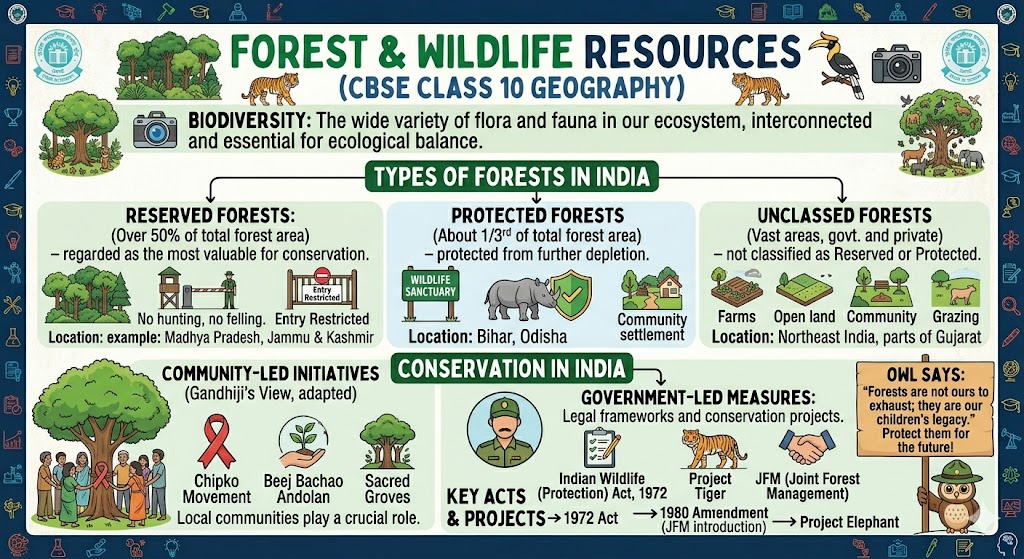
Ans: Biodiversity refers to the variety of flora (plants) and fauna (animals) in a given region. It is essential for the stability of the ecosystem. - Differentiate between Flora and Fauna.
Ans: Flora refers to the plant life of a region, whereas Fauna refers to the animal life of a region. - Define Reserved Forests.
Ans: Reserved Forests are the most valuable forests where commercial activities like grazing and tree cutting are strictly prohibited.
Short Answer Questions (SA) – 3 Marks
- Explain three main causes of depletion of biodiversity in India.
Habitat destruction: Due to expanding agriculture, mining, and urbanization, forests are being cleared.
Poaching: Illegal hunting of animals for fur, skin, or medicinal purposes threatens their survival.
Pollution: Air and water pollution harm sensitive plant and animal species. - What are Sacred Groves? Why are they important?
Ans: Sacred Groves are patches of forest that are worshipped by local communities. Cutting trees or hunting animals here is forbidden by religious beliefs. They play a crucial role in conserving rare and endangered species.
Long Answer Questions (LA) – 5 Marks
- Describe the role of local communities in the conservation of forests and wildlife.
Introduction: Conservation is not solely the job of the government; local communities have a deep connection with the forest.
Traditional Protection: In many areas, villages have protected forests for ages. They are known as Sacred Groves.
Movements: The Chipko Movement in the Himalayas is a classic example where women hugged trees to save them. The Beej Bachao Andolan in the Himalayas protects traditional crop varieties.
JFM: The government launched Joint Forest Management (JFM) to involve local people in restoring degraded forests. In return, villagers get timber, bamboo, and fodder.
Conclusion: These efforts show that when people benefit directly, they protect the environment better. - Discuss the various steps taken by the Indian government to protect wildlife.
Wildlife Protection Act 1972: Provided legal protection to animals.
Project Tiger: Started to save tigers and their habitat.
CITES: India joined the convention to ban international trade in wildlife products.
Amendments: The Wildlife Protection Act was amended to include plants and insects.
National Parks and Sanctuaries: Many areas are declared as protected zones where human interference is minimal.
Smart Revision Notes (One-Day Revision)
- Biodiversity = Variety.
- India = One of the 12 mega-biodiversity countries.
- Forest Types: Reserved (Restricted) > Protected (Restricted) > Unclassed (Open).
- Species Types: Normal → Vulnerable → Endangered → Rare → Endemic → Extinct.
- Act 1972: Wildlife Protection.
- Project 1973: Tiger.
- Chipko Movement: Hug trees.
- Sacred Groves: Religious conservation.
- JFM: Joint Forest Management (Govt + People).
Frequently Asked Questions (FAQs)
1. What is the difference between endemic and endangered species?
Endemic species are found only in a specific area (e.g., Lemurs in Madagascar), while Endangered species are at high risk of extinction (e.g., Tigers).
2. Why are forests called ‘Biodiversity Hotspots’?
Because they contain a huge variety of plant and animal species that are not found anywhere else, and they are threatened by human activity.
3. What is the ‘Chipko Movement’ famous for?
It is famous for the method of hugging trees to prevent them from being cut down.
4. How does deforestation affect the climate?
Deforestation leads to global warming and an increase in CO2 levels, causing climate change.
5. What was the main objective of Project Tiger?
To ensure a viable population of the tiger in its natural habitat and to protect it from extinction.