
Novels have long been one of the most influential forms of literary expression, offering readers a unique opportunity to explore human experiences, social realities, cultural transformations, and philosophical ideas. From the social satire of Jane Austen to the psychological depth of Fyodor Dostoevsky and the magical realism of Gabriel García Márquez, novels continue to shape the way we understand ourselves and the world around us.
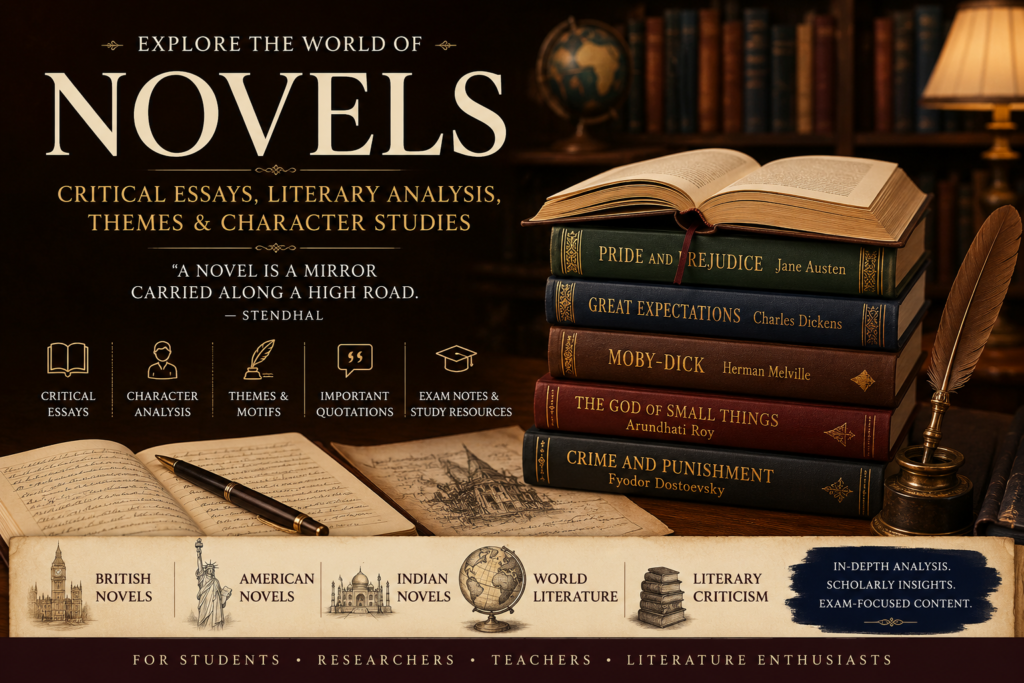
Welcome to our comprehensive collection of critical essays, literary analyses, themes, character studies, and examination-oriented notes on some of the most celebrated novels in English and World Literature. This section has been designed for students, researchers, teachers, competitive examination aspirants, and literature enthusiasts who seek a deeper understanding of classic and modern novels.
British Literature
Romantic Period
Jane Austen(1775-1817)
Pride and Prejudice
- Irony in Pride and Prejudice
- Representation of Society in Jane Austen’s Pride and Prejudice
- Significance of title in Pride and Prejudice
Victorian Period
Charles Dickens
Hard Times
- Justification of Title in Hard Times
- Representation of Victorian Society in Hard Times
- James Harthouse Character Analysis
- Tom Gradgrind Character Analysis
- Louisa Gradgrind Character Analysis
- Mr. Josiah Bounderby Character Analysis
- Thomas Gradgrind
Modern and Postmodern Period
William Golding(1911-1993)
Lord of the Flies
World Literature in English
JK Rowling(1965-)
The Philosopher’s Stone
- Love Family and Friendship in Harry Potter and the Philosopher’s Stone
- Harry Potter’s Search for Identity and Belonging in Harry Potter and the Philosopher’s Stone
- Humility and Self-Sacrifice in Harry Potter and the Philosopher’s Stone
Toni Morrison(1931-2019)
Beloved
- Beloved by Toni Morrison: Slavery, Memory and Trauma Explained
- Beloved as a Gothic Novel: Supernaturalism, Slavery and Horror Explained
Alice Walker(1944-)
The Color Purple
- Lesbianism in The Color Purple: Celie and Shug Avery’s Journey to Selfhood
- Significance of Female Bonding in Celie’s Emancipation Process in The Color Purple
- Slavery and Racism in The Color Purple: The Struggles of Black Women in America
- Narrative Style and Structure in The Color Purple
- Womanism in The Color Purple
- Significance of Title and Religion in The Color Purple
Salman Rushdie
Haroun and the Sea of Stories
- Free speech censorship in Haroun and the Sea of Stories
- Haroun and the Sea of Stories as a Postmodern Novel: Metafiction & Intertextuality
- Postcolonial context in Haroun and the Sea of Stories : Subversion, Identity, and Power
- Haroun and the Sea of Stories as Children’s Literature – Themes & Style
Autobiographies
Binodini
Revathi
The Experiment with my Life
The Outcaste
Why Study Novels?
Novels are more than stories. They are reflections of society, history, culture, politics, and human psychology. Through the study of novels, readers can examine complex social issues, explore diverse perspectives, and understand the literary techniques employed by great writers.
A careful reading of novels helps readers:
- Develop critical thinking skills.
- Understand historical and cultural contexts.
- Analyze themes, symbols, and motifs.
- Explore character development and relationships.
- Appreciate narrative techniques and literary styles.
- Prepare for academic examinations and literary research.
What You Will Find in This Section
This collection aims to provide comprehensive resources on famous novels from British, American, Indian, and World Literature. Each novel study may include:
Critical Essays
Detailed critical interpretations that examine literary themes, narrative techniques, historical significance, and scholarly perspectives.
Plot Summaries
Clear and concise summaries that help readers understand the major events and structure of the novel.
Character Analysis
In-depth studies of major and minor characters, their motivations, relationships, and symbolic significance.
Themes and Motifs
Exploration of recurring ideas such as love, class, identity, alienation, colonialism, gender, power, morality, and social change.
Symbolism and Imagery
Discussion of important symbols, metaphors, and images that contribute to the meaning of the text.
Important Quotations
Key passages and quotations with explanations to aid literary understanding and examination preparation.
Examination Notes
Useful notes and important questions for university examinations, English Honours courses, postgraduate studies, B.Ed., and UGC NET preparation.
British Novels
British literature has produced some of the most enduring novels in world history. Readers can explore critical studies of works by Jane Austen, Charles Dickens, Thomas Hardy, George Eliot, Virginia Woolf, D. H. Lawrence, and many others.
Popular topics include:
- Social class and marriage in Pride and Prejudice
- Industrial society in Hard Times
- Fate and tragedy in Tess of the d’Urbervilles
- Modern consciousness in Mrs Dalloway
American Novels
American fiction reflects the nation’s evolving social, political, and cultural landscape. This section includes analyses of major works by Nathaniel Hawthorne, Herman Melville, F. Scott Fitzgerald, William Faulkner, Toni Morrison, and other influential writers.
Areas of study include:
- The American Dream
- Race and identity
- Individualism
- Social inequality
- Historical memory
Indian Novels in English
Indian English fiction offers valuable insights into colonialism, nationalism, tradition, modernity, and cultural identity. Readers will find critical discussions on works by R. K. Narayan, Mulk Raj Anand, Raja Rao, Salman Rushdie, Arundhati Roy, Amitav Ghosh, and other prominent authors.
Common themes include:
- Colonial experience
- Cultural conflict
- National identity
- Social reform
- Postcolonial consciousness
World Literature Novels
Literature transcends national boundaries. This section also features significant novels from world literature, introducing readers to diverse literary traditions and philosophical perspectives.
Featured areas include:
- Russian realism
- French realism
- Existentialism
- Magical realism
- Modernism and postmodernism
Who Is This Resource For?
This collection is especially useful for:
- Undergraduate students
- Postgraduate students
- English Honours learners
- Literature researchers
- School and college teachers
- B.Ed. students
- UGC NET aspirants
- Competitive examination candidates
- General readers interested in literary studies
Explore the World Through Novels
Every great novel opens a window into a different world. Whether you are interested in literary criticism, thematic analysis, character studies, or examination preparation, this section aims to provide reliable, accessible, and academically valuable resources.
Begin your journey through the rich and fascinating world of novels, where stories become history, imagination becomes insight, and literature becomes a deeper understanding of life itself.