
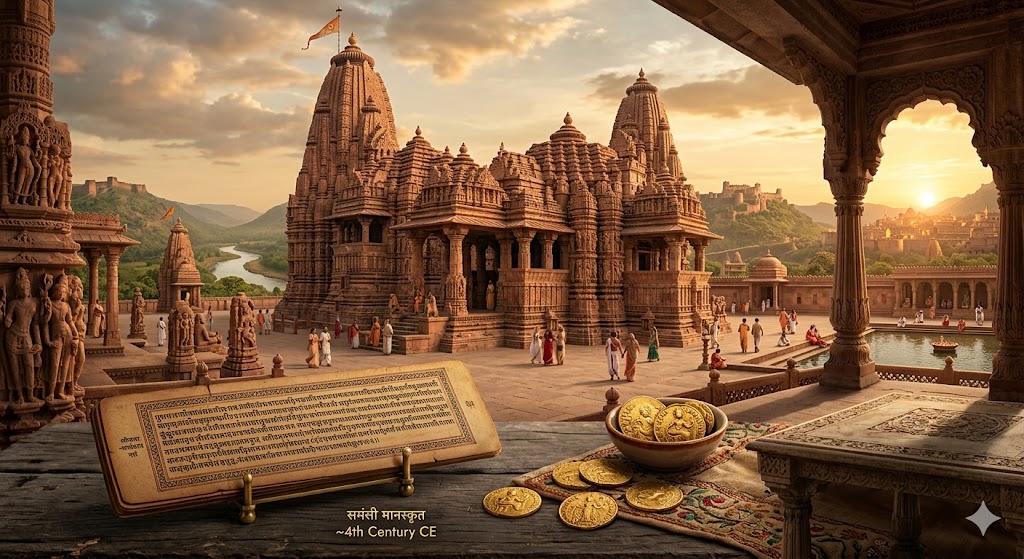
The Age of the Guptas: The Golden Age of Indian History
Introduction
Imagine an India where gold coins were the standard currency, where mathematicians discovered the concept of zero, and where poets wrote plays that would be read 1,500 years later. Welcome to The Age of the Guptas.
For an ICSE Class 9 student, this chapter isn’t just a list of kings and dates; it is the story of India’s “Golden Age.” This period (approx. 320–550 CE) saw a spectacular boom in art, science, literature, and politics. In your ICSE exams, this chapter is high-scoring and crucial, often featuring in both short-answer and structured long-answer sections. By the end of this guide, you will be able to discuss Samudragupta’s conquests and Kalidasa’s poetry like a pro!
Chapter Overview
The Gupta Empire rose from the ruins of the Kushan Empire in Magadha. While the Mauryas created the first great empire, the Guptas refined Indian civilization. Key themes include:
Political Unification: Bringing North India under one umbrella.
Cultural Excellence: The peak of Sanskrit literature and Hindu temple architecture.
Scientific Progress: Innovations by Aryabhata and Varahamihira.
Learning Objectives
After reading this “One-Stop Guide,” you will:
Identify the sources (literary and archaeological) of the Gupta period.
Understand the military achievements of Chandragupta I, Samudragupta, and Chandragupta II.
Explain the Golden Age concept through contributions in science, literature, and art.
Analyze the administration and social life of the era.
Detailed Explanation of the Chapter
1. Sources of Information
How do we know so much about the Guptas? We rely on two main pillars:
A. Archaeological Sources
Allahabad Pillar Inscription (Prayag Prashasti): Composed by Harisena, the court poet of Samudragupta. It is engraved on an Ashokan pillar and lists Samudragupta’s conquests in detail. It’s our most important “eulogy” (Prashasti).
Coins: The Guptas issued a large number of gold coins (Dinars). These coins tell us about the king’s titles, their hobbies (like Samudragupta playing the Veena), and the empire’s prosperity.
B. Literary Sources
Accounts of Fa-hien: A Chinese pilgrim who visited India during the reign of Chandragupta II. He described the people as honest, the administration as mild, and the country as wealthy.
Works of Kalidasa: Known as the “Shakespeare of India,” his works like Shakuntala and Meghaduta provide a glimpse into the social and cultural life of the time.
2. Great Rulers of the Gupta Empire
Chandragupta I (319 – 335 CE)
The first powerful ruler who took the title Maharajadhiraja (King of Kings). He strengthened his position by marrying Kumaradevi, a Licchavi princess.
Samudragupta (335 – 375 CE)
Known as the “Napoleon of India” (by historian V.A. Smith) because of his brilliant military campaigns.
North India (Aryavarta): He uprooted 9 kings and annexed their kingdoms.
South India (Dakshinapatha): He defeated 12 kings but reinstated them as feudatories (tributary kings). This showed his political wisdom—ruling the south from the north was impossible back then!
Chandragupta II ‘Vikramaditya’ (375 – 415 CE)
The empire reached its peak under him.
He destroyed the Sakas (Western Kshatrapas), gaining control over the Arabian Sea ports.
He was a great patron of art and had the Navaratnas (Nine Gems) in his court.
3. Why is it called the “Golden Age”?
| Field | Contribution |
| Literature | Kalidasa (Abhigyanashakuntalam), Vishakhadatta (Mudrarakshasa). |
| Science | Aryabhata (calculated the value of $\pi$, explained eclipses, discovered the Earth rotates on its axis). |
| Medicine | Dhanvantari (the father of Ayurveda). |
| Art/Architecture | The first freestanding Hindu temples (Dashavatara Temple at Deogarh). The Ajanta Caves paintings. |
| Metallurgy | The Iron Pillar at Mehrauli (which hasn’t rusted in 1,600 years!). |
Exam-Oriented Study Material
Important Dates and Events
319-320 CE: Beginning of the Gupta Era (Accession of Chandragupta I).
335-375 CE: Reign of Samudragupta.
399-414 CE: Fa-hien’s visit to India.
Important Terms and Definitions
Prashasti: An inscription composed in praise of a king.
Maharajadhiraja: “King of Kings”—a title signifying imperial power.
Navaratnas: A group of nine extraordinary scholars in the court of Chandragupta II.
Important Personalities
Harisena: Composed the Allahabad Prashasti.
Kalidasa: Greatest Sanskrit poet/playwright.
Aryabhata: Famous mathematician and astronomer.
Fa-hien: Chinese traveler who left detailed accounts of Gupta India.
Comparison: Mauryas vs. Guptas
| Feature | Mauryan Empire | Gupta Empire |
| Administration | Highly Centralized | Decentralized (more power to local lords) |
| Religion | Promoted Buddhism (Ashoka) | Revived Hinduism (Vaishnavism) |
| Economy | State-controlled | Private trade flourished |
Mnemonics for Navaratnas
“V-C-K-D… plus 5 more!”
(Varahamihira, Chandragupta’s gems, Kalidasa, Dhanvantari…)
Tip: Focus on the big three for ICSE: Kalidasa (Poet), Varahamihira (Astronomer), Dhanvantari (Doctor).
Before diving into Question and Answers, read an article on History as your favorite subject.
Questions & Answers Section
Very Short Answer Questions (1 Mark)
Who was the founder of the Gupta Dynasty?
Ans: Sri Gupta.
Which title was assumed by Samudragupta?
Ans: Kaviraja (or Napoleon of India).
Name the Chinese pilgrim who visited during Chandragupta II’s reign.
Ans: Fa-hien.
Short Answer Questions (2–3 Marks)
Why is the Allahabad Pillar Inscription important?
Ans: It is the primary source for Samudragupta’s reign. It lists his conquests, his character, and his skills as a musician and poet.
Mention two scientific achievements of the Gupta period.
Ans: (1) Aryabhata discovered that the Earth rotates on its axis. (2) The concept of ‘Zero’ and the decimal system were developed.
⭐ Descriptive Questions (5 Marks)
“Samudragupta was not only a great conqueror but also a great lover of art.” Explain.
Ans: While his military feats are recorded in the Prayag Prashasti, his coins show him playing the Veena (Lute). He patronized Buddhist scholars like Vasubandhu and was a poet himself, earning the title ‘Kaviraja’.
Long Answer Questions (8–10 Marks)
Discuss the factors that make the Gupta period the “Golden Age” of Indian History.
Political Unity: After centuries of chaos, the Guptas united North India.
Literary Brilliance: Sanskrit became the official language. Kalidasa wrote masterpieces.
Scientific Advancement: Aryabhata and Varahamihira made breakthroughs in astronomy and math.
Religious Tolerance: Although the kings were Hindus, they allowed Buddhism and Jainism to thrive.
Economic Prosperity: Trade with Rome and Southeast Asia led to immense wealth, evidenced by gold coins.
Picture-Based Question
(Imagine a picture of the Mehrauli Iron Pillar)
Identify the object. (Iron Pillar at Mehrauli)
Which king is it associated with? (Chandragupta II)
What does it tell us about Gupta science? (It shows their advanced knowledge of metallurgy as the pillar has not rusted.)
Also give a look at our study guides on
“The Mauryan Empire” (Previous Chapter) and “The Sangam Age” (Contemporary/Preceding era).
Special Student-Friendly Features
💡 Exam Tips
Keywords: When writing about Samudragupta, always use the term “Napoleon of India.”
Diagrams: If a question asks about the Allahabad Pillar, mention it was originally an Ashokan pillar.
⚠️ Common Mistakes
Confusing the Chandraguptas: Remember, Chandragupta Maurya founded the Mauryan Empire. Chandragupta I started the Gupta era. They are hundreds of years apart!
Spelling: Practice spelling “Varahamihira” and “Vikramaditya.”
🧐 Did You Know?
The Guptas didn’t actually use “Gupta” as a surname initially; it became a dynasty name as they grew in power!
FAQ Schema Questions with Answers (Gupta Period)
1. Who was known as the “Napoleon of India”?
Samudragupta was called the “Napoleon of India” by historian V. A. Smith because of his remarkable military conquests and expansion of the Gupta Empire. He defeated many kings in northern and southern India and established a strong empire through his military skill and diplomacy.
2. What are the main sources of information for the Gupta Period?
The main sources of information for the Gupta Period include inscriptions, coins, literary works, and accounts of foreign travelers. Important sources are the Allahabad Pillar Inscription written by Harisena, Gupta gold coins, and the writings of the Chinese traveler Faxian. Sanskrit literature and archaeological remains also provide valuable information about Gupta administration, society, religion, and culture.
3. Why is the Gupta period called the Golden Age?
The Gupta Period is called the Golden Age of India because it witnessed great progress in art, literature, science, mathematics, astronomy, architecture, and education. Scholars like Kalidasa made major contributions to literature, while scientists like Aryabhata advanced mathematics and astronomy. Peace, prosperity, and cultural development flourished during this period.
4. Who were the “Navaratnas”?
The “Navaratnas” or “Nine Gems” were a group of nine learned scholars and intellectuals believed to have been part of the court of Chandragupta II. The most famous among them was Kalidasa, known for his outstanding Sanskrit literature. These scholars contributed greatly to fields like literature, medicine, astronomy, and grammar.
Conclusion
The Age of the Guptas was a time when India shone brightest on the world stage. From the mathematical genius of Aryabhata to the poetic beauty of Kalidasa, this era laid the foundation for modern Indian culture.
Revision is your superpower! Go through the “Cause and Effect” table one more time before your test. You’ve got this!
Keep studying, keep growing! For more ICSE Class 9 History notes, subscribe to our newsletter.