
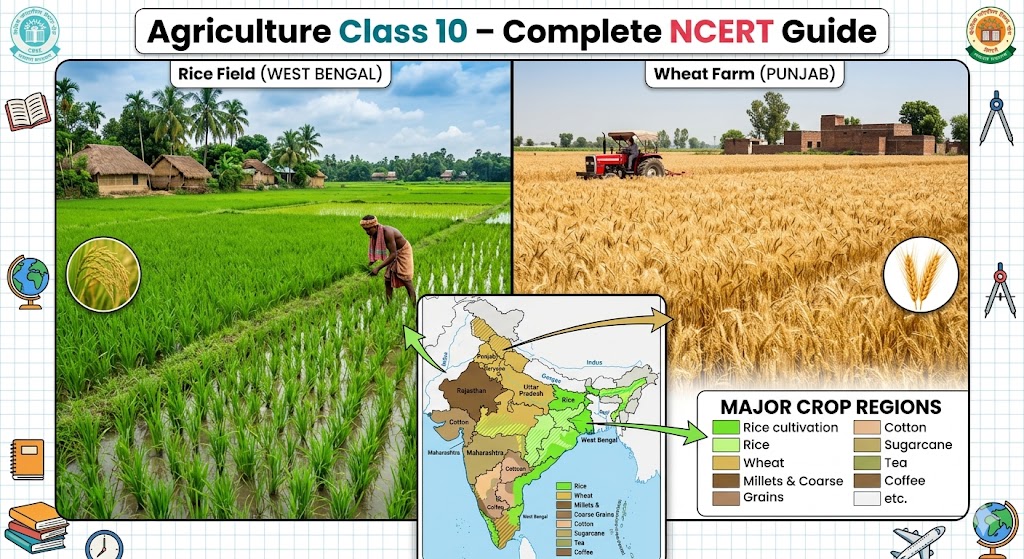
πΎ Agriculture Class 10 | Complete NCERT Guide, Notes, Types of Farming, Cropping Patterns, Major Crops for CBSE, UP Board, Bihar Board, RBSE
Agriculture is the backbone of the Indian economy. Did you know that two-thirds of India’s population is still engaged in agricultural activities? For a Class 10 student, understanding this chapter is not just about passing examsβit’s about understanding how the food on your plate reaches you. Whether you are studying under CBSE, UP Board, Bihar Board (BSEB), Rajasthan Board (RBSE), MP Board, Jharkhand Board, Haryana Board, or any Hindi Belt board following NCERT pattern, the core concepts of Agriculture Class 10 remain the same. This guide will help you decode complex terms like “Slash and Burn” and “Green Revolution” with ease.
π Chapter Overview: Agriculture Class 10 Geography
| Aspect | Detail |
|---|---|
| Chapter Number | Chapter 4 (Geography: Contemporary India β II) |
| Main Topics | Types of Farming (Primitive Subsistence, Intensive, Commercial, Plantation), Cropping Patterns (Rabi, Kharif, Zaid), Major Crops (Rice, Wheat, Millets, Pulses, Sugarcane, Oilseeds, Cotton, Jute, Rubber), Technological & Institutional Reforms (Green Revolution, White Revolution, Bhoodan-Gramdan) |
| Marks Weightage | 6-8 marks (CBSE) | 5-8 marks (UP/Bihar/RBSE/MP) |
| Difficulty Level | Easy to Moderate (factual + map work) |
| Map Work Topics | Major Rice producing states (West Bengal, Punjab, UP), Wheat producing states (Punjab, Haryana, UP), Cotton, Jute, Tea, Coffee regions |
π± Types of Farming in India (Most Important)
| Type of Farming | Characteristics | Tools/Inputs Used |
|---|---|---|
| Primitive Subsistence | Done on small patches; depends on monsoon & natural fertility; includes shifting cultivation (slash & burn) | Hoe, Dao, Digging sticks |
| Intensive Subsistence | High population pressure on land; labor-intensive; high doses of biochemical inputs | Fertilizers, pesticides, irrigation, HYV seeds |
| Commercial Farming | Large scale; aimed at profit and market sale; high use of modern inputs | HYV seeds, chemical fertilizers, pesticides, machinery |
| Plantation | A single crop grown on a large area (e.g., Tea, Coffee, Rubber); capital intensive; export-oriented | Migrant labor, fertilizers, machinery |
P = Primitive Subsistence | I = Intensive Subsistence | C = Commercial | P = Plantation
πΉ Primitive Subsistence Farming (Shifting Cultivation)
Also known as “Slash and Burn” agriculture. Farmers clear a patch of land by cutting trees and burning them. The ashes add fertility. After 2-3 years, they move to a new patch.
Local names of shifting cultivation in different regions:
- Jhumming β Assam, Meghalaya, Mizoram, Nagaland
- Milpa β Mexico
- Roca β Brazil
- Ladang β Indonesia
- Chena β Sri Lanka
- Podu β Andhra Pradesh
- Bewar β Madhya Pradesh
πΉ Intensive Subsistence Farming
Practiced in densely populated areas (Bihar, UP, West Bengal, Punjab). Farmers use high doses of fertilizers and irrigation to get maximum yield from small landholdings.
πΉ Commercial Farming
Farmers grow crops for sale in markets. Examples: Commercial wheat farming in Punjab, Commercial rice farming in West Bengal.
πΉ Plantation Agriculture
A single crop (tea, coffee, rubber, sugarcane, banana) grown on a large estate. Requires capital-intensive management. Examples: Tea gardens in Assam & West Bengal, Coffee plantations in Karnataka.
πΎ Cropping Patterns: Rabi, Kharif, and Zaid (Most Scoring)
1. Rabi Crops (The Winter Crops)
- Sown: October to December (after monsoon)
- Harvested: April to June
- Key Crops: Wheat, Barley, Peas, Gram, Mustard
- States: Punjab, Haryana, Himachal Pradesh, Jammu & Kashmir, Uttarakhand, Uttar Pradesh
- Climate: Requires cool growing season and bright sunshine at ripening
2. Kharif Crops (The Monsoon Crops)
- Sown: With the onset of monsoon (June-July)
- Harvested: September-October
- Key Crops: Paddy (Rice), Maize, Jowar, Bajra, Tur (Arhar), Moong, Urad, Cotton, Jute, Groundnut, Soyabean
- Climate: Requires hot and humid conditions with heavy rainfall (100 cm+)
3. Zaid Crops (The Summer Crops)
- Duration: Short season between Rabi and Kharif (April-June)
- Key Crops: Watermelon, Muskmelon, Cucumber, Vegetables, and Fodder crops
“Rabi = Winter Crop (R for Rice? No! Rice is Kharif, Wheat is Rabi)
Think: Wheat Paratha in Winter = Rabi
Rice with Monsoon = Kharif
Zaid = Zero season β between two main seasons (Watermelon Summer)
π Major Crops of India: Geographical Requirements (Detailed)
| Crop | Temperature | Rainfall | Soil | Major Producing States |
|---|---|---|---|---|
| Rice | High (Above 25Β°C) | High (Above 100 cm) | Alluvial soil (best), clayey soil | West Bengal (largest), Punjab, Uttar Pradesh, Andhra Pradesh, Odisha, Tamil Nadu |
| Wheat | Cool growing season; bright sunshine at ripening | 50-75 cm | Loamy soil, Black soil (in Deccan) | Punjab, Haryana, Uttar Pradesh, Madhya Pradesh, Rajasthan, Bihar |
| Jowar | Warm & arid conditions | 30-50 cm | Black soil, alluvial, red soil | Maharashtra (largest), Karnataka, Madhya Pradesh, Andhra Pradesh |
| Bajra | Hot and dry | 20-40 cm | Sandy soil, black soil | Rajasthan (largest), Maharashtra, Gujarat, Uttar Pradesh |
| Ragi | Moderate | 50-100 cm | Red soil, black soil | Karnataka (largest), Tamil Nadu, Himachal Pradesh, Uttarakhand |
| Maize | 21Β°C-27Β°C | 50-100 cm | Well-drained alluvial soil | Karnataka, Madhya Pradesh, Bihar, Andhra Pradesh, Telangana |
| Sugarcane | Hot & humid (21Β°C-27Β°C) | 100-150 cm | Deep rich loamy soil | Uttar Pradesh (largest), Maharashtra, Karnataka, Tamil Nadu, Bihar |
| Cotton | High (21Β°C-30Β°C) | 50-100 cm | Black soil (Regur) best | Maharashtra (largest), Gujarat, Madhya Pradesh, Karnataka, Andhra Pradesh, Telangana, Tamil Nadu |
| Jute (Golden Fiber) | High (25Β°C-35Β°C) | 150-200 cm | Alluvial soil (well-drained) | West Bengal (largest), Bihar, Assam, Odisha, Meghalaya |
| Tea | 20Β°C-30Β°C | 150-300 cm | Well-drained loamy soil (acidic) | Assam (largest), West Bengal (Darjeeling), Tamil Nadu (Nilgiris), Kerala |
| Coffee | 15Β°C-28Β°C | 150-250 cm | Well-drained loamy soil | Karnataka (largest), Kerala, Tamil Nadu |
β’ Ragi is rich in iron, calcium, and roughage β important nutritional value question.
β’ Jowar is the third most important food crop in India.
β’ Jute is called the ‘Golden Fiber’ β used for making gunny bags, ropes, carpets.
β’ Sericulture β rearing of silkworms for silk production.
π Technological and Institutional Reforms in Indian Agriculture
After independence, the government took several steps to modernize Indian agriculture and achieve self-sufficiency.
πΉ Land Reforms
- Consolidation of small land holdings
- Abolition of Zamindari system
- Cooperative farming promotion
πΉ Green Revolution (1960s-70s)
Based on package technology: High Yielding Variety (HYV) seeds, chemical fertilizers, pesticides, and irrigation. Father of Green Revolution in India: Dr. M.S. Swaminathan. Initially focused on wheat in Punjab, Haryana, and UP. Later rice production increased.
πΉ White Revolution (Operation Flood) β 1970s
To increase milk production. Made India the largest milk producer in the world. Father of White Revolution: Dr. Verghese Kurien (Anand, Gujarat β Amul).
πΉ Financial Support
- Kisan Credit Card (KCC): Easy credit for farmers
- Personal Accident Insurance Scheme (PAIS): Insurance coverage
- Minimum Support Price (MSP): Government guarantees a minimum price for crops
- Subsidies: On fertilizers, seeds, and electricity for irrigation
πΉ Bhoodan-Gramdan (Bloodless Revolution)
Initiated by Vinoba Bhave. Bhoodan = Land donation (wealthy landowners voluntarily donated land to landless poor). Gramdan = Whole village donated land for common ownership.
L = Land Reforms | G = Green Revolution | W = White Revolution | B = Bhoodan-Gramdan | K = Kisan Credit Card (financial)
πΉ Impact of Globalization on Indian Agriculture
- Positive: Export opportunities (basmati rice, tea, spices, cotton), introduction of modern technology.
- Negative: Competition from imported goods, exploitation by multinational corporations, rising debt among small farmers.
π― Board-Wise Exam Focus
| Board | Most Important Topics |
|---|---|
| CBSE | Competency-based questions on institutional reforms, globalization impact, map work (rice & wheat producing states), difference between Rabi & Kharif, plantation agriculture case study (Tea/Coffee). |
| UP Board | Detailed explanation of shifting cultivation (local names), difference between primitive and intensive subsistence farming, long answer on cropping patterns, Bhoodan-Gramdan, White Revolution. |
| Bihar Board (BSEB) | Jhumming definition, geographical conditions of rice & wheat, importance of millets (Ragi, Jowar, Bajra), land reforms, map work β jute producing states. |
| RBSE (Rajasthan) | Millets (Bajra) cultivation in arid zones, water management in agriculture, Kharif crops of Rajasthan, cotton production. |
| MP Board | Soyabean production, wheat and rice in MP, Jowar cultivation, Green Revolution impact on MP. |
πΊοΈ Important Maps & Visual Suggestions (Insert in Blog)
- Map 1: India β Major Rice Producing States (West Bengal, Punjab, UP, Andhra Pradesh, Odisha, Tamil Nadu)
- Map 2: India β Major Wheat Producing States (Punjab, Haryana, UP, Madhya Pradesh, Rajasthan, Bihar)
- Map 3: India β Cotton & Jute Producing Areas (Cotton: Maharashtra, Gujarat, MP; Jute: West Bengal, Bihar, Assam)
- Map 4: Tea (Assam, West Bengal) & Coffee (Karnataka, Kerala) regions
- Map 5: Sugarcane producing states (UP, Maharashtra, Karnataka, Tamil Nadu)
- Alt text suggestions: “Rice producing states map India Class 10 Agriculture”, “Rabi Kharif Zaid crops comparison chart”, “Tea plantations in Assam map”, “Green Revolution states India map”
π Board Exam Important Questions (CBSE, UP, Bihar, RBSE, MP)
β Very Short Answer (1 Mark)
Q1. What is Sericulture?
Ans: The rearing of silkworms for the production of silk fiber.
Q2. Name the crop known as ‘Golden Fiber’.
Ans: Jute.
Q3. What is Jhumming?
Ans: Shifting cultivation practiced in Assam, Meghalaya, Mizoram, Nagaland.
Q4. Define Bhoodan movement.
Ans: Land donation movement initiated by Vinoba Bhave where landowners voluntarily donated land to landless poor.
Q5. Which state is the largest producer of Rice in India?
Ans: West Bengal.
Q6. What is the sowing season of Rabi crops?
Ans: October to December.
Q7. Who is known as the Father of Green Revolution in India?
Ans: Dr. M.S. Swaminathan.
β Short Answer (3 Marks)
Q1. Explain any three features of ‘Plantation Agriculture’.
Ans: (i) Single crop grown on a large area. (ii) Capital intensive with migrant labor. (iii) Products are processed locally and exported (e.g., tea, coffee).
Q2. Why is agriculture called the backbone of the Indian economy?
Ans: (i) Employs two-thirds of the population. (ii) Contributes 17-18% to GDP. (iii) Provides raw material to industries (textiles, sugar). (iv) Biggest source of income for rural households.
Q3. Differentiate between Rabi and Kharif crops. (3 differences)
Ans: Rabi (winter: Oct-Dec sowing, Apr-Jun harvest, wheat, gram). Kharif (monsoon: Jun-Jul sowing, Sep-Oct harvest, rice, cotton).
Q4. Describe the geographical conditions required for the cultivation of wheat.
Ans: Cool growing season, bright sunshine at ripening, 50-75 cm rainfall, loamy or black soil. Major states: Punjab, Haryana, UP.
Q5. What is ‘Slash and Burn’ agriculture? Mention its local names in India.
Ans: Primitive method where trees are cut and burned on a patch; after fertility drops, farmers move. Local names: Jhumming (Assam/NE), Podu (AP), Bewar (MP).
β Long Answer (5 Marks)
Q1. Describe the geographical conditions required for the growth of Rice. Explain why West Bengal and Punjab are major rice producers.
Ans: High temp (>25Β°C), high rainfall (>100 cm or irrigation), alluvial soil. West Bengal has high rainfall and deltaic soil; Punjab uses canal irrigation & HYV seeds.
Q2. Discuss the impact of globalization on Indian agriculture. Give both positive and negative effects.
Ans: Positive: exports (basmati, spices), modern technology. Negative: Import competition, farmer debt, MNC exploitation.
Q3. Explain the technological and institutional reforms introduced in Indian agriculture after independence.
Ans: Land reforms, Green Revolution (HYV seeds), White Revolution (milk), Kisan Credit Card, Bhoodan-Gramdan, MSP, subsidies.
Q4. Differentiate between Primitive Subsistence and Intensive Subsistence farming.
Ans: (Table format: tool use, land patch, fertility, population pressure, examples)
Q5. Classify crops based on seasons with examples and major producing states.
Ans: Rabi (wheat β Punjab), Kharif (rice β West Bengal), Zaid (watermelon β North India).
β Competency & Assertion-Reason Questions
Assertion (A): Jute is known as the ‘Golden Fiber’.
Reason (R): Jute is used to make gunny bags and export earns foreign currency.
Ans: Both A and R true, R is correct explanation.
Assertion (A): Ragi is considered a coarse grain but has high nutritional value.
Reason (R): Ragi is rich in iron, calcium, and roughage.
Ans: Both A and R true, R explains A.
Assertion (A): Green Revolution was successful only in Punjab and Haryana.
Reason (R): These states had reliable irrigation and assured markets.
Ans: Both A and R true, R correctly explains.
Competency Question: A farmer in Rajasthan wants to grow a crop with low water requirement in sandy soil. Which two crops would you suggest?
Ans: Bajra (pearl millet) and Jowar β drought-resistant, suitable for arid zones.
β Source-Based (Passage) Question
“The Green Revolution introduced High Yielding Variety seeds in the 1960s. It significantly increased wheat and rice production in Punjab, Haryana, and Uttar Pradesh. However, it also led to overuse of fertilizers and groundwater depletion.”
Q1. What were the key inputs of Green Revolution?
Ans: HYV seeds, chemical fertilizers, pesticides, assured irrigation.
Q2. Name two negative impacts of Green Revolution.
Ans: Groundwater depletion, soil degradation due to overuse of chemicals.
β MCQs with Answers (Board Pattern)
- Which type of farming is also known as ‘Slash and Burn’? Primitive Subsistence (Shifting cultivation)
- Which crop is known as ‘Golden Fiber’? Jute
- Which state is the largest producer of Rice in India? West Bengal
- Kharif crops are harvested in which months? September-October
- Who started the Bhoodan movement? Vinoba Bhave
- What is the sowing season of Rabi crops? October to December
- Which soil is ideal for cotton cultivation? Black soil (Regur)
- Which millet is rich in iron and calcium? Ragi
- Tea gardens are mainly found in which two states? Assam & West Bengal
- Operation Flood is associated with which product? Milk (White Revolution)
π Previous Year Question Trends (2019-2024 across Boards)
- Difference between Rabi and Kharif crops β asked 15+ times (3 marks)
- Geographical conditions of Rice and Wheat β asked 12+ times (5 marks)
- Types of farming (primitive vs intensive vs commercial) β 10+ times
- Green Revolution & its impacts β 8+ times
- Map work (rice/wheat producing states) β every year
- Plantation agriculture (tea/coffee) β 5+ times
β Common Mistakes Students Make
- Confusing Rabi and Kharif crops: Remember β Rice is NOT Rabi. Rice is Kharif. Wheat is Rabi (Winter paratha = wheat).
- Ignoring Map Work: Students lose easy 2-3 marks by not practicing identification of major crop-producing areas.
- Mixing Shifting Cultivation Names: Don’t confuse Jhumming (Assam) with Milpa (Mexico) β Know at least three local Indian names.
- Forgetting the exact temperature/rainfall figures: Write approximate ranges (e.g., 50-75 cm for wheat).
- Not mentioning both advantages and disadvantages of Green Revolution: Always write both for 5-mark answers.
π Smart Revision Notes (Last-Minute)
- Types of farming: Primitive (Jhumming), Intensive, Commercial, Plantation.
- Cropping seasons: Rabi (Winter β Wheat, Oct-Dec sowing), Kharif (Monsoon β Rice, Jun-Jul), Zaid (Summer β Watermelon).
- Rice: High temp >25Β°C, >100 cm rainfall, alluvial soil β West Bengal (largest producer).
- Wheat: Cool season, 50-75 cm rainfall, loamy soil β Punjab, Haryana, UP.
- Jute (Golden Fiber): West Bengal, Bihar β used for gunny bags.
- Green Revolution (HYV seeds) β M.S. Swaminathan; White Revolution (Milk) β Verghese Kurien; Bhoodan β Vinoba Bhave.
- Millets: Jowar (Maharashtra), Bajra (Rajasthan), Ragi (Karnataka β rich in iron & calcium).
π§ Mnemonics & Memory Tricks
π One-Day Revision Strategy
- Morning (2 hrs): Revise types of farming + difference between Rabi, Kharif, Zaid + geographical conditions of rice & wheat.
- Afternoon (1.5 hrs): Memorize major crops table (state-wise production) + practice 30 MCQs + 5 short answers.
- Evening (1.5 hrs): Draw maps of Rice, Wheat, Cotton, Jute producing states twice + write two 5-mark answers (Green Revolution & Plantation).
- Night (30 min): Revise mnemonics, glance through Bhoodan-Gramdan & White Revolution, go through common mistakes.
βοΈ Exam Writing Tips (For CBSE & Hindi Belt Boards)
- For “geographical conditions” questions, write: Climate (temp + rainfall) β Soil β Major states β Crops example.
- Underline keywords: Rabi, Kharif, Zaid, HYV seeds, Jhumming, Plantation, Golden Fiber.
- Draw a simple table for Rabi vs Kharif crops β teachers love clarity.
- In map work, label states clearly with black pen after pencil outline. Use arrows to indicate regions.
- For UP/Bihar/RBSE boards, define all technical terms before explaining (e.g., define Sericulture, Bhoodan, Green Revolution).
β Frequently Asked Questions (Student Google Searches)
π― Conclusion
Agriculture is not just a chapter in your textbook; it is the lifeline of India. From the food on your plate to the clothes you wear (cotton), everything comes from agriculture. This complete guide covers types of farming, cropping patterns (Rabi, Kharif, Zaid), major crops with geographical conditions, Green Revolution, White Revolution, Bhoodan-Gramdan, board exam questions, MCQs, map work, and revision mnemonics β everything you need to score 95%+ in CBSE, UP Board, Bihar Board, RBSE, MP Board, and all Hindi Belt NCERT-based boards. Master these concepts, focus on the differences between crop types, and practice your maps. Clarity is your best tool! All the best for your board exams! πΎ


