
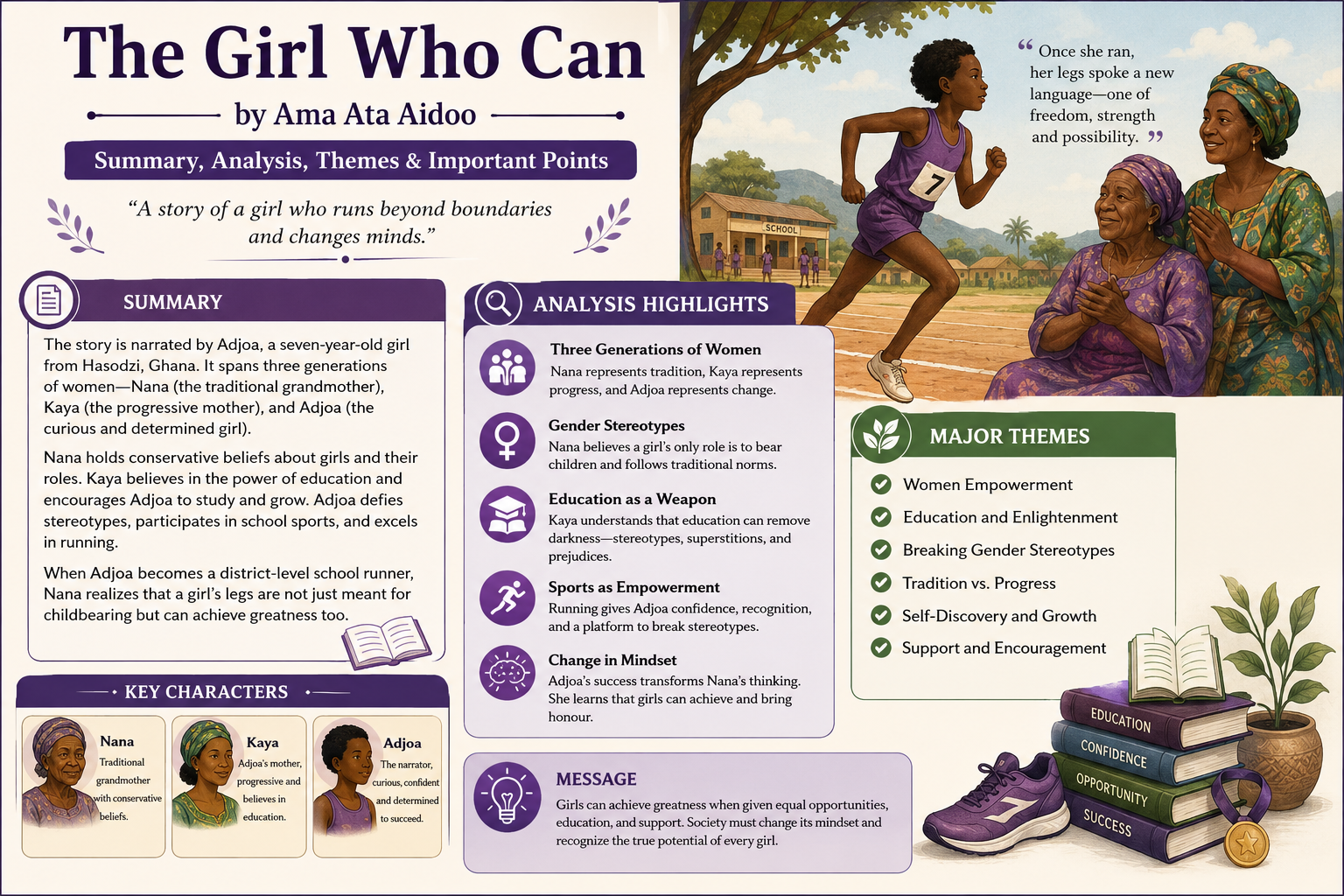
The Girl Who Can Summary by Ama Ata Aidoo (Easy and Detailed Explanation)
In the story “The Girl Who Can” by Ama Ata Aidoo, a girl called Adjoa talks about girls and their upbringing. It is through her story that she talks about upliftment of girls through education and sports. The story covers three generation of women who are impacted by enlightening thoughts. Nana is the first generation of women who is the grandmother of Adjoa. She entertains conservative thinking because she never got the chance to illuminate herself with upliftment and growth.
Second is Kaya, Adjoa’s mother who is active in her girls’ upbringing. Not only she wants education for Adjoa, bit also she wants her to grow. She is a woman of optimistic thoughts. She could feel the importance of education in one’s life that has the ability to remove the darkness-sterotypes, superstitions, prejudices and evil from the society. It is she who advocates for Adjoa’s education. The third generation is Adjoa who is a girl of unconventional thoughts and opinions. She brings awareness regarding girls growth to her more or less ignorant family. She actively participates in sports and becomes a contestant for running race. She also studies properly to gain knowledge.
Adjoa wins races but didn’t used to feel tell that at home because it was not new. She was doing this for several times. But becoming a school runner at district level was a kind of achievement in itself. Both the mother and grandmother were too happy to utter any words.
Since then Nana understood that a girls legs are also meant for running. It can do miracles if provided with right opportunities and support.
The Girl Who Can Analysis by Ama Ata Aidoo | Detailed Literary Analysis
Introduction to The Girl Who Can: Setting, Narrator, and Background
“The Girl Who Can” is a short story by Ama Ata Aidoo. It is the story of a small girl born in Hasodzi, a bog village in Ghana, Africa. Hasodzi has got very good soil quality. When drought was common in different parts of Africa, Hasodzi was lucky to be blessed with fertile soil. The narrator is the girl, Adjoa who thinks that the soil fertility produces so much food that she is not able to complete her food. This is a childish humour because the narrator is a girl who thinks finishing food is more important than the soil problem of Africa. It is obvious she is a little girl who is just revealing her problems.
Adjoa’s Childhood Perspective and Innocence in The Girl Who Can
Nana, who is maternal grandmother of Adjoa says to the narrator that she is not able to perceive the problems that the life carries. Adjoa is only seven years old and she says that she does not consider the problems of her and her family same. The major concern of the child right now is that she lacks proper language and vocabulary to communicate her ideas. The other problem is that whether she should say her ideas loud or keep quiet. She does not want to be the laughing stock of her family.
Adjoa’s Ideas and Her Grandmother Nana’s Conservative Attitude
The narrator is a different sort of girl with many ideas. She used to fear the reaction of the people if she said those ideas out and loud. She then describes what happens when she shared her ideas with her maternal grandmother, Nana. Whenever the narrator used to utter her thoughts, her grandmother would halt for a moment and burst out laughing. She used to do this always. Nana used to laugh till tears came out from her eyes. She also used to share Adjoa’s ideas to other people and their reaction were identical.
Symbolism of Adjoa’s Legs: Gender Stereotypes and Traditional Beliefs
After this comes the issue of legs. Adjoa, the seven years old narrator had a unique bodily feature which were her legs. Her legs were long and exceptionally thin. There used to be a clash of thoughts between Adjoa’s mother, Kaya and Nana. Nana was a traditional woman who only knew that by being born as a girl, the only job is to carry children in their wombs. She often used to stare at Adjoa’s legs and ponder on the same thought.
Kaya’s Progressive Views on Girls’ Education and Women’s Empowerment
On the other hand, we find Kaya to be a loving and open-minded woman and mother. She loved her child and didn’t feel anything abnormal about the narrator’s legs. She was thankful that her child was born safe and sound with all the four limbs. She used to often debate with Nana whenever the topic was Adjoa’s legs, that how some children don’t have their all the four limbs. She says that she is grateful to God to have all the four limbs of Adjoa with no disabilities. So what if it does not have so much flesh on her bones. This kind of thought is highly appreciable to be entertained by an African grown up in conservative setting.
Adjoa’s Curiosity About Society’s Beauty Standards for Women
Listening to all these conversations, Adjoa became very curious to see as how the legs of other woman look like. She wanted to see for herself because Nana used to talk a great deal about proper legs and its child carrying requirements. But she was not able to get the opportunity because maximum of the times these women legs were hiding behind long garments.
The child is a curious creature who tries to learn more about their surrounding through different ways. Adjoa was listening to such conversations regarding the physique of a woman as per society’s standards. In order to find that, Adjoa thinks that she will be able to get herself see the legs if she could find out bathing women. This is the way a child is seeing things and problems. She is trying to figure out what was the problem with her legs. Why is it abnormal? Why does Nana stare at her legs and talk so much on it?
Importance of Education and Sports in The Girl Who Can
Now, Adjoa was going to school. Kaya was very serious for her daughter’s education. She always used to feel that she was missing something in her life. She felt the need of a proper education which can take you to great heights. At school, the narrator was doing good. She is selected for various sports in school, especially running.
Nana used to argue with Kaya of sending Adjoa to school. She used to think that it is the waste of time by sending the girl to school. But when it was Kaya who knew that there exists a chaotic darkness that can be removed if Adjoa receives education.
How Education Changes Nana’s Mindset: Ending of The Girl Who Can Explained
So, here the importance of education is given a significant status. Education is the weapon to erase darkness. Through education Adjoa gets the opportunity to enlighten herself. She gets the opportunity to run in the school’s sports competition. This opportunity changes everything in Adjoa’s life. She can feel the changes that come when one gets the opportunity to grow. Her grandmother who used to hold prejudices and misunderstandings regarding girls reform, she wasn ow actively participating in Adjoa’s success. She understood that long legs could also be used for running in sports. This was the first time for a woman like Nana to know that a girl can do whatever she wants. She is not born on this planet for only bearing children. But girls are also meant to run in races and bring honour to their school and family.
Frequently Asked Questions (FAQs) on The Girl Who Can by Ama Ata Aidoo
1. What is the main theme of The Girl Who Can?
The main theme of The Girl Who Can is women’s empowerment through education and equal opportunities. The story also highlights gender stereotypes, traditional beliefs, and the importance of changing societal attitudes toward girls.
2. Why does Nana criticize Adjoa’s legs?
Nana believes that a girl’s legs should be strong enough for childbearing according to traditional beliefs. She considers Adjoa’s thin legs unsuitable because of her conservative mindset.
3. How does Kaya differ from Nana?
Kaya is progressive and believes in educating and supporting her daughter. Unlike Nana, she values education, personal growth, and equal opportunities for girls.
4. How does sports change Nana’s opinion about Adjoa?
When Adjoa becomes a successful school runner, Nana realizes that her granddaughter’s long legs are perfect for running. She understands that girls can achieve success beyond traditional gender roles.
5. What is the significance of education in The Girl Who Can?
Education empowers Adjoa to develop confidence, gain knowledge, and prove her abilities. It also helps challenge social prejudices and changes Nana’s traditional thinking.
6. What is the message of The Girl Who Can by Ama Ata Aidoo?
The story conveys that girls should receive equal education, encouragement, and opportunities. With proper support, they can excel in academics, sports, and every sphere of life.
Conclusion: The Girl Who Can Summary and Analysis
The Girl Who Can is a powerful story that challenges traditional gender stereotypes and celebrates the importance of girls’ education, women’s empowerment, and equal opportunities. Through the contrasting perspectives of Nana, Kaya, and Adjoa, Ama Ata Aidoo shows how education and encouragement can transform both individuals and society. The story ultimately reminds readers that girls are capable of achieving excellence in every field when they are given the freedom and support to pursue their dreams.