
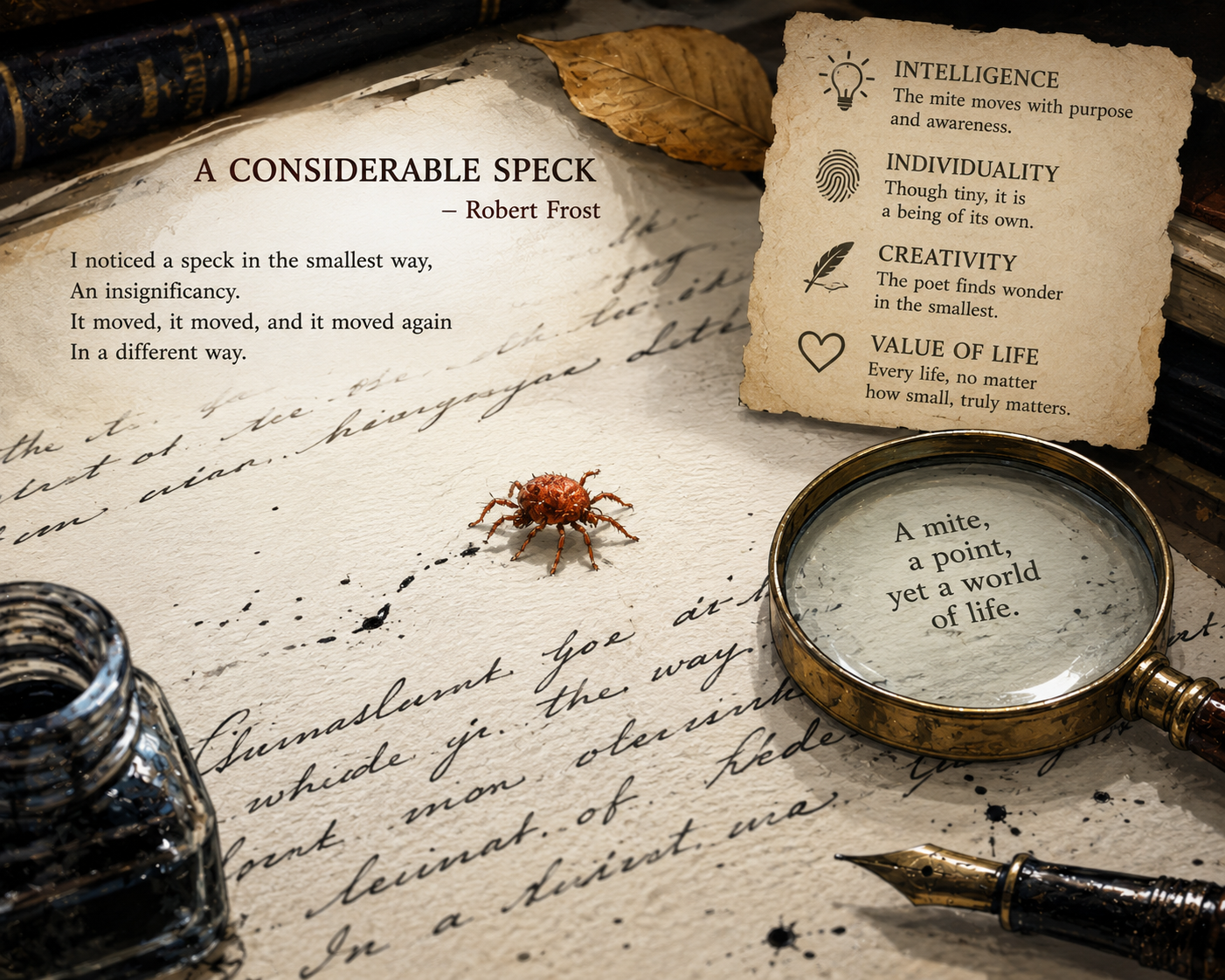
A Considerable Speck Summary
The poet suddenly saw a speck running across the sheet where he was doing his work.If the speck didn’t display any movement, he would not have been able to figure out that the speck is a living mite. He didn’t have any expectation of killing it so he decided to observe the movement of the insect. He waited for the mite to move The mite raced towards the words written in ink. The insect was confused at the ink present there. So, it either drank it or smelt it. But it didn’t relish it. It had no intention to face death. This shows that the insect was using it s brain to examine the unfamiliar thing seen by it for the first time. To save its life, it was running here and there in sheer terror and cunningness. It seemed to accept its own destiny.
The poet already decided not to kill the tiny creature because it has a mind of its own. He decided not to harm the mite but to inspect its movement. He didn’t want to kill it because he believd in love for all living creatures. But because the mite is a living creature who deserves the opportunity to live.He allowed it stay there till it slept.
Line by Line Explanation
A speck that would have been beneath my sight
A speck that the speaker would not have see it(this speck is an insect)
On any but a paper sheet so white
The speck is on the white sheet of paper
Set off across what I had written there.
It was found set off across where he had written
And I had idly poised my pen in air
And the speaker idly poised his pen in the air
To stop it with a period of ink
Only to put a full stop on the path of the ink
When something strange about it made me think.
When something strange about the insect striked the thoughts of the speaker
This was no dust speck by my breathing blown,
This speck didn’t come due to the breath of the speaker
But unmistakably a living mite
But it is a living mite. The speaker comes to know it is a living small insect
With inclinations it could call its own.
With inclinations it could call
It paused as with suspicion of my pen,
The insect paused with the suspicion of the pen
And then came racing wildly on again
And it came racing wildly on its own
To where my manuscript was not yet dry;
To the space where the manuscript of the speaker was not dry.
Then paused again and either drank or smelt–
The insect paused again and it either drank or smelled
With loathing, for again it turned to fly.
With disgust the smell of the ink, for again it decided to fly
Plainly with an intelligence I dealt.
The speaker thought intelligently
It seemed too tiny to have room for feet,
The space seemed so tiny to have room for feet
Yet must have had a set of them complete
To express how much it didn’t want to die.
The insect didn’t want to die
It ran with terror and with cunning crept.
It ran with terror and cunningness here and there
It faltered; I could see it hesitate;
It began to falter and The speaker is a witness to its hesitation
Then in the middle of the open sheet
Then in the middle of the open sheet
Cower down in desperation to accept
It began to move by taking a low position in desperation to accept
Whatever I accorded it of fate.
I have none of the tenderer-than-thou
Collectivistic regimenting love
With which the modern world is being swept.
But this poor microscopic item now!
Since it was nothing I knew evil of
I let it lie there and I hope it slept.
The poet here declares that he did not believe in indiscriminate love for all human beings. As mite seemed to have a mind of its own, so he decided not to kill it. The poet here satirizes those who equate intelligence with the dullard. A mere mite with intelligence is superior to a human who has no mind of his own. The poet allowed it to lie on the paper till it slept.
I have a mind myself and recognize
Mind when I meet with it in any guise.
No one can know how glad I am to find
On any sheet the least display of mind.
The poet here says that he is a thinking human being and as such he gives importance to any “display of mind” on any “sheet” of paper. Incidentally, the insignificant mite has displayed his mind on his sheet of paper and gets rewarded. The poet implicitly expresses his praise for those who give life to the text by using their intelligence, imagination and individual thinking.
A Considerable Speck Theme: Theme of Thinking and Creativity in Robert Frost’s Poem
The whole poem is based on an incident where a speck, which is aliving mite, decides to explore the sheet where the poet was writing. He was using ink to jot down something. This mite, unfamiliar with the ink, experiments with it. It drinks some of the ink and smells the rest. It doesn’t make the mistake of gulping the ink. Also, it showed the tendency to save his life by running down the sheet in hesitation and cunningness.
The poet likes the individuality of the mite. He openly shows disfavour towards collective thought process of the whole world. He is critical of the people who don’t show any endeavour to come up with a thought of their own. They often rely on what is said collectively in the society. This is something that runs against the subjectivity of an individual.
So, the poet decides to let the mite be given an opportunity to live.
A Considerable Speck Form: Poetic Form and Structure
A Considerable Speck is a lyric poem with a strong narrative element. Frost recounts a simple personal experience of observing a tiny mite on his manuscript, but the incident develops into a philosophical reflection on intelligence, individuality, and the value of life. The poem is also considered a meditative poem because it moves from observation to deeper contemplation.
Literary Devices in A Considerable Speck
Robert Frost employs several literary devices to enrich the poem’s meaning.
Personification
The tiny mite is given human qualities. It appears to think, hesitate, inspect the ink, and make decisions, making it seem intelligent rather than instinctive.
Imagery
Frost creates vivid visual images of the tiny black mite moving across the bright white sheet of paper. The contrast helps readers clearly imagine the scene.
Symbolism
The mite symbolizes intelligence, individuality, and the dignity of all living beings, while the white paper symbolizes the larger world in which even the smallest life has significance.
Irony in A Considerable Speck: Why Is the Mite Called “Considerable”?
The title is ironic because the creature is physically insignificant, yet it becomes “considerable” due to its display of intelligence and awareness.
Contrast
The poem contrasts:
• Smallness and greatness.
• Physical weakness and mental strength.
• Lifeless ink with living intelligence.
Metaphor
The mite serves as an extended metaphor for independent thinkers who survive through intelligence rather than strength.
Enjambment
Many lines continue into the next without punctuation, producing a natural conversational flow and reflecting the speaker’s continuous observation.
Alliteration
Repeated consonant sounds add musicality and emphasis in several lines, such as repeated s and m sounds.
Assonance
The repetition of vowel sounds creates a smooth rhythm and enhances the poem’s lyrical quality.
Consonance
Repeated consonant sounds contribute to the poem’s gentle, reflective tone.
Repetition
Words related to mind, thinking, and intelligence reinforce the poem’s central idea that mental awareness is what makes the mite “considerable.”
Tone
The tone shifts from curiosity to amusement, then to admiration, and finally to philosophical reflection.
Frequently Asked Questions
What is the summary of A Considerable Speck?
The poem describes Robert Frost’s encounter with a tiny mite moving across his manuscript. Instead of killing the creature, the poet observes its movements and recognizes signs of intelligence, individuality, and a desire to survive.
What is the main theme of A Considerable Speck?
The main theme of the poem is the importance of thinking and creativity. The poem also explores individuality, intelligence, freedom, survival, and respect for living beings.
What does the mite symbolize in A Considerable Speck?
The mite symbolizes intelligence, individuality, independent thinking, and the dignity of even the smallest living creature.
Why is the poem titled A Considerable Speck?
The title is ironic. Although the mite is physically tiny and seemingly insignificant, its display of intelligence makes it “considerable” in the eyes of the poet.
What is the significance of the white sheet of paper in A Considerable Speck?
The white sheet provides the background against which the tiny mite becomes visible. Symbolically, it can represent a larger world in which even a very small living being has importance.
What literary devices are used in A Considerable Speck?
Robert Frost uses several literary devices, including personification, imagery, symbolism, irony, contrast, metaphor, enjambment, alliteration, assonance, consonance, repetition, and tone.
What does Robert Frost criticize in A Considerable Speck?
Frost criticizes collective or regimented thinking and expresses appreciation for individuality, independent thought, intelligence, and creativity.
Conclusion
A Considerable Speck presents a simple encounter between a poet and a tiny mite but transforms it into a thoughtful reflection on intelligence, individuality, creativity, survival, and the value of life. Robert Frost shows that even the smallest creature can become “considerable” when it demonstrates awareness and independent action. The poem ultimately celebrates the importance of having a mind of one’s own.
Read The Power of Music Summary, Analysis and Full Study Guide