
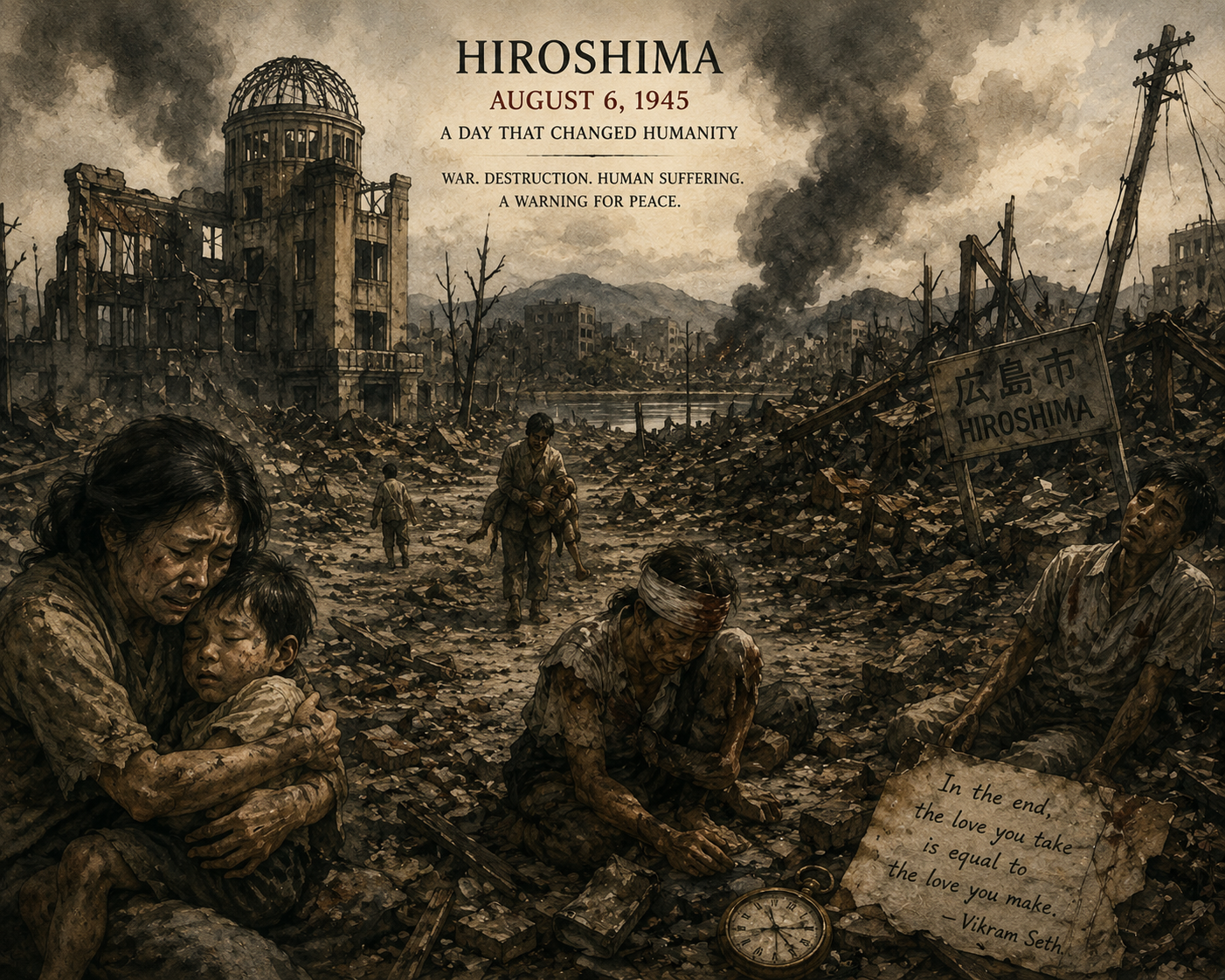
Vikram Seth’s “A Doctor’s Journal Entry for August 6, 1945” is a poem which captures the horrific outcome just after US bombs Japan’s Hiroshima. It highlights the different form of suffering faced by the people. The bombing made people disfigured whose sight is a pure terror to behold. The poet had described this terrifying sights minutely without any gaps. The people become zombies due to excess pain. They are caught in a bewildered state because they cannot figure out what has just happened. The reading of the poem is in itself a difficult task, A Doctor’s Journal Entry is a painful reading for its readers.
Summary of A Doctor’s Journal Entry
The poem opens on a fine morning when suddenly two flashes happen subsequently. The speaker gets terribly injured and so the people. He is perplexed and tries to decipher his situation. He calls out for his wife who comes out in a bewildered state. They manage to get out of their house when they come across a dead man. This scene makes them frightened but they decide to move further. Then, they come across the live crushing of a building which turns into debris and dust. They became successful in figuring out their injured condition and what they needed was a treatment. Then the thought of being naked stroked the speaker. But with no option they move further. Here, he gets the help from a soldier who offers his towel to the speaker. After this he could no longer move forward. He asks his wife, Yecko San to continue moving and get to the hospital. When the speaker sits there, suffering terribly, he sees a naked woman with a naked child. He turns away but the next moment he saw a naked man. He comes to realise that somehow they were getting striped. The whole scenario looked as if the people were zombies.
Analysis of A Doctor’s Journal Entry
The poem is a condemnation of war. The poem is set in the city of Hiroshima, Japan when US dropped the atom bombs on the city in an attempt to force the Japanese emperor to surrender and end the Second World War. It is Narrative poem written in free verse. It has no fixed rhyme scheme or regular meter, allowing the poet to present the events naturally and realistically. The poem is written as a journal (diary) entry, recording the doctor’s personal experiences and observations on 6 August 1945. It is written in the first-person narration (“I”), making the account direct, authentic, and emotionally powerful. It is written in lyrical mode sharing the personal anguish of the poet and the people.
It captures the suffering and sorrow of the people so accurately as if one can feel the war is going on before one’s eyes. The protagonist here is the poet who get disfigured and dislodged. Then, he calls to his wife who also appears in a frantic state. They are unable to figure out their circumstances-What is happening, why is it happening and what is more to come in their way. The poem doesn’t uses any poetic expression but is a confession of witnessing a horrifying scene before one’s own eyes. The world was previously unaware of the atomic bomb aftermath. But by reading the poem, the readers get an idea of what are the real successive consequences of atom bombing.
The description of suffering people is exclusively captured in the poem so that it could spread aware. People were striped off their clothes, they were disfigured and were at the risk of near death. Bodies were found lying on the ground.
Line by Line Explanation of A Doctor’s Journal Entry
Stanza 1
The morning stretched calm, beautiful, and warm.
The morning was beautiful , calm and warm
Sprawling half-clad, I gazed out at the form
The speaker was not fully clothed. He gazed outside through his window
Of shimmering leaves and shadows. Suddenly
He saw shimmering leaves and its shadows when suddenly
A strong flash, then another, startled me. I saw the old stone lantern brightly lit.
A strong flash shocks him. There are two flashes back to back. He saw the old stone lantern light up.
Stanza 2
Magnesium flares? While I debated it,
The speaker wonders whether it is magnesium flares seen during the war.
The roof, the walls and, as it seemed, the world
The roof and the wall of the building collapsed while the author was thinking of the flares
Collapsed in timber and debris, dust swirled
The building turned into debris and dust filled the space
Around me – in the garden now – and, weird,
The dust swirled all over the place
My drawers and undershirt disappeared.
Furthermore, the drawers and undershirt of the speaker disappeared.
Stanza 3
A splinter jutted from my mangled thigh.
The speaker’s thigh was in bad condition. A splinter passed forcefully through his thighs.
My right side bled, my cheek was torn,
The speaker’s right side bled and his cheek was in injured condition
and I Dislodged, detachedly, a piece of glass,
The speaker manages to detach a piece of glass
All the time wondering what had come to pass.
And wondering for all the time what has just happened.
Stanza 4
Where was my wife? Alarmed, I gave a shout,
The thought of wife striked the speaker. He began to think where his wife is. So, he starts shouting
‘Where are you, Yecko-san?’ My blood gushed out.
He shouts”Where are you Yecko san? While calling for his wife, the blood gushes out from the speaker which is a terrible outcome
The artery in my neck? Scared for my life,
The veins in the speaker’s throat bursted and blood gushed out from his neck.
I called out, panic-stricken, to my wife.
Pale, bloodstained, frightened, Yecko-san emerged,
Yecko san finally appears-pale, bloodstained and frightened
Holding her elbow. ‘We’ll be fine,’ I urged
She was seen holding her elbow. The speaker says we will be fine
‘Let’s get out quickly.’ Stumbling to the street
And encourages his wife that they need to get out of that situation. They come out of their house, stumbling on the streets
Stanza 5
We fell, tripped by something at our feet.
Both of them stumble on a thing.
I gasped out, when I saw it was a head:
The speaker was surprised with fear at the sight of a terrifying scene. It was a head of a dead man
‘Excuse me, please excuse me -‘ He was dead:
The speaker tries to talk with the dead person thinking he is still not dead.
A gate had crushed him. There we stood, afraid
But the man died due to gate crushing him. Both the husband and wife stood their frozen with fear and terror.
Stanza 6
A house standing before us tilted, swayed,
Both of them saw a house before them that tilted and swayed
Toppled, and crashed. Fire sprang up in the dust,
Then toppled and crashed. A fire sprang up after its crashing
Spread by the wind. It dawned on us we must
Get to the hospital: we needed aid –
The wind ignited the whole fire more. Both of them thought they needed emergency treatment
And I should help my staff too. (Though this made
The sense of duty also dawned on the speaker. He thought of helping his staff.
Sense to me then, I wonder how I could)
All of this made sense but he wondered how he could do that
Stanza 7
My legs gave way. I sat down on the ground.
The speaker could no longer move forward. His legs refused further movement. So the speaker sat on the ground
Thirst seized me, but no water could be found.
The speaker could no longer endure the excessive thirst. But water for relief was alos absent
My breath was short, but bit by bit my strength
The breath of the speaker also became short. But he managed to revive his strength bit by bit
Seemed to revive, and I got up at length.
He managed to get up
Stanza 8
was still naked, but I felt no shame.
He was still naked but he felt no shame
This thought disturbed me somewhat,
The thought of being naked disturbed him
till I came Upon a soldier, standing silently,
till they came by a soldier who was standing there silently
Who gave the towel round his neck to me
He offered the towel around his neck to the speaker so that he could hide his nakedness
Stanza 9
My legs, stiff with dried blood, rebelled. I said
His legs get stifled with dried blood. He was not able to move any further. He said this to his wife Yecko san
To Yecko-san she must go on ahead.
He asks her to move on and take the necessary medical treatment
She did not wish to, but in our distress
His wife was not willing to leave him there but in their distress
What choice had we? A dreadful loneliness
They had no choice and a dreadful loneliness filled the mental space of the speaker
Came over me when she had gone.
He felt terribly lonely after his wife left him
My mind Ran at high speed, my body crept behind.
He was not able to control his thoughts and his body crept behind him
Stanza 10
I saw the shadowy forms of people, some
The speaker saw the shadowy forms of people as if they have turned into zombies.
Were ghosts, some scarecrows, all were wordless dumb –
It seemed that they were like ghosts or scarecrows. All of them were dumb without any words
Arms stretched straight out, shoulder to dangling hand;
Some were walking with arms stretched out or a hand dangling loose from their body.
It took some time for me to understand
It took some time for him to understand the whole situation
The friction on their burns caused so much pain
They feared to chafe flesh against flesh again.
The friction on hteri wounds caused so much pain when the burnt wounds rubbed against each other.
Stanza 11
Those who could, shuffled in a blank parade
The narrator was stunned to see people walking naked as if they are doing a parade
Towards the hospital. I saw, dismayed,
They were all marching towards the hospital
A woman with a child stand in my path – Both naked.
He saw a woman with a child and was surprised to see both of them were naked
Had they come back from the bath?
He wondered whether they came straight from a bath
Stanza 12
I turned my gaze, but was at a loss
He turned down his gaze and was forced to think
That she should stand thus, till I came across
How could a woman dare to stand their naked
A naked man – and now the thought arose
Then the speaker saw a man who was also naked. He got the reason behind
That some strange thing had stripped us of our clothes.
The stripping of clothes
Stanza 13
The face of an old woman on the ground
The face of an old woman was visible their on the ground
Was marred with suffering, but she made no sound.
Her suffering was visible but no sound came from the woman
Silence was common to us all. I heard
Silence was the common thing among this suffering
No cries of anguish, or a single word.
Not a single soul uttered a single cry of anguish.
Frequently Asked Questions
1. What is A Doctor’s Journal Entry for August 6, 1945 about?
A Doctor’s Journal Entry for August 6, 1945 captures the suffering and destruction experienced by people after the atomic bombing of Hiroshima.
2. Who wrote A Doctor’s Journal Entry for August 6, 1945?
The poem was written by Vikram Seth.
3. What is the main theme of A Doctor’s Journal Entry for August 6, 1945?
The poem focuses on the horrors of war, human suffering, destruction, trauma and the devastating consequences of atomic bombing.
4. What is the setting of A Doctor’s Journal Entry for August 6, 1945?
The poem is set in Hiroshima, Japan, on August 6, 1945, immediately after the atomic bombing.
5. What type of poem is A Doctor’s Journal Entry for August 6, 1945?
The poem is presented as a narrative and journal-like account written in free verse and first-person narration.
6. What is the tone of A Doctor’s Journal Entry for August 6, 1945?
The tone is painful, horrifying, realistic, sorrowful and reflective.
7. What does the poem reveal about the effects of atomic bombing?
The poem presents the physical injuries, destruction, confusion, suffering, nakedness, silence and psychological trauma experienced by the victims.
8. Who is Yecko-san in the poem?
Yecko-san is the speaker’s wife. The speaker calls out to her immediately after the bombing and later asks her to continue towards the hospital.
9. Why is A Doctor’s Journal Entry an anti-war poem?
The poem presents the terrible human consequences of war and atomic bombing. Its detailed depiction of injury, destruction, fear and suffering condemns the devastating effects of war.
10. What is the significance of the journal form in the poem?
The journal form makes the experience personal and immediate. The first-person narration allows readers to experience the speaker’s confusion, fear, pain and observations directly.
Conclusion
A Doctor’s Journal Entry for August 6, 1945 is a powerful portrayal of the suffering and destruction caused by atomic bombing. Through the personal experience of the speaker, Vikram Seth presents the physical and emotional consequences of war and reminds readers of the devastating impact of violence on ordinary human beings. The poem remains a painful and thought-provoking reflection on war, suffering and human survival.
Read Skimbleshanks: The Railway Cat – T.S. Eliot Summary, Analysis and Full Study Guide