
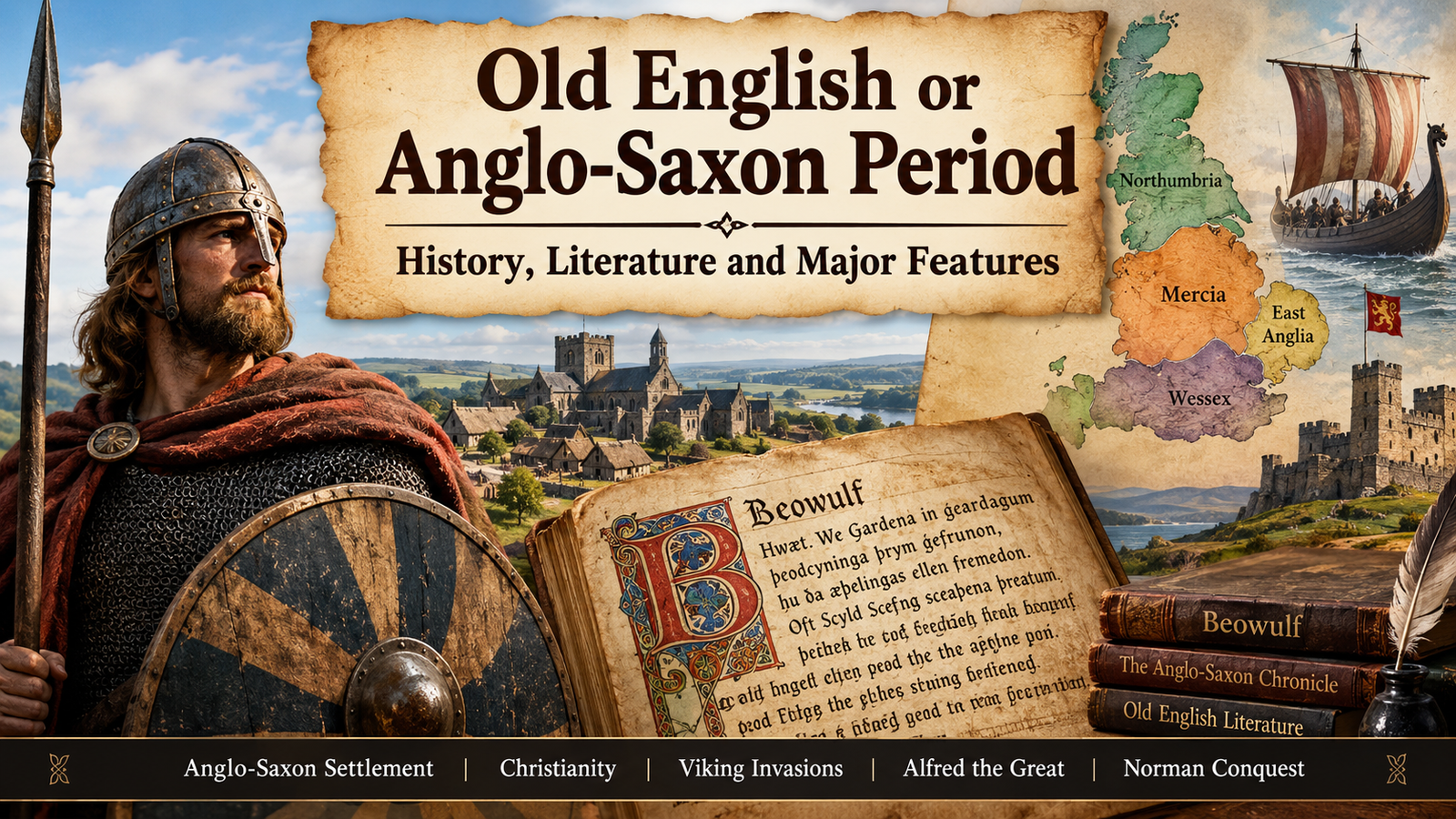
Old English or Anglo-Saxon Period: History, Literature, Language and Major Features
Old English Period or Anglo-Saxon Period, is the earliest historical form of the English language, spoken in England and southern and eastern Scotland in the early Middle Ages. It was brought to Great Britain by Anglo-Saxon settlers in the mid-5th century, and the first Old English literary works date from the mid-7th century.
Old English developed from a set of Anglo-Frisian or Ingvaeonic dialects originally spoken by Germanic tribes traditionally known as the Angles, Saxons and Jutes. As the Anglo-Saxons became dominant in England, their language replaced the languages of Roman Britain: Common Brittonic, a Celtic language, and Latin, brought to Britain by Roman invasion.
Old English had four main dialects, associated with particular Anglo-Saxon kingdoms: Mercian, Northumbrian, Kentish and West Saxon. It was West Saxon that formed the basis for the literary standard of the later Old English period. The speech of eastern and northern parts of England was subject to strong Old Norse influence due to Scandinavian rule and settlement beginning in the 9th century.
Historical and Political Background of the Old English Period: Anglo-Saxon England History and Political Development
Timeline Before the Coming of the Germanic Tribes: Early Britain, Celtic Britain and Roman Rule
The timeline before the coming of the Germanic tribes:
c.6000 BC: Britain cut off from continental Europe by English Channel
c.5000 BC: Proto-Indo-Europeans living in Eastern Europe and Central Asia
c.1000 BC: Germanic Indo-European tribes living in parts of modern-day Germany
c.500 BC: Celts inhabit much of Europe, and beginning to colonize the British Isles
55 BC: First Roman raids on Britain under Julius Caesar
43AD: Roman occupation of Britain under Emperor Claudius (beginning of Roman rule of Britain)
410-436 AD: Roman withdrawal from Britain
Timeline After the Coming of the Anglo-Saxon Tribes: Anglo-Saxon Settlement and Development of England
The period after the coming of the Anglo-Saxon tribes:
c.450: Anglo-Saxon settlement (Angles, Frisians, Saxons, Jutes) of Britain begins
450-480: Earliest Old English inscriptions
597: St. Augustine arrives in Britain (beginning of Christian conversion of the Anglo-Saxons)
c.600: Anglo-Saxon language covers most of modern-day England
c.660 :“Cædmon’s Hymn” composed in Old English
731: The Venerable Bede writes “The Ecclesiastical History of the English People” (in latin)
792 raids of Britain begin
c.800: Old English epic poem “Beowulf” composed
865: The Danes launch full-scale invasion and occupy Northumbria
871 : Alfred the Great becomes king of Wessex, encourages English prose and translation of Latin works
871: “The Anglo-Saxon Chronicle” is begun
878 : Danelaw established, dividing Britain into Anglo-Saxon south and Danish north
911: Charles II of France grants Normandy to the Viking chief Hrolf the Ganger (the beginning of Norman French)
c.1000: The oldest surviving manuscript of “Beowulf” dates from this period
1066: The Norman conquest under William the Conqueror
Early Anglo-Saxon History (410–660): Origins and Development of Anglo-Saxon England
Withdrawal of Romans and Arrival of Germanic Tribes (410–560): Anglo-Saxon Settlement in Britain
The departure of the Romans in 410 left the British population open to the inroads of the invaders from the north. No longer protected by the Roman military against the constant threat from the Picts and Scots of the North, the Celts felt themselves increasingly vulnerable to attack. Around 430AD, the ambitious Celtic warlord Vortigern invited the Jutish brothers Hengest and Horsa (from Jutland in modern-day Denmark), to settle on the east coast of Britain to form a bulwark against sea raids by the Picts, in return for which they were “allowed” to settle in the southern areas of Kent, Hampshire and the Isle of Wight.
According to British traditions the English from the Continent came first as mercenaries to help in the defence against the Picts and Scots; but soon they began to settle in the country, and archaeological evidence shows that certainly permanent settlements had been made in the last quarter of the fifth century if not before. In The Angles (from a region called Angeln, the spur of land which connects modern Denmark with Germany) gradually began to settle in increasing numbers on the east coast of Britain, particularly in the north and East Anglia. The Frisian people, from the marshes and islands of northern Holland and western Germany, also began to encroach on the British mainland from about 450 AD onwards. Still later, from the 470s, the war-like Saxons (from the Lower Saxony area of north-western Germany) made an increasing number of incursions into the southern part of the British mainland. Over time, these Germanic tribes began to establish permanent bases and to gradually displace the native Celts.
The Celts were pushed further and further back by the invaders into the wilds of Scotland, Wales, Cornwall and Ireland, although some chose to flee to the Brittany region of northern France) and even further into mainland Europe.
In succession followed the inroads of the Danes in the ninth century; the rise of Wessex among the early English kingdoms with the important contribution of Alfred the Great; the establishment of the Danelaw in England with the permanent settlement of Danes in the country; the accession of a Danish king (1017); and the Norman influence on the English court which began before the Conquest in 1066. All these events had their effect on the literature of the period.
Christianization of the Anglo-Saxons (560–660): Christianity, Literacy and Old English Culture
Then followed the Christianization of the pagan English tribes, beginning in Northumbria with the work of Irish missionaries, though the influence from Rome begins in Kent (597). In the last half of the 6th century, four structures contributed to the development of society; they were the position and freedoms of the ceorl, the smaller tribal areas coalescing into larger kingdoms, the elite developing from warriors to kings, and Irish monasticism developing under Finnian (who had consulted Gildas) and his pupil Columba.
In the 6th century, Christianity was re-established and Britain began to flourish as a center for learning and cultural production. Although many of the Romano-Celts in the north of England had already been Christianized, St. Augustine and his missionaries from Rome brought Christianity to the pagan Anglo-Saxons to the rest of England in 597 AD. After the conversion of the influential King Ethelbert of Kent, it spread rapidly through the land, carrying literacy and European culture in its wake. Augustine was made Archbishop of Canterbury in 601 AD and several great monasteries and centres of learning were established particularly in Northumbria (e.g. Jarrow, Lindisfarn).
Æthelberht was converted to Christianity, churches were established, and wider-scale conversion to Christianity began in the kingdom. Æthelberht’s law for Kent, the earliest written code in any Germanic language, instituted a complex system of fines. Kent was rich, with strong trade ties to the continent, and Æthelberht may have instituted royal control over trade. For the first time following the Anglo-Saxon invasion, coins began circulating in Kent during his reign.
Middle Anglo-Saxon History (660–899): Mercia, Monasticism, Vikings and Alfred the Great
Mercian Supremacy: Rise of the Kingdom of Mercia in Anglo-Saxon England
By 660, the political map of Lowland Britain had developed with smaller territories coalescing into kingdoms, and from this time larger kingdoms started dominating the smaller kingdoms. In the 7th century, the Kingdom of Mercia rose to prominence under the leadership of King Penda. Mercia invaded neighbouring lands until it loosely controlled around 50 regions covering much of England. Mercia and the remaining kingdoms, led by their warrior elites, continued to compete for territory throughout the 8th century. Massive earthworks, such as the defensive dyke built by Offa of Mercia, helped to defend key frontiers and towns.The Mercian influence and reputation reached its peak when, in the late 8th century, the most powerful European ruler of the age, the Frankish king Charlemagne, recognised the Mercian King Offa’s power and accordingly treated him with respect, even if this could have been just flattery.
Learning and Monasticism (660–793): Education, Scholarship and Intellectual Life in Anglo-Saxon England
Michael Drout calls this period the “Golden Age”, when learning flourished with a renaissance in classical knowledge.
In 669 Theodore, a Greek-speaking monk originally from Tarsus in Asia Minor, arrived in Britain to become the eighth Archbishop of Canterbury. He was joined the following year by his colleague Hadrian, former abbot of a monastery in Campania (near Naples).
One of their first tasks at Canterbury was the establishment of a school; and according to Bede (writing some sixty years later), they soon “attracted a crowd of students into whose minds they daily poured the streams of wholesome learning”. As evidence of their teaching, Bede reports that some of their students, who survived to his own day, were as fluent in Greek and Latin as in their native language.
Anglo-Saxon monasticism developed the unusual institution of the “double monastery”, a house of monks and a house of nuns, living next to each other, sharing a church but never mixing, and living separate lives of celibacy.
The Vikings in Anglo-Saxon England: Viking Raids, Danelaw and Scandinavian Influence on English
By the late 8th Century, the Vikings (or Norsemen) began to make sporadic raids on the east cost of Britain. They came from Denmark, Norway and Sweden, although it was the Danes who came with the greatest force. The wealth of the monasteries and the success of Anglo-Saxon society attracted the attention of people from continental Europe, mostly Danes and Norwegians. Notorious for their ferocity, ruthlessness and callousness, the Vikings pillaged and plundered the towns and monasteries of northern England. In 793, they sacked and looted the wealthy monastery at Lindisfarne in Northumbria – before turning their attentions further south. By about 850, the raiders had started to over-winter in southern England and, in 865, there followed a full-scale invasion and on-going battles for the possession of the country.
The 9th century saw the rise of the Wessex kingdom, especially with King Alfred the Great, who fashioned himself “King of the Anglo-Saxons” and oversaw an increasing unity of the English people and improved the kingdom’s legal system and military structure and his people’s quality of life.
Viking expansion was finally checked by Alfred the Great and, in 878, a treaty between the Anglo-Saxons and the Vikings established the Danelaw, splitting the country along a line roughly from London to Chester, giving the Norsemen control over the north and east and the Anglo-Saxons the south and west.
Over time, Old Norse was gradually merged into the English language, and many Scandinavian terms were introduced.
By the time Alfred the Great came to the throne in 871, most of the great monasteries of Northumbria and Mercia lay in ruins and only Wessex remained as an independent kingdom. But Alfred, from his capital town of Winchester, set about rebuilding and fostering the revival of learning, law and religion. Crucially, he believed in educating the people in the vernacular English language, not Latin, and he himself made several translations of important works into English, include Bede’s “Ecclesiastical History of the English People”. He also began the “Anglo-Saxon Chronicle”, which recounted the history of England from the time of Caesar’s invasion, and which continued until 1154.
Late Anglo-Saxon History (899–1066): Formation, Unification and Development of England
Reform and Formation of England (899–978): Rise of a Unified English Kingdom
A framework for the momentous events of the 10th and 11th centuries is provided by the Anglo-Saxon Chronicle. However, charters, law-codes and coins supply detailed information on various aspects of royal government, and the surviving works of Anglo-Saxon and vernacular literature, as well as the numerous manuscripts written in the 10th century.
During the course of the 10th century, the West Saxon kings extended their power first over Mercia, then into the southern Danelaw, and finally over Northumbria, thereby imposing a semblance of political unity on peoples.
The prestige, and indeed the pretensions, of the monarchy increased, the institutions of government strengthened, and kings and their agents sought in various ways to establish social order.This process started with Edward the Elder who succeeded Alfred the Great. Edward the Elder was succeeded by his son Æthelstan, who Keynes calls the “towering figure in the landscape of the tenth century”. His victory over a coalition of his enemies celebrated by a poem in the Anglo-Saxon Chronicle, opened the way for him to be hailed as the first king of England.It was only after twenty years of crucial developments following Æthelstan’s death in 939 that a unified kingdom of England began to assume its familiar shape. Edmund and Eadred succeeded Æthelstan.
Between 970 and 973 a council was held, under the aegis of Edgar,son of Edmund where a set of rules were devised that would be applicable throughout England. In 959 Edgar is said to have “succeeded to the kingdom both in Wessex and in Mercia and in Northumbria, and he was then 16 years old”
Æthelred and the Return of the Scandinavians (978–1016): Viking Invasions of England and Danish Rule
The reign of King Æthelred the Unready , son of Edgar witnessed the resumption of Viking raids on England, putting the country and its leadership under strains as severe as they were long sustained. Raids began on a relatively small scale in the 980s but became far more serious in the 990s, and brought the people to their knees in 1009–12.England was then invaded by Sweyn Forkbeard, the son of a Danish king. In April 1016, Æthelred died of illness, leaving his son and successor Edmund Ironside to defend the country. Swein’s son, Cnut, liquidated many of the older English families following his seizure of power in 1016. Æthelred’s son, Edward the Confessor, had survived in exile in Normandy and returned to claim the throne in 1042. After the defeat of the English in the Battle of Assandun in October 1016, Edmund and Cnut agreed to divide the kingdom so that Edmund would rule Wessex and Cnut Mercia, but Edmund died soon after his defeat in November 1016, making it possible for Cnut to seize power over all England.The Battle of Assandun was fought between Danish and English armies on 18 October 1016.
In the 11th century, there were three conquests: one by Cnut in 1016; the second was an unsuccessful attempt of Battle of Stamford Bridge in 1066; and the third was conducted by William of Normandy in 1066. Edward became king in 1042.
Harold, Stamford Bridge and the Battle of Hastings (1066): Norman Conquest of England and the End of the Anglo-Saxon Period
Harold was crowned king after the death of Edward the Confessor in January 1066. Harold was a powerful earl and member of a prominent Anglo-Saxon family with ties to Cnut the Great. Upon the death of his brother-in-law King Edward the Confessor on 5 January 1066, the Witenagemot convened and chose Harold to succeed; Shortly after he was crowned king, Harold faced invasions by his brother Tostig, the Norwegian King Harald III of Norway, and Duke William II of Normandy.
Harold defeated Tostig and Harald III at the battle of Stamford Bridge on September 25, 1066.
Harold’s army marched south to confront William at the Battle of Hastings on October 14, 1066. Harold was defeated by the strength of William’s attack and because his army was still recovering from Stamford.
Frequently Asked Questions About the Old English or Anglo-Saxon Period: History, Language and Literature
What is the Old English or Anglo-Saxon Period?
The Old English or Anglo-Saxon Period is the earliest historical form of the English language and is associated with the Anglo-Saxon settlement and development of England during the early Middle Ages.
When did the Old English Period begin and end?
The supplied study material identifies the Old English or Anglo-Saxon period broadly with the period from around 500 to 1100.
What are the four main dialects of Old English?
The four main dialects of Old English were Mercian, Northumbrian, Kentish and West Saxon. West Saxon formed the basis for the literary standard of the later Old English period.
Who were the Anglo-Saxons?
The Anglo-Saxons were Germanic peoples traditionally identified as the Angles, Saxons and Jutes, whose settlement in Britain played an important role in the development of Old English.
What was the importance of Christianity in Anglo-Saxon England?
Christianization contributed to learning, literacy and cultural production. Monasteries and centres of learning were particularly important in the development of Anglo-Saxon intellectual and cultural life.
What was the impact of the Vikings on Anglo-Saxon England?
The Viking raids and invasions affected Anglo-Saxon political history and contributed to the establishment of the Danelaw. Old Norse also influenced the English language, with many Scandinavian terms entering English.
Why is Alfred the Great important in Old English history?
Alfred the Great played an important role in the revival of learning, law and religion. He also encouraged education in the vernacular English language and translated important works into English.
What happened in England in 1066?
In 1066, Harold became king after the death of Edward the Confessor. Harold defeated Tostig and Harald III at Stamford Bridge but was later defeated by William at the Battle of Hastings.
Conclusion: Importance of the Old English Period in English Literary History
The Old English or Anglo-Saxon Period forms an important foundation of English language and literary history. The period was shaped by Germanic settlement, Christianization, the rise of kingdoms such as Mercia and Wessex, Viking invasions, the influence of Old Norse, the contributions of Alfred the Great and the events of 1066. Understanding these historical developments provides an essential foundation for studying the development of English and Anglo-Saxon England.
Read the fascinating history of Anglo-Norman Period