
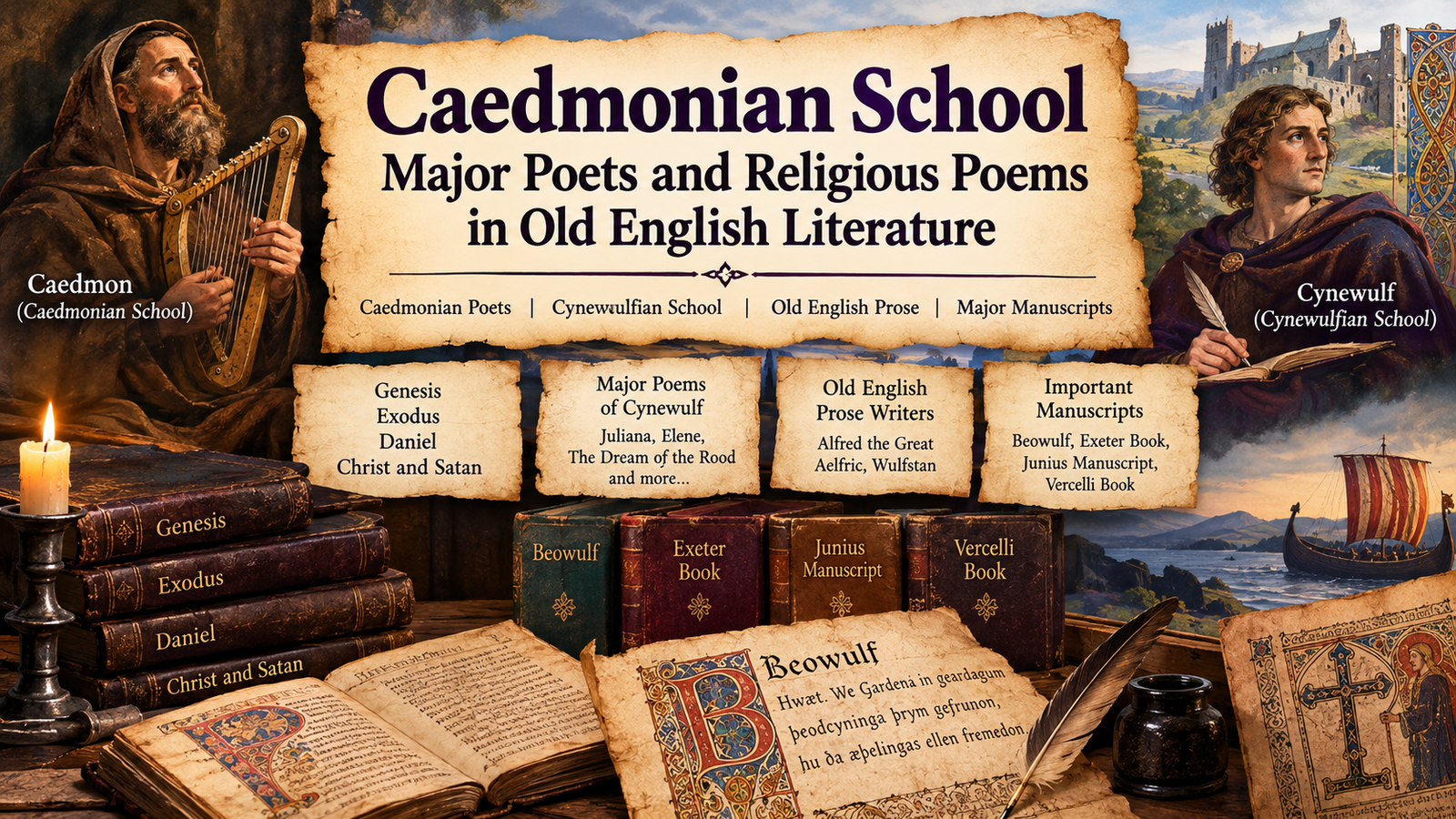
Caedmonian School: Major Poets and Religious Poems in Old English Literature
The earlier poems were written by Caedmon and a number of other poets known as Caedmonian School.
Genesis: Summary, Themes and Significance of the Old English Biblical Poem
Genesis which deals with the first twenty two chapters of Old Testament is divided into two sections : GENESIS A & GENESIS B. GENESIS A: The first part begins with a description of God and Angels in Heaven, mentions the rebellion of the Angels and their subsequebnt fall. GENESIS B: The second section shows a remarkable handling of narrative, records the events from the fall of the angels to the fall of the man.
Exodus: Summary and Themes of the Old English Biblical Poem
Exodus is a poem of some 600 lines which records the escape of the Israelities through the Red sea and the drowning of the Egyptian army.
Daniel: Summary, Themes and Significance of the Old English Religious Poem
Daniel: The poems deals with the first five chapters of Daniel. It is subdivided into two parts that depicts the reign of Nebuchchandnezzar and Daniel’s interpretations of the ominous dream.
Christ and Satan: Summary and Themes of the Old English Religious Poem
The last poem Christ and Satan is contained in the second part of Junius Manuscript but it does not paraphrase any particular Biblical book, retells the number of episodes from Old and New Testament.
Cynewulf’s Works: Major Poems and Features of the Cynewulfian School
The earlier that were written by Cynewulf and a number of other poets were known as Cynewulfian School.
Signed Poems by Cynewulf: Major Old English Religious Poems
Juliana, Elene, The Christ, The Fates Of The Apostles.
Unsigned Poems of the Cynewulfian School: Major Old English Poems
Andreas, The Phoenix, The Dream Of The Rood, Guthlac, The RIDDLES.
Juliana: Summary, Themes and Significance of the Old English Christian Poem
It is a story of a woman who suffers inhuman torments in her effort to defend Christainity, before she is beheaded.
Elene: Summary, Themes and Significance of the Old English Religious Poem
Elene, relates the story of discovery of true cross by the empress Helena, mother of Constantine The Great.
The Christ: Summary, Structure and Themes of the Old English Religious Poem
This is a poem of 1700 lines. This didactic poem is divided into three parts:
Nativity
Ascension
The Day of Judgement.
The Fates Of The Apostles: Summary and Significance of the Old English Christian Poem
It is a short poem of 122 lines focuses on the lives of the twelve apostles after they dispersed to spread the Gospel
Andreas: Summary and Themes of the Old English Christian Poem
It is an Old English Poem on St. Andrew the apostle, fighting against evil forces.
The Dream Of The Rood: Summary and Significance in Old English Religious Poetry
it is undountedly the finest of all Old English religious poem, which presents the accounts of a dreamer who saw vision of a bright cross, brilliantly adorned with genre and got inspired by it.
The Phoenix: Summary, Themes and Symbolism in the Old English Poem
This poem is about mythological bird Phoenix which after each thousand year burns itself to be reborn.
Guthlac: Summary and Themes of the Old English Religious Poem
The poem Guthlac describes how Guthlac is tempted and tormented by foul friends and serene death of the saint
Riddles: Exeter Book Riddles and Their Importance in Old English Literature
There is a collection of about 95 riddles in Exeter book.
Anglo-Saxon Prose: Major Writers and Works of Old English Prose
Alfred the Great: Old English Prose and Contributions to English Literature
Alfred the great, king of Wessex, was a patron of learning during The Old English Period. He is considered as “the father of English Prose”. He states that he has began the series of translation because of the lamentable state of the English Language. Even the knowledge of Latin was declining so the king in order to encourage learning started to translate some of the major texts into his own language. The five important translations are:
• Pastoral Care of Pope Gregory(first)
• History of the world of Orosius
• Bede’s Ecclesiastical History
• Boethius Consolation of Philosophy
• Soliloquies of St.Augustine(last)
Aelfric: Major Works and Contributions to Old English Prose
• Catholic Homilies
• Lives Of The Saints
• Translations From Scriptures.
• Colloquy.
He is best known for his Grammar who was a churchman who became abbot of Enshyman in 1005. Several of his works are extant. Catholic Homilies Which consists of two series of sermons suitable for delivery by priests and a third series called Lives of the Saints, and translations from scriptures.
He is best known for his flowing and vigorous style that show s his remarkable talent in putting down the difficult thoughts in narrative form.
His Colloquy is a dialogue between master and pupils not only from the literary but from the historical point of view.
Wulfstan: Sermo Lupi ad Anglos and Major Contributions to Old English Prose
Sermo Lupi ad Anglos: Summary, Style and Significance in Old English Literature
Wulfstan was Bishop of Worcester and Archbishop of York. Several of his signed homilies survive and there are many more which are believed on good evidence to be by him. His most famous piece is the Sermo Lupi ad Anglos Which is known for its sheer force and vigour, its repetition of ideas, and the alliterative nature of its style. It is fluent and powerful.
The Major Manuscripts of Old English Literature: Important Anglo-Saxon Manuscripts and Their Contents
Most Old English poetry is preserved in four manuscripts of the late 10th and early 11th centuries. The Beowulf manuscript (British Library) contains Beowulf, Judith, and three prose tracts; the Exeter Book (Exeter Cathedral) is a miscellaneous gathering of lyrics, riddles, didactic poems, and religious narratives; the Junius Manuscript (Bodleian Library, Oxford)—also called the Caedmon Manuscript, even though its contents are no longer attributed to Caedmon—contains biblical paraphrases; and the Vercelli Book (found in the cathedral library in Vercelli, Italy) contains saints’ lives, several short religious poems, and prose homilies. In addition to the poems in these books are historical poems in the Anglo-Saxon Chronicle; poetic renderings of Psalms 51–150; the 31 “Metres” included in King Alfred the Great’s translation of Boethius’s De consolatione philosophiae (Consolation of Philosophy); magical, didactic, elegiac, and heroic poems; and others, miscellaneously interspersed with prose, jotted in margins, and even worked in stone or metal.
Frequently Asked Questions About Caedmonian School, Cynewulfian School and Old English Literature
What is the Caedmonian School in Old English literature?
The Caedmonian School refers to Caedmon and a number of other poets associated with the earlier Old English religious poems.
What are the major poems associated with the Caedmonian School?
The major poems discussed under the Caedmonian School include Genesis, Exodus, Daniel, and Christ and Satan.
What are the two sections of the Old English poem Genesis?
Genesis is divided into two sections: Genesis A and Genesis B. Genesis A describes God, the Angels, the rebellion of the Angels and their fall, while Genesis B records events from the fall of the angels to the fall of man.
What is the Cynewulfian School?
The Cynewulfian School refers to poems written by Cynewulf and a number of other poets associated with him.
What are the signed poems of Cynewulf?
The signed poems of Cynewulf are Juliana, Elene, The Christ, and The Fates of the Apostles.
What are the unsigned poems of the Cynewulfian School?
The unsigned poems listed under the Cynewulfian School are Andreas, The Phoenix, The Dream of the Rood, Guthlac, and The Riddles.
What is The Dream of the Rood about?
The Dream of the Rood presents the account of a dreamer who sees a vision of a bright cross, brilliantly adorned with jewels, and becomes inspired by the vision.
What are the major works of Alfred the Great?
The five important translations associated with Alfred the Great are Pastoral Care of Pope Gregory, History of the World of Orosius, Bede’s Ecclesiastical History, Boethius’ Consolation of Philosophy, and Soliloquies of St. Augustine.
Who were the major Old English prose writers?
The major Old English prose writers discussed here include Alfred the Great, Aelfric and Wulfstan.
What are the four major manuscripts of Old English poetry?
The four major manuscripts are the Beowulf Manuscript, the Exeter Book, the Junius Manuscript and the Vercelli Book.
What is the Exeter Book famous for?
The Exeter Book is a miscellaneous collection containing lyrics, riddles, didactic poems and religious narratives.
What is the Junius Manuscript?
The Junius Manuscript, also called the Caedmon Manuscript, contains biblical paraphrases and is one of the major manuscripts preserving Old English poetry.
Conclusion: Importance of Caedmonian and Cynewulfian Poetry in Old English Literature
The Caedmonian and Cynewulfian schools represent an important part of Old English religious poetry. Poems such as Genesis, Exodus, Daniel, Christ and Satan, Juliana, Elene, The Christ, The Fates of the Apostles, Andreas, The Dream of the Rood, The Phoenix and Guthlac demonstrate the importance of religious themes in Old English literature. Alongside this poetry, the prose writings of Alfred the Great, Aelfric and Wulfstan and the major Old English manuscripts provide an essential foundation for understanding Anglo-Saxon literature and the development of English literary history.