
About the Author:
Sharankumar Limbale is a Marathi novelist, poet, critic, and short story writer. He has penned more than 40 books but is best known for his autobiographical novel Akkarmashi published in 1984. It was translated into several Indian languages including Malayalam, Tamil and Hindi. He also wrote a critical work Towards an Aesthetics of Dalit Literature. He was born to an outcast landless mother and an upper-caste father. Therefore, he describes himself as an ‘Akkarmashi.’
A Critical Note on the Outcaste by Sharankumar Limbale:
‘The Outcast’ is an extract taken from the famous autobiographical novel The Outcast written by Sharankumar Limbale. Firstly, it was written in Marathi language with the name Akkarmashi. Later, in 2003 Santosh Bhoomkar translated it to English with the title The Outcaste. The Outcaste is considered as one of the important works which exposes discrimination against the Dalit community. As it is an autobiographical story, Limbale draws many painful incidences from his own life. He was an illegitimate son born to an untouchable outcast mother and upper-class father. He faced several discriminations, as an untouchable, in different phases of his life. Here, ‘The Outcaste’ reflects the conditions of a particular oppressed class, the Mahar community.
School Experience of the Author:
As a member of the Mahar community, he had faced many discriminations during his time at school. This extract tells us about his experience in a school picnic when he was in the third standard.
Caste Politics in Education:
In the extract, caste politics is reflected in different ways and means. The upper caste students were always protected by their teachers. They were already informed about their picnic. Therefore, all upper caste students came with preparations. At same time, the outcaste students were not informed before. Therefore, again they had to go back home to bring their tiffin.
Game Politics:
Another discrimination took place in the form of game politics. There were separate games assigned for upper-caste and outcast students. The upper caste Vani and Brahmin boys played Kabaddi. But being a member of the Mahar community, they could play simple games like touch-and-go.
Food Politics and Segregation:
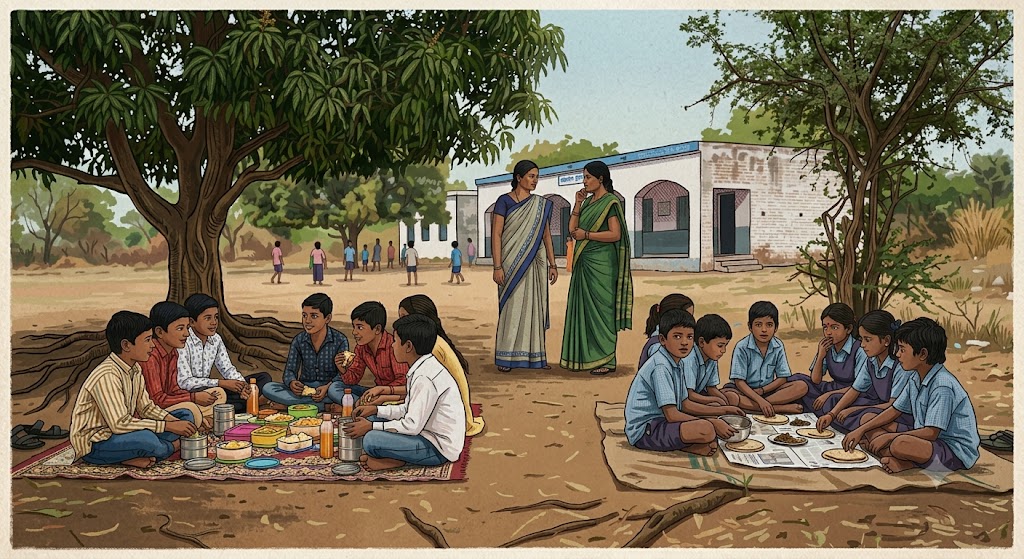
Discrimination can be seen in the form of food politics also. After the games, they were asked to sit separately under different trees. The Outcast students did not have good food to eat, they had brought dried bhakari and chutney, and bombil fish curry. At the same time, the upper caste students brought varieties of fried and tasty food. At the end of the lunch, teachers asked the upper-caste boys and girls to collect the leftovers on a paper and give it to them.
Teacher’s Humiliation and Essay Writing:
On the next day of the picnic, the teacher asked both third and seventh standard students to write an essay about their picnic. Senior boys and girls were swiftly started to write the essay. Limbale as a 3rd standard student, could not start writing as other students. When the teacher noticed him, he shouted “You son of a bitch, come on, start writing! You like eating an ox, don’t you?” He didn’t know how to write and what to write. But he started to remember the incidences that happened the day before. Here the teacher abused him without giving any consideration as a third standard student. It shows the mentality of the upper class those who see everything in the eyes of the caste system, they never leave even the children.
Summary of The Outcaste
In The Outcast, Sharankumar Limbale describes his experience during the time of a school picnic. The upper caste students were informed before by their teachers about the picnic, therefore they came with all preparations, but the outcast Mahar boys and girls were not informed before. So they came without any preparations. That day was a strange experience for them because they haven’t had any picnics so far. They rushed to the home and came back with tiffin. After they returned from home, joined a group of boys and girls who were getting ready to start their journey.
Journey to the Picnic Site:
On the way, they have seen a group of women, who were gathering dung cakes. Then they saw Harya, who was grazing cattle along the bank of river. He was also a student of the same school, but his father put him on a farm run by Girmallya because of poverty. His family was a poor one, his mother did not even have proper clothes, and they could not eat properly. But after Harya had joined the job he was not a burden for his family and now all the members of his family could have sufficient food and cloth. Here Harya had to sacrifice his education for the sake of his family.
Games at the Picnic:
When they reached their destination place, boys and girls were started to play different games. The caste girls played Phugadi, teachers cards game. Here, the author did not join with them, he just watched them from the distance. The upper caste Vani and Brahmin boys played Kabaddi but Mahar students cannot join them. Because Outcast students can play only simple games like touch-and-go. Mallya, Umbrya, and Parshya all belong to outcast Mahar community.
Lunch and Social Segregation:
After the game was over, they were asked to sit and have lunch. The boys and girls from the upper caste were asked to sit in a circle under a banyan tree with their teachers. The Mahar boys and girls were asked to sit under another tree. Here the tree that allotted for the outcast students was a bare one. The cast students were sharing food with the teachers. Then, some questions came to the writer’s mind. Dare I offer my chutney and bakeris to my teacher?
Hunger and Memory:
Author’s stomach was used to be like a ‘grave’. His hunger used to never be satisfied. Author’s mother used to shout at him out of frustration ‘What is it you have, a stomach or Akkalkot?’. The author confesses that he always felt he used to eat greedily whatever food he used to get. It is pathetic to listen that he searched every bit of leftover food in the house to make up his tiffin.
Return and Leftover Food:
At the end, the upper class students were ordered to give the leftover food to the Dalit children. The author and Parshya carried the bundle of leftover food at their return. The upper class boys and girls were laughing and joking at the sight of Dalit boys and girls carrying their food. Their laughing and joking didn’t bother them because their whole attention was on the bundle of food. Hunger was their main concern and above that eating delicacy was something unusual for them.
The note should be made about the practice of untouchability and discrimination which were instilled in the students for Dalits. Dalits remained busy in satisfying their basic amenities.
Mother Masamai and Home Reality:
It is interesting to note the difference between a usual mother and author’s mother, Masamai. When the narrator went back home, Masamai asked him that why didn’t he bring something for her. What we expect a reaction from usual mother is that she asks her children whether they enjoyed their trip or not, whereas Masamai is asking if the author has brought something for her or not. The circumstances that prevailed in the community made them to do so.
Writing Experience and Inner Conflict:
Next, the author narrates that how their teacher asked them to write their experiences of the picnic. It was not difficult for the seventh form student to write but the author was facing difficulty. The question was what to write. It is whether the author should pen down the horrible experiences of the picnic or not. There was nothing good to fill his slate with. He didn’t know what was good experiences and he recalled all what passed on the picnic day.
Working of Caste System:
The narrator mentions the manner in which they were made to sit in the school. They were segregated on the basis of caste and came community. Vani and Brahmin from high castes. Their class was taken in the temple of Ithoba. The girls sat in a separate section. Down the hall was reserved for boys and girls from the cobbler community. The entrance was meant for Mahar community. This shows how they were barred from entering the temple too.
Oppression and Daily Life:
On weekends, like Saturdays, the Mahar boys were asked to smear the walls and floor with cowdung paste. The narrator was particularly admired for this because he was an expert in it. The narrator mentions his field of expertise, which are gathering cowdung and smearing the floor surface with it. These types of menial works were not supposed to be carried out by upper class. The Mahars and people belonging to lower rungs of the society carried out this main occupation.
Occupation and Identity:
Another occupation mentioned by the narrator is sweeping. By mistake and unconsciously, the narrator reached the middle of the temple. The narrator develop different feelings and emotions regarding this. At one point of time, he feels happy at entering the temple. Dalits and lower class people were deprived of their right to enter the temple. The narrator felt glad for getting the chance of crossing the entrance but simultaneously he feared someone might notice him.
The narrator felt sad that the society didn’t want to accept them. He confessed that they too are Hindu by the faith but due to caste system they are not allowed to enter the temple. The narrator feels that that they are village thrown out. The society made him feel that he is not a child but ‘garbage’.
The narrator frequently mentions about the umbilical cord: He feels that this cord has been severed…