
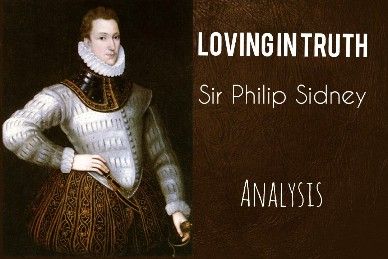
Introduction
“Loving in Truth” is the opening sonnet of Astrophil and Stella, one of the greatest sonnet sequences in English literature.
Poem at a Glance
- Title: Loving in Truth (Sonnet 1)
- Poet: Sir Philip Sidney
- Collection: Astrophil and Stella
- Published: 1591 (posthumously)
- Genre: Sonnet
- Period: Elizabethan Renaissance
- Form: English sonnet with Petrarchan influence
- Themes: Love, poetry, inspiration, creativity, sincerity
Summary
The speaker is deeply in love and wants to express his feelings through poetry so that his beloved may read his verses, understand his love, pity his suffering, and eventually return his affection.
To write the perfect love poem, he studies the works of other poets, hoping to gain inspiration. However, despite all his efforts, no suitable words come to him. The more he imitates others, the more difficult writing becomes.
Finally, his Muse appears and offers simple but profound advice:
“Look in thy heart, and write.”
The speaker realizes that authentic poetry comes not from copying others but from expressing genuine emotions.
LINES 1-4
“Loving in truth, and fain in verse my love to show, / That she, dear she, might take some pleasure of my pain, / Pleasure might cause her read, reading might make her know, / Knowledge might pity win, and pity grace obtain.”
EXPLANATION
The poet is loving in reality and is eager to express his emotions in verse in order to make his beloved take some pleasure in reading about the poet’s hopelessness. The pleasure of reading might make her know the unique state of the poet, and this knowledge might gain her pity, and pity might obtain her grace (favor) for him.
LINES 5-8
“I sought fit words to paint the blackest face of woe, / Studying inventions fine, her wits to entertain, / Oft turning others’ leaves, to see if thence would flow / Some fresh and fruitful showers upon my sun-burn’d brain.”
EXPLANATION
He sought apt words to describe the deepest melancholy of mankind. He studied excellent artistic compositions (“inventions fine”) of other poets to compose fine poetry to entertain her. The poet frequently turned to others’ pages (“others’ leaves”) to find some inspiration. These inspirations would act as fresh and fruitful showers upon his dry, sun-burned brain.
LINES 9-14
**”But words came halting forth, wanting Invention’s stay; / Invention, Nature’s child, fled step-dame Study’s blows; / And others’ feet still seemed but strangers in my way. / Thus, great with child to speak, and helpless in my throes, / Biting my truant pen, beating myself for spite, / ‘Fool,’ said my Muse to me, ‘look in
The words were coming to the poet but in a halting manner. It required the stay of inspiration, but Invention is a child of Nature, and Study acts as his stepmother. Being a stepmother, it guided about, and both the inhibition and invention flee away from him. Other poetic works seemed unfamiliar to the poet as their experience is different from his own; therefore, the poet has stated the word ‘strangers’ to give a clue to his condition. His condition is like a pregnant woman who’s suffering from labor pain in giving birth—similarly, the poet is suffering to produce a poem. Being frustrated, he starts to chew his pen and beat himself. Seeing the frustrated condition of the poet, the Muse advises him to look into his own heart and compose the poem.
SETTING / METRE / RHYME SCHEME
The setting of the poem is a table and chair where the poet is sitting to compose a poem. His theme is based on the Petrarchan theme of unrequited love for his sweetheart Penelope Devereux, who is married to Lord Rich.
Structurally and thematically, the sonnet is an affectionate one. Regarding structure, it is divided into an octave and a sestet, along with a typical rhyme scheme. Thematically, it is based on the Petrarchan theme of unrequited love.
The poem is composed in iambic pentameter with the rhyme scheme abab abab cdcd ee.
Major Themes
1. Love
Love is the motivating force behind the poet’s desire to write.
2. Poetry and Inspiration
The poem explores where artistic inspiration truly comes from.
3. Originality
Sidney argues that originality is superior to imitation.
4. Sincerity
The best poetry expresses honest emotions rather than borrowed language.
5. Creativity
Creative writing requires imagination and emotional truth, not merely technical skill.
Literary Devices
Personification
The Muse, Nature, Study, and Invention are treated as living beings.
Example:
“Invention, Nature’s child…”
Metaphor
The poet compares his creative struggle to childbirth:
“Great with child to speak…”
This metaphor conveys the difficulty of producing original poetry.
Alliteration
Examples include:
- Fresh and fruitful
- Pleasure might
These repeated sounds create musicality.
Imagery
Sidney uses vivid images such as:
- Sunburned brain
- Halting words
- Biting the pen
These images illustrate the frustration of the creative process.
Symbolism
- The Muse symbolizes artistic inspiration.
- The Heart symbolizes genuine emotion.
- The Pen represents poetic creation.
Central Idea
The poem teaches that authentic poetry comes from personal experience and heartfelt emotion rather than imitation. Sidney emphasizes that while reading other writers can be valuable, the truest source of creativity lies within the poet’s own heart.
Important Quotations
“Loving in truth, and fain in verse my love to show.”
This opening line introduces the poet’s desire to express genuine love through poetry.
“Oft turning others’ leaves…”
This line highlights the poet’s unsuccessful attempt to imitate other writers.
“Fool,” said my Muse to me, “look in thy heart, and write.”
The famous concluding line conveys the poem’s central message: sincere emotion is the foundation of great poetry.
Why the Poem Is Important for Students
This sonnet is widely studied because it:
- Introduces the famous sonnet sequence Astrophil and Stella.
- Explains Renaissance ideas about poetic inspiration and creativity.
- Demonstrates the effective use of personification, metaphor, imagery, and symbolism.
- Encourages writers to value originality and emotional honesty.
- Is frequently included in BA English, MA English, and UGC NET English Literature syllabi due to its literary and historical significance.