
Introduction
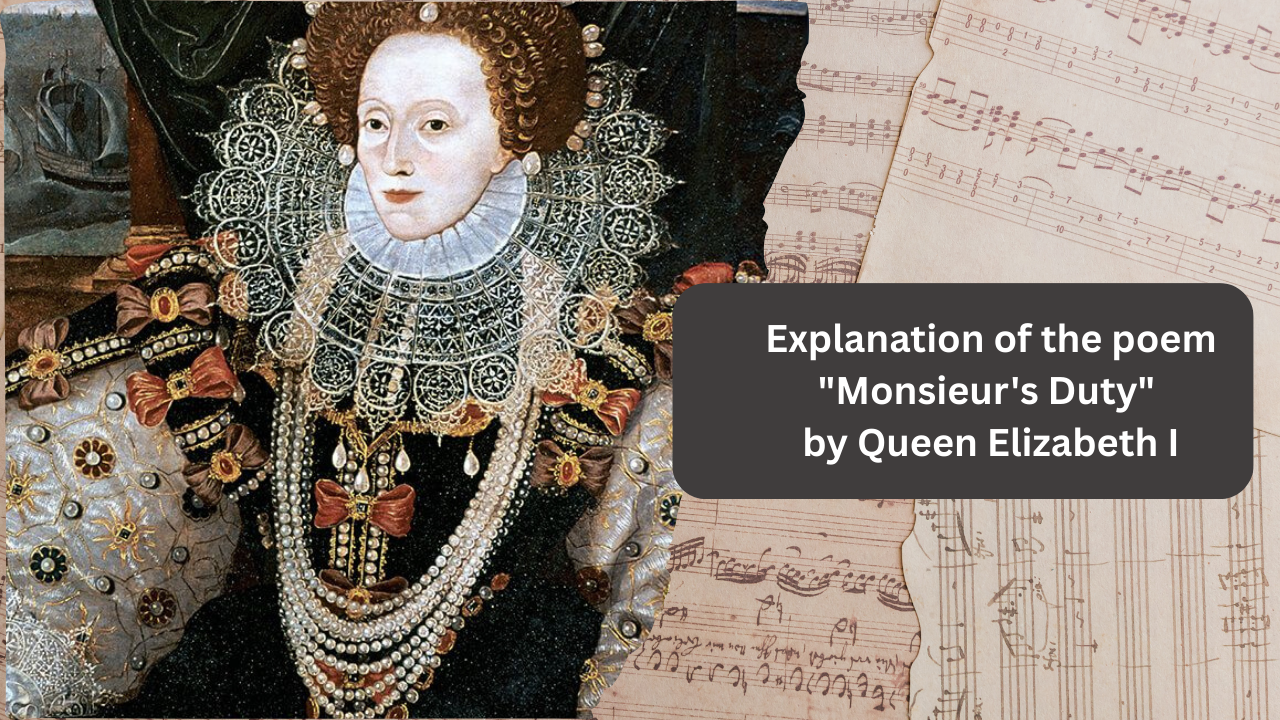
“On Monsieur’s Departure” is a famous piece of poetry attributed to Queen Elizabeth I. The time around which this poem was composed is 1582, written on the occasionof departure of Duke of Anjou. Duke of Anjou was a potential suitor to the Queen.
Summary
The speaker reveals a painful inner conflict. She loves someone but cannot openly express her affection. Instead, she must hide her true feelings and even pretend to hate the person she loves.
She describes her sorrow as a shadow that constantly follows her. No matter what she does, she cannot escape it. Her emotional suffering remains with her at all times.
In the final stanza, the speaker pleads for relief. She asks either for a gentler form of love that will not torment her or for complete freedom from love. If neither is possible, she wishes for death so that she may finally forget the pain of love.
The poem portrays the emotional cost of suppressing personal desires in the name of duty.
On Monsieur’s Departure line by line explanation
LINE 1–6
I grieve and dare not show my discontent;
I love and yet am forced to seem to hate,
I do, yet dare not say I will meant,
I seem stark mute but inwardly do prate.
I am and not, I freeze and yet am burned,
Since from myself another self I turned.
The speaker states that she is suffering from intense grief but her position of being queen restricts her from showing her discontent.
She loves but she is forced to express hate. The speaker did love but she is now forced to say that she never meant it. The following line presents the personality of the speaker.
It could be said that the speaker is in complete (stark) peaceful (mute) state, but within herself the speaker is talking foolishly about various subjects (prating). She would not recognize herself, she is intermingling her emotions within herself. The alternation of emotions created a new persona within herself.
LINE 7–13
My care is like my shadow in the sun
Follows me flying flies when I pursue it
Stands and lies by me doth what I have done
His too familiar care doth make me rue it
No means I find to rid him from my breast,
Till by end of things it be supprest.
The speaker describes the condition when one’s problems (care) follows her throughout every moment of her life. The speaker’s problems follow her when she tries to figure it out they flew away. Her problems stand and lie by her however she has tried to catch or figure out. They are always out of her reach.
The speaker no longer wishes to be for him or remember when he was there. It is now the goal of the speaker to rid him from her breast but she is unsuccessful.
LINE 12-18
Felt some gentle passion slide into my mind;
For I am soft and made of melting snow;
Or be more cruel, love and so be kind.
Let me, or float or sink, be high or low;
Or let me live with some more sweet,
Or die and so forget what love ere meant.
The speaker pleads to feel something deeply. She wants to get out from her present situation. She has now become weak to face all these emotions as she is fragile like melting snow. The speaker thinks of cruelty could help her to get from her present mental state. If the person she loves make her believe that he hated her, it would be an act of kindness
The speaker wants to feel one emotion at a time either extreme or slight to sustain the life. She needs to be either with sweet content or forget what love ever meant to her.
Major Themes
Conflict Between Love and Duty, Hidden Emotions, Unfulfilled Love
The speaker must sacrifice personal happiness for public responsibility. The poem explores the pain of concealing genuine feelings. Love remains incomplete because circumstances prevent its expression. The speaker experiences a struggle between the heart and the mind.
Public Identity vs Private Self and Suffering
As a queen, the speaker cannot freely act according to her personal desires. Emotional pain dominates the entire poem.
Literary Devices
Paradox
The poem is filled with paradoxical expressions:
- “I love and yet am forced to seem to hate.”
- “I freeze and yet am burned.”
- “I am and not.”
These contradictions emphasize the speaker’s emotional conflict.
Antithesis
Opposite ideas are placed together:
- Love and hate
- Freeze and burn
- Live and die
Simile
“My care is like my shadow in the sun.”
The speaker compares her sorrow to a shadow that never leaves her.
Metaphor
The shadow represents the grief that constantly follows the speaker.
Repetition
The repeated use of “I” stresses the intensely personal nature of the poem.
Central Idea
The poem shows that love cannot always be openly expressed. Personal emotions are sometimes sacrificed because of social expectations, political obligations, or public duty. Queen Elizabeth I presents the painful reality of balancing private desire with the responsibilities of leadership.
Important Quotations
“I grieve and dare not show my discontent.”
This opening line introduces the central conflict: the speaker suffers inwardly but cannot reveal her emotions.
“I love and yet am forced to seem to hate.”
This paradox captures the struggle between true feelings and outward appearance.
“My care is like my shadow in the sun.”
The comparison suggests that sorrow follows the speaker wherever she goes.
“Or let me live with some more sweet content, / Or die and so forget what love ere meant.”
The concluding lines express the speaker’s desperate wish for peace, whether through happiness or death.
Why the Poem Is Important for Students
This poem is significant because it:
- Illustrates key characteristics of Elizabethan lyric poetry.
- Demonstrates the effective use of paradox, antithesis, simile, and imagery.
- Explores universal themes such as love, sacrifice, identity, and duty.
- Offers insight into the emotional and political challenges faced by Queen Elizabeth I.
- Is frequently studied in BA English, MA English, and UGC NET English Literature courses for its literary and historical importance.