
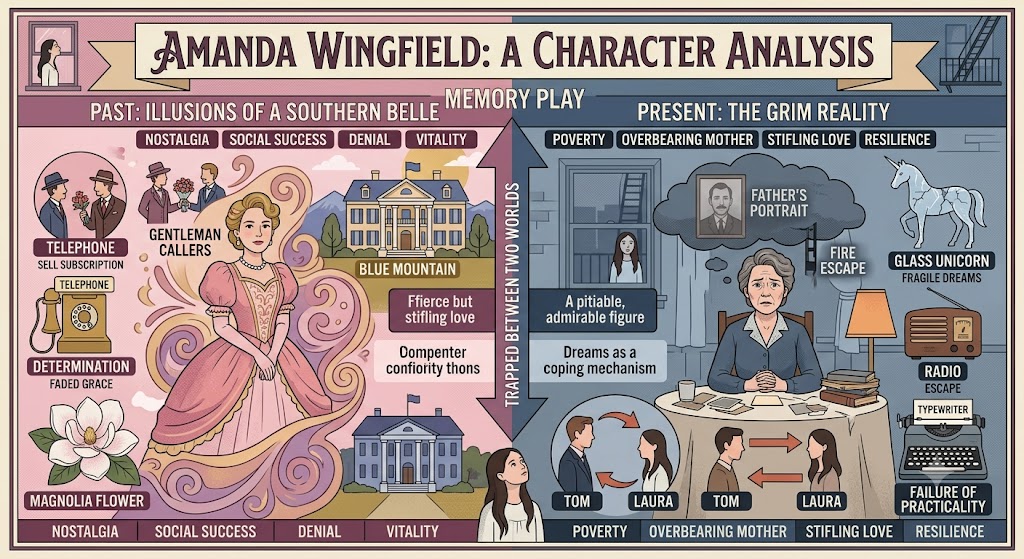
Amanda Wingfield is one of the most complex characters in The Glass Menagerie. Living in memories of her Southern belle past, she struggles to accept reality and constantly worries about the future of her children, Laura and Tom. Her blend of strength, nostalgia, and illusion makes her both admirable and tragic.
Introduction to Amanda Wingfield
Amanda is a strong yet pathetic woman living in a world of sentimental illusions while stubbornly refusing to accept life with its drabness and absence of hope. She is the most obviously complex and multifaceted of all the characters and Williams acknowledges as much in his initial character notes. His description of “A little woman of great but confused vitality” immediately indicates some of her obvious contradictions as does he notes that “there is much to admire in Amanda as much there is to love and pity as to laugh at”
Amanda Wingfield as Tennessee Williams’ Mother
In Amanda, Williams presents us unapologetically, with a detailed portrait of his own mother Edwina Dabkin Williams. It is necessary for a play’s protagonist to go on an emotional journey and finally to be somehow changed by it. But Amanda of all the characters in The Glass Menagerie is the one who changes least. She remains an unchangeable force rather than a dramatic subject capable of emotional evolution. Her concern for her children is often asphyxiating because of her fear of an uncertain future. Living in a world of sentimental illusion Amanda refuses to fully accept the apartment at St. Louis and its actual value with its drabness and absence of hope.
Amanda as the Southern Belle
Like Blanche Dubois in A Streetcar Named Desire she is the aging southern belle, lamenting the loss of the old pre civil war days of debutante balls and gentlemen callers. This habit of recollecting the lost days is something which is highly satirical and ironic in Amanda for if she truly portrayed Edwina Williams who was born in 1884, Amanda would have been far too young to remember the pre-war days before 1861. Thus Williams makes it clear that Amanda’s memories are an inextricable mixture of fact and rose tinted fiction.
Amanda’s Attachment to the Past
Amanda Wingfield is “a woman of great but confused vitality clinging frantically to another time and place… She is not paranoiac but her life is paranoia” (The Glass Menagerie). She has preserved her past in her mind and whenever she feels that her present is not going as per her will, her mind moves towards her past and she loves to narrate the things from her past.
Amanda’s Relationship with Laura Wingfield
Laura Wingfield, her daughter has failed to establish contact with reality and is like a piece of her own collection of glass menagerie “too exquisitely fragile to move from the shelf” (The Glass Menagerie). Her crippled body has left her in a situation where she feels that she cannot move with the external world and has created a world of her own.
Amanda’s Relationship with Tom Wingfield
Tom Wingfield, her son, is a poet and not satisfied with the job in the shoe warehouse. “very time, we find in the play that Amanda keeps on directing her children, how to eat, how to comb, or how to dress, which Tom does not like. This is seen when Tom says to her mother, “I haven’t enjoyed one bite of this dinner because of your constant directions on how to eat…”(The Glass Menagerie). Since Tom is not happy with the life he is living, whenever there is an argument with his mother he ends it with a cigarette.
Amanda’s Concern for Laura’s Future
Amanda is very much concerned about Laura. She wants her “to stay fresh and pretty ̶for gentlemen caller” (The Glass Menagerie). Laura is shy and is not able to socialize with the people outside. She knows that she is crippled and she is not going to have any gentleman caller, as said by her, “I’m not expecting any gentlemen callers” (The Glass Menagerie). She is having low self-esteem and wants to live always in her world of glass animals. As said by Freud in his book, ‘personal happiness is often ignored in the interests of social unity and cohesion’ (Civilization and its Discontents).
Amanda’s Illusions and Memories
In order to unite socially and to see her mother happy, Laura has to act against her will. As described by Freud in his book, The Civilization and its Discontents that “powerful deflections, which causes us to make light of our misery” Amanda is always deflecting from her present towards her past. She describes from her past that she used to have many handsome and wealthy gentleman callers, of whom she remembers each and everything. Time and again, she tells her children about the seventeen gentleman callers which she once had in her past.
Amanda’s Fear of Abandonment and Security
In her life, the moments of happiness lie in her past. She was attracted towards the charm of Mr Wingfield and she is having regret for marrying Mr Wingfield, who left her to survive on her own along with her children. Amanda is trying to find a substitute in the form of her Son-in-Law as she knows that Tom might leave them like his father. Her worry is reflected when she tells Tom, “What right have you got to jeopardize your job? Jeopardize the security of us all? How do you think we’d manage if you were ̶” (The Glass Menagerie).
Amanda’s Denial of Laura’s Disability
She wants the happiness of her daughter Laura. She never calls her crippled but instead, she used the word defect for the drawback in her daughter. “Nonsense! Laura, I’ve told you never, never to use that word. Why, you’re not crippled, you just have a little defect- hardly noticeable, even!” (The Glass Menagerie). She is living in a world of illusion, and Tom always reminds his mother “to face the facts” She expects many gentleman callers for her daughter. She is afraid that her daughter may end up as an old maid. She wants to keep pace with civilization and to move with the external world. And when she fails, she turns away towards her past as southern belle. In the Words of Freud, “Against the dreaded external world, one can only defend oneself by some kind of turning away from it, if one intends to solve the task by himself” (Civilization and its Discontents).
Conclusion
Amanda Wingfield emerges as one of the most memorable and complex characters in The Glass Menagerie. Her nostalgic attachment to the past, concern for her children, and inability to fully accept reality make her both admirable and tragic. Through Amanda, Tennessee Williams explores themes of memory, illusion, motherhood, and the struggle to cope with an uncertain future.