
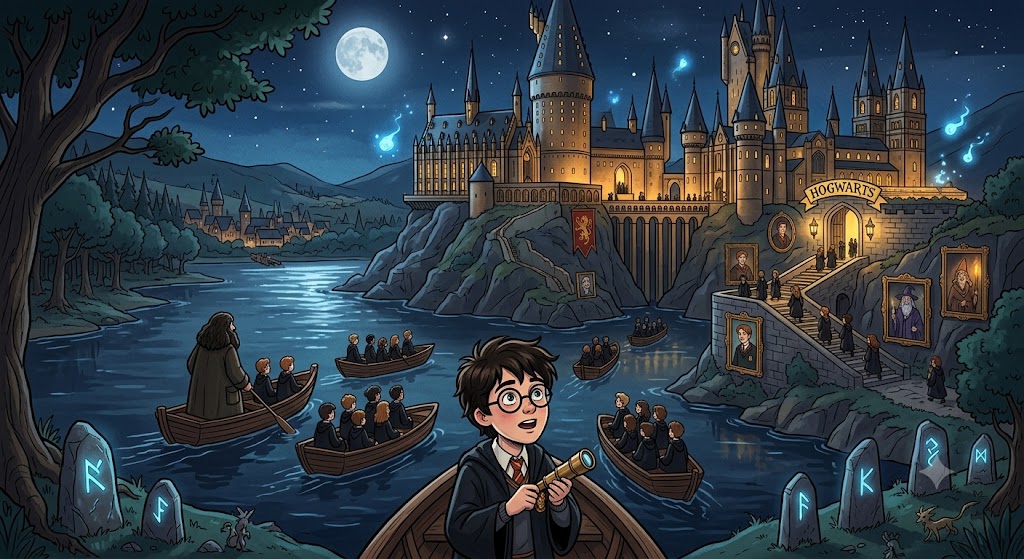
Self-Discovery / Knowing oneself and one’s ability / the category to which he belong / Magic, Difference, and Belonging
Introduction: Harry Potter’s Journey of Self-Discovery
Harry Potter and the Philosopher’s Stone is the first novel in a seven-part series centering on protagonist Harry Potter, who discovers that he is a wizard when he is eleven years old. The series tracks an epic battle between good and evil in the wizarding world, but the first book is, in its essence, a coming-of-age story.
In his initial years, Harry feels distinctive about himself as if he does not belong to the people around him. He silently spends ten years of life according to the norms of the Muggle world because he was still ignorant of the fact that he belonged to the world of wizards. There is a craving for a happy family, love, hope, cooperation and bonding. He is deprived of the basic child’s needs and love.
Harry’s Isolation in the Muggle World
It is only when he discovers he is a wizard and is introduced to the other wizards and the magical world around him, that he is able to grow and feel confident. Harry’s transition from the non-magical “Muggle” world to the magical world parallels his transition from the isolation and dejection of feeling to the beauty and excitement of finding a place where he belongs.
Harry’s early life in the Muggle world is marked by isolation and rejection; his Aunt Petunia and Uncle Vernon make him feel that he is profoundly different from other people and punish him for that difference. His parents, Lily and James (who are a witch and wizard), died when he was just a year old. They were killed by a dark wizard named Voldemort, and subsequently Harry is raised by his Aunt Petunia and Uncle Vernon (who are Muggles).
The Dursleys and the Suppression of Harry’s Identity
Aunt Petunia and Uncle Vernon despises magic and doesn’t ever utter the very word in their home. They refuse even to tell Harry that he has these magical abilities. They try to put Harry in the normal world or more specifically in a Muggle world. But harry does not belong to their world and his magic comes out in full force and he is often punished as a result.
Signs of Harry’s Magical Difference
One day, Aunt Petunia tries to cut Harry’s hair to her own liking, making him almost bald except for his bangs. When his hair grows back immediately the next day, she punishes him by making him remain in his cupboard for a week. In other words, Aunt Petunia isolates Harry for what makes him different—his magical abilities, which are still unknown to him—making him feel worthless and like he doesn’t belong.
When Harry is included—a rare occurrence—on a trip to the zoo for his cousin Dudley’s birthday, he finds that he is able to communicate with a snake in a glass display. He then unintentionally makes the glass disappear, allowing the snake to escape. Harry is severely disciplined and again made to stay in the cupboard for a week without any meals.
Later, Vernon insists to Aunt Petunia that when they took him in as a baby, they swore they would “stamp out that dangerous nonsense.” In referring to magic as “dangerous nonsense” that needs to be “stamp[ed] out,” Vernon firmly positions Harry’s difference—his magical ability—as something inherently evil that needs to be quashed.
Vernon and Petunia’s displeasure is then passed on to Dudley as well, who makes sure Harry is miserable at school by preventing him from making friends, often chasing him or picking on him. These treatments sum up an idea that Harry has felt through his whole life: the odd occurrences that seem to mark a difference in him signify that he doesn’t fit in.
Hagrid’s Revelation and Harry’s Self-Discovery
Harry discovers himself only When a wizard named Hagrid visits Harry and informs him that he is a wizard. Harry always wanted to know himself. He questions Hagrid about his existence. Magic represents a new world to which Harry finds that he truly belongs, and one that he starts to grow into over the course of the book.
Entering the Wizarding World
J.K. Rowling’s wizarding world is not an entirely separate, mythical place, but one that is woven into the fabric of the non-magical world. Hagrid takes Harry on a shopping trip in London to the magical Diagon Alley, a wizarding shopping area where Hagrid gives Harry a basic knowledge about what his magical abilities mean. The magical qualities of Harry make him special. He truly recognizes himself when he enters Hogwarts as astudent.
Hogwarts as a Place of Acceptance
Hogwarts is a school different from the muggle’s school. The school is a place of desire for every child where he or she goes for a journey rather than studying math, science, and languages, at a fixed place.
Hogwarts’s students learn Charms, Herbology, Potions, and Transfiguration. The building itself is very different, as the staircases move on their own, ghosts flit about the hallways, and owls deliver the morning mail.
“Harry had never even imagined such a strange and splendid place,” which implies that the things that make Hogwarts (and perhaps Harry himself) seem different or “strange” are also the things that make it “splendid.”
The Significance of Gryffindor House
Additionally, the magical Sorting Hat at Hogwarts places children into four different “Houses” based on their personalities and defining attributes. When Harry is placed into Gryffindor House, it literally gives him a sense of belonging, of joining a group of children that become his closest friends.
Embracing Difference and Finding Community
On a broader scale, Hogwarts itself is a place for those who are different and don’t quite fit into the Muggle world. In other words, Harry essentially finds belonging by embracing rather than shying away from the magic that makes him different.
Harry Potter as a Coming-of-Age Story
The Sorcerer’s Stone bears many touchstones of a classic coming-of-age story; Harry Potter is a neglected child who feels different and isolated from those around him. When he enters a new school and makes new friends, however, he sees how his differences give him the opportunity to feel as though he belongs. What sets Harry Potter apart is Rowling’s sly implication that being able to find that world—where one’s differences are celebrated—can literally be a magical thing.