
✍️ English Grammar Study Hub
Master English Grammar from Parts of Speech to Sentence Structure
Welcome to the English Grammar Study Hub, your complete resource for learning English grammar rules, sentence structure, word usage, and effective communication. Whether you are a school student, competitive exam aspirant, teacher, or English language learner, this hub provides organized access to essential grammar concepts that form the foundation of spoken and written English.
Grammar is the backbone of language. It helps us communicate clearly, write accurately, and express ideas effectively. By mastering grammar, learners improve their reading, writing, speaking, and comprehension skills.
Why Learn English Grammar?
English grammar helps you:
✅ Write correct and meaningful sentences
✅ Improve spoken and written communication
✅ Enhance reading and comprehension skills
✅ Build confidence in English usage
✅ Prepare for academic and competitive examinations
✅ Develop strong language foundations
Explore English Grammar by Topic
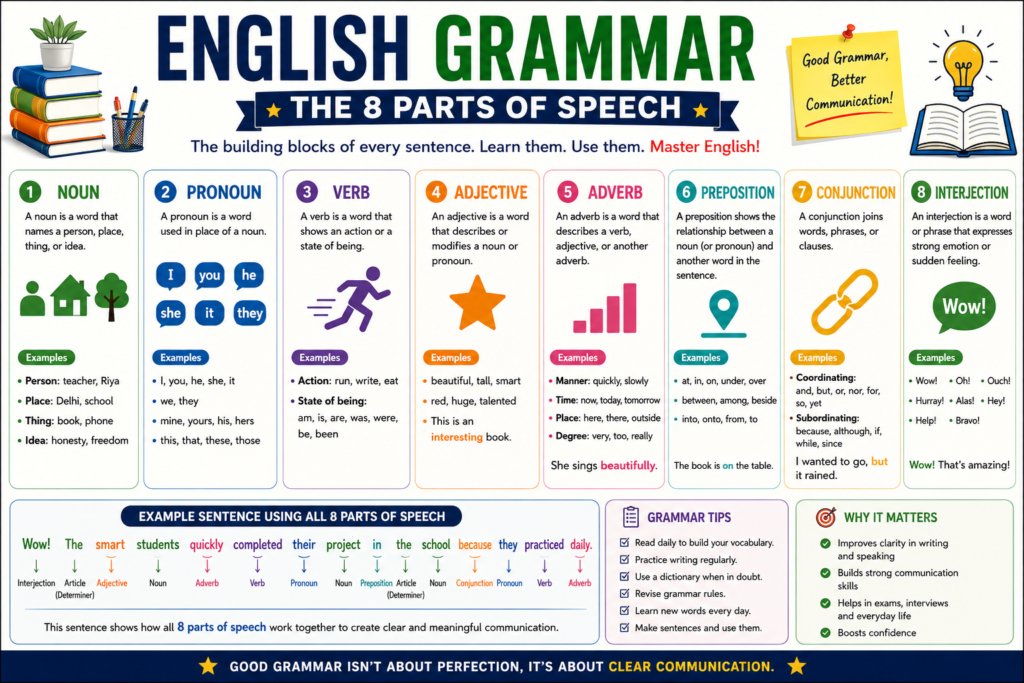
📝 Parts of Speech
Understand the building blocks of English grammar and learn how words function in sentences.
🔤 Tenses and Verbs
Learn how actions are expressed across different time periods.
Topics Covered
- Present Tense
- Past Tense
- Future Tense
- Forms of Verbs
- Helping Verbs
- Modal Verbs
- Subject-Verb Agreement
👉 Explore Tenses and Verbs Articles
(Coming Soon!))
📖 Sentence Structure and Transformation
Understand how sentences are formed and transformed for effective communication.
Topics Covered
- Types of Sentences
- Phrase and Clause
- Active and Passive Voice
- Direct and Indirect Speech
- Sentence Transformation
- Question Tags
👉 Explore Sentence Structure Articles
(Coming Soon!))
📚 Articles, Determiners and Modifiers
Learn how words modify and clarify meaning in sentences.
Topics Covered
- Articles (A, An, The)
- Determiners
- Quantifiers
- Modifiers
- Degrees of Comparison
👉 Explore Articles and Determiners Articles
(Coming Soon!))
✒️ Punctuation and Usage
Master the rules that improve clarity and accuracy in writing.
Topics Covered
- Capitalization
- Punctuation Marks
- Common Grammar Errors
- Word Usage
- Confusing Words
- Editing and Proofreading
👉 Explore Punctuation and Usage Articles
(Coming Soon!))
📑 Vocabulary and Word Formation
Strengthen your command of English vocabulary and word-building techniques.
Topics Covered
- Synonyms and Antonyms
- Prefixes and Suffixes
- Homophones
- Idioms and Phrases
- One-Word Substitutions
👉 Explore Vocabulary Articles
(Coming Soon!)
English Grammar for Students and Competitive Exams
Specially designed for:
- School Students
- CBSE and ICSE Learners
- State Board Students
- SSC
- Banking Exams
- Railway Exams
- UPSC Foundations
- UGC NET Aspirants
Important Grammar Areas
- Parts of Speech
- Tenses
- Voice Change
- Narration
- Sentence Correction
- Error Detection
- Vocabulary Building
👉 Explore Exam-Oriented Grammar Resources
(Add post links here)
Learning Resources
📚 Grammar Notes
Easy-to-understand explanations with examples.
✍️ Practice Exercises
Topic-wise grammar exercises and worksheets.
❓ MCQs and Quizzes
Test your understanding through practice questions.
📄 Rules and Examples
Quick-reference grammar guides for revision.
Frequently Asked Questions
What is English Grammar?
English grammar is the system of rules that governs how words, phrases, and sentences are structured and used in the English language.
Why is English Grammar Important?
Grammar helps us communicate clearly, avoid misunderstandings, and improve both written and spoken English.
What Are the Main Parts of Speech?
The eight parts of speech are nouns, pronouns, verbs, adjectives, adverbs, prepositions, conjunctions, and interjections.
How Can I Improve My English Grammar?
Regular practice, reading, writing, learning grammar rules, and solving exercises are the best ways to improve grammar skills.
Conclusion
English grammar is the foundation of effective communication. From understanding parts of speech and sentence structure to mastering tenses, punctuation, and vocabulary, grammar helps learners express ideas accurately and confidently.
Through this English Grammar Study Hub, you can explore Parts of Speech, Tenses, Sentence Structure, Voice Change, Narration, Articles, Punctuation, Vocabulary, and Grammar Exercises in a structured and learner-friendly manner.
Whether you are preparing for examinations, improving your writing skills, or building fluency in English, this hub provides everything you need to strengthen your command of the language.
Start exploring the topics above and build a strong foundation in English Grammar today.