
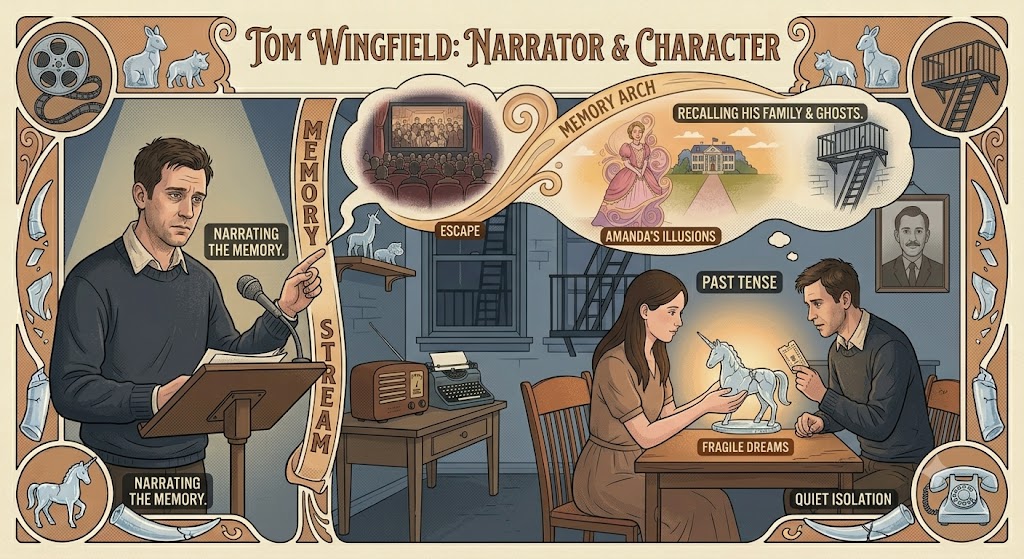
Introduction to Tom Wingfield
Tom Wingfield is the narrator as well as the character in The Glass Menagerie which was first staged at The Civic Theatre, Chicago. The narrator is introduced to us as a person dressed as merchant sailor. He strolls across to the fire escape and lights a cigarette. He addresses to the audience that he is the opposite of a magician who will present the truth in the pleasant disguise of illusion.
Historical Background of the Play
The readers are taken aback to the thirties when Spain Civil War took place. Spanish Civil War, (1936–39), military revolt against the Republican government of Spain, supported by conservative elements within the country. The play is set against the backdrop of this revolution as well as the Great depression which impacted the middle-class especially. Tom Wingfield belong to this middle-class section of the American society.
Tom as the Narrator of a Memory Play
Tom’s residence, The Wingfield apartment was one of those cellular living-units of the beehive like conglomerations that ran down the St Louis alleys. Tom, mentions in the address that the readers will be engaged in a memory play. Since it is a memory play, the narrator is taking the license of manipulating as per his wish. Next, the character mentions the other characters in the play. Amanda, his mother; his crippled sister, Laura and the most realistic character, Jim O’ Conor. Tom calls him the emissary of the realistic world.
Tom and the Influence of Mr. Wingfield
Tom Wingfield is much more like his Mr. Wingfield, who is called the fifth character, present only in the photograph. Mr. Wingfield abandoned his family to live his own life to the fullest. Similarly, Tom desires to abandon his responsibility to achieve his own dreams. Tom takes refuge in movies and writing his manuscripts. He is furious at Amanda when Amanda throws away his works.
Tom’s Relationship with Amanda Wingfield
Tom is taunted by Amanda as a selfish person who is not bothered about his family. Tom feels exasperated by Amanda’s tale of seventeen gentleman callers. The tale which becomes a refuge for Amanda is an indigestion for Tom and Laura due to being glutted. Laura tolerates it while Tom shows his weariness.
Tom’s Relationship with Laura Wingfield
Laura and Tom shares a close bond. Even though, Tom in the end, he cannot totally wipe out the memory of Laura. ‘Oh Laura, Laura, I tried to leave you behind me, but I am more faithful than I intend to be.” Being a memory play, the narrator of the play, Tom also becomes a character in it.
Tom’s Nostalgia and Guilt
Tom, the narrator looks back with fond nostalgia and also with haunted guilt. Tom narrates the events recollected and reconstructed by his memory of them, memories which he remembers in order to forget. As his final speech makes particularly clear, Tom constantly reliving the past in his present. At the suggestion and pressure of his mother, Tom brings Jim O’ Conor to home for Laura.
The Symbolic Presence of Mr. Wingfield
Tom tells us about the fifth character who doesn’t appear in the play, it is his father whose larger than life portrait looms over the living room setting. It seems to suggest that the size of the image has grown artificially large in his memory thereby reflecting the length of the shadow which the father’s memory still casts over the characters in the play.
Tom’s Escape and Its Consequences
For Tom, Jim’s visits and the unfortunate incident that followed was the straw which finally broke his restrains. We thus understand that the entire play had been a general confession for Tom to relieve his guilt for leaving his family stranded to pursue his own dreams. Indeed he makes it tragically clear to us that escape didn’t mean freedom for him at all for he is relentlessly chain to his past the entire play it seems to the readers or audience that it has been an attempt on Tom’s part to exorcise the ghost of that night and now that the play is over the past reveals itself in the present as a painful pantomime and all that the audience is left with, his collapse of communication that the play has to communicate.
Contradictions in Tom’s Character
Even taken as a single character, Tom is full of contradiction.
On the one hand, he reads literature, writes poetry, and dreams of escape, adventure, and higher things. On the other hand, he seems inextricably bound to the squalid, petty world of the Wingfield household. We know that he reads D. H. Lawrence and follows political developments in Europe, but the content of his intellectual life is otherwise hard to discern. We have no idea of Tom’s opinion on Lawrence, nor do we have any indication of what Tom’s poetry is about. All we learn is what he thinks about his mother, his sister, and his warehouse job—precisely the things from which he claims he wants to escape.
Critical Perspectives on Tom Wingfield
Tom’s attitude toward Amanda and Laura has puzzled critics. Even though he clearly cares for them, he is frequently indifferent and even cruel toward them. His speech at the close of the play demonstrates his strong feelings for Laura. But he cruelly deserts her and Amanda, and not once in the course of the play does he behave kindly or lovingly toward Laura—not even when he knocks down her glass menagerie.
Critics have suggested that Tom’s confusing behavior indicates an incestuous attraction toward his sister and his shame over that attraction. This theory casts an interesting light on certain moments of the play—for example, when Amanda and Tom discuss Laura at the end of Scene Five. Tom’s insistence that Laura is hopelessly peculiar and cannot survive in the outside world, while Amanda (and later Jim) claims that Laura’s oddness is a positive thing, could have as much to do with his jealous desire to keep his sister to himself as with Laura’s own quirks.
Conclusion
Tom Wingfield emerges as one of the most complex characters in The Glass Menagerie. As both narrator and participant, he embodies the themes of memory, guilt, responsibility, and escape. His struggle between personal freedom and familial duty makes him a deeply tragic figure whose memories continue to haunt him long after he leaves home.