
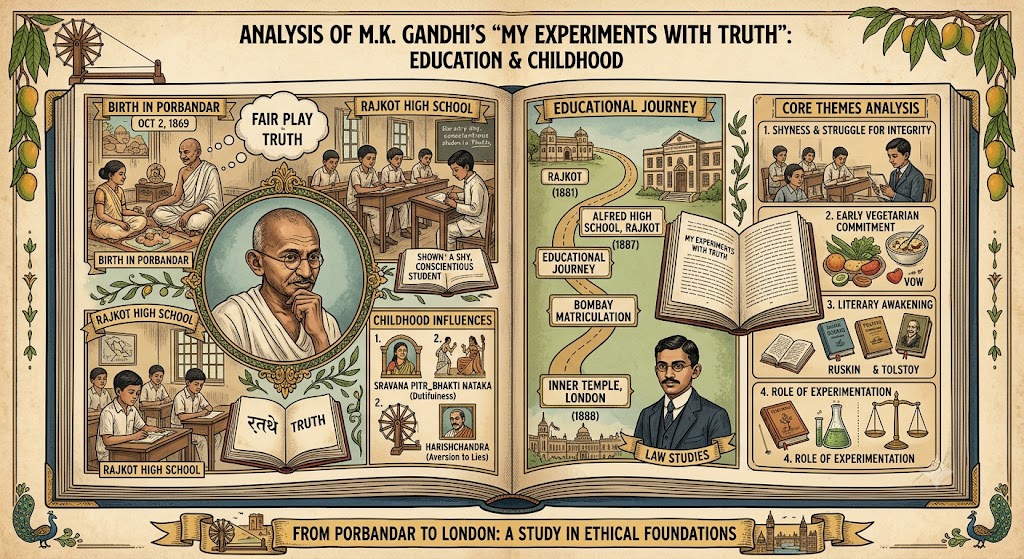
M.K. Gandhi (Education / Childhood / Child Marriage / Learnings)
Introduction: Gandhi’s Early Life and Education
“I have already said that I was learning at the high school when I was married” comment on the given statement with reference to M.K Gandhi’s Autobiography
Mahatma Gandhi, by name of Mohandas Karamchand Gandhi, (born October 2, 1869, Porbandar, India — died January 30, 1948, Delhi) was a national and social activist, Indian lawyer, politician and writer who became the leader of the nationalist movement against the British rule of India.
Gandhi got married when he was learning at the high school. Gandhi being three brothers were receiving their education at the same high school. His eldest brother was in a much higher class and the other brother was just ahead of one class. Gandhi does not see marriage during schooling as a good step. However, the traditional Indian society norms could not be denied which resulted in the marriage of the two brothers. Gandhi blames marriage for wasting a year in their school. This also shows that people recognized marriage more important than education. It was the belief of people in those times that education could also be gained after the marriage but getting married should not be neglected. Child marriage was a common phenomenon of the Indian society when Gandhiji experienced himself getting married. However Gandhi continued his study whereas his brother abjured his education. He exclaims that “Heaven knows how many youths are in the same plight.” Indirectly Mohandas shows one aspect of the past Hindu society where marriage and studies used to go hand in hand.
At The High School: Gandhi as a Student
In the chapter “At The High School” Mohandas Karamchand Gandhi recollects or reminisces over his school days. He claims himself to be a fair student who was not a “dunce” and enjoyed affection of teachers. He was a progressive student as his schooling is associated with progress and good character certificate, prizes and even scholarship. He is a devout person who thanks God because he received more than his capability. During those days, scholarships were reserved only for students from Sorath Division of Kathiawad. Gandhi belonged to the Sorath Division.
In his whole schooling career at high school, he received only once corporal punishment. After the punishment to get some relief, Gandhi cried piteously. This incident took place when he was in first or second standard. When he was in seventh standard, the headmaster Dorabji Edulji Gimi was popular among boys as a disciplinarian, a man of method and a good teacher. He made gymnastics and cricket compulsory for student that were disliked by Mahatma altogether. Gandhi did not like high-energy exercises as he was somewhat of shy students. However, he confesses about his mistake years later in his autobiography.
“I now see was wrong… physical training should have as much place in the curriculum as mental training”
The author talks about the benefits of taking long walks in the open air. He took this advice of habit.
Learnings and Penalties in Gandhi’s School Life
Gandhi reveals the reason for his dislike of gymnastics. He used to serve his father. For him, serving father was more important than physical exercise. One day he could not guess the right time and the bad weather was the reason as put forward by Gandhi for his being late for gymnastic classes. Gandhi was convicted of lying by Mr. Gimi. However, Gandhi takes this incident as an experience in his life. “I saw that a man of truth must also be a man of care.”
Mohandas Gandhi claims that he is paying the penalty of neglecting exercise at school days. But another of the penalty includes his not so good handwriting. During his time spent in England, when he was practicing law, he observed the importance of good handwriting. His time especially spent in South Africa made him realize how “bad handwriting should be regarded as sign of an imperfect education.” For this penalty, Gandhi also gives advice to young men, women and children. According to him, children should be taught the art drawing first before learning.
Next Mahatma Gandhi recalls how his year lost due to marriage was compensated. He was awarded the privilege of skipping a class. From third grade, he was promoted to grade four. The difficulty faced by him in grade four was English as medium of instruction. Another subject was geometry. However, with difficulty he reached the thirteenth proposition of Euclid. Somehow, Gandhi found the method of simplify the geometry. He discovered the core of the subject that was a pure and simple use of one’s reasoning power.
Language and Curriculum in Gandhi’s Educational Thought
Gandhi, in the end, emphasizes the importance of learning vernacular language beside English. He feels that vernacular could also be easily used as medium of instruction than English.
• “It is now my opinion that in all Indian curricula of higher education there should be a place for Hindi, Sanskrit, Persian, Arabic and English.
The last words said by him could be taken as non-secular. It is because in his own opinion that, “he who would learn good Urdu must learn Persian and Arabic, as one who would learn good Gujarati, Hindi, Bengali, Marathi must learn Sanskrit.”