
Theological Epigraph and the Idea of Inclusive Love
“I will call them my people,
which were not my people;
and her beloved,
which was not beloved.”
— ROMANS 9:25
Toni Morrison, American novelist, quoted the above given epigraph of her novel Beloved (1987) from the New Testament; the King James translation of Romans 9:25. The apostle Paul is talking about God’s love, which he wants to suggest is for everyone, especially those people who seem excluded. It refers to the idea that God has always loved Gentiles (non-Jews) and Jews alike. Similarly, it’s also for those blacks who were condemned to slavery.
Beloved as an African-American Social Novel
Beloved (1987) is an social African-American novel and a social document on slavery. Black slaves played a huge role in laying the economic foundations of the United States—especially in the South. During the 17th and 18th centuries, African and African Americans slaves worked mainly on the tobacco, rice and
Slavery and Plantation Economy in America
indigo plantations of the southern seaboard.
This important literary piece is about a slave woman, Sethe, from her pre-Civil War days as a slave in Kentucky to her time in Cincinnati, Ohio, in 1873. Although Sethe gained her freedom from slavery and lived in Cincinnati, the past memories haunted her tremendously.
Slavery was horrible for man, but it was more horrible for women. The Blacks were not allowed to develop family relationship before 1865. Williams mentions in his article, “How slavery Affected African American Families” that “slavery not only inhibited family formation but made stable, secure family life difficult if not impossible”. Sexual abuse was one of the cruelest hardships endured by the enslaved African-Americans, practices by their slave-holders.
Sethe escaped from Sweet Home in Kentucky to Cincinnati with her four children. She was chased by her old master, the schoolteacher, she did not accept to succumb to slavery, instead, she kills one of her children to show her resistance. The slave-catcher thought Sethe to be unstable and returned to Kentucky. As a mother, Sethe didn’t want her children to lead a torturous and gruesome lives of slaves. Death was better than living a hellish life under the institution of slavery.
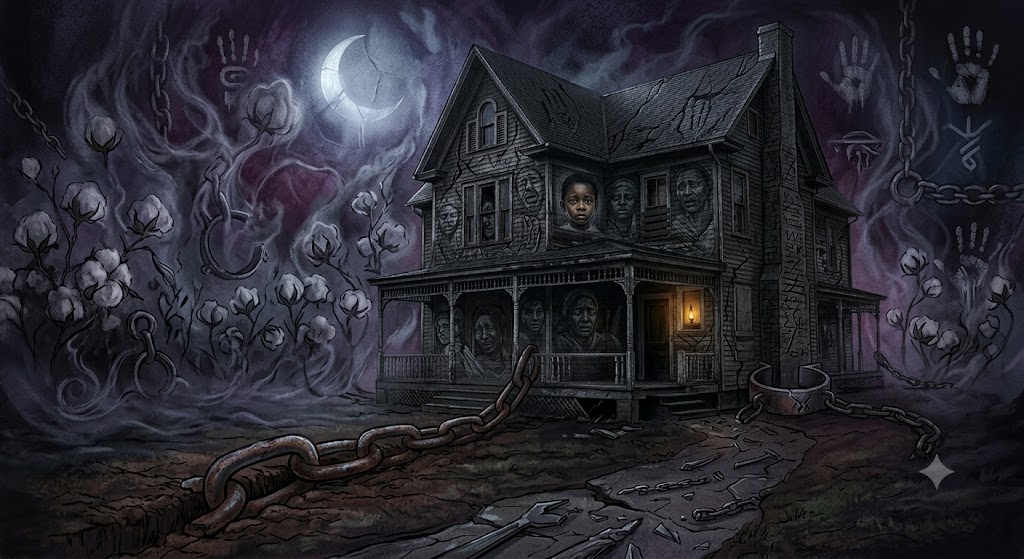
The Haunting of 124 Bluestone Road
However, the ghost of the killed baby gan to haunt 124 on the Bluestone Road.
“124 WAS SPITEFUL”
Beloved was thirteen when she was brought on Sweet Home. She was married to Halle, the last son of Baby Suggs and raised four children. She was raped and bodily violated when the schoolteacher and his nephews took the milk of Sethe. They also whipped her pregnant body and it took the form of a tree.
“They used cowhide on you?
And they took my milk.
They beat you and you was pregnant?
And they took my milk.”
Sethe was tortured bodily and psychologically when she was a slave at Kentucky. But after her freedom, the past continuously haunted her memories. In Encyclopedia and Dictionary of Medicine, Nursing and Allied Health, memory is defined as “the mental faculty that enables one to retain and recall previously experienced sensations, impressions, informations and ideas” (Kean). Toni Morrison in Beloved portrays the impact of slavery experiences on the memory of society and that of individual, who is denied in the process any sense of workable and meaningful past.
The dead child of Sethe returns as an incarnation in the face of Beloved. Beloved lives with Sethe, proving to be powerful and malicious. On discovering
Beloved as Incarnation and Psychological Return
Beloved’s identity, Sethe believed that she had been given a second chance. Sethe tried to make amends for the past, but the girl’s needs were devouring. The ghost didn’t forgive Sethe for the actions. A group of women come to force the ghost to leave, but Sethe is almost destroyed.
Slavery squeezed out the life and background of slaves. They were commodified and treated as animals. They were exploited, abused and denied basic rights. The impact was so severe that Sethe’s present got hampered due to her past:
“She was not thinking of the atrocity the men committed on her, or the reason for her scared back, but by this negation, the reader has been made aware of the horrible sexual act that she has been physically abused. Then… Her boy lapping in the puddle near her feet, and suddenly there was Sweet Home rolling out before her eyes… it made her wonder if hell was a pretty place too… the most innocent occurrence or image has connotations that bring back the horror of what happened at the picturesque Sweet Home.”
Baby Suggs and the Trauma of Slavery
Not only Sethe but Baby Suggs is the practical example of the brutality of the past, the slave system, suffering from sexual abuse and lack of normal maternal function: she was separated from her children and she
The Weight of Loss and Generational Trauma
was used only as breeding machine by the slave owners. Commenting on Baby Suggs’s tragic stance in slavery life, Stamp Paid, one of the minor character of Beloved, remarks:
“Sixty years of losing children to the people who chewed up her life… five years of freedom given to her by her last child, who bought her future with his… to lose him too; to acquire a daughter see… that daughter slay the children (or try to); to belong to a community of… free Negroes and then have to step that community step back and hold itself at a distance—well, it could wear out even a Baby Suggs, holy.”
Conclusion: Memory, Slavery, and the Haunting of the Past
Beloved ultimately presents slavery not only as a historical institution but also as a continuing psychological condition that refuses to remain in the past. Through Sethe, Baby Suggs, and the haunting presence of Beloved, the novel reveals how trauma survives beyond physical freedom and reshapes memory, identity, and family relationships.
The return of the dead child as a living presence symbolizes the inescapable weight of guilt and remembrance. Morrison shows that the scars of slavery are not limited to physical violence but extend into emotional and spiritual realms, affecting generations. The novel therefore becomes both a Gothic narrative of haunting and a powerful social document of African-American history.
In the end, Beloved suggests that true liberation is not only the end of slavery but also the difficult process of confronting and healing from the memories it leaves behind.