
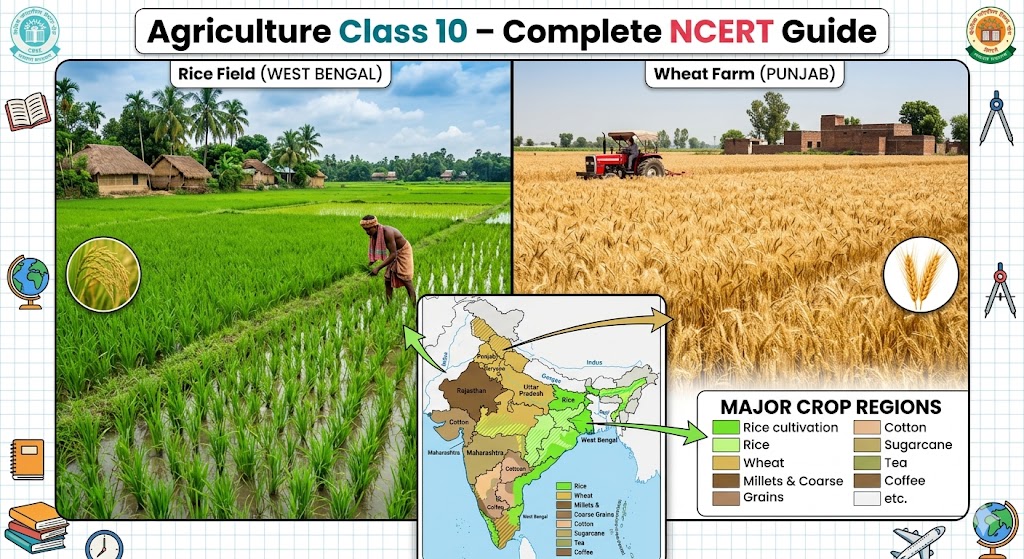
Primary Activities in Agriculture and Natural Resource Extraction
Agriculture is the science, art, and practice of cultivating land, growing crops, and raising livestock to produce food, fiber, and other essential products for human use. It is one of the oldest economic activities and forms the backbone of many economies around the world. Agriculture ensures food security, provides employment, and contributes significantly to national development.
Related to extraction and production of natural resources. Examples:
- Agriculture
- Fishing
- Gathering
Secondary Activities: Processing Raw Materials in Agriculture and Industry
Concerned with processing of raw materials. Examples:
- Manufacturing steel
- Baking bread
- Weaving cloth
Tertiary Activities: Support Services for Agriculture and Economy
Provide services to support primary and secondary activities. Examples:
- Transport
- Trade
- Banking
- Insurance
- Advertising
Agriculture Definition and Importance in Modern Society
Agriculture covers those productive efforts by which man settled on the land, seeks to make use of and if possible accelerate and improve upon the natural genetic or growth processes of plant and animal life to the end that these processes will yield the vegetables and animal products needed or wanted by them.
What is Agriculture: Basic Concepts and Scope
Agriculture is a primary activity which includes the following things:
- Growing crops, fruits, vegetables, flowers
- Rearing livestock
- About 50% of the world’s population is engaged in agriculture.
- About two-thirds of India’s population depends on agriculture.
- Favourable soil, climate and topography are essential.
- Arable land: Land suitable for growing crops
- Agriculture is concentrated in regions with suitable conditions.
Farm System: Understanding Agricultural Inputs, Operations, and Outputs
Agriculture can be studied as a system.
Agricultural Inputs: Essential Resources for Farming
- Seeds
- Fertilisers
- Machinery
- Labour
Agricultural Operations: Key Farming Processes and Practices
- Ploughing
- Sowing
- Irrigation
- Weeding
- Harvesting
Agricultural Outputs: Products Derived from Farming
- Crops
- Wool
- Dairy products
- Poultry products
Influence of Environment on Agriculture
Agriculture is closely related to environment. It depends solely upon environmental factors.
Types of Farming: Classification Based on Geography and Technology
Farming is classified based on:
- Geographical conditions
- Demand for produce
- Labour
- Level of technology
Main Types of Agriculture Worldwide
Agriculture as per area, land and population
Intensive Agriculture and Extensive Agriculture
Intensive Agriculture: Maximizing Yield Per Hectare in Densely Populated Regions
The agriculture followed in regions of very dense population of tropics and subtropics, where there is limited supply of land is called intensive agriculture.
Features of Intensive agriculture are:
- use of maximum labour and high yielding seeds
- highest yield per hectare
- per capita production is very low
- cultivation with the aid of irrigation in case of requirement
Extensive Agriculture: Large-Scale Commercial Farming with Mechanized Operations
It is a type of farming in which large farmlands are cultivated by employing agricultural machines, tractors and others to raise wheat, corn, maize for commercial market on the world and for international trade.
Features of Extensive agriculture:
- large farmlands
- all the works in the farmland are done by machine
- care is taken for preserving the fertility of the farmland
- one or two crops are raised on commercial basis
Agriculture as per object
Subsistence Agriculture, Commercial Agriculture and Plantation Agriculture
Subsistence Agriculture: Small-Scale Farming for Family Consumption
It is a type of agriculture where farmer produces crops and rears animals to fulfil his needs and not for market.
Features of Subsistence Agriculture:
- small farmland
- production meets only the needs of the farmer and his family
- no excess production for marketing
- work in the farmland is done manually and by animals
- agricultural returns are very low
Commercial Agriculture: Large-Scale Crop Production for International Markets
The method of farming which follows the production of crop at commercial rate on extensive farmland with the favour of soil, climate and environment, is known as commercial farming. Its main objective is to produce more crop for sale in the international market.
- crops are produced to sell them in the market, particularly in the world market
- modern mechanized methods are employed to raise the highest yield with the lowest cost of production
- large farmlands extend over hundreds of hectares
Plantation Crop Farming: Cash Crop Cultivation in Tropical Regions
Plantation agriculture develops mainly in tropical region. It is a type of farming in which ‘planted’ trees or bushes yield crops over a period of years. The yield or the crops produced in this farming are mostly used as raw-materials for industries. So factory sheds are common scenes within the farmland of this type of farming. Tea, coffee and rubber are the most important crops of plantation farming.
Classification of farming as per climate
Wet or Humid Farming: Rain-Dependent Agriculture in High Rainfall Regions
This method of farming is practised in regions of abundant rainfall. Lands are prepared for cultivation with the advent of rainy season and crops are planted. The harvest is done in late autumn or early winter. Rice, jute and sugarcane are grown in this way in our country.
The humid farming is characterised by the following features:
- cultivation is done by rain water
- different types of crops are grown according to rainfall distribution
- the amount of harvest depends on rainfall
- long rainy season often provides advantages for more than one cropping
In regions of humid farming, there are some disadvantages too. These are:
- excessive rainfall brings flood and destroys crops
- rainwater often washes out the fertile grains of soil and soil erosion poses a serious problem
- humid farming is limited within the rainy season
Humid farming is practised in some parts of India, Bangladesh, Myanmar, China, Japan, South Korea, Indo-China, Indonesia, Malaysia and Zaire.
Irrigation Farming: Cultivation Using Artificial Water Supply in Low Rainfall Areas
The irrigation farming is followed in regions of low rainfall or in regions of seasonal rainfall. It is practised in regions where rainfall is low, but water is available from perennial rivers nearby or from beneath the ground.
The irrigation farming is characterized by the following features:
- crops are produced with the help of irrigation water
- irrigation water facilitates double or multiple cropping
- choice of cropping is mainly guided by market
- the farmers enjoy good economic condition for getting facilities of multiple croppings; they use high yielding seeds, chemical fertilizer and advanced method of cultivation
- as a result of irrigation, dry land turns green with crops and vegetation
This farming faces some problems, such as:
- the cost of production of crops gets higher
- the fertility of land decreases due to long period of irrigation and cultivation
This type of farming is practised in many parts of Egypt, Sudan, India, Pakistan, China and Australia.
Dry Farming: Water Conservation Techniques in Scanty Rainfall Regions
The dry farming method is practised in regions of scanty rainfall where irrigation is not possible or is very much limited by natural environment. The limited precipitation that occurs, is fully utilized in many ways, such as:
- the arable land is divided into several steps like terraces so that rainwater can roll down along the slope to make the soil wet and moist
- soil is being prepared for cultivation before rain comes, so that the land can absorb water easily
- to prevent evaporation from wet soil, the farmers cover the land with dry leaves and grasses immediately after rainfall
- generally, the crops which need less rainfall and can grow in dry areas, are cultivated
The dry farming is practised in the western parts of the United States and Canada, in Mexico and Central America in drier uplands of Brazil, Australia, Israel, Syria, Turkey and parts of South India and Africa.
Mixed Farming OR Mixed Agriculture: Integrated Crop and Livestock Production
The method of farming in which the cultivation of arable crops and the rearing of livestock are done on the same farms is known as Mixed Farming.
Its characteristic features are:
- In this farming production of crops and rearing of animals are done side-by-side and on the same farmlands.
- In this method farming techniques are highly advanced; modern agricultural machinery, selected high yielding seeds and maximum use of chemical fertilizers are common.
- scientific crop rotation is practised.
The mixed farming was at first introduced in parts of Europe. It has gradually become popular in the eastern parts of the United States and different parts of South Africa, Ukraine and Argentina. On several areas of China, Japan, France and India, Silkworms are reared and crops are grown on the same farmlands as something like the mixed farming method.
Classification of Farming as per the intensity
Monoculture or Single Cropping Agriculture: Cultivation of One Crop Year-Round
The cultivation of only one crop on a farm land is called single cropping agriculture. In this farming method only a single crop is grown and harvested in a year. The crop which thrives best according to soil and climatic environment is preferred for cultivation.
Characteristic features:
- The crop which is best suited to the local soil and climatic environment is grown
- a particular single crop is raised year after year
- crop is grown on commercial scale
- It is grown mainly for export and foreign market
The tea plantation of Darjeeling in West Bengal and Assam valley, coffee cultivation in Brazil, cocoa cultivation on the Guinea coast and rubber cultivation in Malaysia and Indonesia, are some distinctive examples of Monoculture.
Double Cropping Agriculture: Growing Two Crops Annually in Distinct Seasons
When crops are cultivated and raised twice a year, the method is called double cropping agriculture.
Characteristic features:
- Crops are raised twice a year
- they are raised according to two distinctive seasons of a year
This type of farming is widely practised in China, Japan, India, Bangladesh, Myanmar and Indonesia.
Multiple Cropping Agriculture: Intensive Cultivation for Maximum Annual Harvests
In multiple cropping system, lands are cultivated for several times (say thrice or more) in a year and farmers get harvest several times. It is practised in densely populated areas.
Characteristic features:
- Lands are cultivated and crops are raised several times in a year
- Agriculture is done by means of advanced method of cultivation with the aid of irrigation, high yielding seeds, chemical fertilizers and pesticides
- Intensive method of agriculture is followed
- crop rotation is widely practised
In recent years, multiple cropping system is introduced in many parts of our country. It has become popular in Japan, China, U.S.A., South Korea, North Korea, Indo-China and Myanmar.
In the present-day agriculture, we notice two more distinctive features in the method of farming. These are:
- Crop Rotation
- Market Gardening
Food Security and Agriculture: Ensuring Global Food Supply
Agriculture plays a vital role in ensuring food security by providing a stable supply of food for the growing global population. Advances in agricultural technology, irrigation, and sustainable farming practices help increase productivity and support economic development.
Green Revolution: Transforming Global Food Production with High-Yielding Seeds
Green Revolution is a revolution that was initiated to sustain the growing population of the Earth. It refers to the enormous increase of food production in both developing and underdeveloped countries through the introduction of high yielding varieties of seeds(crops) and application of modern agricultural techniques.
Norman Borlaug, the father of Green Revolution in the world, who led initiatives to increase agricultural crop production, was invited in India by the adviser to the Indian minister of agriculture M.S. Swaminathan. Punjab was selected by the Indian Government as a site of experiment. M.S. Swaminathan is known as the “father of the Green Revolution in India.”
Measures adopted in Green Revolution
- Use of high yielding varieties of seeds: These genetically developed seeds drastically increase crop production per acre compared to traditional seeds.
- Irrigation: The artificial supply of water to agricultural fields ensures crops receive consistent moisture independent of unpredictable rainfall.
- Use of insecticides and pesticides: These chemical sprays protect growing crops from destructive bugs and diseases that would otherwise ruin the harvest.
- Consolidation of land holdings: This policy merges scattered, tiny plots of land owned by a single farmer into one large, contiguous farm for efficient cultivation.
- Land reforms: These legal changes redistribute ownership rights from wealthy landlords to actual tillers to create a fairer farming system.
- Improvement of rural infrastructure: Building better roads, storage warehouses, and reliable power grids connects isolated farmers directly to profitable markets.
- Supply of agricultural credit: Providing low-interest loans helps farmers buy expensive inputs like seeds, machinery, and equipment without falling into debt traps.
- Use of chemical fertilizers: These nutrient-packed chemicals quickly feed the soil with nitrogen, phosphorus, and potassium to accelerate plant growth.
- Use of Sprinklers and Drip irrigation: These precision watering methods deliver water directly to the plant base or mimic light rain to minimize water waste.
White Revolution: India’s Dairy Development and Milk Production Success
White revolution in India occurred in 1970 when the National Dairy Development Board was established to organise dairy development through co-operative societies. The first dairy development programme first took shape in Gujarat, in the Anand district. The cooperatives provided financial support and advise to increase milk production.
Objectives of White Revolution
- Obtaining, transportation, supply and storage of milk at the chilling plants.
- Provide cattle fodder.
- Provide veterinary treatment, superior cattle breed, artificial insemination facilities etc.
- Production of wide varieties of milk products and their marketing.
- provide extension services.
Phases of White Revolution
Phase-I (1970-1981)—During this phase dairy development programme was introduced in ten states to provide milk to cities like Delhi, Mumbai, Kolkata and Chennai. Mother dairies were set up in these 4 cosmopolitan cities.
Phase-II (1981-1985)—In this phase dairy development programme was extended to state like Karnataka, Madhya Pradesh and Rajasthan. In 155 districts, within 25 continuous milk shade areas a ‘cluster’ of milk producers union was established. Milk marketing improved in 144 cities of the country. The Dairy co-operative societies were set up with over 36 lakh members in about 35 thousand villages. A vaccine called ‘Raksha’ for controlling diseases in cattle population was developed at the Research Institute at Hyderabad.
Phase-III (1985-2000)—Several co-operative societies were set up in this phase. The number of co-operative societies went up to about 1,35,439 with about 14 million members. Milk production in this phase almost became double.
The last phase from 2000 onwards is still continuing and in this current phase milk production in India has occupied the first position.
Achievements of White Revolution
- White Revolution has influenced people to take up dairying as an occupation.
- The production of milk has increased by leaps and bounds and it is about 6 times more than what India produced prior to Independence.
- The per capita milk per day has increased from 125 gm to 263 gm.
- Less import of milk and dairy products.
- Marginal farmers and landless labourers are looking up to dairying as a source of income.
- Extensive research centres are set up in major centres like Anand, Mehsana and Palanpur. Metro dairies in metropolitan cities have been set up.
- Livestock Insurance scheme for protecting farmers against losses due to animal death has been taken up.
- Quality of livestocks, ensuring disease free state of animals, cross breeding etc have been taken up by the co-operative societies.
Problems and Prospects of White Revolution
Some problems of White Revolution are:
- Collection of milk from remote and distant areas is quite expensive and takes a lot of time.
- Cattle are kept under unhygienic conditions in most villages.
- The breed of cattle is not of superior quality.
- Proper marketing of milk and milk products needs to be improved.
- The extension service programme is not effective.
Blue Revolution: Fisheries Development and Fish Production in India
The development of fish production in India is called Blue Revolution. India is the third largest producer of fish and second largest producer of inland fish in the world.
Fishing and the major fishing grounds in India
According to the natural environments and physical features of the country, there are three types of fishing grounds in India. They are – The Fishing grounds of the inland waters, coastal fishing grounds and deep sea fishing grounds.
The Fishing grounds of inland water
It includes the fisheries and fishing of ponds, rivers and natural lakes of the inland areas. The river mouth and estuaries are regarded as important fishing grounds. The inland fisheries present a wide variety of catches – Ruhi, Katla, and Mrigel. Besides these fishes are Kai, Magur and Shingi. Shrimp is commonly found in inland rivers and ponds. Most of these inland fish are fresh water fish.
The water of the river mouths, estuaries, deltas and lagoons are salty, because of nearness to the seas. The fish of these areas are known as salt water fish. These includes Hilsa, Bhetki, parse, Bhangar, Pomfret and so on.
Big catches come from the river Ganga, Mahanadi, Krishna and Kaveri. The Lake Chilika in Orissa, Loktak in Manipur, Wular in Kashmir, Kolleru and Pulicat in Andhra Pradesh and brackwaters of Kerala supply abundant supply of fishes.
Coastal Fishing
Coastal fishing is carried on in shallow continental shelves upto a distance of 8-10 km from the coast. Coastal fishing is practised by West Bengal, Orissa, Andhra Pradesh and Tamil Nadu on the eastern Coast and Gujarat, Maharashtra, Goa, Karnataka and Kerala on the Western Coast. The main fishes that are caught are sardine, shrimp, mackerel, tuna, herring, bonito and halibut.
Deep sea fishing
Far away from the coast, deep sea fishing is operated by trawlers and fishing ship; most of which are made by foreign companies. The Government of India set up The Fishery Survey of India to carry on programmes of deep sea fishing. It studies and performs research works on the movement carry on the programmes of deep se fishing. It studies and performs research works on the movement of shoal of fishes and location of fishing ground in off shore areas. It has 26 trawlers engaged in the investigational jobs. Its headquarter is located in Mumbai. It has six regional officers, located at Kochi(Cochin), Chennai, Marmago, Vishakapatnam, Veraval and Port Blair.
Comprehensive Food Crops Requirements
| Crop | Climatic Condition & Rainfall | Ideal Temp. | Soil Condition | Nature of the Land | Supply of Labor | Supply of Capital | Major Producing Countries |
|---|---|---|---|---|---|---|---|
| Rice | Tropical & Sub-tropical; Heavy rainfall (Above 100 cm) | 20°C to 35°C | Deep fertile alluvial or clayey soils (retains moisture well) | Flat, leveled lowlands and river deltas (needed to hold standing water) | High; highly intensive manual labor needed for transplanting and harvesting | Moderate; higher for modern seeds, machinery, and irrigation setups | China, India, Indonesia, Bangladesh, Vietnam |
| Wheat | Temperate; Moderate rainfall (50 cm to 75 cm) | 12°C to 25°C | Well-drained, fertile loamy or black volcanic soils | Well-drained rolling plains or flat fields (allows heavy machinery use) | Low to Moderate; highly mechanized in modern farming systems | High; heavy investments needed for tractors, harvesters, and fertilizers | China, India, Russia, USA, Australia |
| Tea | Tropical & Sub-tropical; High, well-distributed rain (100 cm to 250 cm) | 15°C to 35°C | Deep, fertile, humus-rich, acidic soils (pH 4.5 to 5.5) | Well-drained hill slopes (standing water completely rots the roots) | Very High; massive amounts of cheap labor needed to hand-pick leaves | High; long gestation period before first harvest, plus factory processing units | China, India, Kenya, Sri Lanka, Turkey |
| Coffee | Tropical; Warm and wet with high rain (125 cm to 225 cm) | 15°C to 28°C | Deep, rich, well-drained volcanic soils or laterite soils | Gently sloping hills or undulating highlands (avoids waterlogging) | Very High; hand-picking berries requires large numbers of seasonal workers | High; requires capital for estate management, processing, and long crop delays | Brazil, Vietnam, Colombia, Indonesia, Ethiopia |
| Sugarcane | Tropical & Sub-tropical; High moisture & rain (75 cm to 150 cm) | 21°C to 35°C | Deep, rich alluvial loams or heavy clays with good drainage | Flat or gently undulating plains (helps in irrigation and heavy hauling) | High; required for planting, weeding, cutting, and rapid loading | High; costly inputs (fertilizers, cane crushing mills, transport networks) | Brazil, India, China, Thailand, Pakistan |
| Sugar Beet | Temperate; Moderate, well-distributed rain (25 cm to 60 cm) | 10°C to 25°C | Deep, homogeneous sandy loam rich in humus and nutrients | Fairly level plains or lowlands (ideal for heavy mechanical operations) | Low to Moderate; mostly machine sown and mechanically harvested | High; highly industrialized farming requiring expensive specialized machinery | Russia, France, USA, Germany, Turkey |
Agricultural Requirements: Oilseeds, Fiber, and Industrial Crops
| Crop Type & Name | Climatic Condition & Rainfall | Ideal Temp. | Soil Condition | Nature of the Land | Supply of Labor | Supply of Capital | Major Producing Countries |
|---|---|---|---|---|---|---|---|
| Groundnut (Oilseed) | Tropical & Sub-tropical; Moderate rain (50 cm to 125 cm). Prolonged drought or waterlogging is harmful. | 22°C to 30°C | Well-drained, light sandy loams or loamy soils. Needs loose soil so the pods can easily grow underground. | Flat or gently rolling plains. Avoids heavy water pooling. | Moderate to High; needed for sowing, weeding, and pulling out the underground pods at harvest. | Moderate; required for quality seeds, gypsum/calcium fertilizers, and decorticating (shelling) machines. | China, India, Nigeria, USA, Sudan |
| Mustard (Oilseed) | Sub-tropical & Temperate; Low to moderate rain (50 cm to 100 cm). Thrives in cool, dry weather with clear, frost-free days. | 10°C to 25°C | Fertile alluvial loam is ideal, though it can adapt to sandy or clayey soils with good drainage. | Flat, well-leveled plains. Clear drainage is essential to avoid waterlogging during flowering. | Moderate; heavily concentrated during the brief harvesting and threshing period. | Moderate; needed for high-yielding seed varieties, fertilizers, and oil-expelling machinery. | Nepal, Canada, India, China, Ukraine |
| Cotton (Fiber Crop) | Tropical & Sub-tropical; Moderate rain (50 cm to 100 cm). Requires a minimum of 200 frost-free days and bright sunshine. | 21°C to 35°C | Deep, moisture-retentive black volcanic soil (regur) or deep alluvial soils. | Well-drained, flat plains or rolling lowlands. Standing water ruins the cotton bolls. | Very High; massive amounts of cheap human labor are required for hand-picking delicate cotton bolls. | High; intensive investment required for pesticides (highly pest-prone), fertilizers, and cotton ginning processing. | China, India, USA, Brazil, Pakistan |
| Jute (Fiber Crop) | Humid Tropical; High rainfall (above 150 cm) and high relative humidity (80% to 90%). | 24°C to 37°C | New, deep, fertile alluvial soils enriched annually by silt from river floods. | Lowlands, river deltas, and floodplains. Can tolerate seasonal flooding in later growth stages. | Very High; required for planting, harvesting, and the intensive manual process of “retting” (steeping stems in water to extract fiber). | Moderate to High; needed for fertilizer inputs and leasing or maintaining water channels for processing fibers. | India, Bangladesh, China, Uzbekistan, Nepal |
| Rubber (Industrial Crop) | Equatorial & Tropical; Heavy, well-distributed rain year-round (200 cm to 400 cm). No distinct dry season. | 25°C to 35°C | Deep, rich, well-drained loamy or lateritic soils with acidic pH (4.5 to 6.0). | Gently sloping hills or undulating highlands (usually up to 400m elevation) to prevent any water stagnation. | High & Skilled; requires a permanent, skilled labor force daily for “tapping” (carefully slicing the bark to extract latex juice). | Very High; takes 5 to 7 years of heavy investment before the trees can be tapped, plus processing factories for rubber sheets. | Thailand, Indonesia, Vietnam, Malaysia, India |
Frequently Asked Questions About Agriculture
Q1: What is the definition of agriculture?
A: Agriculture is the science, art, and practice of cultivating land, growing crops, and raising livestock to produce food, fiber, and other essential products for human use. It is a primary economic activity that ensures food security and provides employment to about 50% of the world’s population.
Q2: What are the three types of economic activities in agriculture?
A: The three types of economic activities are: Primary activities (related to extraction and production of natural resources like agriculture and fishing), Secondary activities (concerned with processing raw materials like manufacturing steel and baking bread), and Tertiary activities (providing support services like transport, trade, and banking).
Q3: What is the difference between subsistence and commercial farming?
A: Subsistence farming is practiced to meet the needs of the farmer’s family using small landholdings and simple tools. Commercial farming is practiced on a large scale for profit, using modern technology and high-yield varieties to produce surplus crops for sale in the market.
Q4: What is intensive subsistence farming?
A: Intensive subsistence farming is practiced on small plots of land using simple tools and large amounts of labour. It involves growing multiple crops in a year, with rice as the main crop, and is common in South Asia, Southeast Asia, and East Asia.
Q5: What is shifting cultivation?
A: Shifting cultivation, also known as slash-and-burn agriculture, is a primitive farming method where trees are cut and burned, and the ash is mixed with soil to grow crops. After the soil fertility decreases, the land is abandoned and farmers move to a new area. It is practiced in the Amazon Basin, Tropical Africa, Southeast Asia, and Northeast India.
Q6: What is nomadic herding?
A: Nomadic herding is a primitive subsistence farming practice where herdsmen move with their animals (sheep, camel, yak, goats) from place to place in search of fodder and water. It is practiced in arid regions like Sahara, Central Asia, Rajasthan, and Jammu and Kashmir.
Q7: What are the major food crops of the world?
A: The major food crops of the world include rice, wheat, maize, and millets. Rice is the staple food of tropical regions, wheat is cultivated in temperate regions, maize grows in moderate climates, and millets are drought-resistant coarse grains grown in less fertile areas.
Q8: Which are the leading producers of rice and wheat?
A: The leading producers of rice are China, India, Japan, Sri Lanka, and Egypt. The leading producers of wheat are USA, Canada, Russia, and India.
Q9: What are the main fibre crops and beverage crops?
A: The main fibre crops are cotton (grown in China, USA, and India) and jute (grown in India and Bangladesh). The main beverage crops are tea (grown in Kenya, India, China, and Sri Lanka) and coffee (grown in Brazil, Colombia, and India).
Q10: What is plantation agriculture?
A: Plantation agriculture is a commercial form of farming where a single cash crop like tea, coffee, rubber, cocoa, or coconut is grown on large estates for export purposes. It involves large-scale production, high capital investment, and hired labor, and is mainly practiced in tropical and subtropical regions.
Q11: What is the difference between cooperative farming and collective farming?
A: Cooperative farming is a voluntary system where farmers pool their land, labor, and resources while retaining ownership rights, sharing benefits. Collective farming is a system where land and resources are collectively owned and managed by a group or the state, with shared profits, common in socialist economies.
Q12: What are the methods of agricultural development?
A: Methods of agricultural development include expanding cropped area, multiple cropping, better irrigation facilities, use of fertilizers, high-yielding variety (HYV) seeds, and mechanisation of farming operations to increase farm production and ensure food security.
Q13: What is horticulture?
A: Horticulture is the branch of agriculture concerned with the cultivation of fruits, vegetables, flowers, medicinal plants, and ornamental plants. It provides nutritious food, generates employment, supports export earnings, and enhances environmental sustainability.
Q14: What is Mediterranean agriculture?
A: Mediterranean agriculture is practiced in regions with hot, dry summers and mild, wet winters. Farmers grow specialty crops like grapes, olives, citrus fruits, and vegetables. It is a form of commercial farming focusing on high-value agricultural products.
Q15: What is the role of agriculture in food security?
A: Agriculture plays a vital role in food security by providing a stable supply of food for the growing global population. Advances in agricultural technology, irrigation, and sustainable farming practices help increase productivity and support economic development.
Conclusion: Agriculture as the Foundation of Global Development
Agriculture is the foundation of human civilization and remains a key sector for economic growth and food security. Various types of agriculture have evolved to suit different environmental and socio-economic conditions, ranging from primitive subsistence farming to highly mechanized commercial agriculture. Major food crops such as rice and wheat continue to sustain billions of people around the world, making agriculture indispensable for global development.
Understanding the different farming systems, crop types, and agricultural practices helps us appreciate the complexity and importance of this primary economic activity. From the small farms of India to the large mechanized farms of the United States, agriculture continues to evolve with technological advancements while facing challenges like climate change, population growth, and the need for sustainable practices. The future of agriculture lies in balancing productivity with environmental sustainability to ensure food security for generations to come.