
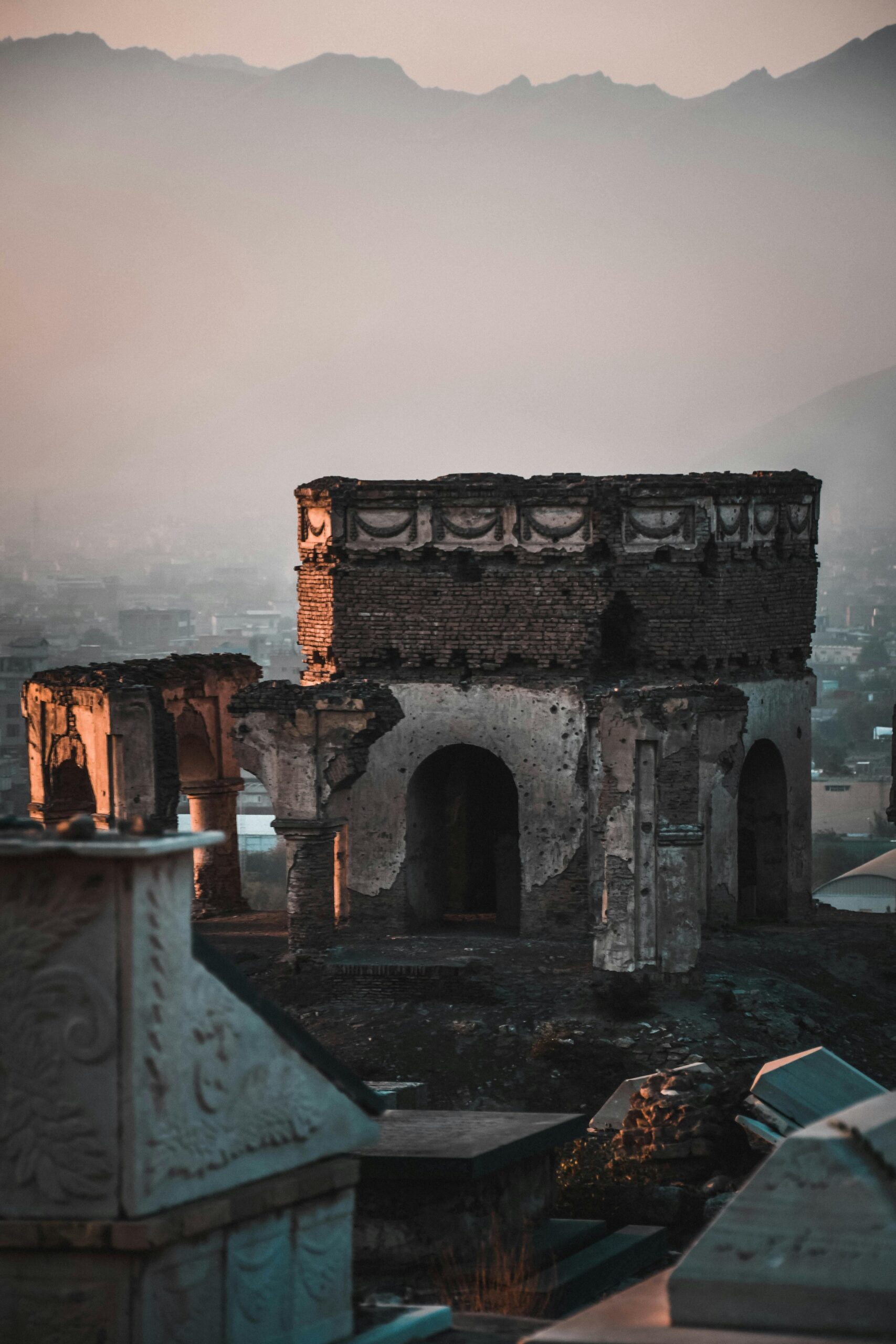
Ancient Civilizations or River Valley Civilizations
Introduction
During Bronze Age, many civilizations developed around river valley due to various reasons. These reasons being abundant water supply; land was fertile that supported substantial growth; agricultural growth provided time for recreational and artistic activities. Rivers also supported means of transport. This led to trade and commerce. These ancient civilization came to be known as river valley civilizations.
The Mesopotamian Civilization: Cradle of Early Urban Culture
Introduction to one of the oldest river valley civilization, Mesopotamian Civilization
The land to the north of the Persian Gulf, that is the modern Iraq, was known as Mesopotamia in ancient times.
Mesopotamia, which in Greek language means ‘the land between two rivers’, is a broad fertile valley between the rivers Tigris and Euphrates in West Asia. These two rivers run parallel to each other, overflowing their banks during floods and depositing alluvial silt along the lower reaches of the plain.
The rainfall was not plentiful but it was adequate. most importantly, the two rivers had annual floods, creating exactly the agricultural conditions.
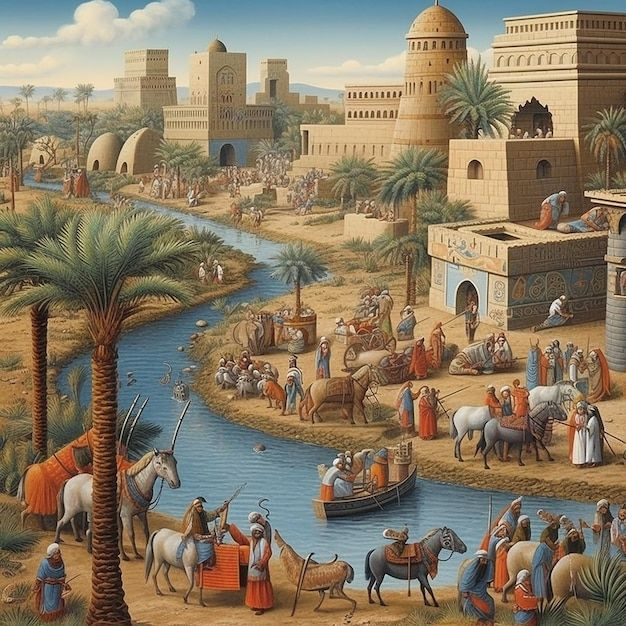
The earliest and most advanced urban culture that flourished on the lower valley of the Euphrates was known as the Sumerian civilization. On the north-eastern side of Sumer were regions called Babylonia and Akkad and the highlands in the north were called Assyria.
Around 3500 BCE, the Sumerians developed the world’s first civilization. This civilization flourished for about 1,500 years and was then absorbed by the Babylonians and finally the Assyrians. Various civilizations, such as the Babylonian and Assyrian civilizations rose and fell in this region. Hence Mesopotamia is called the cradle and grave of many civilizations.
This civilization flourished from 3500 BCE to 600 BCE. Generally acknowledged as the oldest civilization in the world, this civilization came to light as late as the first quarter of the 20th century.
Cities of Mesopotamia
In the distant past, the land between the Tigris and the euphrates was marshy and full of shrubs and bushes. In later times, tha land was cleared and settlements began to appear on the higher areas. In later times, the land was cleared and settlements began to appear on higher areas. The sumerian cities marked a maojor advancement over th evillage communities. These were large : ur occupied 150 acres. Each city was an independent unit, like a city-state, probably inhabited by a single tribe. These cities were efficiently governed and soon became centres of prosperous centres of trade and commerce.Ur, uruk, Eridu, Lagash, Kish and Akkad have brought to light countless artefacts and relics of ancient buildings, from which we can an idea of town -planning.
Characteristics of the Mesopotamian Civilization
Social Structure of Mesopotamian Society
The Mesopotamian society was divided into three classes.
- The upper class consisted of the members of the royal family, priests and high officials.
- The middle class consisted of farmers, artisans and traders. The majority of the people were farmers.
- The lower class consisted of slaves.
Family Life and Education in Mesopotamia
The father was the head of the family and enjoyed special privileges. The rights of women were protected. Children were brought up very strictly and boys were sent to schools to study reading, writing and arithmetic. Girls were trained in dance and music.
Town Planning and Urban Settlement in Mesopotamia
The discovery of the Sumerian city of Ur tells us how the people of early Mesopotamia lived. The cities were not as well planned as the Harappan cities but they followed a uniform pattern. Excavations show that the city was divided into three main parts—the sacred area, the walled city on a mound and the outer town. The sacred area had the temple-tower or ziggurat dedicated to the patron god of the city. There were smaller temples dedicated to other gods. This area also had the storehouse as well as the offices. People lived in the walled city and the outer town areas. Houses were built along the streets. Each house had a central courtyard with rooms around it.
Occupation and Economy in MesopMesopotamian agriculture / irrigation systemotamia
Mesopotamian agriculture / irrigation system
The main occupation of the Mesopotamians was agriculture. The Euphrates and Tigris Rivers were their main sources of water supply. Flooding was irregular. So they built an elaborate and highly developed irrigation system to ensure a steady supply of water throughout the year. They also built dykes to control floods.
To increase agricultural yield, they invented the ox-drawn plough. They also used the wheeled wagon for transportation of goods. The modern world is indebted to them for these inventions. They revolutionized the evolution of human society. The Mesopotamians are believed to be the first to cultivate wheat. They also grew barley, pulses and fruits.
Domestication of Animals in Mesopotamia
They domesticated animals such as the cow, goat, sheep and donkey.
Art and Craft in Mesopotamian Civilization
The increase in agricultural production and abundant stocks of food supplies freed the population from toiling in the fields. They now had more time to develop their creative skills. Settlements grew into towns and specialized skills such as pottery, weaving and metalwork (jewellery, armour and statues) began to develop.
Trade and Commerce in Ancient Mesopotamia
Stone, timber and metal ores were scarce in Mesopotamia and so these commodities were traded for the produce of the fields. A flourishing foreign trade developed. Food grains and finished products were exported to the Mediterranean countries and Egypt. Seals found in the Indus Valley show that they also had trade relations with India. They kept records of their business accounts on clay tablets. Trade and commerce increased the prosperity of the civilization.
Art, Architecture and Religion in Mesopotamia
Brick built houses
The urban centres had a large number of houses built along the road. Sumer was the first civilisation to introduce the use of bricks. The areas did not have much stone or wood. Moreover, the houses had to be sturdy to withstnad the effects of the annual floods. Hence, all these houses, palaces as well as ordinary dwellings were built of sun-dried or burnt bricks.
Streets
The houses stood along the streets. There was less space between the houses. The roads were lined with bricks. The streets were kept clean.
Architectural Contributions of Mesopotamian Civilization|Ziggurat temple
The Mesopotamians introduced architectural forms such as arches, columns, domes and vaults in the construction of buildings. This is believed to be one of the greatest contributions of Mesopotamia in the field of architecture.
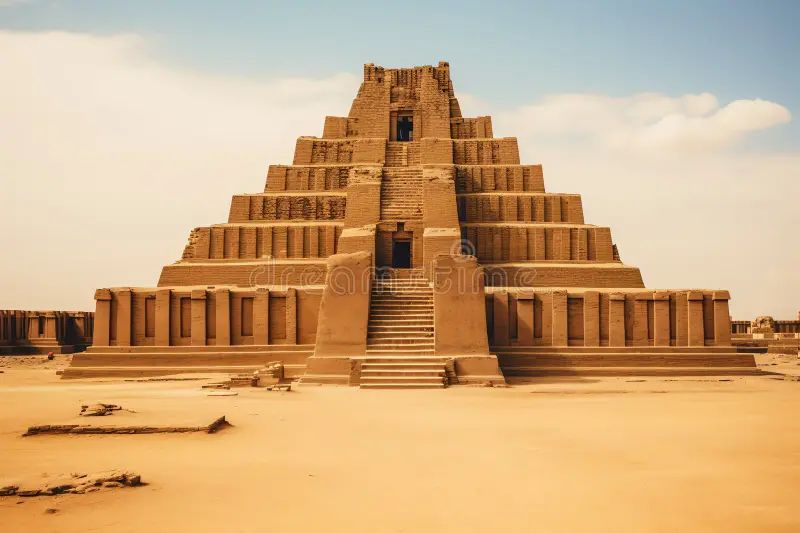
Their temple-towers (ziggurats) were monumental structures made from sun-baked bricks. They looked like man-made mountains soaring high above the earth. They were many storeys high and decorated with tiles, precious stones and marble. These temples were also used as observatories, schools, granaries and trade centres.
The architects also built big cities, canals and dams. The Hanging Gardens of Babylon is a brilliant specimen of Mesopotamian architecture. It is one of the seven wonders of the ancient world.
The discovery of metal objects, statues, gold and silver ornaments and pottery is proof of the technical knowledge and skill of the artisans.
Religious Beliefs and Practices in Mesopotamia
The Mesopotamians believed in many gods. Every city had its own special god. They worshipped the forces of nature like the sun, rain, moon and stars. The king was the chief priest and the representative of God on earth. In later years, the king appointed priests to look after the temple or the ziggurat. The priests occupied a very important position in society.
The Mesopotamians may have believed in life after death. Drinking vessels, ornaments, weapons, etc., have been found in some graves.
Achievements of the Mesopotamian Civilization
Cuneiform Script: The Writing System of Mesopotamia
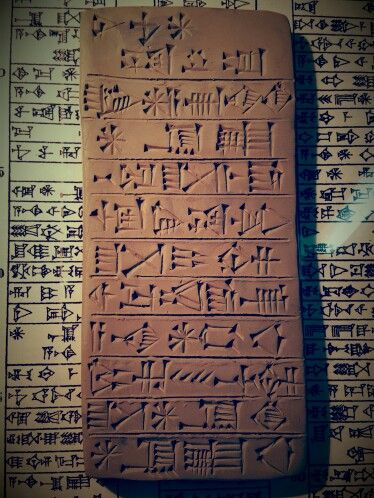
The Mesopotamians invented and developed a system of writing known as cuneiform (wedge-shaped). They wrote from right to left with a stylus (a sharp pen made of reeds, bone and sometimes of metal). They wrote on the smooth, soft surface of clay tablets which were then baked in fire and hardened. Each tablet was like the page of a book. Several such clay tablets made a complete book. The cuneiform script has been deciphered and thus we can get important information about the Mesopotamians.
Scientific and Mathematical Achievements of Mesopotamia
The Mesopotamians were skilled mathematicians. They had a special sign for number ‘one’. If they wanted to write five, they would repeat the sign of ‘one’ five times. They counted in tens and sixties. They also used the figure 60 as the unit for measuring time. They were also the first to divide an hour into 60 minutes and a minute into 60 seconds. A year was divided into 12 months. Days and nights were divided into two equal halves consisting of 12 hours each.
The Sumerians had invented many technological advances to their credit. The SUmerians might have invented the potter’s wheel.They were the first to use the wheeled chariots and carts. The Sumerian astronomers believed in the movement of the stars from their ziggurats. Astrology was a popular way of telling the future.
Hammurabi Code of Law: The Legal System of Ancient Mesopotamia
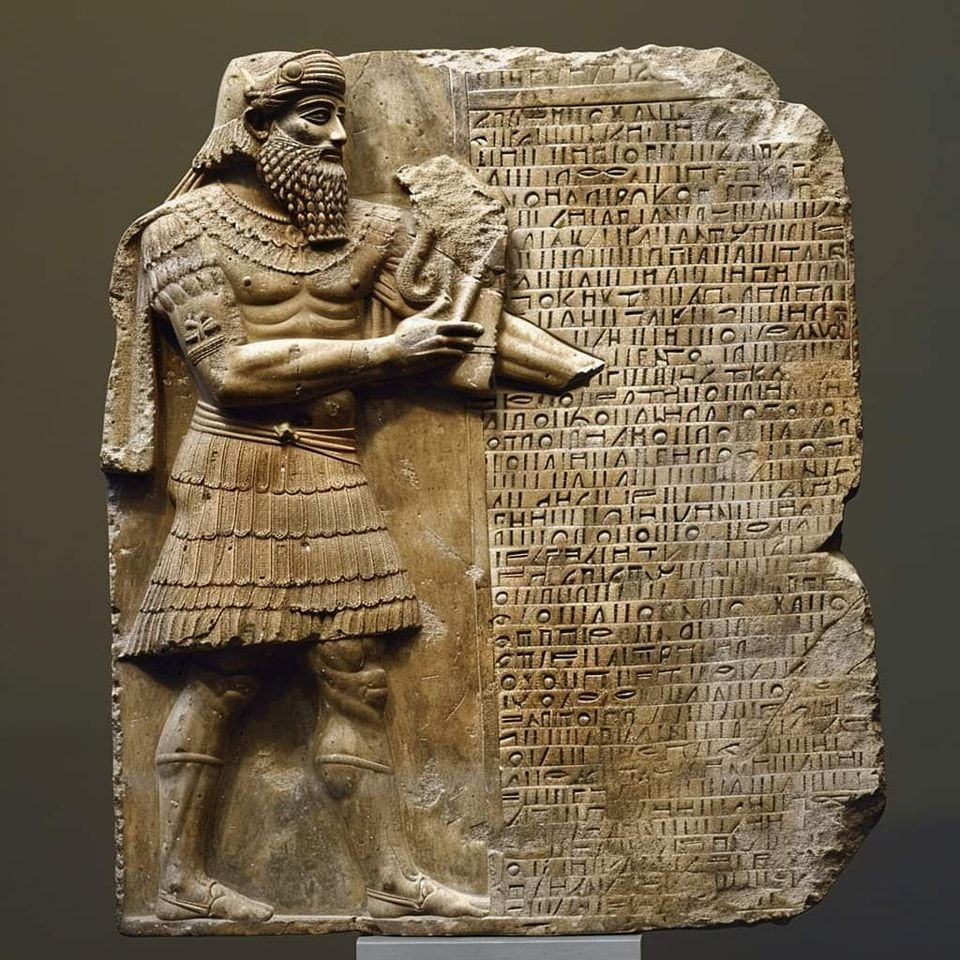
Hammurabi, the king of Babylon, compiled a code of law dealing with every aspect of human life. This code of law, written on a stone slab, is one of the oldest legal codes known to humans. These laws protected the poor and the weak and safeguarded the rights of women. Severe punishments were given for dishonest dealings, for example, if a house fell on its owner and he died, then the builder was put to death. If it fell on the owner’s son, the builder’s son was punished. Other nations also followed the law code developed by Hammurabi.
Much of our modern civilization can be traced back to the inventive genius of Mesopotamians. Yet the vibrant culture declined and was soon forgotten. The Euphrates River, the lifeline of this civilization, unexpectedly changed its course. The inhabitants abandoned the valley. Winds and sandstorms eroded the buildings and the monuments, burying the treasures of this great civilization beneath a barren desert plain.
Harmonious society centering the temples
In Sumer, a harmonious society developed centering the temples. All the classes, the merchants, artisans , craftsmen, fishermen, gardeners and others blended into a single unit under the leadership of the priests, through whose influence thepeople communicated with the god. All the peoplepaid 1/3 to 1/6 of their earnings to the state.
The Crafts
The Sumerians were adept at making pottery, and especially , in the use of terracotta. They made various aarticles, such as objects of everyday use, pots, vessels, and ornaments with terracotta. They did weave a kind of cloth from the fibres of hemp. Their real expertise was in the field of metallurgy. Theuse of metals probably originated in Sumer. In the earlier phase ,they used copper, bronze and lead, while inthe latter stages they became expert in the use of gold and silver.
Literature
The Sumerian epic of Gilgamesh is the world’s oldest surviving literary work. It was composed around 2000 B.C. and is a tale of heroism. It tells the story of Sumerian king Gilgamesh of uruk, who lived around 2,700 B.C.. The epic describes the valor, sincerity and eventual failure of the great hero Gilgamesh. Other literary works are the biographies of kings, and their relationships to Gods.
The Egyptian Civilization: Gift of the Nile| One of the River Valley Civilizations that practised mummification
Ancient Egypt, like other early civilizations, developed in a river valley—the valley of the river Nile. The river Nile was central to the whole civilization and a constant and major influence on its development.
The ancient Greek historian, Herodotus, called Egypt the ‘Gift of the Nile’. Every year, without fail, the river would overflow its banks, transforming the entire valley into a vast lake. When the waters receded, they left behind a deposit of black, fertile soil along each bank. Crops grew easily in this soil and yielded rich harvests. The Nile provided water for irrigation. The Egyptians built an elaborate network of canals, dams, dykes and reservoirs to carry on agriculture on a large scale.
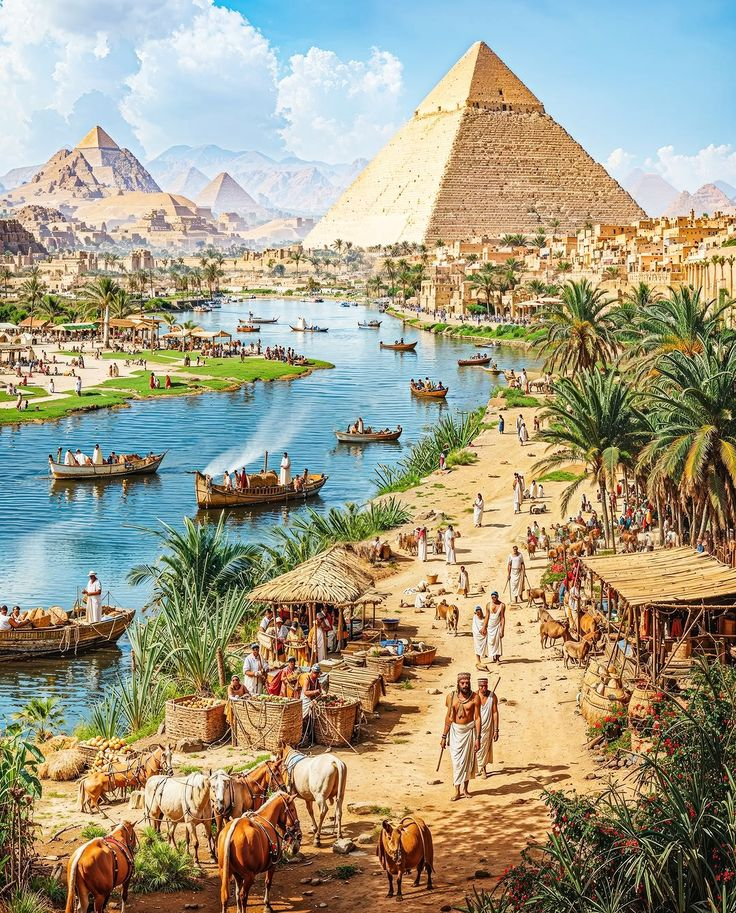
The Nile also served as a national highway and the main transportation channel. This enabled the Egyptians to develop trade relations with neighbouring countries, making their country a land of plenty.
The valley of the Nile was a narrow strip of fertile land stretching along the banks of the Nile. It was about 1,200 km long. The rest of the country was a desert of sand and stone. These deserts served as natural barriers to foreign invasions. So the early Egyptian settlers enjoyed many years of peace and security during which they learnt to build huts, grow crops, domesticate animals and establish a society of their own.
The ancient Egyptians strongly believed that there was life after death and devoted all their energies preparing for eternity. They believed that a dead person lived on in his tomb, which was his eternal home. The more beautiful it was, the more splendid would be the afterlife. This belief inspired the ancient Egyptians to build giant pyramids, magnificent temples, monuments and tombs.
This was the manner in which one of the earliest and most enduring civilizations in history was born which flourished for more than 2,000 years. Archaeological excavations, inscriptions and official documents have helped historians to reconstruct the history of ancient Egypt.
The history of ancient Egypt is divided into three periods.
- The Old Kingdom (approximately 3000–2000 BCE)
- The Middle Kingdom (approximately 2000–1700 BCE)
- The New Kingdom (approximately 1600–1100 BCE)
For about a hundred years (1700–1600 BCE), Egypt was invaded and ruled by the Hyksos tribes. The decline of the Egyptian empire set in with the collapse of the New Kingdom. Egypt was repeatedly invaded by the Babylonians, Assyrians, Persians and finally by Alexander the Great. Alexander founded the city of Alexandria. It later became one of the greatest cultural centres of the ancient world during the reign of Ptolemy, one of the generals of Alexander. Ptolemy was the founder of the last dynasty of Egypt.
From the earliest times, Egypt was divided into two parts—Lower Egypt and Upper Egypt. About 3200 BCE, these were united and ruled by pharaohs or kings to become a brilliant civilization that lasted until the death of Cleopatra, the last pharaoh, in 30 BCE.
Characteristics of the Egyptian Civilization
Social Structure of Ancient Egypt
The Egyptians were divided into three distinct classes.
- The upper class consisted of the royal family, rich landowners, high ranking priests, government officials and doctors.
- The middle class consisted of merchants, manufacturers, craftspeople and the lower clergy.
- The lower class consisted of the peasants. At the bottom of the social hierarchy were the slaves who were mainly prisoners of war.
Archaeological excavations, inscriptions and official documents tell us a great deal about the life and times of the ancient Egyptians.
Family Life and Social Customs in Ancient Egypt
The families were close-knit groups. The relationship between the husband, wife and children was usually close. The father was the head of the family. Women were treated with respect and their property rights were protected. They were more or less equal to men in the eyes of law. Children enjoyed carefree and happy lives. The boys were sent to school and the girls stayed at home and learnt housework.
Wealthy families lived lives of luxury and pleasure. Family outings and recreation included hunting, fishing, swimming and sailing on the Nile.
Food and Diet of the Ancient Egyptians
Bread made from wheat and beer made from barley formed the staple diet of the people. They also ate vegetables, fruits, meat and dairy products.
Dress and Fashion in Ancient Egypt
Dresses were made of white linen. The early Egyptians dressed simply. The men wore a loin cloth and the women wore long, tight-fitting dresses with shoulder straps. Later, their dresses became more complex. Both men and women wore elaborate jewellery, cosmetics and wigs. Men paid as much attention to their hairstyles and complexions as women did.
Shelter and Housing in Ancient Egypt
The Egyptians lived in houses made of sun-baked bricks. The rooms were airy with small windows set high on the walls to keep out the sun and let the daylight enter.
Occupation and Economy in Ancient Egypt
Agriculture and Farming in the Nile Valley
The chief occupation of the Egyptians was agriculture. The fertile soil, abundant supply of water from the Nile and a vast irrigation network enabled them to grow crops throughout the year. Their chief crops were wheat, barley and millet. Vegetables and fruits such as dates, apples, peaches and figs were grown.
Domestication of Animals in Ancient Egypt
Animals such as pigs, cows, sheep, goats, donkeys, camels, doves and geese were domesticated.
Art and Craft in Egyptian Civilization
The craftspeople worked very hard to satisfy the demands and expensive tastes of the aristocratic and priestly classes. There were skilled craftspeople such as potters, goldsmiths, carpenters, weavers, sculptors and painters.
The sculptors carved large stone statues of kings and gods while the artists decorated the tomb walls with exquisite paintings. These paintings tell us a great deal about the lifestyle of the early Egyptians.
Architecture and Engineering Marvels of Ancient Egypt
Architects and engineers built remarkable monuments such as pyramids and temples. The Great Pyramid at Giza is one of the Seven Wonders of the World.
The Egyptians built a number of magnificent temples with pillared halls. The walls and pillars were decorated with beautiful paintings of humans, animals and birds.
Another architectural wonder is the Sphinx, a mythological figure with the body of a lion and the head of a man. It is carved out of a single block of stone.
Medicine and Healthcare in Ancient Egypt
Egyptian doctors and surgeons were renowned for their skills. The advanced and elaborate technique used in mummification or embalming an Egyptian corpse showed their deep knowledge of the human body and its systems. Doctors (mainly priests) specialized in the treatment of eyes, teeth, etc.
Trade and Commerce in Ancient Egypt
Trade was carried on both by land and sea routes. For internal trade, goods were transported by boats and barges along the Nile and by road on camels and donkeys.
For foreign trade, the Egyptians built the world’s first seafaring ships. They exported linen, wheat, glassware, jewellery and furniture. They imported gold, ivory, copper and cedar wood. The king controlled foreign trade. The barter system was used and the medium of exchange was usually grain, silver and copper.
Religion and Political Life in Ancient Egypt
Religious Beliefs and Practices of the Egyptians
The Egyptians worshipped many gods and goddesses connected with nature. Ra, the sun god, and Osiris, the god of the blessed dead, were among the most important gods. The pharaohs were also worshipped as gods. Each god had his own temple and priest. Every city, town and village had its own favourite god.
Certain animals and birds such as the jackal, crocodile, bull and hawk were also worshipped.
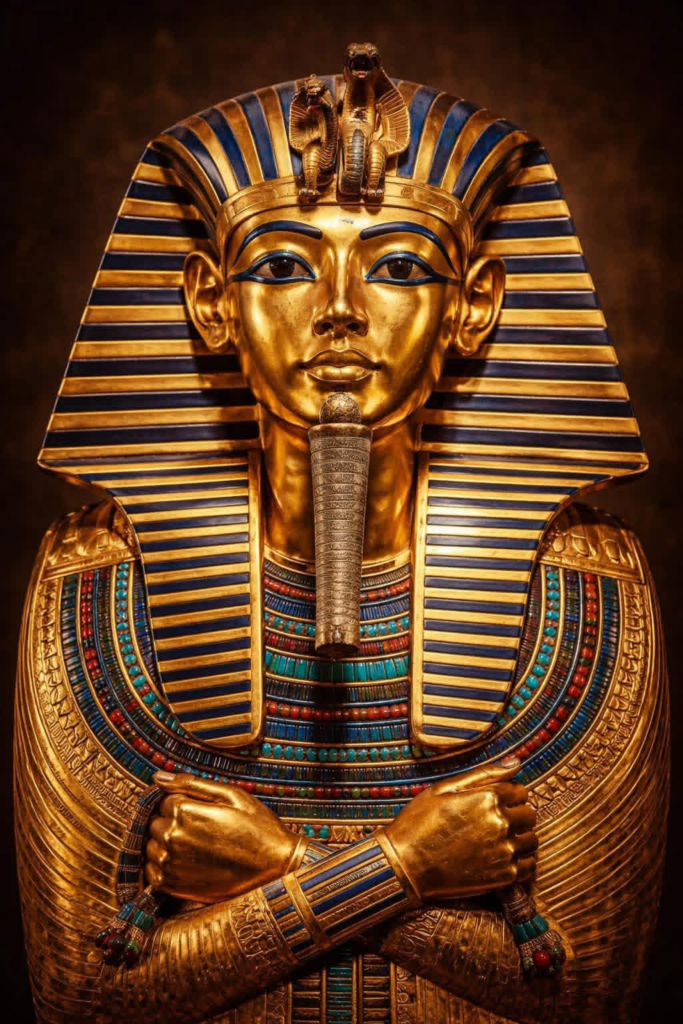
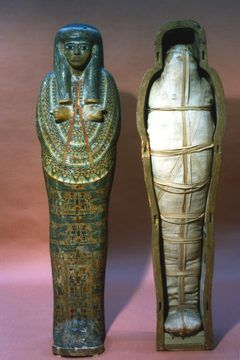
The Egyptians believed in life after death. So, they preserved the body of the dead. A dead body was embalmed with spices and wrapped in fine linen. Such a preserved body is known as a mummy.
Food, wine, clothes, furniture, jewellery and weapons were put into the tombs. Pyramids were the tombs of the pharaohs.
Political Life and Administration in Ancient Egypt
The pharaoh was the king of Egypt. He was all-powerful and was treated like God. He was a hereditary ruler and was believed to be God’s representative on earth. He was at the head of an advanced administration. The country was divided into provinces called nomes, each governed by an official called nomarch. The king was assisted by officials. They supervised every aspect of the administration, including tax collection.
The government controlled all the resources. The king gifted large estates to private owners but a major part of the produce was taken as tax for the royal treasury.
Achievements of the Egyptian Civilization
Hieroglyphic Script and Writing System of Ancient Egypt
The Egyptians developed a form of writing called hieroglyphic script (sacred writing). In the beginning, they used picture writing. Each picture stood for a separate word. About 2,000 picture signs have been found on ancient pyramids and temples. Later, they developed a simplified alphabet which had 24 consonants and no vowels.
Invention of Paper and Ink in Egypt
At first, the Egyptians wrote on stone, walls and clay tablets. Later, they used paper which they made from papyrus, a water reed. The word paper comes from the word papyrus.
The Egyptians wrote from right to left using a reed sharpened at the end. They used ink made of soot, gum and water.
Solar Calendar and Timekeeping in Ancient Egypt
The Egyptians introduced the world’s first solar calendar. They found that the average time between two annual floods was 365 days. The year was divided into 12 months, each consisting of 30 days. The remaining five days were used for celebrating religious festivals.
Mathematics and Astronomy in Egyptian Civilization
A highly advanced system of mathematics was developed by the Egyptians to deal with tasks such as the construction of pyramids and other monuments, land survey and the calculation of revenue.
The need to calculate the time of the annual floods led to the development of astronomy. The Egyptians were the first to make an instrument to observe the movements of stars and planets. They also invented the water clock to read the time at night.
Medical Knowledge and Mummification process in Egypt
The Egyptian mummies, prepared thousands of years ago, are still well preserved. This is proof of their advanced knowledge of medicine and human anatomy. They are also credited with having made the world’s first medical diagnosis.
By 1000 BCE, the glory and splendour of the Egyptian empire had declined. Foreign invasions and internal revolts weakened the empire and reduced it to a shadow of its former self. Herodotus, writing in the 5th century BCE, observed, ‘There is no country that possesses so many wonders, nor any that has such a number of works which defy description.’
Did You Know?
Cleopatra was the name of seven queens in ancient Egypt. However, only one Cleopatra became famous and popular, i.e. Cleopatra VII. She was famed for her beauty and intelligence. She ascended the throne when she was only 17 years old.
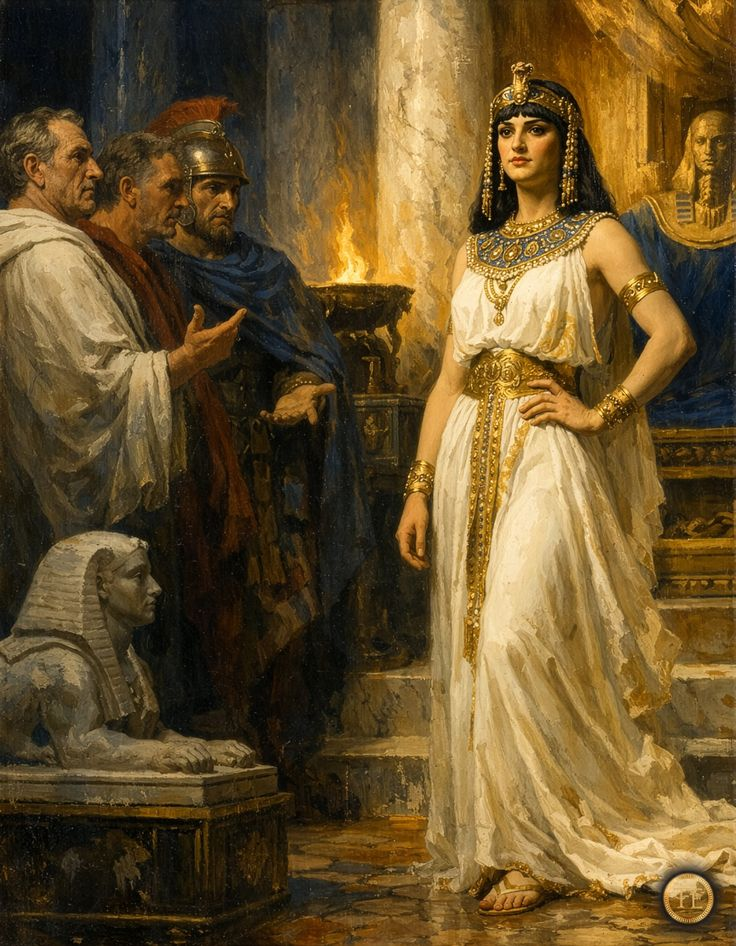
She was fluent in nine languages, including her native Egyptian. Both Julius Caesar and Mark Anthony courted her. In 30 BCE, she committed suicide, supposedly from a snake bite, after Anthony’s defeat at Actium.
The Harappan Civilization: India’s First Urban Culture
The discovery of the ancient ruins of Mohenjodaro and Harappa are one of the greatest discover- Harappa by Dayaram Sahni in 1921 and of Mohenjodaro by Rakhaldas Banerjee in 1922–23, both officers of the Archaeological Survey of India, exploded an age-old myth. It was earlier believed that the history of India began with the coming of the Aryans. The excavation of the ruins of the highly planned cities of Harappa and Mohenjodaro pushed back the history of India by almost 2,000 years. It proved beyond doubt that a highly advanced urban civilization flourished in India about 4,500 years ago.
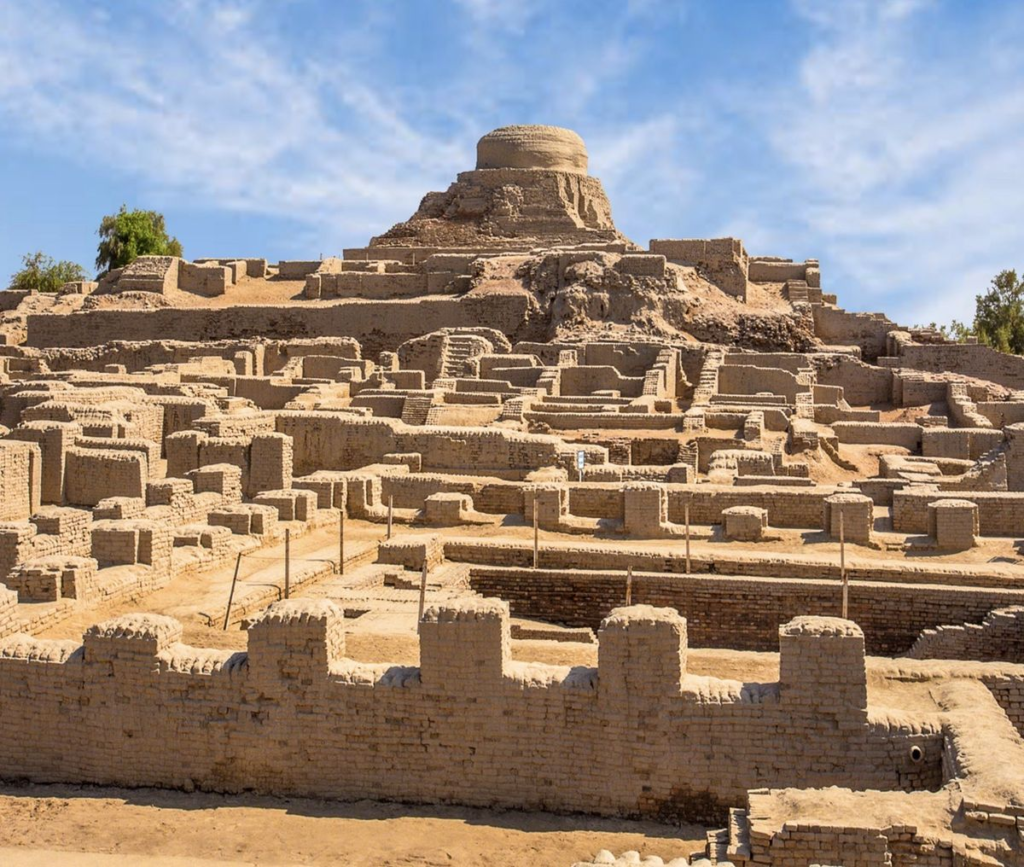
This civilization belonged to the Chalcolithic Age and no traces of iron have been found. It is estimated that the Indus Valley civilization flourished between 2500 BCE and 1500 BCE. The discovery of Indus Valley seals and pottery among the ruins of ancient Sumerian cities shows that India had trade links with Mesopotamia which was a contemporary civilization of the Indus Valley civilization.
Mohenjodaro means ‘mound of the dead’. It is located on the banks of the river Indus in the Larkana district of Sind (now in Pakistan). Harappa is situated on the banks of the river Ravi in the Montgomery district of western Punjab (in Pakistan).
For many years after the discovery of these sites, it was believed that the civilization was confined to the valley of the Indus and its tributaries. However, later excavations of similar sites proved that this civilization extended far beyond the Indus Valley to many parts of northern and western India.
About 2,800 sites have been discovered so far, making the Indus Valley civilization the largest civilization of the ancient world.
Harappa
Excavated by Dya Ram sahini in 1921. It is situated on th ebanks of River Ravi in Montgomery district of Punjab.It was one of the oldest ciities in th esubcontinent, which arcaeologists found 80 years ago. It was the first city to be discovered. The coffin burials are the charactersitic feature of Harappa.
Mohenjodaro
It is located onth eLarkana district of Sind onthe bank of Indus. it was discovered by R.D. Banerjee in 1922. The Great Bath was founded at Mohenjodaro. It was lined with bricks, coated with plaster, and made water tigtht with a layer of natural tar. There were steps leading down to Great bath from two sides , while there were rooms on all sides. Water was probably brought in from a well, and drained out after use. Scholars have estimated that the toal number of wells in Mohenjodari was about 700.
The other important finding is granary, unicorn seals, bronze dancing girl statue, seal of man with deers, elephants, tiger and rhinos. It is considered to be Pashupati seals.
Chanhudaro
It is located on the Mullan Sandha, Sind on the Indus river. It was discovered by NG Majumdar in 1931. The findings from this site is Bangle factory. This site is also known for its crafts production like bead making, shell cutting, metal working , seal making and weight making.
Since the principal cities of this civilization were first discovered around the river Indus and its tributaries, it is referred to as the Indus Valley civilization. It is also called the Harappan civilization because Harappa was the first site to be unearthed and the features of the other sites resemble those of Harappa.
Some major sites of the Indus Valley civilization are Lothal (Gujarat), Ropar (Punjab), Kalibangan (Rajasthan), Alamgirpur (Uttar Pradesh), Surkotada (Gujarat) and Banawali (Haryana). The two newest sites are Rakhigarhi (Haryana) and Dholavira (Gujarat).
Main Features of the Harappan Cities
Town planning Harappan civilization and Urban Design of the Indus Valley Civilization
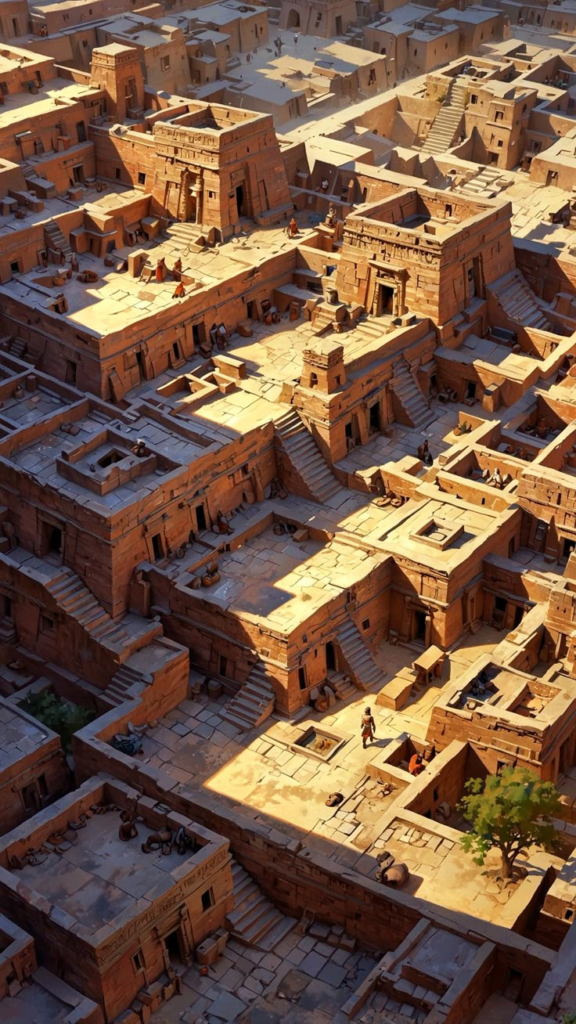
The excavations carried out at various sites prove that around 4,500 years ago highly civilized people lived in this region and gave to the world its earliest cities, its first town planning, its first architecture in stone and clay and its first example of sanitary engineering and drainage system.
The Indus Valley cities were very well-planned. The main streets ran parallel to each other, cut at right angles by smaller streets, dividing the cities into rectangular blocks. The main roads were straight and very wide (about 30 feet) and curved at the corners to allow carts to pass easily. The streets were often paved with baked bricks.
Buildings and Architecture of the Harappan Civilization
The Indus Valley people were skilful builders. The buildings were of two types—dwelling houses and public buildings.
Dwelling Houses in Harappan Cities
Large blocks of houses were built along the sides of the streets. The houses, many of them double storeyed, had flat roofs. They were of different sizes. Some were like palaces while others had only two small rooms. They were made of baked bricks of very good quality (they have lasted for 4,500 years).
An average house had a courtyard surrounded by rooms, a bathroom, a kitchen and a well. A narrow staircase led to the rooms upstairs.
Public Buildings of the Indus Valley Civilization
The Great Granary
The Great Granary at Harappa was a large building. Historians believe that it was used to store surplus food grains. There were two rows of granaries. Each row had six granaries. A similar granary has been found in Mohenjodaro.
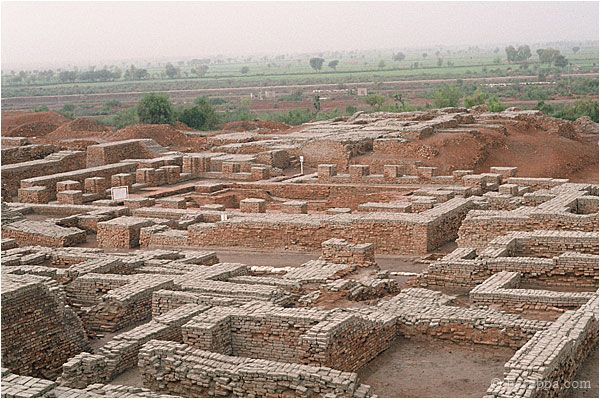
All the granaries were built close to the river bank so that the grains could be easily transported with the help of boats. Near the Great Granary in Harappa, circular brick platforms have been found which were probably used for threshing grain. There were also many furnaces where metal workers produced a variety of objects.
The Assembly Hall
The Assembly Hall was another striking building found in Mohenjodaro. It was a pillared hall with thick walls and 20 pillars made of burnt or baked bricks. This may have been an assembly hall, a prayer hall or a palace.
Indus Valley drainage system
The people of the Indus Valley had an excellent, well-planned drainage system. The kitchens and the bathrooms (with sloping floors) had drains connected to the street drains. The street drains ran along the side of the streets and were usually covered. They had manholes at regular intervals (for inspection and cleaning). The drainage system proves that the Indus Valley people paid great attention to sanitation and cleanliness.
The Great Bath at Mohenjodaro
Another important building was the Great Bath at Mohenjodaro. This building resembled a large swimming pool. It had six entrances, a central bathing pool, galleries and dressing rooms. Two flights of steps led to the bottom of the pool. The floor and walls of the pool were made of burnt bricks and made watertight with a lining of bitumen. Water from an adjacent well was used to fill the pool with fresh water and the used water was drained out through an outlet in one corner. The Great Bath was probably used during religious ceremonies.
Characteristics of the Indus Valley Civilization
Society and Social Structure of the Harappan Civilization
Harappan society probably consisted of several social groups: rulers, merchants, traders and artisans, farmers and manual labourers.
Food and Diet of the Harappan People
Wheat was the staple food. They also grew barley, mustard, fruits and vegetables. Milk, meat, fish and eggs formed a part of their diet.
Dress, Ornaments and Personal Appearance in Harappan Civilization
People wore cotton and woollen garments. Two-piece dresses were worn by both men and women. The men wore a garment similar to the dhoti while the women wore skirts.
The upper garment was a shawl worn around the shoulder. Both men and women wore ornaments. They wore necklaces, amulets and finger rings. The women also wore a headdress, earrings, bangles, girdles, bracelets and anklets. The rich wore ornaments made of gold, silver and ivory. The poor wore shell, bone and copper jewellery.
The men kept beards. Their hair was combed backwards and was either cut short or coiled in a knot on top of the head. The women probably tied their hair tightly and used hairpins and combs to keep their hair in place. They also used cosmetics.
Recreation, Games and Amusement in Harappan Society
The Indus Valley people preferred indoor games to outdoor activities. They spent their free time dancing, singing and playing board games with dice. They also played a game similar to modern chess. The children played with various toys like wheeled carts, dolls, animals with movable heads, sliding monkeys, rattles and whistles. The toys were generally made of baked clay or terracotta.
Occupation and Economy in the Harappan Civilization
Agriculture and Farming in the Indus Valley
The main occupation of the people of the Indus Valley was farming. Farmers grew wheat, barley, fruits and vegetables. They also cultivated cotton and were the first people in the world to do so. The land was fertile and the farmers grew enough surplus food to feed the people in towns and cities.
Domestication of Animals in Harappan Civilization
Animals like goats, sheep, buffaloes, elephants and humped bulls were domesticated. Dogs and cats were kept as pets.
Art, Craft and Metallurgy in the Indus Valley Civilization
The Indus Valley people were excellent potters and skilled craftspeople. They made pottery of various shapes and sizes on the potter’s wheel. These pots were generally glazed and painted. They made terracotta female figurines which were probably symbolic of the Mother Goddess. They also knew the art of using metals.
The goldsmiths made gold and silver jewellery, the coppersmiths made utensils and the bronzesmiths made tools, weapons and metal sculptures such as the famous figure of the ‘dancing girl’. They were also engaged in other crafts like brick laying, boat making, stone cutting, masonry and carpentry. Spinning and weaving were important occupations.
Did You Know?
The bronzesmiths were an important group of artisans in the Indus Valley civilization. Bronze is made by mixing copper and tin. The Harappans got copper from the Khetri mines of Rajasthan and from Baluchistan. Tin came from Afghanistan and Iran. The Harappans used bronze vessels, axes, saws, knives and spears. They also made statues in bronze like the statue of the dancing girl.
Trade and Commerce in the Harappan Civilization
The Indus Valley people carried on flourishing trade both within and outside India. They traded with countries like Mesopotamia (Iraq), Persia (Iran) and Afghanistan. Trade relations with Mesopotamia have been proved with the discovery of Mesopotamian seals in the cities of the Indus Valley civilization and Harappan seals in the ancient cities of Mesopotamia. A variety of weights and measures were used and trade was probably carried on by barter system.
Trade was carried on both by land and sea routes. Bullock carts, boats and ships were probably used for transport. A dockyard has been discovered at Lothal.
Seals and Script of the Indus Valley Civilization
More than 2,000 seals have been unearthed from various sites. They are generally small, flat, rectangular or square in shape and made of clay, soapstone and copper. They are skilfully carved with figures of humans and animals such as the unicorn, humped bull, goat, tiger, elephant, etc. These seals were probably used by merchants and traders to stamp goods.
Seals are valuable sources of information about the life and culture of the people and tell us a great deal about their religious beliefs, artistic skills, trade contacts, dress and ornaments.
The script engraved on the seals continues to puzzle scholars and historians even today. Many important facts about Harappan life and culture will come to light if and when the script is deciphered. It has picture-like signs that probably represent words, objects and ideas.
Religion and Beliefs of the Harappan Civilization
Some of the objects found in the ruins help us to form an idea of the religion of the Harappans. No temples have been found. Numerous smoke-stained clay figures of a female deity have been found. This was probably the Mother Goddess figure, seated in a yogic posture and surrounded by various animals is engraved on some seals. The pipal tree was probably regarded as sacred and worshipped. The discovery of a large number of amulets suggests that people probably wore them as lucky charms to ward off evil spirits. Like the Egyptians, they also believed in life after death. They buried the dead together with items of food, utensils, ornaments, etc. Sometimes they cremated the dead and kept the ashes or bones in an urn along with items of daily use.
Administration and Governance in the Indus Valley Civilization
Judging from the excellence of the Harappan civilization it is clear that the cities were efficiently governed. However, we do not have exact information about their government. There is no evidence of kings or queens. Each city was probably looked after by a committee consisting of rich merchants and priests.
Decline of Indus Valley Civilization
The Indus Valley civilization which flourished for about a thousand years, came to an abrupt end. Historians have put forward various theories for its sudden decline:
- Natural calamities like earthquakes, floods or epidemics might have destroyed the cities.
- Invasion by foreign tribes like the Aryans may have led to its destruction.
- A change in the course of the river Indus may have rendered the land infertile.
The Chinese Civilization: Unique Culture of the East| Hwang Ho (Yellow River) civilization | one of the river valley civilizations that was way ahead of its time
Like the other three ancient civilizations—the Mesopotamian, the Egyptian and the Harappan civilizations—the Chinese civilization also grew up in a river valley. This civilization flourished in the valley of the river Hwang Ho (Yellow River) and later extended to the valley of the river Yangtze.
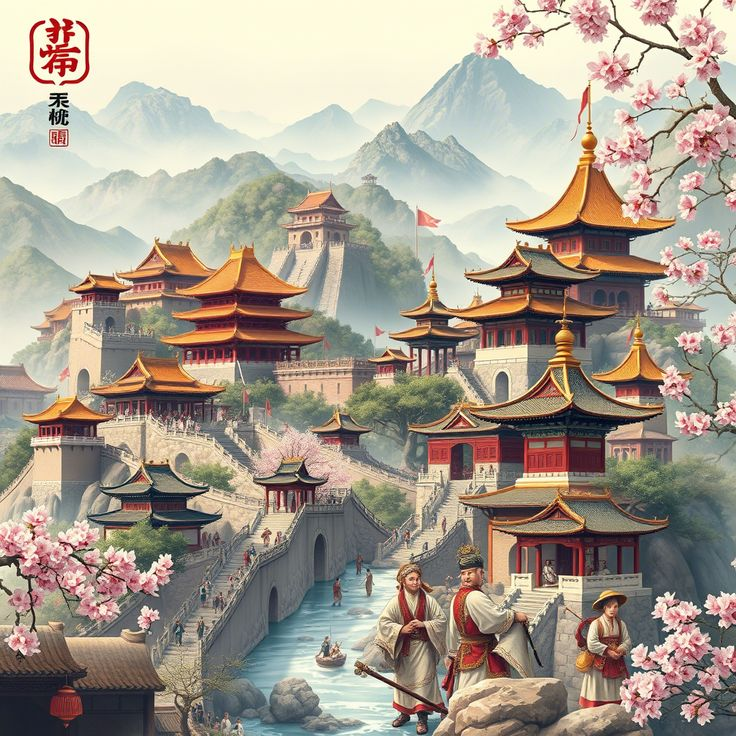
The river Hwang Ho is also known as ‘China’s Sorrow’ because it changed its course frequently and caused devastating floods, resulting in great loss of life and property. At the same time, the floods deposited fertile yellow silt (called loess) along its banks, which made the land ideal for agriculture.
The high mountains and the vast Gobi Desert cut off China from the rest of the world. This isolation helped the Chinese to develop a unique civilization of their own without any outside influence.
The early history of China is based on legends and myths. Historians have reconstructed the ancient history of China on the basis of archaeological excavations, ancient scripts, ruins of buildings and tombs.
According to legends, the first rulers of China were the Xia (Hsia) dynasty. This was followed by the Shang dynasty (about 1766–1122 BCE), the Zhou (Chou) dynasty (1122–221 BCE), the Qin (Chin) dynasty (221–206 BCE) and the Han dynasty (206 BCE – 220 CE). The country derived its name ‘China’ from the Qin dynasty. Under the Han dynasty, China became a powerful empire.
Characteristics of the Chinese Civilization
Social Structure of Ancient China
The king occupied the highest position in society. Below him were the nobles, merchants, craftspeople and farmers. At the bottom of the social hierarchy were the slaves.
The society was broadly divided into three classes.
- The upper class consisted of the royal family, nobles and high officials (called mandarins).
- The middle class consisted of merchants and craftspeople.
- The lower class consisted of farmers and slaves.
The social structure was rigid. The nobles lived lives of luxury and comfort in large, beautifully decorated palaces. The merchants and craftspeople lived in towns and cities. The farmers lived in villages and worked hard from dawn to dusk. The slaves were mainly prisoners of war and were treated harshly.
Family Life and Ancestor Worship in Ancient China
The family was the most important unit of society. The eldest male member was the head of the family and his authority was absolute. Ancestor worship was common and the younger members of the family showed great respect to their elders.
The position of women was lower than that of men. They were expected to be submissive and obey their fathers, husbands and sons. However, they were respected as mothers.
Food and Diet of the Ancient Chinese
The staple food of the people was millet and wheat in the north and rice in the south. They also ate meat, fish, vegetables and fruits. Tea was a popular beverage.
Dress and Fashion in Ancient China
The Chinese dressed simply. The common people wore loose gowns or robes made of cotton or hemp. The wealthy people wore garments made of silk. Both men and women wore long robes and kept their hair long.
Shelter and Housing in Ancient China
The Chinese lived in houses made of wood and sun-baked bricks. The houses of the rich were large and had many rooms arranged around a central courtyard. The roofs of the buildings were curved at the corners to protect them from evil spirits.
Occupation and Economy in Ancient China
Agriculture and Farming in the Chinese Civilization
The main occupation of the Chinese was agriculture. The fertile soil and an abundant supply of water enabled them to grow a variety of crops. Their chief crops were wheat, barley, millet and rice. They also grew fruits and vegetables.
The Chinese were the first to cultivate tea. They also reared silkworms and developed the art of making silk cloth (sericulture).
Domestication of Animals in Ancient China
The Chinese domesticated animals such as pigs, dogs, cattle, sheep and horses.
Art, Craft and Porcelain in Chinese Civilization
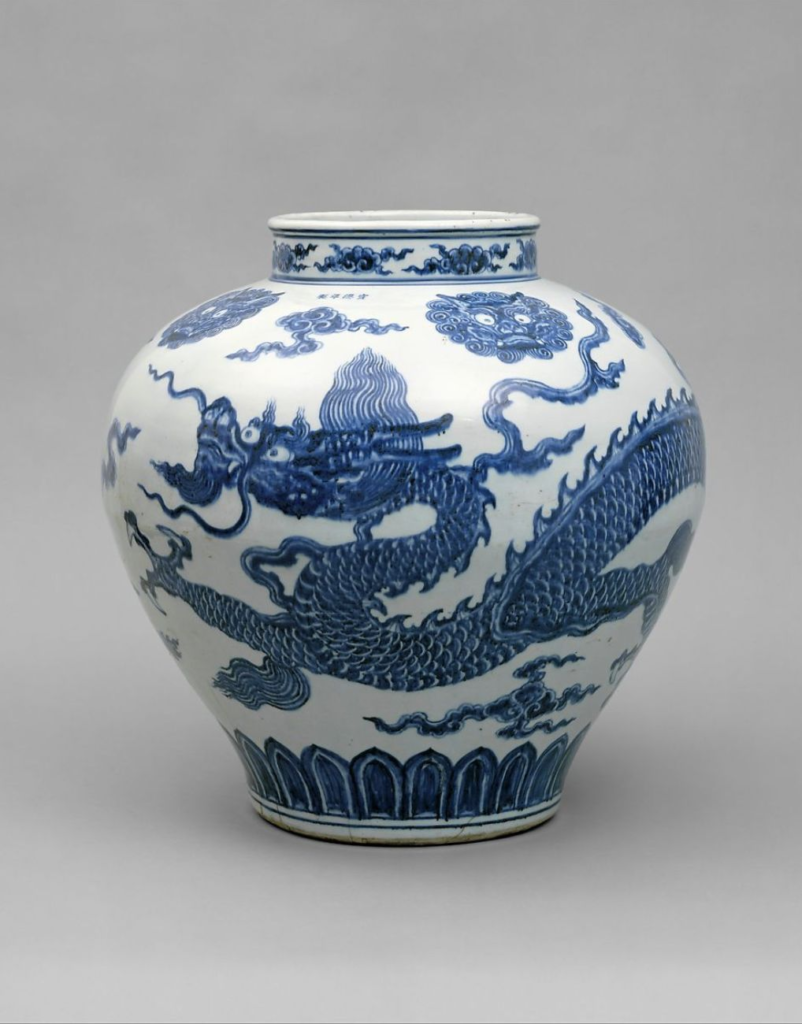
The Chinese were skilled craftspeople. They made beautiful pottery on the potter’s wheel. They were famous for their exquisite porcelain (china clay) pottery, which was highly valued all over the world.
They were also skilled in metalwork, woodwork and weaving. They made beautiful objects of bronze, jade (a semi-precious stone) and silk.
Architecture and the Great Wall of China
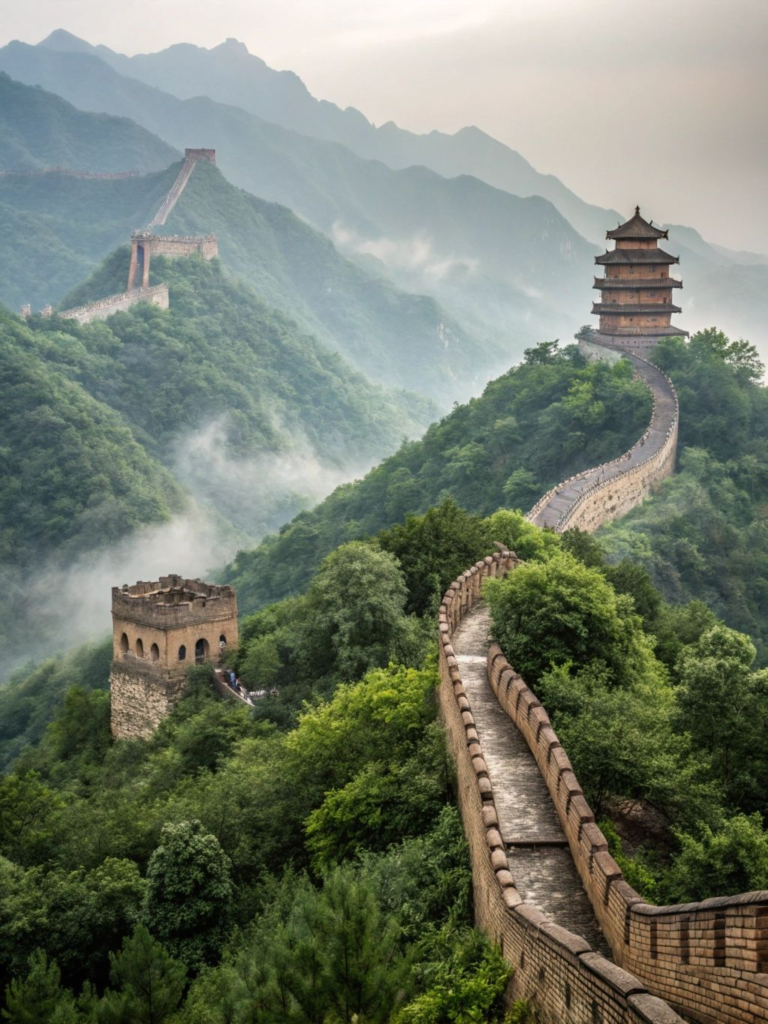
The Chinese were excellent builders. Their most famous architectural achievement is the Great Wall of China. It was built by Emperor Qin Shi Huang to protect China from the invasions of the nomadic tribes of the north. It is about 2,400 km long and is one of the Seven Wonders of the Ancient World.
The Chinese also built beautiful temples and palaces. Their unique architectural style is reflected in their pagodas (temple towers with multiple tiers and curved roofs).
Trade and Commerce in Ancient China
The Chinese carried on flourishing trade both within and outside the country. They traded with countries like India, Egypt, Mesopotamia and Rome.
The famous Silk Route connected China with central Asia and Europe. The chief exports of China were silk, tea, porcelain and paper. They imported horses, glass and precious stones.
Religion and Philosophy in Ancient China
Religious Beliefs and Philosophical Systems of China
The early Chinese worshipped the forces of nature, such as the sun, rain, wind and thunder. They also practiced ancestor worship.
In later years, three great religious and philosophical systems developed in China: Confucianism, Taoism and Buddhism.
Confucianism and Taoism
- Confucianism: Founded by Confucius, it emphasized right conduct, respect for elders and filial piety.
- Taoism: Founded by Lao Tse, it advocated a simple life in harmony with nature.
- Buddhism: Introduced from India, it became very popular and influenced Chinese art, architecture and literature.
Achievements of the Chinese Civilization
Script and Writing System of Ancient China
The Chinese developed a unique system of writing. Instead of an alphabet, they used pictograms and ideograms (symbols representing objects and ideas). They wrote vertically from top to bottom with a brush made of camel hair and ink on silk cloth or bamboo slips.
Invention of Paper in China
The Chinese were the first to invent paper. It was invented by Cai Lun in 105 CE during the Han dynasty. They made paper from hemp, rags and wood pulp.
Printing Technology in Ancient China
The Chinese also invented the art of printing. They used block printing, where characters were carved on wooden blocks, inked and then pressed onto paper.
Mariner’s Compass and Navigation
The Chinese invented the mariner’s compass, which helped sailors to find directions at sea. It revolutionized maritime trade and exploration.
Gunpowder and its Uses in China
The Chinese were the first to make gunpowder. Initially, it was used for making fireworks for amusement, but later it was used in warfare.
Seismograph and Scientific Achievements
The Chinese scientist Zhang Heng invented the world’s first seismograph (an instrument to detect earthquakes) in 132 CE.
Astronomy and Calendar in Ancient China
The Chinese made significant progress in astronomy. They calculated the length of the year as 365¼ days and developed a lunar-solar calendar. They could also predict eclipses accurately.
Did You Know?|Great Wall of China
The Great Wall of China is the longest man-made structure in the world. It is so wide that five horse riders or ten soldiers can walk abreast on it. It was built using stone, brick, tamped earth and wood. Thousands of workers died during its construction.
Ancient Greece and Rome: Classical Civilizations of the Mediterranean
Classical Minoan and Greek Civilizations: Origins of European Culture
South of the mainland of Greece, in the Mediterranean Sea, lies the narrow island of Crete. Two Bronze Age civilizations flourished in ancient Greece—the Minoan civilization of Crete (3000 BCE-1400 BCE) and the Mycenaean civilization with its centre on mainland Greece (1600 BCE-1200BCE).
The Minoans led a peaceful and secure life, protected from invasions by their powerful fleet. These peaceful times greatly helped in the development of civilization and culture in Greece.
The main city of the Minoans was Knossos. It was unearthed in the beginning of the 20th century by an English archaeologist, Sir Arthur Evans. The Minoans built large cities with vast palaces and public buildings. Their exquisite fresco paintings, super thin pottery decorated with beautiful patterns, elaborate sculptures, metalwork and jewellery prove their excellence in the field of art and craft. They devised a written script based on the Egyptian and Sumerian models.
They carried on a flourishing maritime trade with the neighbouring states and became rich and prosperous. Sports like bull-leaping were popular pastimes.
By 1400BCE, the Minoan civilization began to decline. The Minoans were attacked by Mycenaeans from Greece. They never recovered and their former greatness became a memory. When the Mycenaean civilization came to an end, the Greek world went into hibernation and entered a period known as the ‘Dark Age’.
Greek Civilization: Rise of City States and Classical Culture
Centuries later, around 800BCE, Greece awoke to scale new heights in artistic and political achievements that ushered in the age of Classical Greece. By about 9th century BCE, new settlements called city states had been established along the shores of the Mediterranean Sea. Some of the important city states were Athens, Sparta, Corinth, Thebes, Olympia and others. Each city state had its own government and different characteristic features.
These city states were established by Greek colonists who had left their homeland in search of new farmlands. The expansion of farming brought about a change in the Greek way of life. As their wealth and prosperity increased, they devoted their time and energy to the task of developing their cities. These cities became centres of trade and commerce and eventually evolved into independent city states.
These city states often fought amongst themselves to establish control over the others. At other times, they joined together to form a larger state. In spite of their rivalries, a common history and common religion bound together the people of this region into one country, i.e. Greece.
In the 5th century BCE, the Persians attacked Greece. The Greek city states decided to forget their rivalries and fight against their common enemy. A combined Greek army led by the Spartans won an outstanding victory over the Persian army. The end of the Persian war was followed by 50 years of peace and stability and cultural advancement (480–430 BCE). This period in Greek history is described as the ‘Golden Age of Greece’. The magnificent city state of Athens, under the outstanding leadership of Pericles, became the nerve centre of a glorious classical civilization. Artists, architects, poets, philosophers, historians, dramatists, scientists and craftspeople were patronized by Pericles who was the moving force behind the Golden Age of cultural revival.
Characteristics of the Classical Greek Civilization
Political Life and Democracy in Ancient Greece
The Delian League, a league of independent Greek city states, was formed after the Greek victory over the Persians. Under Pericles, Athens became the leader of this league. Pericles developed the democratic system of government. Democracy is a Greek word meaning power of the people. In a democracy citizens played an active part in the government and the welfare of their own state.
All male citizens (except slaves) were members of the General Assembly. They met once a week in a vast open ground to discuss the affairs of the city. Proposals for laws were made and passed by the people themselves. These laws were carried out by the Council of Five Hundred, elected by the people. Courts were set up and cases were tried by the jury. The jury consisted of people from all classes.
Thus, Athens became the best example of a truly democratic country.
[Image Caption] A marble bust of Pericles
Philosophy and Thinkers of Ancient Greece
Socrates, one of the greatest philosophers the world has ever known, lived and taught during the Periclean Age. Socrates taught that human beings must think freely and behave in a rational manner. His teachings were spread far and wide by his famous pupil Plato. Plato, in turn, had an equally brilliant pupil called Aristotle. Aristotle became the greatest philosopher of his time. Alexander the Great was educated by Aristotle.
Religion and Mythology in Ancient Greece
Each city state worshipped its own local gods, but all Greeks believed in the family of gods that lived on Mount Olympus. Zeus was the king of gods and his wife Hera was the goddess of home. The most important of Zeus’s children were Athena (goddess of wisdom), Apollo (god of music), Aphrodite (goddess of love), Ares (god of war) and Hermes (messenger of gods). The Greeks believed that the gods and goddesses spoke to them through their priests and priestesses.
Did You Know?
The Greeks in power at that time could not accept the free thinking ideas of Socrates. An Athenian jury found him guilty of corrupting the youth and interfering with the religion of the city. They sentenced him to death and he was forced to end his life by drinking a cup of hemlock, a deadly poison. He died in the company of his friends and disciples.
Social Life and the Olympic Games in Ancient Greece
The Olympic Games that are held every 4 years originated in ancient Greece. The Greeks celebrated their religious festivals with great pomp and show. The original games were held about 2,750 years ago near Mount Olympus in the sacred city of Olympia. They were a part of the festival celebrations. These games became a national festival and were held every four years.
The Olympic Games were discontinued when the Romans conquered Greece. They were revived in 1896 and they continue to be the greatest international sporting event even today.
Art and Culture of Ancient Greece
Literature and Epic Poetry in Greek Civilization
The Greek civilization is famous for its literature. Some of the greatest legends and myths were created around gods and goddesses. The Greeks enjoyed good plays (mostly serious and tragic). A number of fine plays were written at this time. Some of them are produced even today (both in original and in translation). A number of epics were composed at this time. Epics are long poems describing the deeds of gods and heroic people. Homer, the greatest Greek poet, is still remembered for his two famous epics called Iliad and Odyssey. The Greeks also wrote detailed accounts of important historical events such as the wars between the Greeks and the Persians. The great Greek historian Herodotus is referred to as the ‘father of history’.
[Image Caption] Homer / A scene from the Iliad
[Image Caption] The Epidarus theatre of ancient Greece survives till this day.
Art and Architecture of Classical Greece
The artistic skills of earlier civilizations were highly developed but during this period Grecian art reached a state of perfection. Pottery was finely carved and richly decorated with paintings.
The Athenians were lovers of beauty. The beautiful and graceful statues are proof of their superb skills and artistic brilliance.
The Greeks built magnificent buildings some of which were adorned with sculptures. The Parthenon, a temple built in honour of Athena (the guardian goddess of Athens) on the Acropolis (a hill in Athens), is considered to be one of the most beautiful buildings in the world. Many important modern buildings are based on this model.
Scientific Development and Inventions in Ancient Greece
The Greek civilization is famous for scientific discoveries and inventions. The contributions of Pythagoras (geometry), Democritus (atomic theory) and Hippocrates (medicine) among others continue to influence our lives even today. Hippocrates is known as the ‘father of modern medicine’. Medical students still take an oath based on the Hippocratic Oath which is a set of ideals and rules that a doctor is obliged to follow.
Decline of the Greek Civilization
The magnificent era of Classical Greece ended with the death of Pericles. War broke out between Athens and Sparta. Athenian control and domination of Greece ended with the ultimate defeat of Athens by Sparta in the Peloponnesian War that lasted for about 25 years with short intervals of peace.
In 338 BCE, King Philip of Macedonia, taking advantage of all the interstate fighting, attacked and conquered the whole of Greece. King Philip was a great admirer of the Greek civilization and passed on his love of Greek culture to his son Alexander the Great.
After his father’s death, Alexander, then 20 years old, became the king of Macedonia. He was highly ambitious and wanted to become the master of the whole world. He set out to fulfil his ambition. In 13 years he had succeeded in conquering the greater part of the known world (the civilized world known to man in those times).
Alexander had founded the city of Alexandria near the mouth of the river Nile and established a library that became the largest library of the ancient world. It had a collection of about half a million books.
Alexander’s sudden death at the age of 33 was followed by a period in Greek history known as the Hellenistic Age. The Romans conquered Greece in the middle of the 2nd century BCE. Then they transported Greek culture to Rome and spread it throughout their empire. Thus they saved for future generations a culture that was rich and enduring.
Important Words and Terminology of Ancient Greece
City states were the settlements founded by the Greek colonists.
Pericles was the king under whose leadership Athens became the nerve centre of a glorious classical civilization.
Democracy is a Greek word meaning power of the people.
Philosophy is the set of beliefs based on the knowledge about life and the universe.
The Roman Civilization: Rise of an Empire and Classical Legacy
Rome is built on seven small hills by the banks of the river Tiber. It is the capital of Italy. Italy is a long peninsula bound by sea on three sides. It is a mountainous country. Romulus was the first Roman king and he ruled for nearly 40 years.
The Romans dominated the ancient world for almost 500 years. By 250 BCE, Rome controlled the greater part of the Italian peninsula. In 146 BCE, the Romans conquered Carthage and became the greatest power in the Mediterranean. This was the beginning of the Roman empire which eventually became the largest empire in the ancient world. It stretched from Britain in the north, across most of southern and western Europe to its southern boundaries in North Africa. The Romans had the most powerful army in the ancient world. The army was organized into legions, which were groups of 6,000 foot soldiers.
Did You Know?
There is a popular legend about how Rome was built.
Numiter, the king of Alba, was overthrown by his cruel brother Amulius. When Numiter’s daughter gave birth to twins, Romulus and Remus, Amulius killed their mother and the twins were thrown into the river Tiber. The twins were fed and protected by a she-wolf till a shepherd found them and brought them up. When they grew up he told them about their true parents. The twins killed Amulius and restored Numiter to the throne. Then they decided to build a city on the banks of the river Tiber. They realized that only one of them could become king and so they sought divine guidance, which favoured Romulus. A jealous Remus mocked Romulus, who in anger killed his twin. Thus Romulus became the first king of Rome.
Characteristics of the Roman Civilization
Each legion protected the borders of the empire efficiently and effectively, ensuring peace and security within the empire. The cultural richness and political strength of the Roman empire was a result of this long span of peace and security.
Roman Society and Social Structure
The Roman society was divided into two groups: (i) Patricians and (ii) Plebeians.
The patricians were aristocratic (upper class) Romans. The heads of patrician families formed an assembly called the senate. Its role was to advise the king. In later years, the patricians became more powerful.
The majority of the Romans belonged to the plebeian class, i.e. common people of Rome. They were farmers and artisans. They were not allowed to take part in the affairs of the government. Plebeians could not marry patricians.
Roman Law and the Justinian Code
The laws made by the patricians were oppressive and unjust. Plebeians could be sold like slaves if they could not pay their taxes. In the 5th century BCE, the plebeians revolted against the patricians after which they enjoyed several rights. To safeguard their interests, they had their own officials called tribunes who could ‘veto’ or stop the senate from passing unjust and oppressive laws.
The Roman emperor, Justinian, collected and arranged all the existing Roman laws into a code. The new system of laws, thus formed, was known as the Justinian code (6th century CE).
The elaborate legal system of the ancient Romans was so well conceived that many countries in the modern world have based their legal systems on the Roman model. The basic principles of the Roman legal system were:
- All men had equal rights.
- Everyone, irrespective of their social status, was equal in the eyes of law.
- No one could be punished without a proper and fair trial in a court of law.
Political System of Ancient Rome
In 509 BCE, the people threw their king and ended the monarchy, i.e. a system of government headed by a king or a queen. The monarchy was replaced with a republic. A republic is a form of government where there is no king or monarch and the country is governed by a group of persons elected by the people.
In 395 CE, the Roman empire was divided into Western Roman empire and Eastern Roman empire. Justinian became the emperor of the Eastern Roman empire in 527 CE.
The Roman republic was an oligarchy, i.e. power held by a few. Two officials called consuls were elected by the senate to govern the country for a year. A dictator was appointed for 6 months only to handle emergencies.
Julius Caesar was the first Roman consul to be made dictator for life. He was succeeded by his great nephew Octavian Augustus Caesar.
The first Roman emperor was Augustus Caesar and the empire he established lasted for 500 years. During his reign of 40 years, Augustus Caesar established peace and stability (Pax Romana), strengthened the boundaries of his empire, organized an efficient and enlightened government and promoted economic prosperity.
He gave the Romans a period of peace and prosperity, i.e. conditions that encouraged the growth of trade, industry, art, architecture and literature. The Romans borrowed ideas and skills from others, especially the Greeks, and patronized architects, craftspeople, writers and artists. The result was the birth of a classical civilization whose impact continues to be seen in modern times.
[Image Caption] Statue of Augustus Caesar
(Accompanied by a comprehensive map of the Roman Empire showing regions from Britain and Gaul to Mauretania, Egypt, Greece, Macedonia, Judea, and Syria, surrounding the Mediterranean Sea.)
Literature and Language in Ancient Rome
Rome produced great scholars, poets and dramatists. Roman literature was greatly influenced by Greek scholars. Latin was the state language. It was later adopted by all European countries. Latin literature was greatly enriched by the epic poems of Virgil, the short poems or odes of Horace, the political speeches of Cicero (a statesman and orator) and plays by Plautus and Terence.
Architecture and Engineering in Ancient Rome
Augustus undertook a vast building programme throughout his empire. Large sums of money were spent on beautifying Rome. Towards the end of his long reign, he is supposed to have said, ‘I found Rome a city of brick and am leaving it a city of marble.’
Among the first buildings in Rome was the Pantheon, a temple dedicated to all Roman gods. It was one of the first structures to be built with a dome. The Forum was another impressive structure in Rome. It was a public meeting place around which public buildings and temples were built.
The construction of arches and the use of concrete made these magnificent Roman buildings strong and durable. Arches supported structures such as bridges and aqueducts. Arched roofs called vaults were used in many buildings. Concrete was invented by the Romans and it provided strong building material for walls and vaults. These buildings have a stamp of grandeur and permanence about them and they have transformed Rome into an ‘Eternal City’.
Roads and City Planning in the Roman Empire
The Roman road system was unique—the only one of its kind in the world. The Roman roads were built so well that some of them (about 2,000 years old) are still in use. Many roads in Britain and other parts of Europe still follow the routes worked out by the ancient Romans. This extraordinary network of roads (80,000 km of major roads and 3,22,000 km of secondary roads), linked together the vast territories of the Roman empire. Communication within the empire was excellent and travel was easy as well as safe.
The city had a geometric layout with streets forming a regular grid pattern. The houses of the upper classes were extremely luxurious. They had mosaic floors, fresco paintings on the walls, proper drainage and well-tended gardens.
Aqueducts and Public Works in Ancient Rome
The Romans built aqueducts of stone and concrete to carry fresh water from mountain lakes to the cities. Bridges were built across rivers and valleys to hold up the aqueducts. They also built underground sewers to carry off the waste water beyond the city limits.
Did You Know?
The ancient Romans built magnificent public bath houses in every town throughout their empire. They resembled a large swimming pool and the Romans came here not only for washing and bathing but also for entertainment and healing purposes. In some places a natural spring provided water in the bath and in other places the water was either piped in or brought to the town by an aqueduct. A public bath was built around three main rooms—a warm one called the tepidarium, a hot one called the caldarium, and a big cold bath called the frigidarium, where they could swim.
Religion in Ancient Rome
The Romans believed in many gods and goddesses and built temples in their honour. Some of the important gods were Jupiter (sky god), Mars (god of war) and Apollo (sun god). The Roman emperor was also worshipped as god.
Jesus Christ, the founder of Christianity, was born in Palestine, a Roman province. After years of persecution, Christianity was finally accepted and made the state religion by Emperor Constantine.
Recreation and Entertainment in Ancient Rome
The Romans enjoyed various sports. However, the most popular sport was the fight of the gladiators. In Latin the word gladiator means ‘sword’. These fights were cruel with a lot of bloodshed but the Romans enjoyed the sport tremendously.
The Western Roman empire lasted for over 500 years. It finally came to an end in the 5th century CE after repeated attacks by barbarian tribes. The influence of the Roman empire continues to this day in the classical styles of architecture, law codes, government systems, in languages such as French as well as in
- Why did civilizations develop in river valleys?
Civilizations developed in river valleys because rivers provided fertile soil, water, and transportation. - What is the significance of the Mesopotamian civilization?
Mesopotamia is known as the cradle of civilization for its early cities, writing system, and laws. - How was the Egyptian civilization the “Gift of the Nile”?
Egyptian civilization depended on the Nile River for water, fertile land, and agriculture. - What was the town planning of the Harappan civilization like?
Harappan cities had well-planned streets, drainage systems, and organized settlements. - Who built the Great Wall of China?
The Great Wall of China was primarily built under the rule of Qin Shi Huang. - What are the characteristics of the Indus Valley civilization?
The Indus Valley civilization featured urban planning, drainage systems, trade, and standardized weights. - What is cuneiform writing?
Cuneiform was the wedge-shaped writing system developed by the ancient Sumerians. - How did the ancient Egyptians mummify their dead?
Ancient Egyptians preserved bodies by removing organs, drying them, and wrapping them in linen. - What is Hammurabi’s Code of Law?
Hammurabi’s Code was one of the earliest written sets of laws in history. - Where are the major sites of the Harappan civilization located?
Major Harappan sites are located in present-day India and Pakistan.
Conclusion
Ancient civilizations flourished in different parts of the world, especially near river valleys that supported agriculture and trade. Their achievements in governance, writing, architecture, and urban planning laid the foundation for modern societies. Studying these civilizations helps us understand the origins of human culture, technology, and social organization.