
Before the advent of Mughals and Brisitishers, India had a chain of empires that enriched the tapestry of ancient incredible India. These empires had their own rich history, culture, achievements and improvements. Two such empires are the Mauryan Empire and The Gupta Empire.
The Mauryan Empire
Ancient India began a new journey of life with the establishment of Mauryas. For the first time, a large part of the country was politically unified under the Mauryas. he two main sources of information on the Mauryan period are—Indika by Megasthenes and Arthashastra by Chanakya (also known as Kautilya).The rock and pillar edicts of Ashoka also provide valuable information.
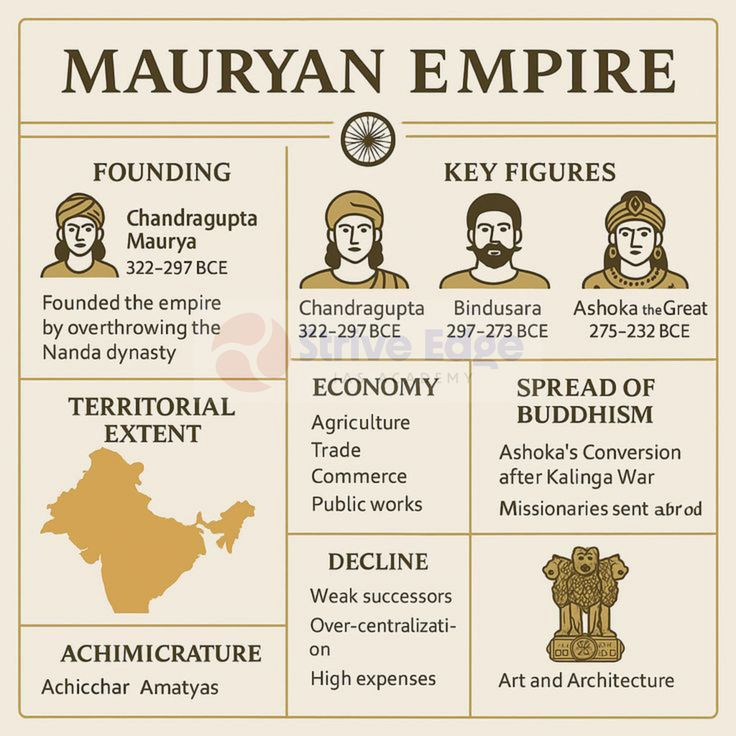
Timeline of the Important Monarchs
Chandragupta Maurya
Overthrown Last Nanda ruler
The first Mauryan ruler that founded the roots of a big empire in India was Chnadragupta Maurya. The Last Nanda ruler, Dhana Nanda got defeated by valiant Chandrapupta Maurya in 321 BCE. Chanakya, a wise Brahman scholar was the master who trained Chandragupta strategically and diplomatically in overthrewing Dhana Nanda.
Freedom from Greek rulers
A few years after Alexander’s death, fighting broke out between his generals for the control of his vast empire. Seleucus, one of Alexander’s generals, became the ruler of the territory stretching from Asia Minor to the Indus. In 305 BCE, he crossed the Indus to recover the territories Alexander had conquered earlier. Chandragupta Maurya defeated him and freed north-western India from Greek control.
Seleucus was compelled to sign a treaty according to which he had to give eastern Afghanistan, Baluchistan and areas west of the Indus to Chandragupta. He gave his daughter to Chandragupta in marriage and sent Megasthenes as ambassador to Chandragupta’s court. In return, he received 500 war elephants.
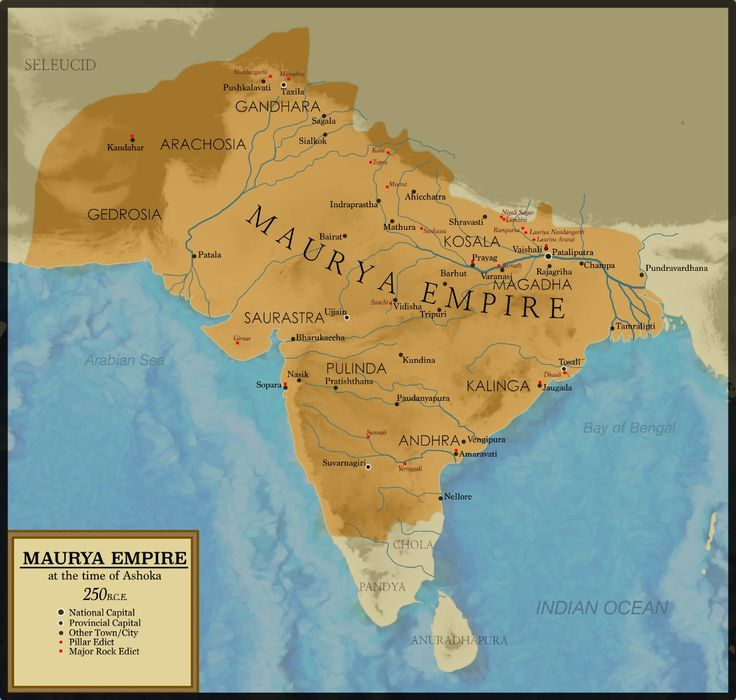
Chandragupta Maurya built a vast empire which was the first great empire in Indian history. By the end of his reign, the Mauryan empire stretched from the Hindu Kush in the north-west to Bengal in the east, from the Himalayas in the north to the Narmada in the south. The powerful kingdom of Kalinga in the east, however, was independent.
Bindusara
Chandragupta Maurya was succeeded by his son Bindusara who ruled for about 25 years. During his reign, the empire extended up to Mysore. He was succeeded by his son, Ashoka.
Ashoka
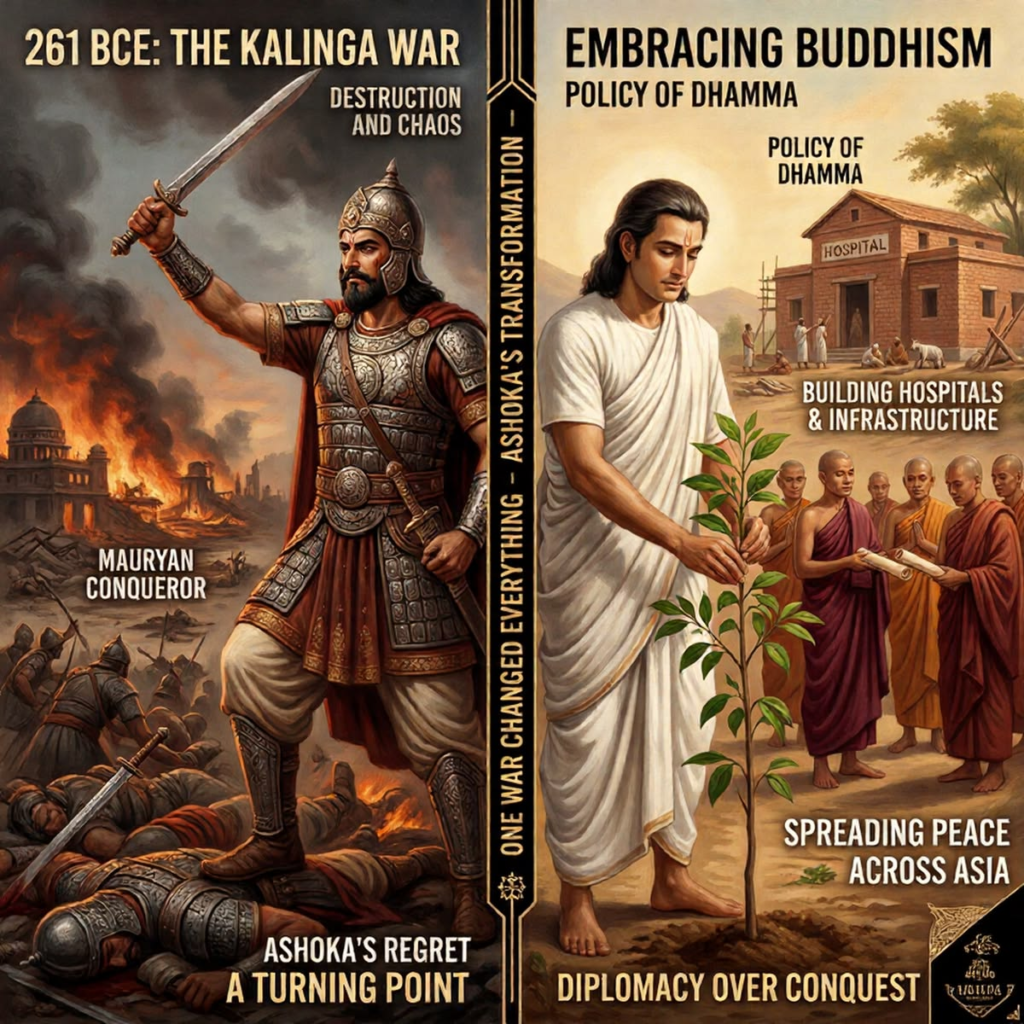
During the ascension of Ashoka in 273 BCE, Kalinga was a powerful kingdom not under the Mauryan Empire. Kalinga was controlling the land and sea routes to South India and South-east Ashoka. In 261 BCE, Ahoka fought a very cruel war to achieve Kalinga. Thsi battle included a lot of bloodshed. His empire now stretched from the Himalayas in the north to Mysore in the south and from the Hindu Kush in the north-west to the Brahmaputra in the east. It also included Kabul, Kandahar, Herat and parts of Nepal and Kashmir.
The death, destruction and great human suffering in this war filled his heart with sorrow and remorse. The Kalinga War became a turning point in Ashoka’s life. He made up his mind to give up warfare and conquer the hearts of people with love.
Did You Know?
Kalinga was a prosperous kingdom lying between the rivers Godavari and Mahanadi, close to the Bay of Bengal. It had an infantry of 60,000 men, 10,000 horsemen and 600 elephants. Ashoka attacked the kingdom to capture this fertile land. It is said that in this battle 100,000 people were killed and 150,000 soldiers were taken prisoners.
Ashoka was deeply influenced by the Buddhist principles of compassion, peace and non-violence. He embraced Buddhism and devoted his life to the moral and material welfare of his subjects. The policy of dig vijaya (conquest of territories) was replaced by dhamma vijaya (conquest through dhamma). [}]
Ashoka’s Dhamma
The word dhamma is derived from the Sanskrit word dharma which means religious duty. Ashoka’s idea of dhamma was based on human values and a code of conduct inspired by the noble teachings of Buddha. He dedicated his entire life to spreading the message of dhamma in India and abroad. The main principles of dhamma were as follows:
- People should live in peace and harmony.
- Everyone should follow ahimsa, i.e. non-violence and non-injury to all living creatures.
- People should love one another and show tolerance and respect towards other religions.
- Children should obey their elders and elders should treat children with understanding. [A-6]
- People should be truthful, charitable and kind to all (including servants and slaves).
Propagation of Dhamma
- Ashoka set a personal example by strictly following the principles of dhamma, inspiring others to do the same.
- He visited all the places associated with the life of Buddha, e.g. Bodh Gaya, Sarnath, etc.
- He ordered the construction of Buddhist monasteries.
- He sent learned Buddhist scholars to distant lands to spread Buddhism. His son Mahendra and daughter Sanghamitra were sent to Sri Lanka to spread the message of Buddhism.
- [✓] Special officers called Dhamma-mahamatras were appointed to spread and enforce the principles of dhamma throughout the kingdom.
- [✓] The principles of dhamma were engraved in Prakrit on rocks, pillars and caves so that people could read and follow them.
- He organized the third Buddhist Council at Pataliputra to discuss ways of propagating Buddhism.
Ashokan Edicts
The edicts are a source of valuable information of the Mauryan period. Edicts are royal commands or proclamations. They were inscribed on rocks, polished stone pillars and caves. They were composed in Prakrit, the language of the people and written in Brahmi script. In the north-west they were written in Greek, Kharoshthi and Aramaic. [)]
Ideals of Kingship
Ashoka was one of the greatest kings in the history of India. He believed that the role of the king was that of a father to his children. So he worked for their prosperity, happiness and welfare.
- He appointed officials called mahamatras to carry out administrative work.
- He built good roads and planted shady trees on both sides of the road.
- Wells were dug and rest houses were built for weary travellers.
- Health centres were built for men and animals.
- Officials were sent on tours to find out and solve the problems of the people. [) A1]
Ashoka occupies a unique place in the history of human civilization. He was the first monarch in the ancient world to denounce war and proclaim peace and non-violence. He championed the cause of universal brotherhood and tolerance.
The Gupta Empire: Golden Age of Ancient Indian History
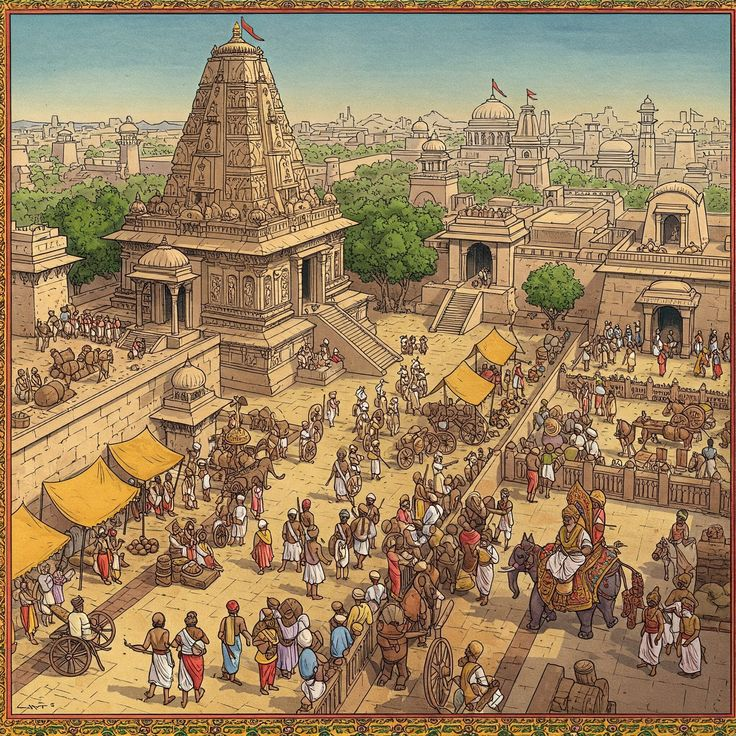
The decline of the Kushans in the north and the Satavahanas in the Deccan was followed by a period of political chaos and instability. For about a hundred years, India was divided into a number of small kingdoms and republics. By the beginning of the 4th century CE, these kingdoms and republics were united under the imperial rule of the Gupta dynasty. For the next 200 years, the history of India was dominated by the Gupta dynasty. Some historians have called their rule the Golden Age of ancient Indian history.
Political History of the Gupta Empire
Chandragupta I: Founder of the Gupta Dynasty
Chandragupta I, the first important ruler of the Gupta dynasty, ascended the throne of Magadha in 320 CE. He married Kumaradevi, a princess of the powerful Lichchhavi tribe of Vaishali, and got Pataliputra as part of his dowry. He ruled from Pataliputra and laid the foundation of the Gupta empire by conquering a number of territories with the support of the Lichchhavis. He expanded his kingdom as far as Allahabad. He ruled for 15 years and took the title of Maharajadhiraja.
Samudragupta: The Great Conqueror and Patron of Arts
Samudragupta ascended the throne after his father’s death. He was one of the greatest rulers in Indian history. The Allahabad Pillar inscription by court poet Harisena gives valuable information about his conquests. Samudragupta is supposed to have defeated nine kings in the north and 12 kings in the south.
Samudragupta followed a policy of conquest and expansion. In the north, he occupied western Uttar Pradesh and the regions around Delhi. These territories were added to his empire and were ruled directly by him. Next, he led an expedition to the Deccan and to South India. He reached as far south as the Pallava capital, Kanchi (in Tamil Nadu). The Pallava king realized he could not face Samudragupta alone. So he formed a powerful confederacy of the kings of South India under his leadership. Samudragupta had to face this powerful alliance.
He did not annex these southern territories as he realized it would not be easy to control such a vast empire in the absence of proper transport and communication facilities. The rulers of the south accepted him as their overlord and paid him tribute.
The frontier states of eastern and western India meekly submitted to him without a fight. These included the kingdoms of Assam, Nepal, the Ganga Delta in the east and the tribal republics of Rajasthan in the west. They accepted him as their overlord and paid large sums of money as tribute.
He celebrated his victory by performing the Ashvamedha yagna. He took the title of Maharajadhiraja.
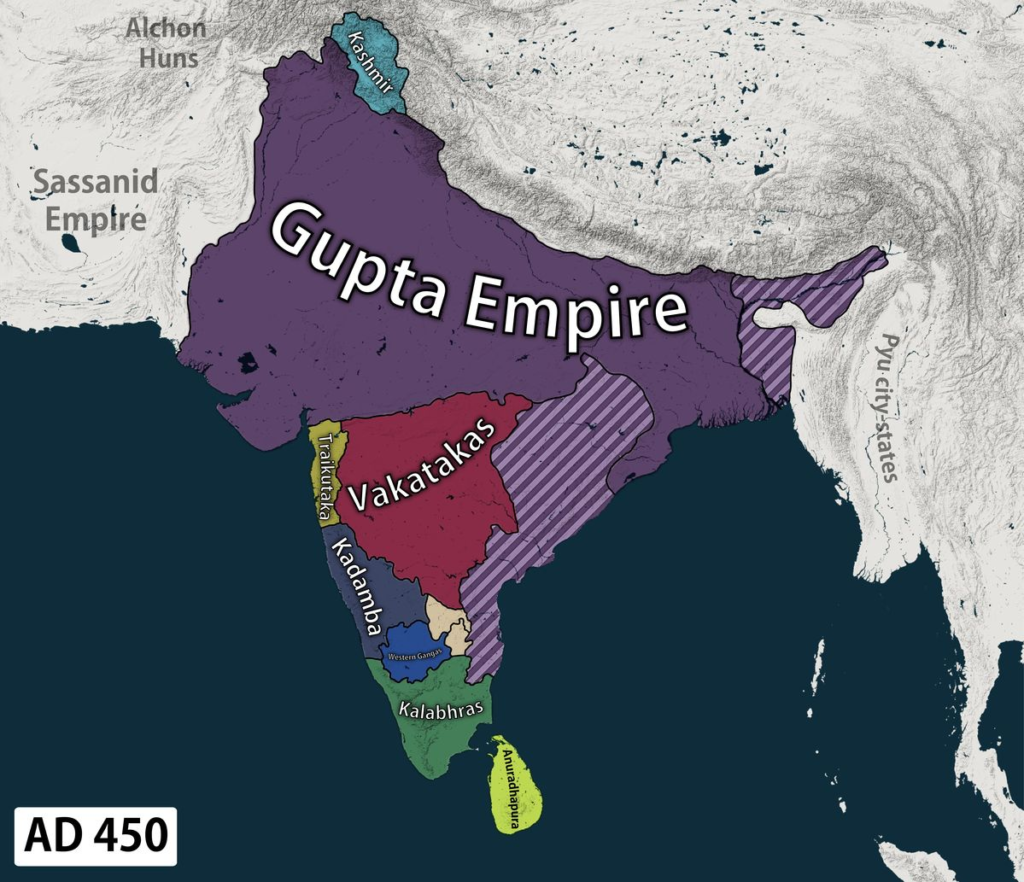
Samudragupta’s direct rule extended from Bengal in the east to Delhi in the west, from the Himalayas in the north to the Narmada in the south. His indirect control over the vassal states covered a much larger area.
Samudragupta was not only a military genius but a talented musician and poet as well. He encouraged Sanskrit literature and patronized prominent scholars like Harisena. He was a staunch follower of Hinduism but was tolerant towards other religions. Buddhist scholars were patronized by him.
Image Caption: Gold coin of Samudragupta depicting the Ashvamedha yagna
Chandragupta II Vikramaditya: The Peak of Gupta Glory
Chandragupta Vikramaditya was the able son of an able father. Like his father Samudragupta, he was a powerful ruler. The Gupta empire reached the height of its power and glory during his reign. He strengthened his position by matrimonial alliances. He married the daughter of a powerful Naga ruler. He gave his daughter in marriage to the Vakataka ruler in the Deccan, from whom he got valuable help during his campaigns against the Sakas.
Image Caption: A coin representing Chandragupta II on a horse
He extended the western boundaries of his empire to the Arabian Sea by defeating the Saka ruler. This was a very important victory because it gave the Guptas control over the three great seaports on the western coast. These were outlets to vast overseas trade. This led to economic growth and prosperity. He moved his capital to Ujjain.
Vikramaditya was a great patron of art and literature. The navaratnas or nine gems including Kalidasa, the greatest Sanskrit poet and dramatist, are associated with his reign. He was a devout follower of Vishnu. The Chinese scholar, Fa Hien, visited India at this time. His account is a rich source of information on the Indian way of life during the Gupta period.
Later Guptas and the Decline of the Empire
Vikramaditya was succeeded by his son Kumaragupta who maintained peace and prosperity. His successor, Skandagupta, defeated and drove out the barbaric hordes of the Huns who invaded India. Skandagupta’s successors were weak and they could not protect the empire from the repeated onslaughts of the Huns. By the beginning of the 6th century CE, the Huns had destroyed the Gupta empire and shattered the political unity of India.
The downfall of the Gupta empire in the middle of the 6th century CE, led to the establishment of numerous small kingdoms which were constantly at war with one another. The Huns continued their raids in northern India. In the beginning of the 7th century CE, Harshavardhana, the king of Thanesar, succeeded in bringing all these kingdoms under his control, establishing political unity, peace and prosperity in northern India.
The Golden Age of Ancient India
Fa Hien visited India during the reign of Chandragupta Vikramaditya and stayed in this country for several years. His accounts are a valuable source of information about this golden period in ancient Indian history.
Administration and Governance in the Gupta Empire
The Gupta kings were able administrators. The empire was divided into provinces that were further divided into districts. Each district was divided into groups of villages.
There were officials at every level of administration. The princes were often appointed as governors of provinces. They were assisted by a group of officers called kumaramatyas. The districts or vishyas were looked after by vishyapatis. Each district also had a council which helped in the administration. The village was independently looked after by the village headman. The Guptas decentralized the administration by giving the officials freedom to administer the territories under their control.
According to Fa Hien’s account, the people were honest, secure, prosperous and happy. They could move freely throughout the empire without fear of being attacked. People did not have to lock their houses when they went out. Crime was rare. There was no capital punishment. Criminals were usually fined. For very serious crimes like treason and rebellion, the right hand was cut off. Taxes were light. There was no spy system.
Economic Conditions During the Gupta Period
Great progress was made in agriculture, industry, trade and commerce during the Gupta period.
- Agriculture was given top priority and the textile industry and other crafts were highly developed.
- Both internal and external trade was brisk and profitable. India had trade links with western Asia, South-east Asia, Africa and several Mediterranean countries. Spices, pearls, ivory, perfumes, textiles and precious stones were exported in exchange for gold. This made the country rich and prosperous.
Religious Life and Tolerance in the Gupta Empire
The Gupta kings were staunch followers of Hinduism. They worshipped Lord Vishnu and were, therefore, called Vaishnavas. They performed religious sacrifices like the Ashvamedha yagna. Temples were built and idol worship was popular. The striking feature of the religious life of the people was the growing popularity of the Bhakti cult which believed in selfless devotion to God. As this cult was inexpensive and simple, it gained mass popularity.
The Guptas encouraged the revival of Hinduism and followed a policy of religious tolerance. The Buddhist university of Nalanda was patronized by the Gupta rulers. Many people were also followers of Jainism during this period. Thus the spirit of religious tolerance was an important feature of the Gupta period.
Scientific Progress and Inventions in the Gupta Period
Rapid progress was made in the fields of mathematics, medicine, astronomy and metallurgy during the Gupta period.
- Aryabhata and Varahamihira were great mathematicians and astronomers. Aryabhata discovered that the earth moves round the sun. He also found out the causes of the lunar and solar eclipses. India’s first space satellite has been named Aryabhata in honour of this great scientist.
- Vagbhata wrote a book on the ayurvedic system of medicine.
- The system of numerals was first used and developed by the Indians and later adopted and improved by the Arabs. The concept of the zero and the decimal system were India’s great contribution to mathematics.
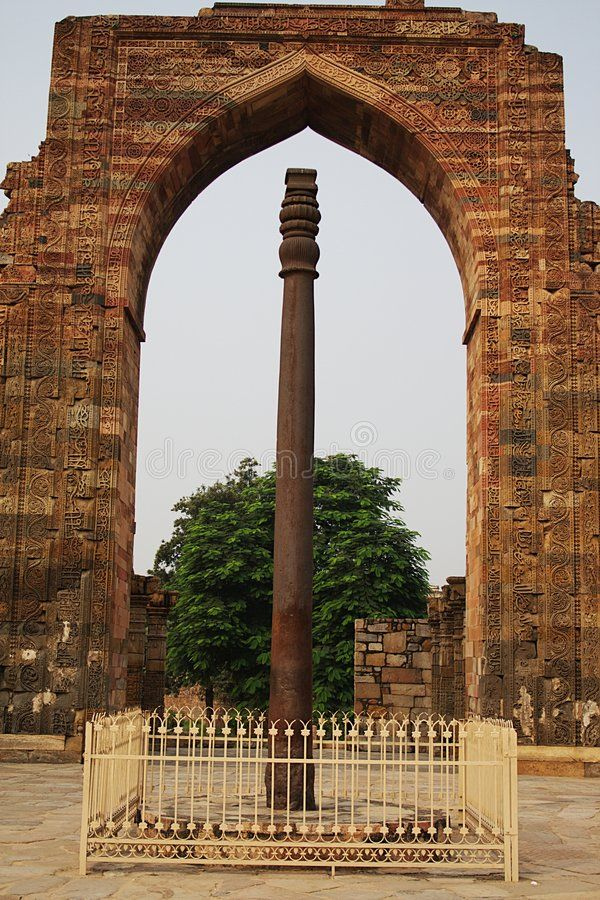
- The Iron Pillar at Mehrauli in Delhi is the best proof of the highly advanced science of metallurgy. The pillar, built in the 4th century CE, has not rusted in the last few centuries. The 25-metre-high copper statue of Buddha and the numerous gold coins testify to their remarkable skills in metal casting.
Cultural Life and Literature in the Gupta Empire
Literature and Sanskrit Revival in the Gupta Period
With the revival of Hinduism, Sanskrit regained its importance. The Gupta rulers made Sanskrit the court language. They patronized Sanskrit playwrights, poets, philosophers and grammarians.
The most outstanding writer of this period was Kalidasa whose works include the famous play Abhijnanashakuntalam and the epic poem Meghaduta. The Panchatantra was compiled, the Puranas were rewritten, and the Mahabharata was revised and rewritten during this period. Shudraka’s Mrichchhadatika was also written during this time.
Did You Know?
Kalidasa has been called the ‘Shakespeare of India’. He wrote three famous plays—Malavikagnimitra, Vikramorvashiya and Abhijnanashakuntalam. Abhijnanashakuntalam is one of the most popular plays. It is the love story of Shakuntala and King Dushyanta. This play is popular even today!
Art and Architecture of the Gupta Empire
Painting and Frescoes in the Gupta Period
Painting reached the height of excellence. The fresco paintings on the walls of the Ajanta caves are proof of their artistic brilliance. The colours used in these paintings still retain their original freshness.
Sculpture and Statues of the Gupta Era
The art of sculpture reached a high degree of perfection during this period. A large number of statues of Buddha have been unearthed at Sarnath. The statue of the seated Buddha is considered to be the finest specimen of Gupta sculpture. Beautiful, lifelike statues of Hindu gods and goddesses have also been found.
Temples and Architectural Achievements of the Gupta Period
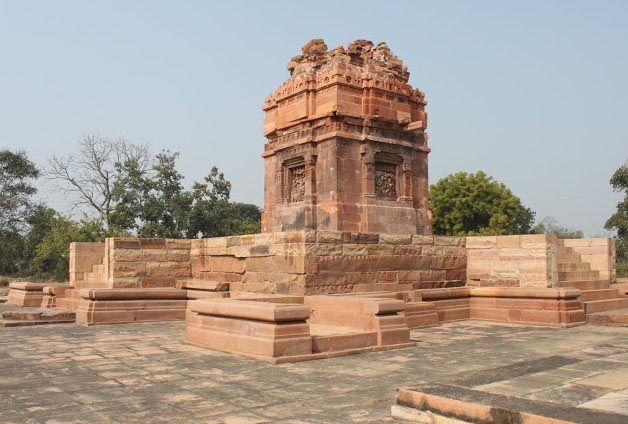
Very few buildings of the Gupta period have survived. The few surviving specimens, however, show that architectural skills were highly developed. They made rock-cut chaityas and built temples of stone and brick. The Vishnu temple in Deogarh and the Buddhist chaityas in the Ajanta caves are fine specimens of Gupta architecture.
Education and Nalanda University in the Gupta Period
The Guptas encouraged education and learning. Liberal grants were given to educational institutions. Their greatest contribution was the establishment of the Nalanda University, which became very famous during the reign of Harsha in the 7th century CE.
The Nalanda University was a centre of Buddhist learning. Medicine, astronomy, grammar, philosophy and Vedic literature were some of the other subjects taught at this university.
Image Caption: Ruins of the Nalanda University
India reached the height of power and glory under the rule of the Guptas. Politically the country was united under a strong and stable government. Economically, the country was rich and prosperous and culturally, it achieved extraordinary heights of artistic brilliance.
Timeline (at the bottom of the page)
- BCE / CE Division Point: 1 CE
- 320 CE: Chandragupta I ascended the throne of Magadha
- Around 400 – 500 CE: Golden Age of ancient Indian history
- Around 550 CE: Huns destroyed the Gupta empire
- Present day: Marked at the far right end of the timeline arrow
Frequently Asked Questions (FAQs) About the Gupta Empire
Q1: Who founded the Gupta Empire?
A: Chandragupta I founded the Gupta Empire. He ascended the throne of Magadha in 320 CE and laid the foundation of the Gupta dynasty by conquering several territories with the support of the Lichchhavis.
Q2: Why is the Gupta period called the Golden Age of ancient Indian history?
A: The Gupta period is called the Golden Age because it witnessed remarkable achievements in art, literature, science, mathematics, astronomy, and metallurgy. The empire enjoyed political stability, economic prosperity, religious tolerance, and cultural brilliance.
Q3: Who was the most powerful ruler of the Gupta Empire?
A: Chandragupta II Vikramaditya was the most powerful Gupta ruler. Under his reign, the Gupta empire reached its peak of power and glory. He extended the empire’s boundaries to the Arabian Sea and patronized the navaratnas or nine gems of his court.
Q4: What does the Allahabad Pillar inscription tell us about Samudragupta?
A: The Allahabad Pillar inscription, composed by court poet Harisena, provides valuable information about Samudragupta’s conquests. It mentions that he defeated nine kings in the north and twelve kings in the south, making him one of the greatest rulers in Indian history.
Q5: What were the major scientific achievements of the Gupta period?
A: Major scientific achievements included Aryabhata’s discovery that the earth moves around the sun, his explanation of lunar and solar eclipses, the development of the decimal system, the concept of zero, and the construction of the rust-resistant Iron Pillar at Mehrauli.
Q6: Who was Kalidasa and what were his famous works?
A: Kalidasa was the greatest Sanskrit poet and dramatist of the Gupta period. He is often called the ‘Shakespeare of India’. His famous works include the play Abhijnanashakuntalam and the epic poem Meghaduta.
Q7: What was the administrative system of the Gupta Empire?
A: The Gupta Empire had a decentralized administration. The empire was divided into provinces, districts, and villages. Princes served as governors, assisted by kumaramatyas. Districts were managed by vishyapatis, and villages were independently governed by village headmen.
Q8: What was the role of Nalanda University during the Gupta period?
A: Nalanda University was a centre of Buddhist learning established during the Gupta period. It became famous during Harsha’s reign and taught subjects like medicine, astronomy, grammar, philosophy, and Vedic literature.
Q9: What was the religious policy of the Gupta rulers?
A: The Gupta rulers were staunch followers of Hinduism, particularly Vaishnavism, but they followed a policy of religious tolerance. They patronized Buddhism and Jainism as well. The Bhakti cult, emphasizing selfless devotion to God, gained popularity during this period.
Q10: What caused the decline of the Gupta Empire?
A: The Gupta Empire declined due to repeated invasions by the Huns in the 6th century CE. Weak successors after Skandagupta could not protect the empire, leading to its eventual destruction by the Huns and the fragmentation of India into small kingdoms.
Q11: Who was Fa Hien and what did he write about India?
A: Fa Hien was a Chinese scholar who visited India during the reign of Chandragupta II Vikramaditya. His accounts provide valuable information about Indian life during the Gupta period, describing honest people, light taxes, rare crimes, and general prosperity.
Q12: What is the significance of the Iron Pillar at Mehrauli?
A: The Iron Pillar at Mehrauli in Delhi is a remarkable example of Gupta metallurgy. Built in the 4th century CE, it has not rusted even after centuries, demonstrating the advanced scientific knowledge of the Gupta period.
Q13: What were the economic conditions during the Gupta period?
A: The Gupta period saw great economic prosperity. Agriculture and textile industries were highly developed. India had profitable trade links with western Asia, South-east Asia, Africa, and Mediterranean countries. Exports included spices, pearls, ivory, perfumes, textiles, and precious stones.
Q14: What were the navaratnas or nine gems of Chandragupta II’s court?
A: The navaratnas were nine distinguished scholars, poets, and artists patronized by Chandragupta II Vikramaditya. Kalidasa, the greatest Sanskrit poet and dramatist, was the most famous among them.
Q15: What are the finest examples of Gupta art and architecture?
A: The finest examples of Gupta art and architecture include the fresco paintings at Ajanta caves, the statue of the seated Buddha at Sarnath, the Vishnu temple at Deogarh, and the Buddhist chaityas in the Ajanta caves.
Conclusion
The Gupta Empire stands as a monumental chapter in the history of ancient India, earning its well-deserved reputation as the Golden Age. From the foundational rule of Chandragupta I to the military conquests of Samudragupta and the cultural zenith under Chandragupta II Vikramaditya, the Gupta dynasty brought political unity, economic prosperity, and cultural brilliance to the Indian subcontinent. The empire’s decentralized administration ensured efficient governance, while its policies of religious tolerance fostered a harmonious society where Hinduism, Buddhism, and Jainism flourished side by side.
The scientific achievements of this period—Aryabhata’s astronomical discoveries, the concept of zero, the decimal system, and the rust-resistant Iron Pillar at Mehrauli—remain enduring testaments to India’s intellectual prowess. The literary masterpieces of Kalidasa, the exquisite frescoes of Ajanta, and the magnificent sculptures of the Buddha at Sarnath reflect the extraordinary artistic heights achieved during this era. The establishment of Nalanda University as a centre of Buddhist learning underscored the Guptas’ commitment to education and knowledge.
The Gupta period’s legacy extends far beyond its political boundaries, influencing Indian culture, science, art, and philosophy for centuries to come. Though the empire eventually fell to the Hun invasions, its contributions to mathematics, astronomy, literature, and architecture continue to shape modern Indian identity. The Gupta Golden Age remains a source of national pride and a reminder of India’s rich civilizational heritage, inspiring generations to appreciate the timeless achievements of ancient Indian civilization.