
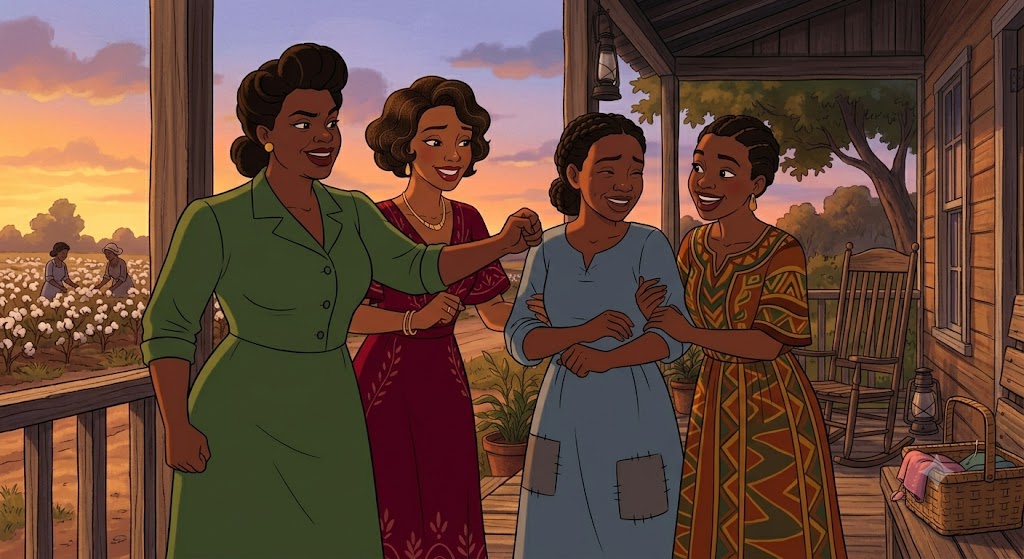
Alice Walker’s The Color Purple highlights the transformative power of female bonding. Through her relationships with Nettie, Sofia, and Shug Avery, Celie overcomes oppression, discovers her identity, and achieves independence.
The Color Purple is a revolutionary black female authored text written by Alice Walker in 1982. In this novel, Walker explores the themes of gender discrimination, racial discrimination, sexism and domestic violence. The novel prominently portrays the struggle of black women for their own identity, self-esteem and independence. The novel was awarded both the American Book Award for Fiction and the Pulitzer Prize.
Celie’s Journey from Oppression to Selfhood
Alice Walker shows the evolution of her major character, Celie, from passive wife and finally to emancipated woman. The novel thoroughly focuses on a life of Celie who is sexually abused struggling to develop her sense of selfhood.
As a black woman, Celie has endured many difficulties before she could establish herself as an independent woman. At the same time with being categorized against by whites, she is also treated badly from all black men in her life: her stepfather and father.
From the beginning, she is bitten and raped by the man she believes to be her father. She has two children with him but they are soon taken away from her. After her pregnancies, she is forced to marry an old widower with four children. She is considered only as a slave and a caretaker for Mr. _____ family. Hence, Celie is always away from the basic human rights of self-determination, freedom from violence, and ownership of her own body no matter where she is.
The Importance of Female Bonding
Throughout the novel, Celie meets several black women, who contribute to her self-discovery. She survives all difficulties through her strong bonding with majorly three black women in her extended family: Nettie (her long separated sister), Sofia (her step-daughter in law) and Shug Avery (her husband’s mistress). The strong bonding with these women renovates Celie’s life and frees her both physically and spiritually. Their presentation of strong and positive female characters is very significant: women defend their honor, family & right; care for the sick, needy & undeserving; work to ensure their & homes, family and right; care for the sick, needy and undeserving; work to ensure their famley’s livelihood; and keep society from moral decay.
Nettie: A Source of Hope and Encouragement
From Nettie’s letters Celie gets to know for the first time that her two children, who she has lost when they are just born, now stay with Nettie in Africa and get good education. This news provides strength to Celie moreover Nettie is always a hope in her life.
Celie considers Nettie as a perfect model of a girl. She describes her to Shug as:
“Smart as anything. Read the newspapers when she was little more than talking. Did figures like they were nothing. Talked real well too. And sweet. There never was a sweeter girl. Eyes just brimming over with it.”
The affectionate sisterhood provides hope of survival during the hardest time of Celie’s life.
Sofia Butler: A Symbol of Resistance
Sofia Butler, Celie’s stepson Harpo’s wife is the first woman Celie encounters who successfully resists male abuse; she is one of the woman in the novel who will challenge Celie’s passivity and influence her development into an independent woman. She is a fat woman with big legs. Sofia challenges Celie to be a stronger individual. Her bravery moves Celie greatly.
Celie was always brought up in an abusive environment and Sofia was an alien girl who break the stereotypes of abuse against women. When Harpo came to Celie and asked for an advice, she said that to beat and control Sofia. Sofia, on knowing the truth, confronts Celie about it. But after an exchange of viewpoints between them, misiunderstandings dispelled and the similar experiences from their families bring them closer. Since then, Celie and Sofia become friends who rely on and help each other throughout the rest of the novel. Bonding with Sofia puts Celie on the path of self-realization, dependence, strength & courage.
Shug Avery and Celie’s Emancipation
The most prominent female character who helped in Celie’s emancipation process is Shug Avery. Shug is the one who leads Celie in her journey towards fighting her long repressed selfhood. Shug is the most ‘liberated’ of the women in the novel; she also suffers verbal attack from the church elders because of her lifestyle. When Shug fell sick and becomes the subject of people’s gossips, there is no one to defend her although Celie wishes she can do so. Mr. _____ brings the sick Shug into his house. Shug’s illness and the temporary dependence imposed on her, creates a mutual bond between these two women. Celie nurses Shug back to health & takes care of her as if she is her lost big girl, Olivia. Celie describes the scene where she combs Shug’s hair:
“Work on her like she a doll or like she Olivia or she like mama. I comb and pat, comb and pat. First she say, hurry up and get finish. Then she melts down a little and leans back giant my knees. That feels just right, she say. That feel like mama used to do.”
The Growth of Sisterhood and Self-Respect
Celie and Sofia’s friendship develops gradually and Shug is also included in this relationship. When Celie and Sofia work on quilts together, Shug donates one of her dresses to share it with them. Shug is warmed by the tenderness and care, hence creating a “Miss Celie’s song” to express her gratefulness to Celie. For the first time, Celie is aware of being respectable. The two women share a long embrace & end in a kiss, bonding their relationship. Through the long communications and observance of Shug, Celie gets the strength she needs to restructure her ‘self’.