
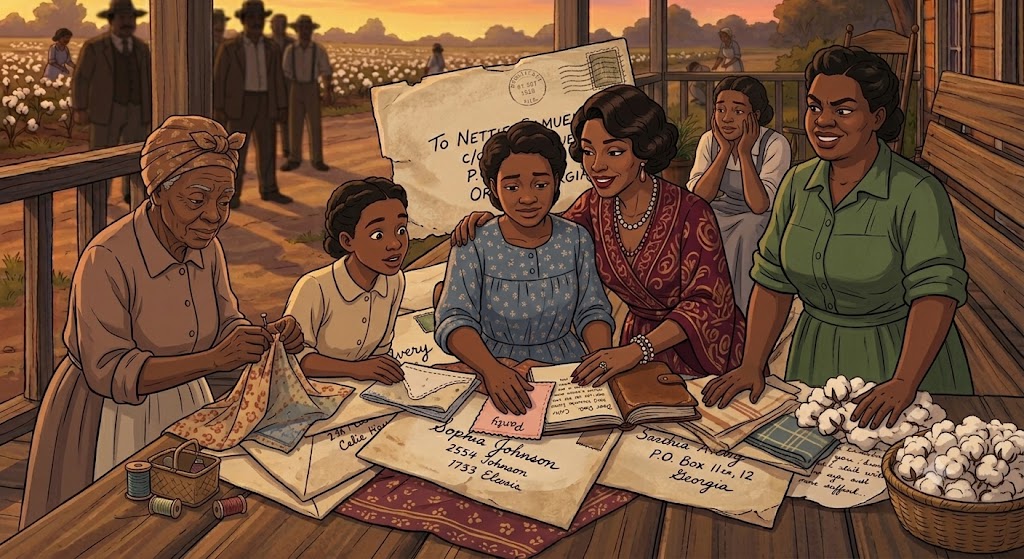
Womanism in The Color Purple: Alice Walker’s Black Feminist Vision
Alice Walker’s The Color Purple reflects the principles of womanism through Black sisterhood, community healing, resistance to oppression, and the empowerment of both women and men.
Alice Walker’s Perspective on Black Women
Alice Walker commented in one of her interviews that Black woman has a different ‘angle’ of looking at things. Elaborating her perspective, she said, Black women ‘see things from a different point of view’. Black women, have to look out and through all those people who have traditionally been on top of them. ‘The Black man, the White woman, and the White man’. Alice Walker has not vividly mentioned about this perspective in her novel but it is subtly present in it. The protagonist, Celie has a different way of looking at reality.
Barbara Christian and Black Feminist Thought
Afro-American critic Barbara Christian has contributed exhaustively to the development of Black women’s writing and its relevance to the Black community. In her essay, “Creating a Universal Literature”, Christian affirms that Black women’s literature reveals a ‘basic truth of our society’. The truth according to Christian is that in ‘every society where there is denigrated other whether that is designated by sex, race, class or ethnic background, the other struggles to declare the truth and, therefore creates truth in form that exist for him or her. The creation of that truth also changes the perception of all those who believe they are the norm’.
The Color Purple as a Black Feminist Text
The Colour Purple can be read as a Black feminist text where the protagonist is the ‘denigrated other’ and in the process of declaring her truth she also speaks on behalf of women like her and thus challenges the belief of a dominant, patriarchal society.
Community and Sisterhood in Black Feminism
Celie’s narrative is closely linked to the stories of Sofia, Nettie, Shug and Mary Agnes as well as Harpo and Mr._____. This is an area of Black feminist studies that is different from white feminism of the 80s. The willingness include all the people in the community redress woman-centric issues, and the need of supportive kinship structures which prevent Black feminism from being a separatist enterprise. Celie’s family dinner at the end of the novel is a good example of this point. It is at this point that Black feminism ceases to be merely a kind of feminism and becomes womanism.
The Evolution of Black Feminism in the 1980s
The woman writers of the 1970s delineated Black women as ‘wounded heroines’ who inevitably had to return to their communities to work out their resistance. But writer of 1980s explored sexism in Black community and the role of ‘community of sisters’ who rise above to alter the scenario. In The Color Purple, Celie and Sofia are victims of Black community’s sexism and they are portrayed striving against .Sexism is also prevalent in tribal communities which is known through the letters of Nettie.
Celie’s Transformation and Empowerment
Women novelists of 1980s according to Barbara Christian showed mobility in their fiction. Celie begins her narrative as a cowering, docile girl but finally is a female entrepreneur with a house and a successful business to her name. The Color Purple had become so popular because women everywhere related to the authenticity of the treatment of violence in man-woman relationships and the documentation of a lesbian relationship as an empowering and liberating one. Celie’s relationship with Shug runs the entire gamut from infatuation to intense erotic pleasure, to intellectual companionship, stable commitment. Celie loves Shug who had helped her to love herself and to appreciate God in the details of life.
Community Healing and Feminist Masculinity
Black feminism extends to the community as well. Emancipation is only possible if the community aids in the healing process. The healing is also extended to Harpo and Mr._____ who were previously stereotypical Black men, abusive and oppressive. After realisation and healing process, they become models of ‘feminist masculinity’. Feminist masculinity is a term coined by African-American critic bell hooks who applies it to men who value their emotional selves and make a conscious decision to go against the prescribed codes of patriarchal masculinity that endorses aggression and violent behaviour.
Challenging Patriarchy and Male Hegemony
The Color Purple is a feminist text which portrays the struggle of Black community at large. It challenges male hegemony, dominant power group, abuse and oppression.
Alice Walker’s Concept of Womanism
Alice Walker had coined the term womanist in the preface to her book In Search of Our Mothers’ Gardens: Womanist Prose. The word ‘womanish’ is associated with audacious, willful behaviour. In The Color Purple, Sofia and Shug are clearly womanist characters for there is very little traditional or conservative about them. Walker includes Black sisterhood concept in womanist definition because a womanist is a woman who loves other women sexually or non-sexually. The most important connotation of the term is “committed to survival and wholeness of entire people, male and female”.
Black Sisterhood and Survival
The Black community has a very strong female presence in the form of maternal figures—the mothers, the surrogate-mothers and other mothers. Walker’s womanist is directed at violence practiced by Afro-American men on their womenfolk. The female-centric cultural context of African Americans is prominent since Black women have always stayed together and devised strategies for survival as well as for healing. Linda Abbandonato remarked that Walker’s communism is clearly influenced by Adrienne Rich’s concept of a ‘lesbian continuum’. The lesbian continuum spans the whole spectrum of women’s friendship and sisterly solidarity. Celie does all the housework, tends to the field and supports the family but is raped by her stepfather and physically beaten by her husband. It is the women around her who helps her to heal and to continue to live.
The Role of Sofia and Shug in Celie’s Healing
Sofia teaches her about resistance to anyone, anywhere who dared to humiliate or oppress her. Celie first feels jealous of her happiness with Harpo and instructs him to subordinate her by beating her up. Later, however, she apologizes to Sofia and learns about her intrepid sisters who are together under every situation. Shug teaches Celie about sexual pleasure and belief in the beauty of God’s creation to help her to be whole after remaining alone just like automaton.
Celie nurses Sofia when she is beaten up in jail. She also nurses Shug back to health. Squeak or Mary Agnes goes to the jail to convince the jailor to free Sofia but is raped in the process. Shug talks to Mr._____ to stop physically assaulting Celie. She is also there to help her get over her anger when she learns about Mr._____ keeping Nettie’s letters concealed from her.
Women’s Support Networks and Collective Empowerment
Shug also helps Celie to cultivate her creative skills by encouraging her to sew and later on finances her business venture too. Mary Agnes and Odessa take care of Sofia’s children when she is serving the prison sentence. Later on, Sofia nurtures Mary Agnes’ daughter Suzie Q when the former is away pursuing her singing career. They are all womanish in their behaviour as they are ‘audacious’ and sometimes ‘outrageous’ but they love and value each other’s company as women and help in the survival of the race.
The Womanist Community in The Color Purple
When Celie celebrates her family at the end of the novel, the value of the womanist community is evident since the men and women share the meal without any bitterness or arrogance. Alice Walker believes that the meaning of The Color Purple is belief in the love of the people.